Pink Carnation

Revisit…

For a time, many things are only for a time.
Some things forever gone, others, on hiatus.
Sometimes returning, welcome on arrival,
Sometimes returning, unwanted and in dread,
Sometimes slithering, seeping in, seeping out,
Creating a stir, unease or great unrest.
But Light, the Great Protector, shines thru,
Revealing all, shedding lies in time,
And casting out, what Time ordains as passed.

The Gospel passage for the First Sunday of Lent (Luke 4:1-13) is referred to as the Temptation of Jesus. After his baptism, Jesus is led into the desert by the Holy Spirit for forty days. And after these days of fasting, he is tempted by the devil in three ways:

First, to use his status as the Son of God to relieve himself of his situation of hunger.

“If you are the Son of God, command this stone to become bread.” (verse 3)

Second, to exalt himself by paying homage, or worshipping, the devil to receive earthly power and glory.

“I shall give to you all this power and their glory; for it has been handed over to me, and I may give it to whomever I wish. All this will be yours, if you worship me.” (verses 6-7)

And third, to show doubt in God, by throwing himself from the parapet of the temple, and thereby testing Scripture:

“If you are the Son of God, throw yourself down from here, for it is written: ‘He will command his angels concerning you, to guard you, and: ‘With their hands they will support you, lest you dash your foot against a stone.’” (verses 9-11)

Jesus responds to these temptations as follows:

“It is written, ‘One does not live on bread alone.’” (verse 4)

“It is written ‘You shall worship the Lord, your God, and him alone shall you serve.’” (verse 8)

And lastly, when the devil tries to zero in on and twist Scripture verses to tempt Jesus away from the truth of who God is calling him to be, Jesus, again focuses on God—a higher purpose—responding:

“It also says, ‘You shall not put the Lord, your God, to the test.’” (verse 12)

The “Temptation of Jesus” Gospel passage ends with, “When the devil had finished every temptation, he departed from him for a time.” (verse 13)

Oftentimes, after going through a challenging situation or event, it is common to be grateful for that time to be over. It can also be tempting to walk away with a notion of achievement or learning from it in a way that we see as being complete. Yet, whether good or bad, there are times when the same, or a similar challenge returns, offering an opportunity to draw even closer to God, and to see or learn even more.

Take some time to consider how open you are to remembering what you’ve learned as well as to learning something new when repeat or similar situations of challenge occur?

Reflecting on Jesus’s words in response to each of the temptations he faced in the desert, what invitation(s) are there for you and Jesus to explore? Allow your prayer to extend into these areas. Express your wants, needs, fears, etc. to Jesus, and allow Jesus to express His thoughts and wisdom to you.

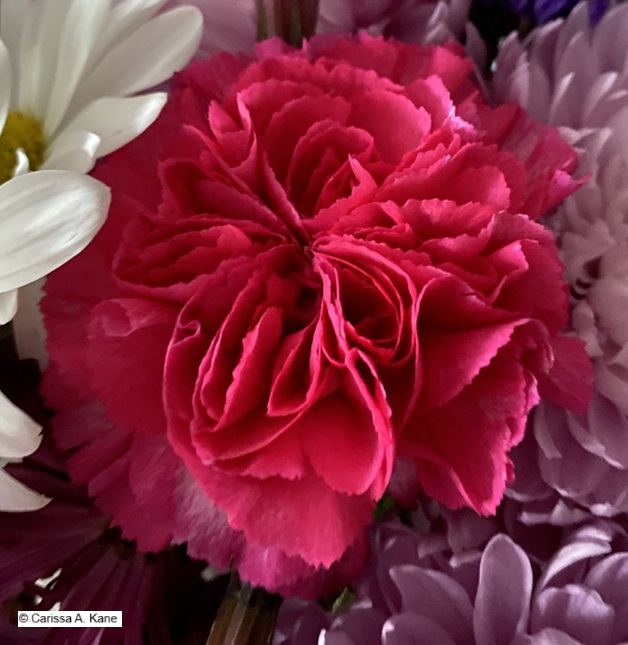
Pink Carnation

You who dwell in the shelter of the Most High, who abide in the shadow of the Almighty, say to the Lord, “My refuge and fortress, my God in whom I trust.” – Psalm 91:1-2

Flowers

Rooted in Love…

As the days passed by,
the flowers, still bright,
holding onto life,
begin to show the
length of days and nights,
separate, away
from the source of life.

Leaves dropping from stems,
petals shriveling,
on the outside first.
Time ticks, closing in.
Hold on as they may,
away from their roots,
they limp as they linger.

In the First Reading for the Seventh Sunday in Ordinary Time (1 Samuel 26:2, 7-9, 12-13, 22-23), David and Abishai find themselves in a position of advantage, having the opportunity to kill Saul, who, along with his soldiers are in a deep sleep. However, despite Saul having grown distant from who he was at the beginning of his rule, and having become David’s enemy, David restrains himself and shows mercy. He says to Abishai, “Do not harm him, for who can lay a hand on the Lord’s anointed and remain innocent?” (v. 9).

Spend some time with the first reading and consider that as beings created in God’s image, in a sense, we are all anointed.

The response for the Psalm is, “The Lord is kind and merciful.” (Psalm 103:8). Reflect on the ways that the Lord has been kind and merciful to you. How does your experience inspire you in terms of the way you view situations and people? In what ways do you feel compelled to be kind and merciful to others? Are there areas where the Lord might want to work with you on expanding upon or reassessing this?

Turning to the Second Reading (1 Corinthians 15:45-49), St. Paul writes of Adam and Jesus, but he is also writing about the call to conversion and discipleship.

As was the earthly one, so also are the earthly,
and as is the heavenly one, so also are the heavenly.
Just as we have borne the image of the earthly one,
we shall also bear the image of the heavenly one. – verses 48-49

Envisioning your life as one line and the events/happenings during your life as another line on a continuum, think about the major events/happenings that have had a direct impact on you. What’s the difference between the times when you have maintained a sense of inner strength (or know-how) and peace, and the times you haven’t?

In the Gospel Reading (Luke 6:27-38), Jesus reminds us that Love is what sustains us. Not embracing cynicism, seeking or plotting revenge, settling or keeping scores. Rather, those are the things that tear us away from Love and the root of goodness and life—God.

How might you draw closer to Love in the challenges you face today? And how might the Lord desire to join you in an area of challenge?

The Lord is kind and merciful, slow to anger, abounding in mercy. – Psalm 103:8

The Sun Rising

Relating to and thru One…

The readings for the Third Sunday of Lent can be seen as a call to pay attention to the nature of relationships and what they lead or point to. In the First Reading (Exodus 20:1-17), God delivers the commandments, which are seemingly clear instructions, and by adhering to them, the people will prosper. Notice how God’s mercy far outweighs any punishment.

For I, the Lord, your God, am a jealous God, inflicting punishment for their ancestors’ wickedness on the children of those who hate me, down to the third and fourth generation; but showing love down to the thousandth generation of those who love me and keep my commandments. (Ex 20:5-6)

Also, notice that punishment is reserved for “those who hate me,” and their children. Hate is a pretty strong word and one can imagine some sort of pattern or learned behavior to reach that point or designation. In that light, perhaps this passage can be viewed as a Lenten invitation to be mindful of one’s actions, the sentiments from which they come, and what they might teach.

Looking at the Responsorial Psalm (Psalm 19:8-11), the response is “Lord, you have the words of everlasting life.” (Jn 6:68c). Again, drawing us to God’s words as priceless and wrapping up by trying to convey just how valuable they are: They are more precious than gold, than a heap of purest gold; sweeter also than syrup or honey from the comb. (Ps 19:11).

As for verses 8-10 of the Psalm, the first part of each line refers to the Lord’s “rules”—laws, decrees, precepts, commands, reverence, and ordinances. The second part of each phrase or sentence provides guidance by giving indicators that one can use to try to determine if they are obeying and honoring the Lord. How? By evaluating the situation and answering the question: Do I experience or have a sense of a refreshed soul/peace, wisdom, a rejoicing heart, enlightenment, endurance/inner strength, truth, or justice?

The law of the Lord is perfect,
    refreshing the soul;
The decree of the Lord is trustworthy,
    giving wisdom to the simple.

The precepts of the Lord are right,
    rejoicing the heart;
the command of the Lord is clear,
    enlightening the eye.

The fear of the Lord is pure,
    enduring forever;
the ordinances of the Lord are true,
    all of them just.

In the Second Reading (1 Corinthians 1:22-25), St. Paul is encouraging the Corinthians, and us, to be careful about the way we go about seeking signs and wisdom. God certainly uses people, situations, and things to accomplish tasks and impart wisdom, however, as St. Paul says, “we proclaim Christ crucified.”  That means, there is no substituting human thoughts, ideas, goals, etc. for God’s will and wisdom as the source or root that one allows to resonate with and guide their soul. Ultimately, things come down to what happens between each person and God, and one is not to blindly follow others thus giving what belongs to or originates with God (one’s soul and will) to another human being and/or their agenda.

In what ways do you take each situation to prayer with an openness to the fact that what is right and just in one situation may not be right and just or the best way in another situation? What’s it like to consider that the “rules” and their application are shaped by God’s love and mercy, and that this is by God’s design? In what ways do you leave room for love and mercy in situations and decisions?

Turning to the Gospel passage referred to as the Cleansing of the Temple (John 2:13-25), we can see Jesus’ disavowal of the perversion of the Temple and the rules and practices around and within it. The focus has become all about transactions and status. Jesus drives everyone out, saying to those profiting at the expense of the poor—those selling doves, “Take these out of here, and stop making my Father’s house a marketplace.” (Jn 2:16). In the verses that follow, Jesus refers to his body as the temple and foreshadows his crucifixion and resurrection. The passage ends with:

But Jesus would not trust himself to them because he knew them all,
and did not need anyone to testify about human nature.
He himself understood it well.
(Jn 2:24-25)

Envision Jesus, who is the source of salvation and redemption, entering the temple area of your life—your heart. Imagine yourself receiving the peace, inner strength, and wisdom of Jesus as you sit together. What would you share? And, what would He who understands human nature well, impart to you in terms of what to drive out and what to keep?

Ready, Set, Lent…

The mark is made,
The season begins,
From one to forty,
Days, one at a time,
As if turning pages
We make our way,
From start to end,
Through these Lenten days.

Giving up, giving in, letting go,
Yet not one thing for another,
As if a game of swapping.
No. Not at all.
Some thing, or things, for One.
The point remains on focus,
In the here and now,
Not here and there
Or scattered about,
But brought together.

Body and soul,
Front and center,
Sorted out or broken down,
But always built back up,
From one desire to another,
According to Thine will,
Heart and mind become one,
Drawn closer, e’er closer,
To the image of One.

A clean heart create for me, O God, and a steadfast spirit renew within me. – Psalm 51:12

Holy, Holy, Holy…

Let the peace of Christ control your hearts;
Let the word of Christ dwell in you richly. – Col 3:15a, 16a

The verses above are used for the Gospel acclamation for the Feast of the Holy Family (usually celebrated the Sunday after Christmas). Oftentimes, the nativity of Jesus and the spirit of Christmas can be accompanied by thoughts of serenity and peace as well as images of idyllic creches and decorations. In such a setting, it can be rather easy to allow the peace of Christ and the word of Christ to flourish within when riding the joy of Christmas or any other anticipated or celebratory day or event. Yet, reality is such that life is a mixed bag and the unexpected, sometimes the dreaded, can come along at any moment, making it more challenging to be open to or inspired by the peace and word of Christ.

Imagine the joy and astonishment of Mary and Joseph at the birth of Jesus and what they initially encountered in the aftermath of his birth as people paid homage. Are there times in your life that come to mind and to which you can relate this experience? Times that have given rise to great joy, overwhelming peace, and/or the feeling of being so amazed.  

Now, here we are, a week later, and in our liturgical celebration, we hear about Simeon and Anna paying homage to Christ and at the same time foretelling what’s to come (Lk 2:2-40).

“and Simeon blessed them and said to Mary his mother, ‘Behold, this child is destined for the fall and rise of many in Israel, and to be a sign that will be contradicted (and you yourself a sword will pierce) so that the thoughts of many hearts may be revealed’.” (v.34-35)  

And coming forward at that very time, she gave thanks to God and spoke about the child to all who were awaiting the redemption of Jerusalem. (v. 38)

What’s it like to reflect on the fact that even though Jesus is the Christ, the reality is that it’s not going to be all roses and sunshine for Jesus, Mary, and Joseph either? It can be tempting to forget or to overlook reality, and to see the Holy Family as not only holy, but also as untouched. Take some time now to invite the Holy Family into whatever is happening at this time in your life. In what ways can you draw strength and inspiration from Jesus, Mary, and Joseph? What’s it like to consider that your experiences, your life, your family, and that of all those around you, are holy too?

Envision the peace and the word of Christ entering into the conversation and dwelling with, within, and all around you, drawing you, and all, closer to God.

Put on, as God’s chosen ones, holy and beloved,
heartfelt compassion, kindness, humility, gentleness, and patience,
bearing with one another and forgiving one another,
if one has a grievance against another;
as the Lord has forgiven you, so must you also do.
And over all these put on love,
that is, the bond of perfection.
And let the peace of Christ control your hearts,
the peace into which you were also called in one body.
And be thankful.
Let the word of Christ dwell in you richly,
as in all wisdom you teach and admonish one another,
singing psalms, hymns, and spiritual songs
with gratitude in your hearts to God.
And whatever you do, in word or in deed,
do everything in the name of the Lord Jesus,
giving thanks to God the Father through him.  – Col 3:12-17

On Schedule…

On a recent trip into the city, memories of daily travel into the office by commuter rail came to mind. In particular, the schedules and the frequency of trains, or lack thereof, depending on what the workday had to offer and when it ended up being time to go home. During that time, there were a number of trains between 4:45pm and around 6:30pm on the line that I needed to take, so if I missed one, I could just hop on the next without much of a wait. However, if I was delayed at work past 6:15, and not able to run fast enough to make it to the platform and onto the 6:30 train before it started pulling out, the wait for the next train was substantial.

Thinking back on those times, I remember running for that last rush hour train and seeing other people do the same, sometimes making it, and sometimes times not. Then there were those occasional times of choosing not to make a mad dash for it, but rather to slow down, letting go of any notion of getting onto the train in those last moments before it pulled away. On those days, it was interesting how the station gradually transformed from being so crowded and noisy to a quieter, more spacious, easy-going place as it moved past the hours known for their rush. It was also easier to appreciate, once foregoing the push to move quickly, hop on, grab a seat, and get outbound.

It seems like a lot of life can be focused on being outbound and moving on to the next thing. Society just keeps pushing for more and more, and with greater speed, seemingly unaware of what is being lost or left behind. This constant hustle often leads to losing sight of what’s personal and meaningful, diminishing the time and patience that allows for potential to be seen and nurtured, and forgetting that “best” is most often brought out in one another by that which is rooted in a higher purpose—that which is mutually beneficial.         

In the First Reading of the Twenty-fifth Sunday in Ordinary Time it is written,

“Seek the Lord while he may be found, call upon him while he is near.” – Isaiah 55:6

In this busy, challenging world in which we live, what’s it like to turn this verse around and to contemplate the Lord seeking you, and calling your name with a desire to draw near to you? Where are the places that you invite or allow the Lord to find you and to be close to you? Where are the places where perhaps you don’t?

In verse 18 of Psalm 145, we read, “The Lord is near to all who call upon him, to all who call upon him in truth.” And in the Second Reading, we read part of St. Paul’s letter to the Philippians, where he relates his desire to be Christ-centered (“Christ will be magnified in my body, whether by life or by death.” – Phil 1:20c). For it is in the Lord, and in living out the ways of the Lord, that he not only finds purpose and meaning, but also becomes an extension of God’s grace to others, encouraging them to also strive toward that which is greater than.    

How are you inspired in relationships? Where do you find purpose, meaning, and mutual, generative benefit? In what ways do you desire to deepen your relationship with God, and others?

In the Gospel reading, Jesus shares the parable of the workers in the vineyard (Matthew 20:1-16) where the focus is on the desire and willingness to join in and work in the vineyard, rather than who got there first, who worked the longest, or any other credentials. This passage is a great reminder that with God, it’s never too late, nor too early, patience is abundant, potential is appreciated, and there’s always room for those who desire a place in the vineyard and come willing to do the work. With God, you can’t miss, not just because the time is always right, but also because the schedule is flexible, as well as forgiving.

Jesus told his disciples this parable:
“The kingdom of heaven is like a landowner
who went out at dawn to hire laborers for his vineyard.
After agreeing with them for the usual daily wage,
he sent them into his vineyard.
Going out about nine o’clock,
the landowner saw others standing idle in the marketplace,
and he said to them, ‘You too go into my vineyard,
and I will give you what is just.’
So they went off.
And he went out again around noon,
and around three o’clock, and did likewise.
Going out about five o’clock,
the landowner found others standing around, and said to them,
‘Why do you stand here idle all day?’
They answered, ‘Because no one has hired us.’
He said to them, ‘You too go into my vineyard.’
When it was evening the owner of the vineyard said to his foreman,
‘Summon the laborers and give them their pay,
beginning with the last and ending with the first.’
When those who had started about five o’clock came,
each received the usual daily wage.
So when the first came, they thought that they would receive more,
but each of them also got the usual wage.
And on receiving it they grumbled against the landowner, saying,
‘These last ones worked only one hour,
and you have made them equal to us,
who bore the day’s burden and the heat.’
He said to one of them in reply,
‘My friend, I am not cheating you.
Did you not agree with me for the usual daily wage?
Take what is yours and go.
What if I wish to give this last one the same as you?
Or am I not free to do as I wish with my own money?
Are you envious because I am generous?’
Thus, the last will be first, and the first will be last.” – Matthew 20:1-16

Exponentially…

As summer heads toward a close, schools reopen, and traffic picks up in the Northern Hemisphere, time can be more challenging to come by as busyness seeks to prevail. Like “a thief in the night” it can swiftly sneak away the quiet, still moments that seem to come more easily during the days of summer. Yet, despite a likely fuller schedule and a quicker pace all around, peace within remains, patiently waiting to connect… waiting to be heard.  

In the Twenty-third Sunday of Ordinary Time, the Responsorial Psalm is “If today you hear God’s voice, harden not your hearts.” (Psalm 95:8). What does that really mean? While it can be difficult to think of oneself as having a heart that is hardened, maybe there’s another way to consider this.

St. Thomas of Villanova said, “I cannot see without light: yet if I shut my eyes in the midst of the noon-day light, the fault is in me, not in the sun.” Although today’s world tends toward pointing fingers, and finding fault may be tempting, perhaps the key here is in exploring what one sees.

What are the situations and places where one is more prone to looking past what’s in plain sight, readily drawing a conclusion, or closing one’s eyes, rather than opening them wider and acknowledging all there is to see or consider? These are the places that hold an invitation to prayer and discovery. These are the places where a heart might be less open to God (hardened) and God’s ways of love, mercy, compassion, peace, hope, integrity, and more. These are the places where one can grow closer to God, living more fully in a way that encompasses a desire for goodness for all and operates to extend love and the flow of God’s grace.

“For where two or three are gathered together in my name, there am I in the midst of them.” – Mt 18:20

First Things First…

The readings for the Seventeenth Sunday in Ordinary Time offer an opportunity to consider priorities and the values that elevate some over others.

In the first reading (1 Kgs 3:5, 7-12), we can see that Solomon acknowledges that although he is king, he needs God’s grace if his desire to rule wisely is going to be fulfilled. He knows that to do right requires more than his own knowledge, perception, and opinions. He understands that he needs to be able to have a sense of more than what he can surmise, and this is why he asks God for a discerning heart (and mind) when he could’ve asked for anything else at all. His top priority is not solely for himself, but for the benefit of all whom he serves as king.

In the psalm, we read the response, “Lord, I love your commands.” (Ps 119:97a). Again, we see reliance on God, as well as value and priority placed on God’s words as providing what is necessary. The psalmist tells of how God’s words are precious, carrying kindness and compassion, and expresses a desire to honor God’s words by living them (“For in all your precepts I go forward; every false way I hate” – Ps 119:128). Then the psalmist says, “The revelation of your words sheds light, gives understanding to the simple.” (Ps 119:130). Again, we see evidence of fulfillment of a desire for truth and understanding as well as a continued desire to be led by God. It’s important to remember that the psalmist has experienced the grace of God directly, just like Solomon. It is in the words of God through intimate, personal exchanges that Solomon and the psalmist come to know in a particular moment what is good and right and wise in God’s eyes.

When we read further, in the second reading, St. Paul stresses relationship with God. In essence, he is saying that when priorities and values are centered in and through God, we become like the Love who created us.

“We know that all things work for good for those who love God,
who are called according to his purpose.
For those he foreknew he also predestined
to be conformed to the image of his Son,
so that he might be the firstborn
among many brothers and sisters.
And those he predestined he also called;
and those he called he also justified;
and those he justified he also glorified.” – Rom 8:28-30

This brings us to the Gospel reading (Mt 13:44-52) and an invitation to prayer and reflection on priorities and values.

Jesus said to his disciples:
“The kingdom of heaven is like a treasure buried in a field,
which a person finds and hides again,
and out of joy goes and sells all that he has and buys that field.
Again, the kingdom of heaven is like a merchant
searching for fine pearls.
When he finds a pearl of great price,
he goes and sells all that he has and buys it.
Again, the kingdom of heaven is like a net thrown into the sea,
which collects fish of every kind.
When it is full they haul it ashore
and sit down to put what is good into buckets.
What is bad they throw away.
Thus it will be at the end of the age.
The angels will go out and separate the wicked from the righteous
and throw them into the fiery furnace,
where there will be wailing and grinding of teeth.

“Do you understand all these things?”
They answered, “Yes.”
And he replied,
“Then every scribe who has been instructed in the kingdom of heaven
is like the head of a household
who brings from his storeroom both the new and the old.” – Mt 13:44-52

The word of God is the revelation of God, and through our graced experiences, we participate in the living word of God. Take some time to pray and reflect on your life through the lens of being a participant in the word of God? What comes to mind? What feelings arise from within? And in what ways do you feel inspired by the word of God, yesterday… today… as you think about the future?

Leaning In…

Henri Nouwen wrote, “Self-knowledge and self-love are the fruit of knowing and loving God. You can see better then what is intended by the great commandment to “love the Lord your God with all your heart, with all your soul, and with all your mind, and to love your neighbor as yourself.” Laying our hearts totally open to God leads to a love of ourselves that enables us to give wholehearted love to our fellow human beings. In the seclusion of our hearts we learn to know the hidden presence of God; and with that spiritual knowledge we can lead a loving life.”

In other words, authentic love starts within, builds and grows through self-discovery and conscious connection to God. It is by this process that hearts are moved toward love in the way they exist and what they exude to the outside world.

In chapter 12 of the Gospel according to Mark, we see an example of interactions similar to those that are so prevalent these days. It is very clear that there are two sides with two very different objectives. What’s going on in the hearts and minds of each side? What’s the priority?

The chapter starts with Jesus telling the Parable of the Tenants—tenant farmers who refuse to pay the owner of the vineyard and beat and/or kill the people sent to collect the owner’s due. They even kill the vineyard owner’s son—they do not recognize him. Knowing that Jesus is calling them out in the telling of this parable, the Pharisees, scribes, and elders want to arrest him.

What makes them so quick to become so defensive? Did they stop to look inside and invite God into the process before labeling Jesus as the enemy and beginning to determine a course of action? What makes them so offended by Jesus’ words and actions?

As the chapter continues, Pharisees and Herodians, and then Sadducees are sent to question Jesus about taxes (should they pay Caesar or not? – verses 13-17) and about resurrection (how is the law of marriage applied for the widower of seven brothers and with no descendants? – verses 18-27). And Jesus’ nature continues to shine through as he continues to speak truth, conveying and citing the Word of God in his replies. He does not get rattled or fall for the attempts to manipulate him.

“Repay to Caesar what belongs to Caesar and to God what belongs to God” (verse 17).

“When they rise from the dead, they neither marry nor are given in marriage, but they are like the angels in heaven. As for the dead being raised, have you not read in the Book of Moses, in the passage about the bush, how God told him, ‘I am the God of Abraham, [the] God of Isaac, and [the] God of Jacob’? He is not God of the dead but of the living. You are greatly misled” (verses 25-27).

Despite knowing, not speculating, but actually knowing what they are trying to do, Jesus does not become defensive or aggressive, or try to avoid them and their questions—he has nothing to hide. He simply answers the questions truthfully, shedding light and putting focus on the real issue—the motives behind behavior. This leads to the question always worth asking, “In all honesty, who or what is being served, and how?” In this case, and in any day and age, lack of integrity and inability to recognize, and live in, truth is not of service to God, or anyone for that matter.

This brings us to the verses of chapter 12 referred to as “The Greatest Commandment”:

One of the scribes came to Jesus and asked him,
“Which is the first of all the commandments?”
Jesus replied, “The first is this:
Hear, O Israel!
The Lord our God is Lord alone!
You shall love the Lord your God with all your heart,
with all your soul,
with all your mind,
and with all your strength.
The second is this:
You shall love your neighbor as yourself.
There is no other commandment greater than these.”
The scribe said to him, “Well said, teacher.
You are right in saying,
‘He is One and there is no other than he.’
And ‘to love him with all your heart,
with all your understanding,
with all your strength,
and to love your neighbor as yourself’
is worth more than all burnt offerings and sacrifices.”
And when Jesus saw that he answered with understanding,
he said to him,
“You are not far from the kingdom of God.”
And no one dared to ask him any more questions. – Mark 12:28-34

Loving God with all of one’s being followed by loving one’s neighbor as oneself is to be the object of one’s striving day in and day out. As any human being can attest, this can be challenging and sometimes a downright struggle, and when left to our own devices it’s impossible. However, when we look at chapter 12 of the Gospel according to Mark, we can see in Jesus’ example of facing adversity with peace, honesty, and integrity, how a close relationship with God broadens the horizon, opening hearts and minds to the true meaning of Scripture, influencing speech and action, and revealing truth to all who are willing to embrace and engage in it over everything else (ambitions, possessions, self-interest, etc.).

With Jesus, the invitation is always open, and it doesn’t matter what you bring to the table, so much as a desire for what is true, what you are willing to let go of in order to learn, and the spirit with which you carry it out into the world.

Shaken and Stirred…

One evening, a long time ago, as a teenager, I was travelling by car with a few friends, when the driver had to jam on the brakes, to avoid an accident. Prior to that moment, there was lots of chatter going on as we drove. However, as the car swerved to stay on the road, narrowly missed a sign that had been to the right of the car, but was now on the left side, and finally screeched to a halt, the noise ceased. In those seconds, it was as if we had shifted into slow motion and were transported into a vacuum, void of all sound. Hearts pounding, we just sat there, recognizing the potential disaster we had escaped. Then, after catching our breaths, we drove on, continuing in silence all the way home. None of us spoke about what had happened.

Throughout life, sometimes events can suddenly thunder into presence of mind, body, and soul. They can do so in such a powerful way that all that is left behind is silence. In chapter 9 of the Gospel according to Mark, the Transfiguration of Jesus is described as both an awesome and frightening experience for the apostles, Peter, James, and John. What transpired, was completely unexpected. In verse 6, Jesus is described as somewhat speechless in terms of how to respond to his companions—“He hardly knew what to say, they were so terrified.”

Clearly, this event shook the apostles; stopping them in their tracks, and reshaping the manner in which they would receive and respond to what was to come, whether consciously or subconsciously. While it seems fitting that the occurrence would happen on a mountain top, what happened would have been a life altering experience, regardless of where it took place or how it was understood at the time. In the Transfiguration of Jesus, eyes were wide open and seeds were firmly planted.

Oftentimes, the Divine is overlooked, dismissed, forgotten, or left behind simply because it’s easier, more convenient, or perhaps preferred, to believe and hold onto experiences that happen where and how one might expect them to occur. Yet, God is not deterred. On that evening so long ago, I remember being shaken and stirred. I also remember the deafening silence all the way home. And in that, the memory etched… to return, here and there. Only with time, and a lot of it, could I see that God was with us that night.

How patient God is! A reminder of the opportunity that openness to the wisdom of each moment, whether it is here and now, in the past, or yet to come, brings. No matter the locale or the emotions an experience evokes, God is with us, with a desire to take hold, to call us forward, and to help us remember as we do, the wisdom that is all around us.   

Jesus took Peter, James, and John
and led them up a high mountain apart by themselves.
And he was transfigured before them,
and his clothes became dazzling white,
such as no fuller on earth could bleach them.
Then Elijah appeared to them along with Moses,
and they were conversing with Jesus.
Then Peter said to Jesus in reply,
“Rabbi, it is good that we are here!
Let us make three tents:
one for you, one for Moses, and one for Elijah.”
He hardly knew what to say, they were so terrified.
Then a cloud came, casting a shadow over them;
from the cloud came a voice,
“This is my beloved Son.  Listen to him.”
Suddenly, looking around, they no longer saw anyone
but Jesus alone with them.

As they were coming down from the mountain,
he charged them not to relate what they had seen to anyone,
except when the Son of Man had risen from the dead.
So they kept the matter to themselves,
questioning what rising from the dead meant. – Mk 9:2-10