When I was young, I recall the warmth of the sun, And the gentle breeze as if echoing goodwill. I did not know it then, but now I do for sure.
Presence, carrying me, instilling love and hope. Peace, keeping me steady, ready for Your wisdom. The joy of knowing You, or thinking that I do, Helps my unbelief, turning doubt into a prayer.
The times, they may seem dark, and danger lurks about. Yet, Grace, I remember, and carry in my heart, The blessing like no other, the gift that Thou art.
The Lord is near to all who call upon him, to all who call upon him in truth. – Psalm 145:18
Reflecting on the past week, think about a couple of things that really grabbed your attention whether out of concern, celebration, etc. What was it that pulled you in, caught your eye or ear, and/or touched your heart?
What is it like now as you recall these things?
In the First Reading for the Eighteenth Sunday in Ordinary Time, Isaiah 55:1-3, it is written:
Come to me heedfully, listen, that you may have life. – verse 3a
Continuing to think about the past week, how have you been attentive to the Lord? In what moment(s) have you felt closest to the Lord? What have you shared and what insights have come to light through listening and prayer?
The Psalm for this Sunday (Psalm 145: 8-9, 15-18) reminds us of the way the Lord meets our needs:
The Lord is gracious and merciful, slow to anger and of great kindness. The Lord is good to all and compassionate toward all his works. The eyes of all look hopefully to you, and you give them their food in due season; you open your hand and satisfy the desire of every living thing. The Lord is just in all his ways and holy in all his works. The Lord is near to all who call upon him, to all who call upon him in truth.
Take some time to consider the qualities described in these verses and the ways you have experienced the Lord meeting your needs. Allow time to express the sentiments that arise within as you recall these graced moments.
In the Second Reading (Romans 8:35, 37-39), St. Paul writes:
Brothers and sisters: What will separate us from the love of Christ? Will anguish, or distress, or persecution, or famine, or nakedness, or peril, or the sword? – verse 35
The answer—nothing. There is absolutely nothing; no matter how big or powerful or existential. There is nothing that can “separate us from the love of God in Christ Jesus our Lord.” (v. 39).
Take a few moments to let that sink in!
When ready, reflect again on the past week and name the moment(s) where you felt closest to the Lord. How was that moment(s) different than a moment where perhaps you didn’t feel as close to the Lord?
In the Gospel passage, Matthew 14:13-21 (included below), Jesus has stepped away from the crowds after learning of John the Baptist’s death. However, he is followed by them to the place to which he has retreated. He knows they’re following him from the start. And what does he do? He doesn’t go further away, turn his back on them, or tell them, “Go away”, “Come back tomorrow”, “Maybe another time”, or “Too late”.
Instead, Jesus’s “heart was moved with pity for them, and he cured their sick.” Not only that, but also as the day grows even longer and into the evening, rather than sending the crowd away or taking leave of them, he feeds them—all 5,000—with five loaves of bread and two fish.
What speaks to you most about this passage?
Spend the next few minutes envisioning the Lord’s care, strength, hope, love, and wisdom being poured upon you and filling your heart, body, and soul. Allow yourself to encounter the warmth and generosity of the Lord.
What do you imagine the Lord wants you to know about the things that caught your attention this past week? And the ones that will catch your attention in the week ahead?
When Jesus heard of the death of John the Baptist, he withdrew in a boat to a deserted place by himself. The crowds heard of this and followed him on foot from their towns. When he disembarked and saw the vast crowd, his heart was moved with pity for them, and he cured their sick. When it was evening, the disciples approached him and said, “This is a deserted place and it is already late; dismiss the crowds so that they can go to the villages and buy food for themselves.” Jesus said to them, “There is no need for them to go away; give them some food yourselves.” But they said to him, “Five loaves and two fish are all we have here.” Then he said, “Bring them here to me,” and he ordered the crowds to sit down on the grass. Taking the five loaves and the two fish, and looking up to heaven, he said the blessing, broke the loaves, and gave them to the disciples, who in turn gave them to the crowds. They all ate and were satisfied, and they picked up the fragments left over— twelve wicker baskets full. Those who ate were about five thousand men, not counting women and children. – Matthew 14:13-21
Through the waves of dissonance, steady and in great calmness, Truth works its way to the front, making known what was hidden, replacing what’s distorted, shining light on what’s debased, transforming what’s been disturbed, renewing all purpose and bringing a meaningful state.
The Spirit of truth will testify to me, says the Lord; and you also will testify. – John 15:26b, 27a
Late afternoon the other day as sunset was moving in, the sky displayed a beautiful spread of colors in between the homes and trees, utility poles and power lines. Through all the obstacles intruding on the view, there was light, not only persevering, but also bringing hope, showing up in shades of glory, working among its surroundings, in a most remarkable way.
When was the last time your attention was caught by light? Recall where you were and what was happening at the time. How were your heart and mind stirred by the experience? As you remember it, how are you touched by it today?
The following verses from the Gospel reading for the Second Sunday of Lent (Matthew 17:1-9) come after Peter, James, and John witness the Transfiguration of Jesus. The three disciples saw remarkable light as they watched Jesus, transfigured, speaking with the prophets, Moses and Elijah. Peter is all about wanting to build three tents at the site—one each for Jesus, Moses, and Elijah.
Take some time to consider what you seek to preserve and what kinds of things lead you to a sense of reverence or admiration?
While he was still speaking, behold, a bright cloud cast a shadow over them, then from the cloud came a voice that said, “This is my beloved Son, with whom I am well pleased; listen to him.” When the disciples heard this, they fell prostrate and were very much afraid. – v. 5-6
Envision yourself on the mountain alongside the three disciples. Like them, you hear the voice and fall to the ground, face down in fear. In that moment, it’s as if you’re alone. But then, Jesus puts his hand on your shoulder and says, “Rise, and do not be afraid.” (v. 7). You lift your head and the first thing you see, are Jesus’s eyes, tenderly looking into your eyes. You reach for and grab his hand as he helps you to stand up. Next, the two of you sit down, and Jesus asks you to tell him what you are afraid of, what is weighing on you or puts your gaze down toward the ground. What do you say? And how does Jesus respond?
What do you need from Jesus to continue raising your eyes toward Him?
Continue the conversation, taking time to reveal what’s on your heart and pausing to really listen to what Jesus wants you to know. When this exchange with Jesus feels complete, allow for some words or a gesture between you and Jesus as you prepare to rejoin the disciples for the trek back down the mountain.
What does Jesus want you to carry with you or to remember most at this moment?
And when the disciples raised their eyes, they saw no one else but Jesus alone. – Matthew 17:8
If this, then that permeates across all spaces, Creating fear, stirring up all kinds of notions, Extracting excuses, and some hare-brained ideas, Running roughshod, shredding norms, raging all about. That mirror on the wall? It’s turning, twisting, And swiftly rotting away from the inside out. Say, who’s the Lear-est?, “What can you do for me-man”?
Stop running every which way, but right side up. Pause. Take a minute and step away. Make a change. Seek Grace. Take it in. Soak it up. Receive the gift. In a world traditionally conditional, Only unconditional love, honest and true, Steadies steps, bridges gaps, raises strength for the day, making whole whatever’s fractured, broken, or faux.
It is written: “The Lord, your God, shall you worship and him alone shall you serve.” – Matthew 4:10
It’s human nature to try to assign meaning to the things that happen in life. We all have experiences that can leave us wondering, “What was that all about?”. They are situations or encounters that may or may not eventually become more fully known or revealed. However, oftentimes, instead of waiting for that moment to come, where everything comes together and starts to make sense, we rush ahead making our own sense of it.
In those times of “What was that all about?”, temptation seeks to make the situation neatly fit into our own understanding or way of looking at things. That is, the temptation is to see what one wants to see through the lens through which one chooses to see it, rather than allowing time for the grace of God to open the eyes of one’s heart.
In the Second Reading for the Third Sunday in Ordinary Time (1 Corinthians 1:10-13, 17), St. Paul writes:
“For Christ did not send me to baptize but to preach the gospel, and not with the wisdom of human eloquence, so that the cross of Christ might not be emptied of its meaning.” – 1 Corinthians 1:17
What words or images come to mind when you consider the meaning of the cross of Christ, and what values do they imply?
How are you influenced by, and how do you remain mindful of, the meaning and those values as you go about each day?
In what ways do you leave room for the possibility that there’s more that you need to consider regarding a situation? How might you rely upon the grace of God more fully?
In the verses that proceed the one above, St. Paul appeals to the church of God—the people—in Corinth not to succumb to temptation, which seeks to separate them and pit them against each other. He starts off by imploring them to be united:
“I urge you, brothers and sisters, in the name of our Lord Jesus Christ, that all of you agree in what you say, and that there be no divisions among you, but that you be united in the same mind and in the same purpose.” – 1 Corinthians 1:10-11
St. Paul’s audience is the early Christian community in Corinth. Surely, they had more than just a few disagreements! Don’t people almost always though? Despite this, people always also have much in common.
Take some time to contemplate areas of disagreement that you may have with family, friends, and/or others. After naming the point(s) of contention, think about at least one thing you have in common and that you both value. How might that become, or continue to be, a source of unity? Pray with the desire that enters your heart as you consider this.
In the Gospel passage for this Sunday (Matthew 4:12-23), in part, it is written:
As he was walking by the Sea of Galilee, he saw two brothers, Simon who is called Peter, and his brother Andrew, casting a net into the sea; they were fishermen. He said to them, “Come after me, and I will make you fishers of men.” At once they left their nets and followed him. He walked along from there and saw two other brothers, James, the son of Zebedee, and his brother John. They were in a boat, with their father Zebedee, mending their nets. He called them, and immediately they left their boat and their father and followed him. He went around all of Galilee, teaching in their synagogues, proclaiming the gospel of the kingdom, and curing every disease and illness among the people. – v. 18-23.
Notice how Jesus called two sets of brothers. Chances are that within each set as well as taken all together, the brothers, didn’t see eye to eye on everything. However, they were all called, and they all left something behind or had to let go of something.
Simon (Peter) and his brother, Andrew, James and his brother, John, certainly must have had their differences, but they all made the individual choice to place their focus on following Jesus, who taught in the synagogues, proclaimed the Gospel, and “cured every disease and illness among the people.” They embraced the Way. And in doing so, they were able to draw closer to God, they were strengthened through their differences, and they stayed united rather than becoming divided.
The Lord is my light and my salvation; whom should I fear? The Lord is my life’s refuge; of whom should I be afraid? – Psalm 27:1
The readings for the Fifteenth Sunday in Ordinary Time present food for thought and prayer about what’s written, how it’s read, and what is brought to life from it. In the first reading (Deuteronomy 30:10-14), Moses urges the people to heed God’s voice and the commandments and statutes passed on to them and written in “this book of law”. He points out that God’s voice and words are not out of reach, but instead, he says, “No, it is something very near to you, already in your mouths and in your hearts; you have only to carry it out.” (v. 14).
Spend a few minutes with this verse. Then, think about this past week, an ongoing situation that is before you, or something that you have coming up. Invite the Lord to help you parse through all the thoughts and feelings of which you become aware as you ponder.
For the responsorial psalm, there are two from which to choose (Psalm 69:14, 17, 30-31, 33-34, 36, 37 or Psalm 19:8, 9, 10, 11). Read each of the responses listed below in silence.
Turn to the Lord in your need, and you will live. (cf. Ps 69:33)
Your words, Lord, are Spirit and life. (Ps 19:9a)
Next, read each response aloud. Notice if one response draws you in, or catches your attention, more than the other.
Bring into your prayer a Psalm response(s) and ask the Lord to guide you and lead you to greater awareness as you continue your contemplation from above. [Allow yourself to go with whichever response you land on first or feel more drawn to. It might be both, or even another verse that comes to mind.]
In the second reading (Colossians 1:15-20), St. Paul writes:
Christ Jesus is the image of the invisible God, the firstborn of all creation. For in him were created all things in heaven and on earth, the visible and the invisible, whether thrones or dominions or principalities or powers; all things were created through him and for him. He is before all things, and in him all things hold together. He is the head of the body, the church. He is the beginning, the firstborn from the dead, that in all things he himself might be preeminent. For in him all the fullness was pleased to dwell, and through him to reconcile all things for him, making peace by the blood of his cross through him, whether those on earth or those in heaven.
Sometimes it can be tricky, and trying, to face big and small choices every day among relationships, dilemmas, situations, etc. Think about how you have been managing. What brings you comfort? And, from where do you draw strength?
Pause to hold the words St. Paul writes of Jesus and remember that “Christ Jesus is the image of the invisible God”, and that you are created in the image of the invisible, and indivisible, God. What happens when you let that reality saturate your heart? Bring to prayer the thoughts and feelings that arise.
Turning to the Gospel passage (Luke 10:25-37), it begins:
There was a scholar of the law who stood up to test Jesus and said, “Teacher, what must I do to inherit eternal life?” Jesus said to him, “What is written in the law? How do you read it?” He said in reply, “You shall love the Lord, your God, with all your heart, with all your being, with all your strength, and with all your mind, and your neighbor as yourself.” He replied to him, “You have answered correctly; do this and you will live.”
Notice how Jesus points the scholar, and us, to the Word of God (“What is written in the law”), how it is processed internally (“How do you read it?”), and how it is lived out (“do this and you will live.”).
Like the scholar, we can know what is written in the law, but if we skip over considering how we are reading it—heart, mind, and soul, how can we possibly live it out authentically, united with God in both Word and Spirit, as intended?
But because he wished to justify himself, he said to Jesus, “And who is my neighbor?” Jesus replied, “A man fell victim to robbers as he went down from Jerusalem to Jericho. They stripped and beat him and went off leaving him half-dead. A priest happened to be going down that road, but when he saw him, he passed by on the opposite side. Likewise a Levite came to the place, and when he saw him, he passed by on the opposite side. But a Samaritan traveler who came upon him was moved with compassion at the sight. He approached the victim, poured oil and wine over his wounds and bandaged them. Then he lifted him up on his own animal, took him to an inn, and cared for him. The next day he took out two silver coins and gave them to the innkeeper with the instruction, ‘Take care of him. If you spend more than what I have given you, I shall repay you on my way back.’ Which of these three, in your opinion, was neighbor to the robbers’ victim?” He answered, “The one who treated him with mercy.” Jesus said to him, “Go and do likewise.” – Luke 10:29-37
Thinking about this passage and the Scripture in the readings and psalm before it, what is most on your mind and in heart at this moment?
Continuing to pray. Ask the Lord to reveal to you whatever God wills, and to help you to bring together what is written, how to read it, and what “Go and do likewise” looks like or means for you today.
Our Father, who art in heaven, hallowed be thy name; thy kingdom come, thy will be done on earth as it is in heaven. Give us this day our daily bread, and forgive us our trespasses, as we forgive those who trespass against us; and lead us not into temptation, but deliver us from evil. Amen.
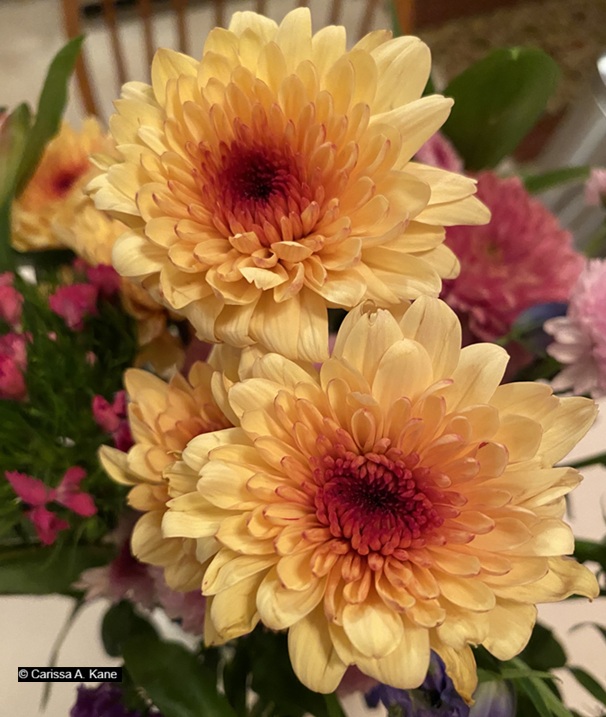
Walking along the path, flowers sprinkled among the greenery on either side bring both brightness and variation to the scene. In the middle, one flower leans toward another as if reaching out to the one looking down at petals lost. Holding on, seeking comfort, seeking peace; providing both to those walking through or passing by.
Stories, so many stories, in the present and in the past. Living, breathing stories, held by many hearts. And then there’s Peace, held within those many stories, seeking hearts to hold them well, souls to glean their wisdom, and bodies with the mind to march peace forward.
Let the peace of Christ control your hearts; let the word of Christ dwell in you richly. – Colossians 3:15a, 16a











You must be logged in to post a comment.