Under the surface, coursing deep within The passages and chambers of one’s heart, Is what pulses through, leads them by the nose, Causing stumbling, bumbling, fool hardy ways.
If humans move to the things they admire, Walking to the beat of what sets their fire, Never stopping to seek something higher, The better of us, will be lost—gotten.
Under the surface, coursing deep within The passages and chambers of one’s heart, Is what pulses through, leads them to good will, Causing careful, kind, faithful, loving ways.
If humans move to things worth admiring, Walking to the beat of great communion, Pausing often to seek something higher, The best of us, will be rediscovered.
If there is any encouragement in Christ, any solace in love, any participation in the Spirit, any compassion and mercy, complete my joy by being of the same mind, with the same love, united in heart, thinking one thing. Do nothing out of selfishness or out of vainglory; rather, humbly regard others as more important than yourselves, each looking out not for his own interests, but also for those of others. Have in you the same attitude that is also in Christ Jesus. – Philippians 2:1-5
When I was young, I recall the warmth of the sun, And the gentle breeze as if echoing goodwill. I did not know it then, but now I do for sure.
Presence, carrying me, instilling love and hope. Peace, keeping me steady, ready for Your wisdom. The joy of knowing You, or thinking that I do, Helps my unbelief, turning doubt into a prayer.
The times, they may seem dark, and danger lurks about. Yet, Grace, I remember, and carry in my heart, The blessing like no other, the gift that Thou art.
The Lord is near to all who call upon him, to all who call upon him in truth. – Psalm 145:18
With each step, weathered, sturdy, or unsure, You keep me steady and moving forward. Even when it seems I’ve fallen behind, Your gentle reassurance and guidance, Instill calm, a sense of being blessed—graced.
No matter where I am or where I go, Your love and wisdom abide within me. The signs, all around, sometimes I catch them, Sometimes I don’t, but still, I know they’re there. Of Your presence for me, for all, there’s no doubt.
The Lord is with me to the end. Lord, your mercy endures forever. Never forsake the work of your hands! – Psalm 138:8
Reflecting on the past week, think about a couple of things that really grabbed your attention whether out of concern, celebration, etc. What was it that pulled you in, caught your eye or ear, and/or touched your heart?
What is it like now as you recall these things?
In the First Reading for the Eighteenth Sunday in Ordinary Time, Isaiah 55:1-3, it is written:
Come to me heedfully, listen, that you may have life. – verse 3a
Continuing to think about the past week, how have you been attentive to the Lord? In what moment(s) have you felt closest to the Lord? What have you shared and what insights have come to light through listening and prayer?
The Psalm for this Sunday (Psalm 145: 8-9, 15-18) reminds us of the way the Lord meets our needs:
The Lord is gracious and merciful, slow to anger and of great kindness. The Lord is good to all and compassionate toward all his works. The eyes of all look hopefully to you, and you give them their food in due season; you open your hand and satisfy the desire of every living thing. The Lord is just in all his ways and holy in all his works. The Lord is near to all who call upon him, to all who call upon him in truth.
Take some time to consider the qualities described in these verses and the ways you have experienced the Lord meeting your needs. Allow time to express the sentiments that arise within as you recall these graced moments.
In the Second Reading (Romans 8:35, 37-39), St. Paul writes:
Brothers and sisters: What will separate us from the love of Christ? Will anguish, or distress, or persecution, or famine, or nakedness, or peril, or the sword? – verse 35
The answer—nothing. There is absolutely nothing; no matter how big or powerful or existential. There is nothing that can “separate us from the love of God in Christ Jesus our Lord.” (v. 39).
Take a few moments to let that sink in!
When ready, reflect again on the past week and name the moment(s) where you felt closest to the Lord. How was that moment(s) different than a moment where perhaps you didn’t feel as close to the Lord?
In the Gospel passage, Matthew 14:13-21 (included below), Jesus has stepped away from the crowds after learning of John the Baptist’s death. However, he is followed by them to the place to which he has retreated. He knows they’re following him from the start. And what does he do? He doesn’t go further away, turn his back on them, or tell them, “Go away”, “Come back tomorrow”, “Maybe another time”, or “Too late”.
Instead, Jesus’s “heart was moved with pity for them, and he cured their sick.” Not only that, but also as the day grows even longer and into the evening, rather than sending the crowd away or taking leave of them, he feeds them—all 5,000—with five loaves of bread and two fish.
What speaks to you most about this passage?
Spend the next few minutes envisioning the Lord’s care, strength, hope, love, and wisdom being poured upon you and filling your heart, body, and soul. Allow yourself to encounter the warmth and generosity of the Lord.
What do you imagine the Lord wants you to know about the things that caught your attention this past week? And the ones that will catch your attention in the week ahead?
When Jesus heard of the death of John the Baptist, he withdrew in a boat to a deserted place by himself. The crowds heard of this and followed him on foot from their towns. When he disembarked and saw the vast crowd, his heart was moved with pity for them, and he cured their sick. When it was evening, the disciples approached him and said, “This is a deserted place and it is already late; dismiss the crowds so that they can go to the villages and buy food for themselves.” Jesus said to them, “There is no need for them to go away; give them some food yourselves.” But they said to him, “Five loaves and two fish are all we have here.” Then he said, “Bring them here to me,” and he ordered the crowds to sit down on the grass. Taking the five loaves and the two fish, and looking up to heaven, he said the blessing, broke the loaves, and gave them to the disciples, who in turn gave them to the crowds. They all ate and were satisfied, and they picked up the fragments left over— twelve wicker baskets full. Those who ate were about five thousand men, not counting women and children. – Matthew 14:13-21
Through the waves of dissonance, steady and in great calmness, Truth works its way to the front, making known what was hidden, replacing what’s distorted, shining light on what’s debased, transforming what’s been disturbed, renewing all purpose and bringing a meaningful state.
The Spirit of truth will testify to me, says the Lord; and you also will testify. – John 15:26b, 27a
We are His, the Lord’s, people, the sheep of His flock. The One we belong to, so much better than great, Carries all without blame, no excuses, no lies, Just a care that runs deep and a heart of pure Love.
While one pretends, leading others astray and awry, The Lord, ever-present, makes clear to the willing, What’s honest and true, compared to what’s opposite. Eyes open or not, the Lord is faithful to all.
Know that the Lord is God, he made us, we belong to him, we are his people, the flock he shepherds. – Psalm 100:3
Created in the Father’s image, shown how to live by His only Son, designed with hearts and minds that are free, able to choose between many things, but made to be moved by the Spirit.
Everywhere, working things for best, sometimes we see it, others we don’t. Either way, you never fade or leave, but wait for an open, honest gaze.
The coming, going, and going ons, time, ages, and different stages, accompanied by the Love of three, Holy Trinity, how blessed are we.
God so loved the world that he gave his only Son, so that everyone who believes in him might not perish but might have eternal life. For God did not send his Son into the world to condemn the world, but that the world might be saved through him. Whoever believes in him will not be condemned, but whoever does not believe has already been condemned, because he has not believed in the name of the only Son of God. – John 3:16-18
The readings for the Solemnity of Pentecost offer an opportunity to contemplate faith from the perspective of both personal experience and communal experience. In the First Reading (Acts 2:1-11), it is written:
Then there appeared to them tongues as of fire, which parted and came to rest on each one of them. And they were all filled with the Holy Spirit and began to speak in different tongues, as the Spirit enabled them to proclaim.
The Spirit not only rested upon each one, but penetrated them, and more than filled them up. The apostles were given what they needed, the ability to communicate effectively with those whose languages were different than theirs.
In what area(s) of your life do you desire the Holy Spirit to assist or inspire you?
The reading continues with the people shocked at what they are hearing and trying to understand what is going on:
We are Parthians, Medes, and Elamites, inhabitants of Mesopotamia, Judea and Cappadocia, Pontus and Asia, Phrygia and Pamphylia, Egypt and the districts of Libya near Cyrene, as well as travelers from Rome, both Jews and converts to Judaism, Cretans and Arabs, yet we hear them speaking in our own tongues of the mighty acts of God.
Recall how you have been taken by surprise, experiencing or witnessing the mighty acts of God.
The Psalm response is from Psalm 104:
Lord, send out your Spirit, and renew the face of the earth. (cf. 30)
Inspired by the mighty acts of the Lord, take some time to pray for the things that your heart longs for the Lord to bring His peace, love, healing, wisdom, and/or unity to.
After naming and praying for each thing, repeat the response from Psalm 104. As you pray, be aware of how your heart and mind are stirred. Allow yourself time to communicate your thoughts and feelings about both personal matters and those regarding your brothers and sisters in your community and around the world.
In the Second Reading (1 Corinthians 12:3b-7, 12-13), St. Paul gives voice to the fact that, yes, we are different (not all have the same gifts, or are called to serve, or to be the same), but that underneath those differences, we are born of the same God. And furthermore, he writes:
To each individual the manifestation of the Spirit is given for some benefit. As a body is one though it has many parts, and all the parts of the body, though many, are one body, so also Christ. For in one Spirit we were all baptized into one body, whether Jews or Greeks, slaves or free persons, and we were all given to drink of one Spirit.
What’s it like to consider that the Holy Spirit can work in each, and every, person, no matter who they are or what they have done, to bring forth the good that God has in mind? How does, or how might, this notion influence you in your words, actions, and thoughts and prayers?
In the Gospel reading (John 20:19-23), it is written:
On the evening of that first day of the week, when the doors were locked, where the disciples were, for fear of the Jews, Jesus came and stood in their midst and said to them, “Peace be with you.” When he had said this, he showed them his hands and his side. The disciples rejoiced when they saw the Lord. Jesus said to them again, “Peace be with you. As the Father has sent me, so I send you.” And when he had said this, he breathed on them and said to them, “Receive the Holy Spirit. Whose sins you forgive are forgiven them, and whose sins you retain are retained.”
Reflecting on this Gospel passage and the fifty days since Easter, what catches your attention? What have you carried forward for yourself, and regarding others? What, if anything, might be interfering with your ability to be guided by and to cooperate more fully with the Holy Spirit? What do you sense the Lord wants you to know at this moment?
Come, Holy Spirit, fill the hearts of your faithful and kindle in them the fire of your love. – Gospel Acclamation
You will show me the path to life, abounding joy in your presence, the delights at your right hand forever. – Psalm 16:11
Thinking over the past week, reflect on the path(s) you traveled as you went from place to place or activity to activity. Try to recall what you were thinking and feeling as you moved from one thing to another. Overall, as you went along each day, what sentiments did you carry with you? To what did you hold onto and of what did you let go?
Take some time to converse with the Lord about what you felt grateful for and what you struggled with or disliked during the week, and what it is like now as you think back on it. What strikes you most? As you share, allow time to listen to what strikes the Lord most about your week. What does the Lord want you to know? How might you draw both peace and strength, joy and reverence from this past week?
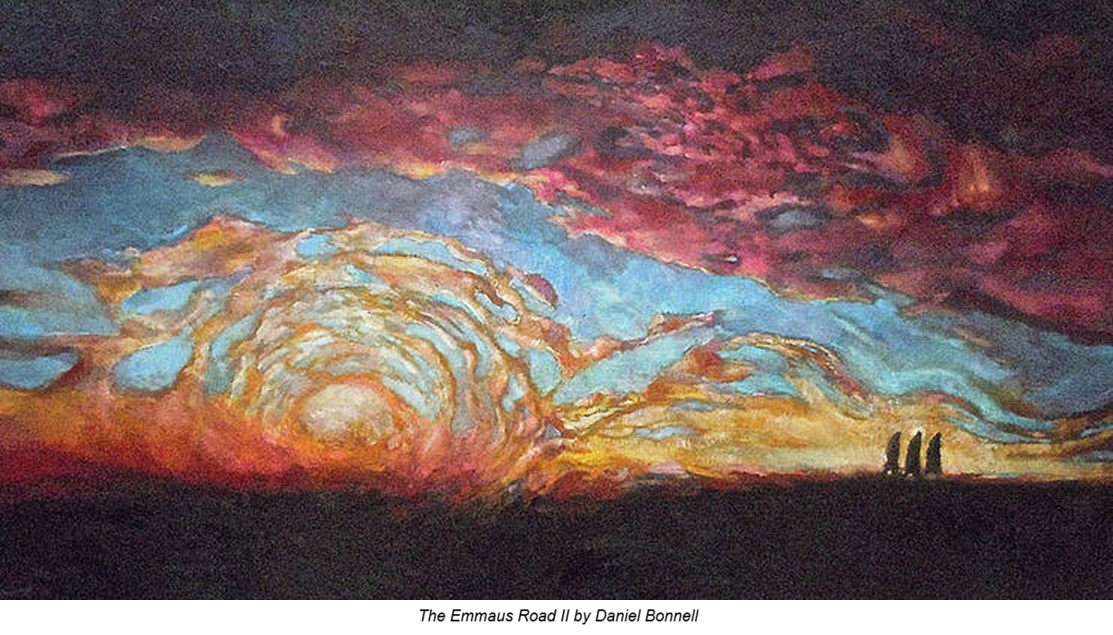
Continuing with paths along one’s journey, imagine yourself on the road to Emmaus as you read the Gospel for the Third Sunday of Easter.
That very day, the first day of the week, two of Jesus’ disciples were going to a village seven miles from Jerusalem called Emmaus, and they were conversing about all the things that had occurred. And it happened that while they were conversing and debating, Jesus himself drew near and walked with them, but their eyes were prevented from recognizing him. He asked them, “What are you discussing as you walk along?” They stopped, looking downcast. One of them, named Cleopas, said to him in reply, “Are you the only visitor to Jerusalem who does not know of the things that have taken place there in these days?” And he replied to them, “What sort of things?” They said to him, “The things that happened to Jesus the Nazarene, who was a prophet mighty in deed and word before God and all the people, how our chief priests and rulers both handed him over to a sentence of death and crucified him. But we were hoping that he would be the one to redeem Israel; and besides all this, it is now the third day since this took place. Some women from our group, however, have astounded us: they were at the tomb early in the morning and did not find his body; they came back and reported that they had indeed seen a vision of angels who announced that he was alive. Then some of those with us went to the tomb and found things just as the women had described, but him they did not see.” And he said to them, “Oh, how foolish you are! How slow of heart to believe all that the prophets spoke! Was it not necessary that the Christ should suffer these things and enter into his glory?” Then beginning with Moses and all the prophets, he interpreted to them what referred to him in all the Scriptures. As they approached the village to which they were going, he gave the impression that he was going on farther. But they urged him, “Stay with us, for it is nearly evening and the day is almost over.” So he went in to stay with them. And it happened that, while he was with them at table, he took bread, said the blessing, broke it, and gave it to them. With that their eyes were opened and they recognized him, but he vanished from their sight. Then they said to each other, “Were not our hearts burning within us while he spoke to us on the way and opened the Scriptures to us?” So they set out at once and returned to Jerusalem where they found gathered together the eleven and those with them who were saying, “The Lord has truly been raised and has appeared to Simon!” Then the two recounted what had taken place on the way and how he was made known to them in the breaking of bread. – Luke 24:13-35
What insight or wisdom does the Lord want to impart to you at this moment? And how might it inspire you to be a greater reflection of God’s love and mercy as you journey on?











You must be logged in to post a comment.