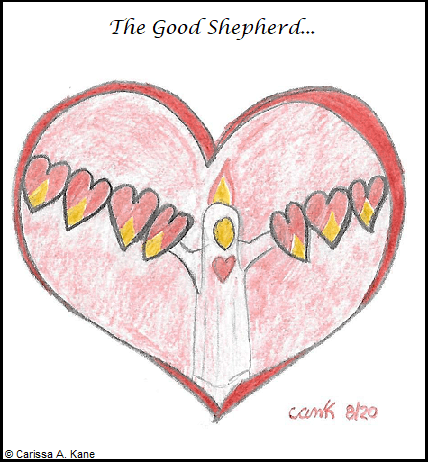
The Shepherd that is Good…

In the Gospel passage for the Foruth Sunday of Easter (John 10:1-10) it is written:

Jesus said:
“Amen, amen, I say to you,
whoever does not enter a sheepfold through the gate
but climbs over elsewhere is a thief and a robber.
But whoever enters through the gate is the shepherd of the sheep.
The gatekeeper opens it for him, and the sheep hear his voice,
as the shepherd calls his own sheep by name and leads them out.
When he has driven out all his own,
he walks ahead of them, and the sheep follow him,
because they recognize his voice.
But they will not follow a stranger;
they will run away from him,
because they do not recognize the voice of strangers.”
Although Jesus used this figure of speech,
the Pharisees did not realize what he was trying to tell them.

So Jesus said again, “Amen, amen, I say to you,
I am the gate for the sheep.
All who came before me are thieves and robbers,
but the sheep did not listen to them.
I am the gate.
Whoever enters through me will be saved,
and will come in and go out and find pasture.
A thief comes only to steal and slaughter and destroy;
I came so that they might have life and have it more abundantly.”

The thief and robber, thinking themself clever, sneaks their way in. They side-step or going over or around the gate, and sometimes even appear to be the gatekeeper. However, Jesus says, though they may get in, they are still a thief and robber, and the sheep will not be fooled by them.

How do you invite the Lord, the Good Shepherd, to help you discern the differences between His voice and that of the stranger who robs and steals?

Take some time to contemplate a situation that might be weighing you down? What might there be that is being robbed or stolen from you when it comes to this? Pray to the Lord for insight and wisdom so that His voice can be stronger or more clear, having greater influence on you and your response to the situation.

In what ways does the Lord want you to have life more abundantly?

The Lord is my shepherd; there is nothing I shall want. – Psalm 23:1

The Emmaus Road II painting by Daniel Bonnell

On the Way There…

You will show me the path to life,
abounding joy in your presence,
the delights at your right hand forever. – Psalm 16:11

Thinking over the past week, reflect on the path(s) you traveled as you went from place to place or activity to activity. Try to recall what you were thinking and feeling as you moved from one thing to another. Overall, as you went along each day, what sentiments did you carry with you? To what did you hold onto and of what did you let go?

Take some time to converse with the Lord about what you felt grateful for and what you struggled with or disliked during the week, and what it is like now as you think back on it. What strikes you most? As you share, allow time to listen to what strikes the Lord most about your week. What does the Lord want you to know? How might you draw both peace and strength, joy and reverence from this past week?

Continuing with paths along one’s journey, imagine yourself on the road to Emmaus as you read the Gospel for the Third Sunday of Easter.

That very day, the first day of the week,
two of Jesus’ disciples were going
to a village seven miles from Jerusalem called Emmaus,
and they were conversing about all the things that had occurred.
And it happened that while they were conversing and debating,
Jesus himself drew near and walked with them,
but their eyes were prevented from recognizing him.
He asked them,
“What are you discussing as you walk along?”
They stopped, looking downcast.
One of them, named Cleopas, said to him in reply,
“Are you the only visitor to Jerusalem
who does not know of the things
that have taken place there in these days?”
And he replied to them, “What sort of things?”
They said to him,
“The things that happened to Jesus the Nazarene,
who was a prophet mighty in deed and word
before God and all the people,
how our chief priests and rulers both handed him over
to a sentence of death and crucified him.
But we were hoping that he would be the one to redeem Israel;
and besides all this,
it is now the third day since this took place.
Some women from our group, however, have astounded us:
they were at the tomb early in the morning
and did not find his body;
they came back and reported
that they had indeed seen a vision of angels
who announced that he was alive.
Then some of those with us went to the tomb
and found things just as the women had described,
but him they did not see.”
And he said to them, “Oh, how foolish you are!
How slow of heart to believe all that the prophets spoke!
Was it not necessary that the Christ should suffer these things
and enter into his glory?”
Then beginning with Moses and all the prophets,
he interpreted to them what referred to him
in all the Scriptures.
As they approached the village to which they were going,
he gave the impression that he was going on farther.
But they urged him, “Stay with us,
for it is nearly evening and the day is almost over.”
So he went in to stay with them.
And it happened that, while he was with them at table,
he took bread, said the blessing,
broke it, and gave it to them.
With that their eyes were opened and they recognized him,
but he vanished from their sight.
Then they said to each other,
“Were not our hearts burning within us
while he spoke to us on the way and opened the Scriptures to us?”
So they set out at once and returned to Jerusalem
where they found gathered together
the eleven and those with them who were saying,
“The Lord has truly been raised and has appeared to Simon!”
Then the two recounted
what had taken place on the way
and how he was made known to them in the breaking of bread. – Luke 24:13-35

What insight or wisdom does the Lord want to impart to you at this moment? And how might it inspire you to be a greater reflection of God’s love and mercy as you journey on?

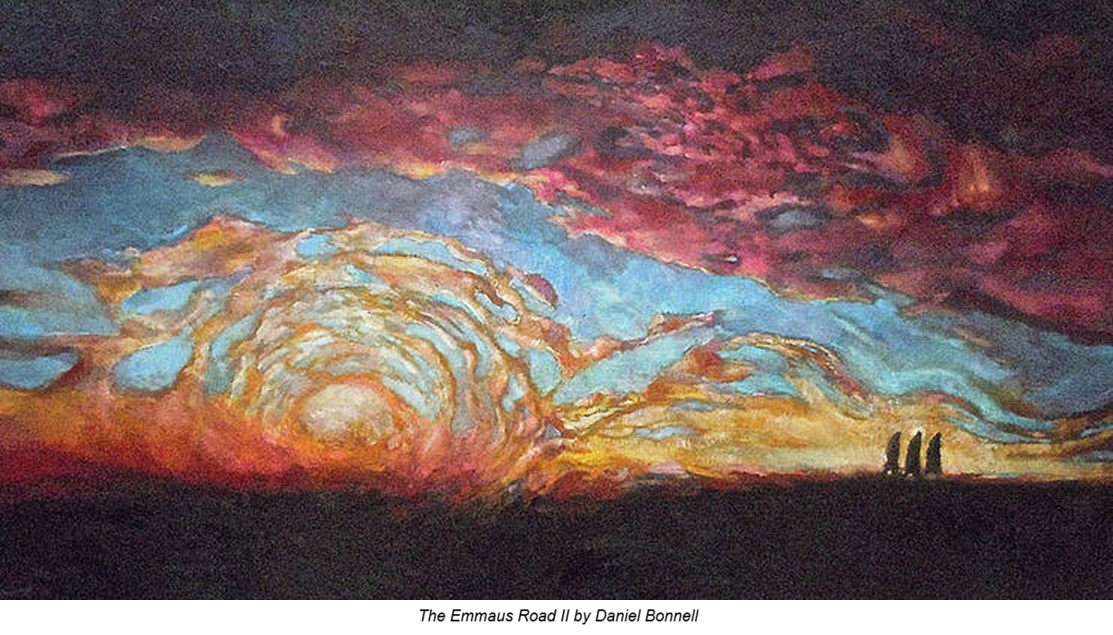
The Emmaus Road II painting by Daniel Bonnell
Easter Heart with Cross in the middle

To Believe is to Remember…

Today is the Second Sunday of Easter, or in the Catholic Church, Divine Mercy Sunday, as it was designated in the year 2000 by Pope John Paul II. When you think of mercy, what does it look like? What characteristics come to mind?

On the night that Jesus was arrested, he said to the disciples gathered around the table,

“This night all of you will have your faith in me shaken, for it is written:
‘I will strike the shepherd,
and the sheep of the flock will be dispersed’;
but after I have been raised up,
I shall go before you to Galilee.” – Matthew 26:31-32

In today’s Gospel (John 20:19-31), the disciples, although afraid from all that transpired and what it might mean for them, have reconnected and come back together. They did not allow what might be labeled as their failures (e.g. fleeing the scene, Peter’s denials) to override the example of Jesus and to tear them apart. Instead, they chose to embrace what was instilled in them by the grace of God and imparted to them by the mercy of God, extending both to each other.

Rather than looking to place blame or find fault with each other and giving rise to in-fighting and division, the disciples, still afraid and likely unsure, gathered together, and in their unity, Jesus appears to them, not upset at them for scattering or holding a grudge, but wishing them peace and extending grace to them.

Jesus came and stood in their midst
and said to them, “Peace be with you.”
When he had said this, he showed them his hands and his side.
The disciples rejoiced when they saw the Lord.
Jesus said to them again, “Peace be with you.
As the Father has sent me, so I send you.”
And when he had said this, he breathed on them and said to them,
“Receive the Holy Spirit.
Whose sins you forgive are forgiven them,
and whose sins you retain are retained.” – John 20:19-23

How do Jesus’s words above speak to you today? Share with Jesus what’s in your heart and on your mind as you consider these verses. Ask Jesus for his perspective.

Now, Thomas who was absent when Jesus appeared to the disciples doesn’t believe what is reported to him by the disciples who were there. Or, perhaps the thing that Thomas doesn’t believe without seeing for himself, is not the words of his fellow disciples, but the words of the Lord.

In other words, maybe the point is not that Thomas was expected to blindly take the words of his fellow disciples as truth, but rather that Thomas’s faith was so shaken by the experience of the crucifixion that it led him to some level of mistrust in the words that Jesus had spoken before his death.

Next, consider Jesus’s response. True to His nature, Jesus, again, doesn’t hold a grudge and doesn’t lose faith in Thomas, but as always, responds with understanding. In his mercy, Jesus appears again to the disciples at a time when Thomas is present. Jesus gives Thomas what he needs in order to be strengthened in his fatih, and at a time when he is able to best receive it.

Now a week later his disciples were again inside
and Thomas was with them.
Jesus came, although the doors were locked,
and stood in their midst and said, “Peace be with you.”
Then he said to Thomas, “Put your finger here and see my hands,
and bring your hand and put it into my side,
and do not be unbelieving, but believe.”
Thomas answered and said to him, “My Lord and my God!”
Jesus said to him, “Have you come to believe because you have seen me?
Blessed are those who have not seen and have believed.” – John 20:24-29

What do you imagine the week between being told about Jesus’s appearance and his reappearance was like for Thomas? What might the week between the two appearances have been like for the rest of the disciples?

Reflect on your experience of moments of uncertainty or times when your faith has been shaken. What was it like? And how did you face it? In what ways was Jesus present to you, and how might you need that same presence today?

Now, Jesus did many other signs in the presence of his disciples
that are not written in this book.
But these are written that you may come to believe
that Jesus is the Christ, the Son of God,
and that through this belief you may have life in his name. – John 20:30-31

In his poem, The Universal Prayer, Alexander Pope wrote, “Teach me to feel another’s woe, to hide the fault I see, that mercy I to others show, that mercy show to me.” How has your heart been touched by mercy? And how you have extended mercy to others?

Easter Heart with Cross in the middle

The Universal Prayer by Alexander Pope
Father of all! In every age,
In every clime adored,
By saint, by savage, and by sage,
Jehovah, Jove, or Lord! Thou great First Cause, least understood!
Who all my sense confined
To know but this, that thou art good,
And that myself am blind; Yet gave me, in this dark estate,
To see the good from ill;
And binding nature fast in fate,
Left free the human will. What conscience dictates to be done,
Or warns me not to do,
This, teach me more than hell to shun,
That, more than heaven pursue. What blessings thy free bounty gives,
Let me not cast away;
For God is paid when man receives,
To enjoy is to obey. Yet not to earth’s contracted span
Thy goodness let me bound,
Or think thee Lord alone of man,
When thousand worlds are round: Let not this weak, unknowing hand
Presume thy bolts to throw,
And deal damnation round the land
On each I judge thy foe. If I am right, thy grace impart
Still in the right to stay;
If I am wrong, oh teach my heart
To find that better way. Save me alike from foolish pride,
Or impious discontent,
At aught thy wisdom has denied,
Or aught thy goodness lent. Teach me to feel another’s woe,
To hide the fault I see;
That mercy I to others show,
That mercy show to me. Mean though I am, not wholly so,
Since quickened by thy breath;
Oh lead me whereso’er I go,
Through this day’s life or death. This day be bread and peace my lot:
All else beneath the sun,
Thou know’st if best bestowed or not;
And let thy will be done. To thee, whose temple is all space,
Whose altar, earth, sea, skies,
One chorus let all being raise;
All nature’s incense rise!

Heart shaped piece of bread

In the Breaking of Bread…

After a long day of preparing,
mixing together ingredients,
waiting for the dough to do its thing,
sectioning it off into pieces,
allowing some more time for proofing,
carefully baking them til just right,
waiting for cool to overcome heat,
dunking, dipping to greater enhance,
and then waiting for all to soak in,
before sending out, sharing the wealth.

Pouring out what was poured into it,
not just on this solitary day,
but the days and years leading to it,
a reflection of the call to all,
generation to generation,
patiently tend and faithfully wait,
take notice of what is taking stem,
what matters most is the Love within,
and letting it shine glory to God,
remembering One, remembers all.

“Then the two recounted what had taken place on the way
and how he was made known to them in the breaking of the bread.” – Luke 24:35

Heart shaped piece of bread

That very day, the first day of the week,
two of Jesus’ disciples were going
to a village seven miles from Jerusalem called Emmaus,
and they were conversing about all the things that had occurred.
And it happened that while they were conversing and debating,
Jesus himself drew near and walked with them,
but their eyes were prevented from recognizing him.
He asked them,
“What are you discussing as you walk along?”
They stopped, looking downcast.
One of them, named Cleopas, said to him in reply,
“Are you the only visitor to Jerusalem
who does not know of the things
that have taken place there in these days?”
And he replied to them, “What sort of things?”
They said to him,
“The things that happened to Jesus the Nazarene,
who was a prophet mighty in deed and word
before God and all the people,
how our chief priests and rulers both handed him over
to a sentence of death and crucified him.
But we were hoping that he would be the one to redeem Israel;
and besides all this,
it is now the third day since this took place.
Some women from our group, however, have astounded us:
they were at the tomb early in the morning
and did not find his body;
they came back and reported
that they had indeed seen a vision of angels
who announced that he was alive.
Then some of those with us went to the tomb
and found things just as the women had described,
but him they did not see.”
And he said to them, “Oh, how foolish you are!
How slow of heart to believe all that the prophets spoke!
Was it not necessary that the Christ should suffer these things
and enter into his glory?”
Then beginning with Moses and all the prophets,
he interpreted to them what referred to him
in all the Scriptures.
As they approached the village to which they were going,
he gave the impression that he was going on farther.
But they urged him, “Stay with us,
for it is nearly evening and the day is almost over.”
So he went in to stay with them.
And it happened that, while he was with them at table,
he took bread, said the blessing,
broke it, and gave it to them.
With that their eyes were opened and they recognized him,
but he vanished from their sight.
Then they said to each other,
“Were not our hearts burning within us
while he spoke to us on the way and opened the Scriptures to us?”
So they set out at once and returned to Jerusalem
where they found gathered together
the eleven and those with them who were saying,
“The Lord has truly been raised and has appeared to Simon!”
Then the two recounted
what had taken place on the way
and how he was made known to them in the breaking of bread. – Luke 24:13-35

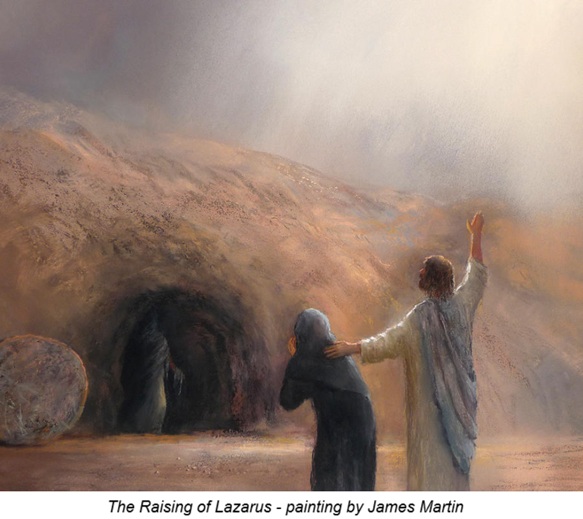
The Raising of Lazarus

The Hope that Raises and Restores…

Approaching the Fifth Sunday of Lent, take a moment to consider the past few weeks and the times you have felt closest to the Lord as well as those times you have felt distanced. Of the situations that come to mind, what jumps out the most in terms of the characteristics of the Lord that you experienced and the ones that, in hindsight, you may have been seeking without knowing it at the time? Take what you notice to prayer, trusting that although the time has passed, conversation with the Lord can still bear fruit, providing insight, wisdom, and whatever else you may need at this moment, and going forward.

As you prepare to consider the readings for this Sunday, invite the Lord to continue the conversation and time together.

In the First Reading from Ezekiel 37:12-14, we have the ending verses of a section referred to as “Vision of the Dry Bones”. The passage is a conversation between the prophet and the Lord where the dry bones are likened to the loss of hope in the Lord, and Ezekiel is instructed as to what he is to tell to the people. As Ezekiel follows each of the Lord’s directives, the vision moves toward the bones being restored to life.

The directives to the dry bones spoken by the prophet are in Word:

“Dry bones, hear the word of the Lord!” (v. 4);

and Spirit:

“Listen! I will make breath enter you so you may come to life.” (v. 5).

The dry bones come to life and the Lord says to Ezekiel: “They are saying, ‘Our bones are dried up, our hope is lost, and we are cut off.’” (v.11)

This is where the First Reading starts. The Lord further instructs Ezekiel, giving him the words to address the need for restoration/renewal, hope, and connection.

Among the words of the Lord, in these verses, to be prophesied are:

“I will put my spirit in you that you may come to life, and I will settle you in your land. Then you shall know that I am the Lord. I have spoken; I will do it” (v. 14)

How are your mind and your heart touched by the words and imagery in this passage? Share what you think and feel at this moment with the Lord. Ask the Lord for openness to receiving his insights about restoration, renewal, hope, and/or connection in your life, your community, and the world at large.

Continuing to stay with the conversation, consider the response to the Psalm, “With the Lord there is mercy and fullness of redemption.” (Psalm 130:7). What are a few ways that you have received the Lord’s mercy and a sense of redemption? How do you feel as you recall those times? In what ways might they instill greater hope in you or inspire you today?

In the Second Reading (Romans 8:8-11), part of what St. Paul writes to the Romans is:

“But you are not in the flesh; on the contrary, you are in the spirit, if only the Spirit of God dwells in you. Whoever does not have the Spirit of Christ does not belong to him. But if Christ is in you, although the body is dead because of sin, the spirit is alive because of righteousness.” – v. 9-10

How do you desire for the Spirit of God, that dwells in you, to be with you and to help you to not only hold onto and connect to, but to also be energized by and to be a reflection of the Lord’s mercy, hope, and inspiration? Share with the Lord whatever is in your heart at this time. Also, take time to allow the Lord to reveal what’s on his heart.

The following verses are an excerpt from the Gospel Reading (John 11:1-45):

Jesus said, “Take away the stone.”
Martha, the dead man’s sister, said to him,
“Lord, by now there will be a stench;
he has been dead for four days.”
Jesus said to her,
“Did I not tell you that if you believe
you will see the glory of God?”
So they took away the stone.
And Jesus raised his eyes and said,
“Father, I thank you for hearing me.
I know that you always hear me;
but because of the crowd here I have said this,
that they may believe that you sent me.”
And when he had said this,
He cried out in a loud voice,
“Lazarus, come out!”
The dead man came out,
tied hand and foot with burial bands,
and his face was wrapped in a cloth.
So Jesus said to them,
“Untie him and let him go.”
Now many of the Jews who had come to Mary
and seen what he had done began to believe in him. – John 11:39-44

Contemplating this passage in the light of your prayers, conversation with the Lord, and what you noticed from the prior readings above, what is the stone that Jesus wants to take away? In what ways might Jesus want you to “untie” and “let go”?

As you pray with this, ask for openness to the Lord’s guidance and for whatever you feel you need to hear the Word of God, to listen, and to receive the Spirit of God. What does the Lord desire for you so that the goodness that dwells within you, continues to sustain you, your hope in the Lord, and extends to others.

The Raising of Lazarus

I am the resurrection and the life; whoever believes in me, even if he dies, will live, and everyone who lives and believes in me will never die. Do you believe this? – John 11:25-26

Beyond What’s Readily Visible…

As we reach Laetare (“rejoice”) Sunday, the thought of rejoicing during a time of such unrest, outright war, and great concern throughout the world can seem so far away and of another world. However, isn’t that part of what faith is all about? Trusting that there is something more. Placing our hope in the One who hears our cries, lifts us up, and gives us guidance and strength as we strive for eternal life. Rejoicing in the Lord who, without fail, is with us.

Take some time to think about what you’re grateful for and to remember the ways in which you have been blessed by the Lord. Then, inspired by the Lord’s faithfulness, pray for whatever enters your mind and heart, knowing that you are praying to the Lord for whom nothing is impossible.

Continuing on, be mindful of the Lord who is ever present and loves us unconditionally as we look at the readings for the Fourth Sunday of Lent.

In the First Reading (1 Samuel 16:1b, 6-7, 10-13a), the Lord sends Samuel to Bethlehem to anoint David king. When Samuel arrives in Bethlehem all he knows is that one of Jesse’s sons is to be anointed and that the Lord will help him to know which one. As soon as Samuel sees the first son, Eliab, he assumes this is the one to be anointed. However, Eliab is not the one.

“But the Lord said to Samuel: Do not judge from his appearance or from his lofty stature, because I have rejected him. God does not see as a mortal, who sees the appearance. The Lord looks into the heart.” – v. 7

What have you been holding in your heart this past week? What about today? What do you imagine is on God’s heart?

As the reading continues, the remaining sons of Jesse are then presented to Samuel, but none of them are the one that he was sent to anoint. This leads Samuel to ask Jesse if he has any other sons. Jesse reveals that there is another son and then sends for David, his youngest, at Samuel’s instruction. Sure enough, David is the one whom the Lord has chosen.

At first sight, Samuel was certain that Eliab had to be the one the Lord had chosen. Yet, in the end, the son the Lord had chosen wasn’t present and had to be sent for. Imagine how unexpected going through the seven sons who were present and not being told, “this is the one,” must have been for Samuel. What do you think led him to ask Jesse if he had any other sons?

What kinds of things do you notice at first sight? How do you experience the unexpected? In what ways do you sense or seek the Lord’s presence in what you notice? In the unexpected?

The Psalm for Laetare Sunday is the following:

The Lord is my shepherd; I shall not want.
In verdant pastures he gives me repose;
beside restful waters he leads me;
he refreshes my soul.
He guides me in right paths
for his name’s sake.
Even though I walk in the dark valley
I fear no evil; for you are at my side
With your rod and your staff
that give me courage.
You spread the table before me
in the sight of my foes;
you anoint my head with oil;
my cup overflows.
Only goodness and kindness follow me
all the days of my life;
and I shall dwell in the house of the Lord
for years to come. – Psalm 23: 1-6

Reflecting on the characteristics of the Lord that are expressed in the Psalm, in what way do you most need the Lord to shepherd you today?

Turning to the Second Reading, it is written:

You were once darkness,
but now you are light in the Lord.
Live as children of light,
for light produces every kind of goodness
and righteousness and truth.
Try to learn what is pleasing to the Lord.
Take no part in the fruitless works of darkness;
rather expose them, for it is shameful even to mention
the things done by them in secret;
but everything exposed by the light becomes visible,
for everything that becomes visible is light.
Therefore, it says:
“Awake, O sleeper,
and arise from the dead,
and Christ will give you light.” – Ephesians 5:8-14

Allow yourself to envision being enveloped in the light of the Lord. As you take in the goodness of the Lord, your heart becomes full of peace, love, and hope. How do you desire to respond? How does the Lord envision you as an extension of God’s peace, love, and hope?

The Gospel passage is John 9:1-41, The Man Born Blind. Read this passage from your Bible.

What part(s) of this passage resonated with you most? What part(s) surprised you or struck you differently than in the past? How does what you noticed or what’s being stirred within you relate to what’s in your heart and what’s weighing on your heart?

What insight does the Lord want to share with you so that you are better able to consider what’s beyond visible and to see more and more with the eyes of your God-given heart?


I am the light of the world, says the Lord;
whoever follows me will have the light of life. – John 8:12

Heart image

Seek With All Your Heart…

In the First Reading for the Sixth Sunday in Ordinary Time, it is written:

If you choose you can keep the commandments, they will save you;
if you trust in God, you too shall live;
he has set before you fire and water
to whichever you choose, stretch forth your hand.
Before man are life and death, good and evil,
whichever he chooses shall be given him.
Immense is the wisdom of the Lord;
he is mighty in power, and all-seeing.
The eyes of God are on those who fear him;
he understands man’s every deed.
No one does he command to act unjustly,
to none does he give license to sin. – Sirach 15:15-20

Take some time to reflect on your words and actions this past week. Consider to what or to whom you “stretched forth your hand” as you went about the week. Invite Jesus to reflect with you. As you review situations that come to mind, how is your heart touched? How do you imagine Jesus’s heart is touched?

The final verse in this week’s Psalm is verse 34 of Psalm 119:

Give me understanding to keep your law, to observe it with all my heart.

There are 613 laws within the first 5 books of the Old Testament (the Torah), there are 10 commandments revealed by God at Mount Sinai, and there are Jesus’s words and example among which is:

You shall love the Lord, your God, with all your heart, with all your soul, and with all your mind.
This is the greatest and the first commandment.
The second is like it: You shall love your neighbor as yourself.
The whole law and the prophets depend on these two commandments. – Matthew 22:37-40

Taking what you have learned through both Scripture and personal experience, how would you describe the heart of God?

In the Second Reading (1 Corinthians 2:6-10), St. Paul gives voice to the fact that knowledge born of the earthly is different than wisdom, pure and true, which is a gift that emanates from God.

But as it is written:
What eye has not seen, and ear has not heard,
and what has not entered the human heart,
what God has prepared for those who love him,
this God has revealed to us through the Spirit.
For the Spirit scrutinizes everything, even the depths of God. – verses 9-10

Contemplate these verses. Notice where your heart is drawn and what comes to mind. As you do so, enter into conversation with Jesus. Reveal your innermost thoughts and feelings and ask him for whatever you need (healing, peace, insight, etc.).

In the Gospel for this week (Matthew 5:17-37), Jesus tells his disciples:

“Do not think that I have come to abolish the law or the prophets.
I have come not to abolish but to fulfill.
Amen, I say to you, until heaven and earth pass away,
not the smallest letter or the smallest part of a letter
will pass from the law,
until all things have taken place.
Therefore, whoever breaks one of the least of these commandments
and teaches others to do so
will be called least in the kingdom of heaven.
But whoever obeys and teaches these commandments
will be called greatest in the kingdom of heaven.
I tell you, unless your righteousness surpasses
that of the scribes and Pharisees,
you will not enter the kingdom of heaven.” – verses 17-20

As you navigate the world around you, how is your heart informed and motivated by God’s laws and commandments, and the spirit of them, along with Jesus’s words and example?

The Gospel passage continues with Jesus stating a few examples of what the disciples have heard or what’s been said of the law of God followed by “But I say to you…”:

“You have heard that it was said to your ancestors,
You shall not kill; and whoever kills will be liable to judgment.
But I say to you…”

“You have heard that it was said,
You shall not commit adultery.
But I say to you…”

“It was also said,
Whoever divorces his wife must give her a bill of divorce.
But I say to you…”

“Again you have heard that it was said to your ancestors,
Do not take a false oath,
but make good to the Lord all that you vow.
But I say to you…” – excerpted verses 21-37

In these verses, Jesus is teaching the disciples a deeper understanding of what they have heard or what’s been said; what they’ve come to know. He’s shifting the focus to connect the law/commandments back to their divine intent—preserving the goodness of God in our hearts.

How might the wisdom of God bring a new understanding or bring greater depth to what you have heard or what’s been said? In what ways might your heart exercise more like the heart of God, the intent of God’s law and commandments, and the teachings and example of Jesus?

Lord, God, creator of all, stretch forth our hearts,
So that your goodness and mercy may shine through.
Let our words and deeds, give you honor and praise.
May they spread hope and love, light and peace, to all.

Heart image

Blessed those who keep the Lord’s testimonies, who seek the Lord with all their heart. – Psalm 119:2

What It’s All About…

It’s human nature to try to assign meaning to the things that happen in life. We all have experiences that can leave us wondering, “What was that all about?”. They are situations or encounters that may or may not eventually become more fully known or revealed. However, oftentimes, instead of waiting for that moment to come, where everything comes together and starts to make sense, we rush ahead making our own sense of it.

In those times of “What was that all about?”, temptation seeks to make the situation neatly fit into our own understanding or way of looking at things. That is, the temptation is to see what one wants to see through the lens through which one chooses to see it, rather than allowing time for the grace of God to open the eyes of one’s heart.

In the Second Reading for the Third Sunday in Ordinary Time (1 Corinthians 1:10-13, 17), St. Paul writes:

“For Christ did not send me to baptize but to preach the gospel,
and not with the wisdom of human eloquence,
so that the cross of Christ might not be emptied of its meaning.” – 1 Corinthians 1:17

What words or images come to mind when you consider the meaning of the cross of Christ, and what values do they imply?

How are you influenced by, and how do you remain mindful of, the meaning and those values as you go about each day?

In what ways do you leave room for the possibility that there’s more that you need to consider regarding a situation? How might you rely upon the grace of God more fully?  

In the verses that proceed the one above, St. Paul appeals to the church of God—the people—in Corinth not to succumb to temptation, which seeks to separate them and pit them against each other. He starts off by imploring them to be united:

“I urge you, brothers and sisters, in the name of our Lord Jesus Christ,
that all of you agree in what you say,
and that there be no divisions among you,
but that you be united in the same mind and in the same purpose.” – 1 Corinthians 1:10-11

St. Paul’s audience is the early Christian community in Corinth. Surely, they had more than just a few disagreements! Don’t people almost always though? Despite this, people always also have much in common.

Take some time to contemplate areas of disagreement that you may have with family, friends, and/or others. After naming the point(s) of contention, think about at least one thing you have in common and that you both value. How might that become, or continue to be, a source of unity? Pray with the desire that enters your heart as you consider this.

In the Gospel passage for this Sunday (Matthew 4:12-23), in part, it is written:

As he was walking by the Sea of Galilee, he saw two brothers,
Simon who is called Peter, and his brother Andrew,
casting a net into the sea; they were fishermen.
He said to them,
“Come after me, and I will make you fishers of men.”
At once they left their nets and followed him.
He walked along from there and saw two other brothers,
James, the son of Zebedee, and his brother John.
They were in a boat, with their father Zebedee, mending their nets.
He called them, and immediately they left their boat and their father
and followed him.
He went around all of Galilee,
teaching in their synagogues, proclaiming the gospel of the kingdom,
and curing every disease and illness among the people. – v. 18-23.  

Notice how Jesus called two sets of brothers. Chances are that within each set as well as taken all together, the brothers, didn’t see eye to eye on everything. However, they were all called, and they all left something behind or had to let go of something.

Simon (Peter) and his brother, Andrew, James and his brother, John, certainly must have had their differences, but they all made the individual choice to place their focus on following Jesus, who taught in the synagogues, proclaimed the Gospel, and “cured every disease and illness among the people.” They embraced the Way. And in doing so, they were able to draw closer to God, they were strengthened through their differences, and they stayed united rather than becoming divided.   

The Lord is my light and my salvation; whom should I fear?
The Lord is my life’s refuge; of whom should I be afraid? – Psalm 27:1

From the heart of God

To those who accepted Him…

In the Gospel passage for the Second Sunday in Ordinary Time, John the Baptist gives witness, or testimony, to Jesus being the Son of God.

John the Baptist saw Jesus coming toward him and said,
“Behold, the Lamb of God, who takes away the sin of the world.
He is the one of whom I said,
‘A man is coming after me who ranks ahead of me
because he existed before me.’
I did not know him,
but the reason why I came baptizing with water
was that he might be made known to Israel.”
John testified further, saying,
“I saw the Spirit come down like a dove from heaven
and remain upon him.
I did not know him,
but the one who sent me to baptize with water told me,
‘On whomever you see the Spirit come down and remain,
he is the one who will baptize with the Holy Spirit.’
Now I have seen and testified that he is the Son of God.” – John 1:29-34

Notice how the passage starts with Jesus coming toward John and John, seeing Him, stating what he has come to know—Jesus is the Son of God. John doesn’t just make this statement or claim, out of thin air. The day before, as written in the previous verses of this Gospel, he was asked who he is, to which he responds, “I am ‘the voice of one crying out in the desert, ‘Make straight the way of the Lord,’ as Isaiah the prophet said.” (John 1:23). He continues, explaining to the priests, Levites, and Pharisees sent to question him that he is not the Messiah. John knows his God-given role and accepts it.

Praying with and reflecting on this passage, what have you come to know about your God-given role, and how does the grace of God reaffirm you in it, and help you to accept and live it out?

Contemplating John’s explanation of how he has come to know that Jesus is the Messiah, what do you make of John saying twice in this passage, “I did not know him”? What strikes you about the words that follow each, “I did not know him”?

I did not know him,
but the reason why I came baptizing with water
was that he might be made known to Israel.”
John testified further, saying,
“I saw the Spirit come down like a dove from heaven
and remain upon him.
I did not know him,
but the one who sent me to baptize with water told me,
‘On whomever you see the Spirit come down and remain,
he is the one who will baptize with the Holy Spirit.’

When you find yourself in a situation of not knowing, how do your instincts and what you know come together with, and make room for, God’s wisdom? How about when you find yourself in a situation where you think, or are sure, that you know?

The Gospel passage ends with John saying, “Now I have seen and testified that he is the Son of God.” Recount whatever comes to mind about what you have seen or experienced that is of God, and how you have come to know.

What is your testimony to God? (Keep in mind that there are many ways in which testimony can be given to God.) How do you desire to give witness to what you have come to know?

From the heart of God

Here am I, Lord; I come to do your will. – Psalm 40: 8a, 9a

Strands of lights rising up from the snow at night.

Bound for the Greater Good…

The Baptism of the Lord in the Gospel according to Matthew describes an interaction between Jesus and John the Baptist. John is a prophet who has his own disciples, and of whom it is written, “At that time Jerusalem, all Judea, and the whole region around the Jordan were going out to him and were being baptized by him in the Jordan River as they acknowledged their sins.” (Matthew 3:5-6). And Jesus is the Christ, the Anointed one, of whom John said, “the one who is coming after me is mightier than I. I am not worthy to carry his sandals. He will baptize you with the holy Spirit and fire.” (Matthew 3:11). Yet, as it is written, they meet and engage with each other without pretense or posturing.

Read and reflect on the Gospel passage for the Baptism of the Lord (below), receiving it as an invitation to prayerfully consider human interactions, both your own and those that you witness. Ask the Lord for insight and wisdom as you do so.

Jesus came from Galilee to John at the Jordan
to be baptized by him.
John tried to prevent him, saying,
“I need to be baptized by you,
and yet you are coming to me?”
Jesus said to him in reply,
“Allow it now, for thus it is fitting for us
to fulfill all righteousness.”
Then he allowed him.
After Jesus was baptized,
he came up from the water and behold,
the heavens were opened for him,
and he saw the Spirit of God descending like a dove
and coming upon him.
And a voice came from the heavens, saying,
“This is my beloved Son, with whom I am well pleased.” –
Matthew 3:13-17

What divine qualities do the words and actions of John the Baptist and Jesus exemplify in this exchange? What strikes you most?

Next, put yourself in John’s shoes as the prophet of whom it is written, “A voice proclaims: In the wilderness prepare the way of the Lord! Make straight in the wasteland a highway for our God!” (Isaiah 40:3). What’s it like to encounter Jesus, knowing that He is the one of whom you’ve been preaching and waiting for? and knowing that it is time for you to step back while He steps forward? What thoughts and feelings arise when you envision saying to Jesus, “I need to be baptized by you” and he replies, “Allow it now. For thus it is fitting for us to fulfill all righteousness”?

Now, ask Jesus to help you to envision His experience in this passage. In what ways might His perspective enlighten your interactions and/or assessments of interactions to which you have been a witness?

How might you be inspired by the example of Jesus and John the Baptist in interactions and when you encounter something or someone known, new, or different?

Strands of lights rising up from the snow at night.

“You are sent into this world to believe in yourself as God’s chosen one and then to help your brothers and sisters know that they are also beloved sons and daughters of God who belong together. You’re sent into this world to be a people of reconciliation. You are sent to heal, to break down the walls between you and your neighbors, locally, nationally, and globally. Before all distinctions, the separations, and the walls built on foundations of fear, there was a unity in the mind and heart of God. Out of that unity, you are sent into this world for a little while to claim that you and every other human being belongs to the same God of Love who lives from eternity to eternity.” – Henri Nouwen