Be Opened…

In the Gospel passage for the Twenty-third Sunday in Ordinary Time (Mk 7:31-37), the people of a village bring a man who is deaf and has a speech impediment to Jesus and plead with him to lay his hand on him. What do you think made the people of the village do this? The deaf man could see, after all, and he could have found his own way to Jesus and asked for himself. What do imagine caused the people to get involved on the deaf man’s behalf? What are some things that lead you to get involved on the behalf of others?

We also read in this passage that Jesus “took him [the deaf man] off by himself away from the crowd.” (v. 33). Perhaps to remove the noise and distractions? Perhaps to engage in a more personal way with the man? Or maybe it was something else.

In the Scripture passage prior to this one, Jesus is trying to step away from the crowds when he is approached by the Syrophoenician woman asking for her daughter to be healed (Mk 7:24-30). This occurs after he has responded to the Pharisees questioning his disciples’ behavior; where Jesus replied in part, “Nothing that enters one from outside can defile that person; but the things that come out from within are what defile.” (Mk 7:15). Considering this teaching and carrying it forward into Jesus’s interactions with the Syrophoenician woman and the deaf man, reflect on the way he receives and responds to people, situations, and what’s going on around him.

How do you receive people, situations, and what’s going on around you? What inner attitudes or dispositions do you carry into interactions? What’s going on in your heart, and how does it affect your response?

Coming back to today’s Gospel Jesus says, “Ephphatha!” (“Be opened!”), and as a result, the deaf man can hear, and his speech impediment is gone. He is healed from his affliction through Jesus’s command, or call, to openness. So why then, does Jesus tell the man not to tell anyone? And how might this fit in with the idea of evangelization?

Maybe Jesus is calling us to be open to what’s going on around us and what God is trying to tell us as individuals, to further open and transform one’s own heart toward greater understanding and compassion. And with that, reminding us that evangelization comes through the grace of God and at times is aided, or complemented, by kind and loving hearts that are both fluid with and fixated on God.
Say to those whose hearts are frightened:
Be strong, fear not!
Here is your God,
he comes with vindication;
with divine recompense
he comes to save you. – Isaiah 35:4

Orchids

In the Presence of Peace…

In the Gospel passage for the Twelfth Sunday in Ordinary Time, Jesus’s disciples reach out to him as the boat they are in is taking on water in the middle of a storm. Jesus says to the wind and the raging sea, “Quiet! Be Still!” and just like that, the storm settles down. This is something he could have done without saying any words, but Jesus, always the teacher, gives his disciples, and us, both an example to follow and words to ponder.

After quieting the storm, Jesus asks his disciples, “Why are you terrified? Do you not yet have faith?” He is not reprimanding them or trying to make them feel bad, but rather he is asking them to reflect on the situation, and trying to help them to know, and to remember, that he is there with them and for them, and so, there is nothing to fear. Without Jesus, the storm can rage on, whether loud and brash or quiet and discreet. It is Jesus’s presence that both quells the storm and brings peace into the quiet and stillness.

Orchids

On that day, as evening drew on, Jesus said to his disciples:
“Let us cross to the other side.”
Leaving the crowd, they took Jesus with them in the boat just as he was.
And other boats were with him.
A violent squall came up and waves were breaking over the boat,
so that it was already filling up.
Jesus was in the stern, asleep on a cushion.
They woke him and said to him,
“Teacher, do you not care that we are perishing?”
He woke up,
rebuked the wind, and said to the sea, “Quiet! Be still!”
The wind ceased and there was great calm.
Then he asked them, “Why are you terrified?
Do you not yet have faith?”
They were filled with great awe and said to one another,
“Who then is this whom even wind and sea obey?” – Mark 4:35-41

Heart

Putting Heart into the matter…

In the Gospel passage for the 10th Sunday in Ordinary Time (Mark 3:20-35), Jesus says to his disciples and the crowd, “If a kingdom is divided against itself, that kingdom cannot stand.” (verse 24). This is in response to the scribes claim that Jesus is driving out demons by or through the prince of demons. Jesus’s words make sense. After all, one cannot bring peace and healing by or through chaotic means. With so much division and vitriol circulating throughout the world, it’s worth considering the heart in the matter.

In the days leading up to this Sunday, the Solemnity of the Most Sacred Heart of Jesus and the Memorial of the Immaculate Heart of the Blessed Virgin Mary are celebrated. When you consider the heart of Jesus, what qualities come to mind? How about when you think about Mary’s immaculate heart?

Based on Scripture, what are some concrete ways that their words and actions reflect these qualities? How does Mary receive unexpected news or events such as the Annunciation, at the Presentation in the temple, and Jesus’s arrest and crucifixion? How does Mary react and respond to the young Jesus when she finds him in the temple after 3 days apart? What does Mary do, and how does she do it, when the wine runs out at the wedding feast in Cana?

What kinds of words does Jesus use and what is his attitude in his encounters with the pharisees and scribes, his disciples, and the crowds? What do Jesus’s actions express? And how does Jesus respond and react during the Passion?

Contemplating the heart of Jesus and the heart of Mary in the happenings of today’s world, how or where do you see the qualities of their hearts coming to life through words and actions? Take time this week to notice the heart behind your words and actions as well as those in the happenings directly around you, in your country, and in the world.

Prayer: Immaculate heart of Mary, intercede on our behalf, so that lies, deception, and all who seek to distort what is true, just, and honorable may be revealed. Sacred heart of Jesus, help us to see through your eyes, and to speak, act, and love, with your heart. Amen.

Heart

With the Lord there is mercy, and fullness of redemption. – Psalm 130:7bc

Fulfillment…

On the Solemnity of the Most Holy Body and Blood of Christ also known as Corpus Christi, the Collect (opening prayer) is: “O God, who in this wonderful Sacrament have left us a memorial of your Passion, grant us, we pray, so to revere the sacred mysteries of your Body and Blood that we may always experience in ourselves the fruits of your redemption.”

Spend some time reflecting on this prayer and on the Sacrament of the Eucharist. What does it mean to you and how has it impacted you? Remember how you have experienced the fruits of the Lord’s redemption. What wonders has the Lord worked in your life? Take a few moments to express gratitude for these experiences and the awareness of them.

In the hymn One Bread, One Body, the lyrics direct us to mindfulness of our call, one and all, to unity as God’s people (the church):

One bread, one body, one Lord of all
One cup of blessing which we bless
And we, though many, throughout the Earth
We are one body in this one Lord
– John Foley, SJ (excerpt from One Bread, One Body)

Recall a time(s) when you have experienced unity and the fruits of the Lord’s redemption with others? In what ways have you witnessed the hand of the Lord? Give thanks for these times of common ground and the remembrance of them.

What hopes and desires do you have at this moment for awareness and unity in your life? your community? your country? and the world? Share these with the Lord. Ask the Lord for the grace to further appreciate and be inspired by experiences of the outpouring of His love.

Pray for one and all to have an open heart and mind to the well-being of all creation, and above all, to draw closer to God so as to embody (to speak and act in accord with) God’s desires as expressed through the example of Jesus.

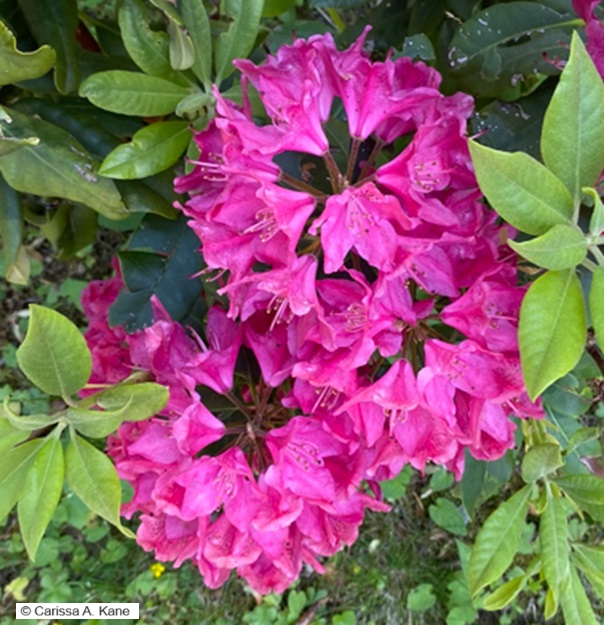
Rhododendron Flowers

How shall I make a return to the Lord
for all the good he has done for me?
The cup of salvation I will take up,
and I will call upon the name of the Lord. – Psalm 116:12-13

This is the Day the Lord Has Made…

Neither grave, nor the gravity,
Could hold Him down.
That cross, though heavy,
Not heavy enough,
Nor could it ever be.
A temporary thing,
A passage, passing with time,
The Begotten not gone.

That stone, though big,
Not big enough,
Nor could it ever be.
A temporary thing,
A passage, passing with time.
The Begotten hidden,
Not seen, not heard,
But certainly not gone.

Then, Easter.
Arriving between the quiet,
Entering amid the stillness,
And everything changes.
Everything becomes new again,
In the remembering of what is.
Nothing ever stronger than What was,
What is, and What shall ever be.

Just as Light cannot be kept from shining,
And Truth, refusing to remain hidden,
There is no greater shield or power than that created by Creator.
We are more than passengers on borrowed time.
More than temporary things or passages, passing with time.
And in Him, with Him, and thru Him,
Neither grave, nor the gravity,
Can hold us down.

Your Grace…

Breaking, broke, broken,
Rescued, healed, awoken,
Ever taken with your Way.
For the sake of all,
It’s all the same.
No one more than the other,
Each onto its own,
But gathered in Your name.

Your grace O Lord,
The longing of our hearts.
Eloi, Eloi, lema sabachthani.
At times, perhaps,
We think we know,
Yet thinking doesn’t make it so.

Your grace O Lord,
The longing of our hearts.
We feel one way or another,
Sometimes many ways at once,
Yet feeling doesn’t make it so.

Your grace O Lord,
The longing of our hearts.
With us, within us,
Always within reach.

Your grace O Lord,
Makes known your Way,
The desire in our hearts,
Yours and ours together,
Rising up, makes it so.

Friday after Ash Wednesday…

It can be easy at times to focus so much on a plan or a routine that one might fall away from the point of having it in the first place. Without even realizing it, the point or the goal can be supplanted by a step(s) laid out to achieve it. This can be especially true during Lent when there’s a tendency to make greater efforts to be intentional about prayer, fasting, and almsgiving.

The scripture passages for today can be taken as an invitation to consider what one’s prayer, fasting, almsgiving, etc. leads them to. For example, in the first reading (Isaiah 58:1-9a), the Prophet Isaiah tells the people what the Lord has said with regards to fasting. The Lord wants to share thoughts and let the people know the attitude and approach that is desired.

Is this not, rather, the fast that I choose:
releasing those bound unjustly,
untying the thongs of the yoke;
Setting free the oppressed,
breaking off every yoke?
Is it not sharing your bread with the hungry,
bringing the afflicted and the homeless into your house;
Clothing the naked when you see them,
and not turning your back on your own flesh?
Then your light shall break forth like the dawn,
and your wound shall quickly be healed;
Your vindication shall go before you,
and the glory of the Lord shall be your rear guard.
Then you shall call, and the Lord will answer,
you shall cry for help, and he will say: “Here I am!”
– Isaiah 58:6-9a

Spend some time contemplating these verses and current events or situations from a broader perspective (e.g. the world, your country) to a more personal one (e.g. your community, family, individual). As you contemplate each area, share your thoughts with the Lord and bring to prayer whatever comes to mind.   

Closing prayer: Lord, grant me, and all your people, the grace to know when our steps are leading us away from the goal—You. Draw us closer and provide us with the wisdom and the strength to let go of whatever may be holding us back. Help us to change course when we’ve gone astray, and to be re-directed so that You and Your ways may always be our foundation and guiding light. We ask this in Jesus’ name. Amen.

Growth mindset

Thursday after Ash Wednesday…

In the Book of Deuteronomy, chapter 30, verses 15-20, after having presented God’s commandments to the people, Moses exhorts them to choose life over death by embracing and living by God’s “commandments, statutes and decrees”. This brings up an interesting question. Outside of obvious situations where the distinction is clear between a choice that is life giving and one that is not, how does one determine what they are really choosing, and perhaps more importantly, why?

There are few things in life that are clear cut and without the possibility for change. Yet, the human tendency leans toward wanting things to be one way or the other, to fit comfortably into categories or boxes, and to be “known for all time”. However, this leaves little to no room for new information or consideration of different circumstances.

Sometimes it can be helpful to flip things around, contemplating them from another angle or two and considering different points of view. Oftentimes, what is thought to be wrong, so different, or out of line, underneath the surface or layers upon first look, can be not so wrong, different, or out of line, at all.

During Lent, we try to renew or refresh our spirit and growth mindset. We open our hearts and minds to seeing and being anew and strengthening our faith and discipleship ways. We are reminded of what it is we profess to believe and why, as well as the desire to choose what is life giving so that even in death, we experience Life.

Take some time to contemplate Moses’ words about choosing life or death alongside the following poem from the Persian poet Rumi.

“I died as mineral and became a plant,
I died as plant and rose to animal,
I died as animal and I was human,
Why should I fear? When was I less by dying?
Yet once more I shall die human,
To soar with angels blessed above.
And when I sacrifice my angel soul
I shall become what no mind ever conceived.
As a human, I will die once more,
Reborn, I will with the angels soar.
And when I let my angel body go,
I shall be more than mortal mind can know.”
– Rumi

What influences your choices? How do you draw inspiration from the example of Jesus in making them? What grace(s) do you desire in this area? Invite Jesus into this conversation, taking time to listen and asking to be open to and to notice whatever insights might be revealed.

Blessed are those who trust in the Lord; the Lord will be their trust. – Jeremiah 17:7

Ready, Set, Lent…

The mark is made,
The season begins,
From one to forty,
Days, one at a time,
As if turning pages
We make our way,
From start to end,
Through these Lenten days.

Giving up, giving in, letting go,
Yet not one thing for another,
As if a game of swapping.
No. Not at all.
Some thing, or things, for One.
The point remains on focus,
In the here and now,
Not here and there
Or scattered about,
But brought together.

Body and soul,
Front and center,
Sorted out or broken down,
But always built back up,
From one desire to another,
According to Thine will,
Heart and mind become one,
Drawn closer, e’er closer,
To the image of One.

A clean heart create for me, O God, and a steadfast spirit renew within me. – Psalm 51:12

Ever Evolving…

The readings for the Fifth Sunday in Ordinary Time begin with a passage from the Book of Job where the subject, Job, continues to express dissatisfaction as he tries to come to terms with, and understand the reason for, the trials and tribulations he is and has been experiencing.

Job spoke, saying:
Is not man’s life on earth a drudgery?
Are not his days those of hirelings?
He is a slave who longs for the shade,
a hireling who waits for his wages.
So I have been assigned months of misery,
and troubled nights have been allotted to me.
If in bed I say, “When shall I arise?”
then the night drags on;
I am filled with restlessness until the dawn.
My days are swifter than a weaver’s shuttle;
they come to an end without hope.
Remember that my life is like the wind;
I shall not see happiness again. – Job 7: 1-4, 6-7  

Thinking about this passage, what resonates with you most? How do you feel about Job’s plight and about God’s role in it?

Recall a time when you felt challenged, and your faith tested. In what ways was God present to you, even if you were not aware or able to name God’s presence as such at that time? What would you say it was about that experience that affected your faith or trust in God? Take some time to share with God what’s on your mind and in your heart at this moment.

The response for the Responsorial Psalm this Sunday is, “Praise the Lord, who heals the brokenhearted.” (Psalm 147 cf. 3a). We all experience heartache and heartbreak as we journey through life. What situation in your life is outright disturbing your heart or creating a sense of unrest or uneasiness? What do you desire from God regarding this situation? What might God want you to know or to consider? In what ways can you envision this situation as an opportunity to deepen your faith and relationship with God?

In the First Letter of St. Paul to the Corinthians, verse 22 of chapter 9, we read, “To the weak I became weak, to win over the weak. I have become all things to all, to save at least some.” What’s it like to consider this, in light of today’s world, as an invitation to getting along in service to God and for the sake of being a living testament to the Gospel? Sticking with this, what would you want to ask St. Paul about this passage and the challenges he faced? What do you need from God as you strive to be a disciple of Jesus in today’s world? Pray for God’s desire for you, in terms of how you navigate the division and issues in today’s world, to be placed in your heart, imparting wisdom throughout each day.  

Next, as we move to the Gospel passage for the Fifth Sunday in Ordinary Time (Mark 1:29-39), we have Jesus’ healing Simon’s mother-in-law as well as a multitude of people. Upon being healed, Simon’s mother-in-law gets back to the business of serving others. We also learn that Jesus separates from the crowd to go pray. Once he is found, Jesus gets back to the business of preaching and healing people as he moves on to the neighboring villages. Take time to contemplate this passage in terms of the necessity of prayer and downtime or time away. What happens when there is an interruption in your routine? In what ways are you open to change? How do you experience the dynamic nature of God through interruptions and changes around you?

“In Christianity, God is not a static thing—not even a person—but a dynamic, pulsating activity, a life, almost a kind of drama. Almost, if you will not think me irreverent, a kind of dance.” – C.S. Lewis