If this, then that permeates across all spaces, Creating fear, stirring up all kinds of notions, Extracting excuses, and some hare-brained ideas, Running roughshod, shredding norms, raging all about. That mirror on the wall? It’s turning, twisting, And swiftly rotting away from the inside out. Say, who’s the Lear-est?, “What can you do for me-man”?
Stop running every which way, but right side up. Pause. Take a minute and step away. Make a change. Seek Grace. Take it in. Soak it up. Receive the gift. In a world traditionally conditional, Only unconditional love, honest and true, Steadies steps, bridges gaps, raises strength for the day, making whole whatever’s fractured, broken, or faux.
It is written: “The Lord, your God, shall you worship and him alone shall you serve.” – Matthew 4:10
The Baptism of the Lord in the Gospel according to Matthew describes an interaction between Jesus and John the Baptist. John is a prophet who has his own disciples, and of whom it is written, “At that time Jerusalem, all Judea, and the whole region around the Jordan were going out to him and were being baptized by him in the Jordan River as they acknowledged their sins.” (Matthew 3:5-6). And Jesus is the Christ, the Anointed one, of whom John said, “the one who is coming after me is mightier than I. I am not worthy to carry his sandals. He will baptize you with the holy Spirit and fire.” (Matthew 3:11). Yet, as it is written, they meet and engage with each other without pretense or posturing.
Read and reflect on the Gospel passage for the Baptism of the Lord (below), receiving it as an invitation to prayerfully consider human interactions, both your own and those that you witness. Ask the Lord for insight and wisdom as you do so.
Jesus came from Galilee to John at the Jordan to be baptized by him. John tried to prevent him, saying, “I need to be baptized by you, and yet you are coming to me?” Jesus said to him in reply, “Allow it now, for thus it is fitting for us to fulfill all righteousness.” Then he allowed him. After Jesus was baptized, he came up from the water and behold, the heavens were opened for him, and he saw the Spirit of God descending like a dove and coming upon him. And a voice came from the heavens, saying, “This is my beloved Son, with whom I am well pleased.” – Matthew 3:13-17
What divine qualities do the words and actions of John the Baptist and Jesus exemplify in this exchange? What strikes you most?
Next, put yourself in John’s shoes as the prophet of whom it is written, “A voice proclaims: In the wilderness prepare the way of the Lord! Make straight in the wasteland a highway for our God!” (Isaiah 40:3). What’s it like to encounter Jesus, knowing that He is the one of whom you’ve been preaching and waiting for? and knowing that it is time for you to step back while He steps forward? What thoughts and feelings arise when you envision saying to Jesus, “I need to be baptized by you” and he replies, “Allow it now. For thus it is fitting for us to fulfill all righteousness”?
Now, ask Jesus to help you to envision His experience in this passage. In what ways might His perspective enlighten your interactions and/or assessments of interactions to which you have been a witness?
How might you be inspired by the example of Jesus and John the Baptist in interactions and when you encounter something or someone known, new, or different?
“You are sent into this world to believe in yourself as God’s chosen one and then to help your brothers and sisters know that they are also beloved sons and daughters of God who belong together. You’re sent into this world to be a people of reconciliation. You are sent to heal, to break down the walls between you and your neighbors, locally, nationally, and globally. Before all distinctions, the separations, and the walls built on foundations of fear, there was a unity in the mind and heart of God. Out of that unity, you are sent into this world for a little while to claim that you and every other human being belongs to the same God of Love who lives from eternity to eternity.” – Henri Nouwen
Moving along, sometimes more quickly than others, Sometimes more like hobbling, or barely there at all, But hope and faith, always looking and taking pause, Trust that the moment will arrive, and take its place.
“Justice shall flourish in his time, and fullness of peace for ever.” – Psalm 72:7
During the season of Advent, we wait in anticipation of what’s coming—the birth of Jesus Christ. However, so much of life is about waiting and anticipating what’s coming. And persevering through it requires a level of trust. The response for the Second Sunday of Advent’s Psalm (above) tells us there will be “justice” and “fullness of peace” and it will be “in his time”.
What gets in the way of your ability to trust and be patient? How do you overcome it?
In the Gospel for this Sunday, it is written of John the Baptist:
It was of him that the prophet Isaiah had spoken when he said: “A voice of one crying out in the desert, ‘Prepare the way of the Lord, make straight his paths.’” – Matthew 3:3
Take some time now, and throughout the week, to envision yourself as the voice crying out in the desert. The way has already been prepared, and you are crying out, but to the Lord. Share what is on your mind and happening in your heart as this time. What do you need from the Lord? What does the Lord desire for you?
The readings for the First Sunday of Advent begin with the prophet Isaiah’s vision:
This is what Isaiah, son of Amoz, saw concerning Judah and Jerusalem. In days to come, the mountain of the Lord’s house shall be established as the highest mountain and raised above the hills. All nations shall stream toward it; many peoples shall come and say: “Come, let us climb the Lord’s mountain, to the house of the God of Jacob, that he may instruct us in his ways, and we may walk in his paths.” For from Zion shall go forth instruction, and the word of the Lord from Jerusalem. He shall judge between the nations, and impose terms on many peoples. They shall beat their swords into plowshares and their spears into pruning hooks; one nation shall not raise the sword against another, nor shall they train for war again. O house of Jacob, come, let us walk in the light of the Lord!” – Isaiah 2:1-5
What does your vision of walking in the light of the Lord look like?
Picture yourself ascending the mountain to receive instruction from the Lord. Be attuned to the stirrings of your heart as you do so. Thinking about your ways (words, actions, and general way of being), ask the Lord to join.
Letting the Lord be the judge, what adjustments might help you to greater reflect the image of God?
The Responsorial Psalm is from Psalm 122 (verses 1-9):
R. Let us go rejoicing to the house of the Lord.
I rejoiced because they said to me, “We will go up to the house of the Lord.” And now we have set foot within your gates, O Jerusalem.
R. Let us go rejoicing to the house of the Lord.
Jerusalem, built as a city with compact unity. To it the tribes go up, the tribes of the Lord.
R. Let us go rejoicing to the house of the Lord.
According to the decree for Israel, to give thanks to the name of the Lord. In it are set up judgment seats, seats for the house of David.
R. Let us go rejoicing to the house of the Lord.
Pray for the peace of Jerusalem! May those who love you prosper! May peace be within your walls, prosperity in your buildings.
R. Let us go rejoicing to the house of the Lord.
Because of my brothers and friends I will say, “Peace be within you!” Because of the house of the Lord, our God, I will pray for your good.
R. Let us go rejoicing to the house of the Lord.
What phrase(s) draws your attention most? In what way does it strike a chord with you? Spend some time praying with this verse(s). How are you inspired? Share the thoughts and feelings that arise with the Lord. Ask the Lord to deepen your understanding and the grace to embody the wisdom of this psalm.
In the Second Reading (Romans 13:11-14), St. Paul writes that time is of the essence as he urges the Christians in Rome to embrace that which is eternal, the Light of Christ, over “works of darkness” (verse 12). Knowing that works of darkness can enter through the disguise of light and that the Light of Christ is not stagnant, in what ways do you invite the Lord to be with you as you make decisions, and how do you keep the Lord in your heart and on your mind, as you proceed through the tasks of each day? Ask the Lord to help you in areas you find challenging and to awaken you to areas of potential growth.
The Gospel for the First Sunday of Advent is from Matthew, chapter 24, verses 37-44:
Jesus said to his disciples: “As it was in the days of Noah, so it will be at the coming of the Son of Man. In those days before the flood, they were eating and drinking, marrying and giving in marriage, up to the day that Noah entered the ark. They did not know until the flood came and carried them all away. So will it be also at the coming of the Son of Man. Two men will be out in the field; one will be taken, and one will be left. Two women will be grinding at the mill; one will be taken, and one will be left. Therefore, stay awake! For you do not know on which day your Lord will come. Be sure of this: if the master of the house had known the hour of night when the thief was coming, he would have stayed awake and not let his house be broken into. So too, you also must be prepared, for at an hour you do not expect, the Son of Man will come.”
“Stay awake!”, “be prepared,” the time is unknown to you. It could happen in the next breath, far into the future, or somewhere in between. What is your initial reaction to this Gospel passage? And, in what ways does it move you?
Part of awareness and preparation involves thinking about when something will be coming or how long it might last. However, no matter how much one might plan, things can change. And while there are things that one can do regularly to be ready, faithfulness to God is about holding fast to the Lord with an openness or flexibility that allows one to cooperate with His grace. In this way, impediments to staying awake and being prepared are cast out, rather than interfering with discernment and a greater sense of God’s will.
What gets in the way of your openness to change, or things being different than what you thought, hoped for, or planned? Think of a situation where you were open to change. What was that like? And what role did prayer play in it?
Now think of a situation where you were resistant or hesitant to change because what you saw was different than your way of thinking, your approach, or what you pictured. What were you clinging to that removed the choice of being flexible? Ask the Lord to step through this situation with you and for the willingness to accept His point of view, whether it includes reaffirmation, further instruction, or gentle correction.
Continue to reflect on and pray with the insights revealed to you throughout the week. Ask for the grace to be inspired and guided by the will of God, and the desire to draw closer to God this Advent.
Show us, Lord, your mercy; grant us your salvation. – Psalm 85:8
In the Gospel passage for the Twentieth Sunday in Ordinary Time, Jesus says to his disciples,
“Do you think that I have come to establish peace on the earth? No, I tell you, but rather division.” – Luke 12:51
It’s not that Jesus wants there to be division, but rather that he knows reality.
One cannot get to peace by holding fast to anything or anyone other than God. And peace, like love, when honest and true, flows through to us by the grace of God, continues with our cooperation, and connects one and all. There’s always an extension onto others.
However, when one looks to differentiate, judge, or draw hard lines, venturing or being led away from grace, the extension gets cut off. For the peace and love of God does not occur in strict isolation, or in a single caste. Similarly, it cannot be had where there is holding back, or where humility lacks.
Take some time to pray with and consider how you experience peace and love. Express to the Lord your thoughts and feelings about the experiences that come to mind.
Next, ask the Lord for guidance and insight as to the ways that what you say and do, and what you don’t say and don’t do, are or can be an extension of the peace and love that has been bestowed to you. Allow yourself time to reflect on this and to hold a conversation with Jesus.
Envision sitting together in a place of quiet solitude. Share with Jesus whatever it is that you need at this moment. Ask Jesus to reveal any blind spots that may be interfering or leading you away from cooperating with God’s grace. What holds you back?
When the conversation reaches its end, picture yourself looking into Jesus’s eyes and feeling his peace radiating throughout you. Your heart is on fire. Jesus smiles gently at you—living faith.
We are living faith, through the choices that we make.
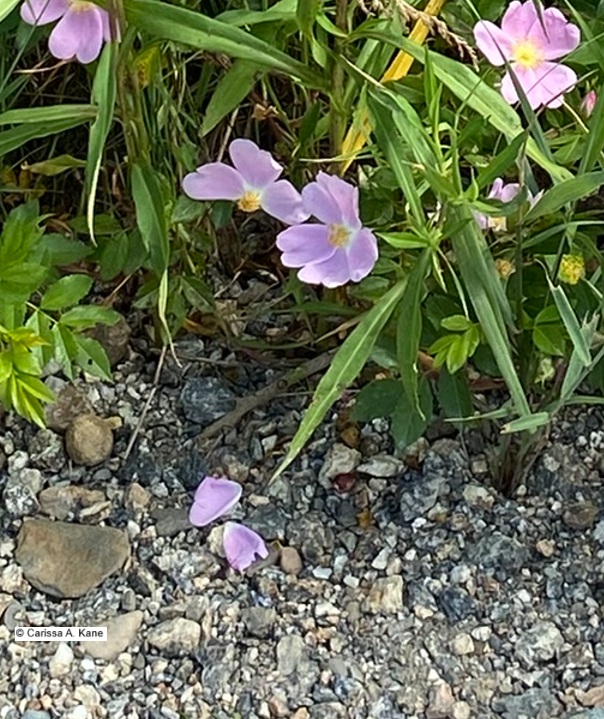
Walking along the path, flowers sprinkled among the greenery on either side bring both brightness and variation to the scene. In the middle, one flower leans toward another as if reaching out to the one looking down at petals lost. Holding on, seeking comfort, seeking peace; providing both to those walking through or passing by.
Stories, so many stories, in the present and in the past. Living, breathing stories, held by many hearts. And then there’s Peace, held within those many stories, seeking hearts to hold them well, souls to glean their wisdom, and bodies with the mind to march peace forward.
Let the peace of Christ control your hearts; let the word of Christ dwell in you richly. – Colossians 3:15a, 16a
In the Gospel passage for the Solemnity of the Most Holy Body and Blood of Christ (Luke 9:11b-17), it is written that as the end of the day is drawing near, Jesus’s disciples go to him with their plan on how to proceed with regards to the crowds who have followed Jesus and his disciples to Bethsaida, a town near the Sea of Galilee, and have witnessed Jesus’s preaching and healing. The disciples say, “Dismiss the crowd so that they can go to the surrounding villages and farms and find lodging and provisions; for we are in a deserted place here.” However, Jesus seems to have other ideas. He responds, “Give them some food yourselves.”
Take a moment to consider how you might receive Jesus’s words in this situation. How might your response vary based on whether you are in a deserted place? What’s it like to consider yourself as part of the solution, no matter where you are?
Next, the disciples focus on what they might do, but recognize it’s not possible for them to do much with what they have:
“Five loaves and two fish are all we have, unless we ourselves go and buy food for all these people.”
Think of a situation where you feel that all you have is not enough to address it. Now, envision Jesus coming into the situation and inviting you to tell him more about it. Start with the words, “All I have is …” Notice what you include (things, people, thoughts, feelings, etc.).
What happens within you as you name what you bring to the situation? How does Jesus receive you and respond?
Now imagine Jesus instructing his disciples, and you, “Have them sit down in groups…”. Then Jesus, with abundant love and patience, turns to you, and tells you more. Pray and converse with Jesus about what this might mean for you and your situation. Share any, and all, thoughts and feelings that arise within you.
In the Gospel passage, after the disciples listened to Jesus and did as he asked, it is written:
“Then taking the five loaves and the two fish, and looking up to heaven, he said the blessing over them, broke them, and gave them to the disciples to set before the crowd. They all ate and were satisfied. And when the leftover fragments were picked up, they filled twelve wicker baskets.”
What’s it like to contemplate the fact that with Jesus, all you have is enough, and can even be more than enough?
Take time today, and throughout the week, to set down whatever is on your plate or is occupying your mind. Then pause and invite Jesus to say the blessing over you and your concerns. Next, allow the peace and wisdom of Jesus, the Bread of Life, to wash over you, and reveal how what you have can meet this moment and the moments ahead, and be more than enough.
I am the living bread that came down from heaven, says the Lord; whoever eats this bread will live forever. – John 6:51









 HopeThatFloats
You must be logged in to post a comment.