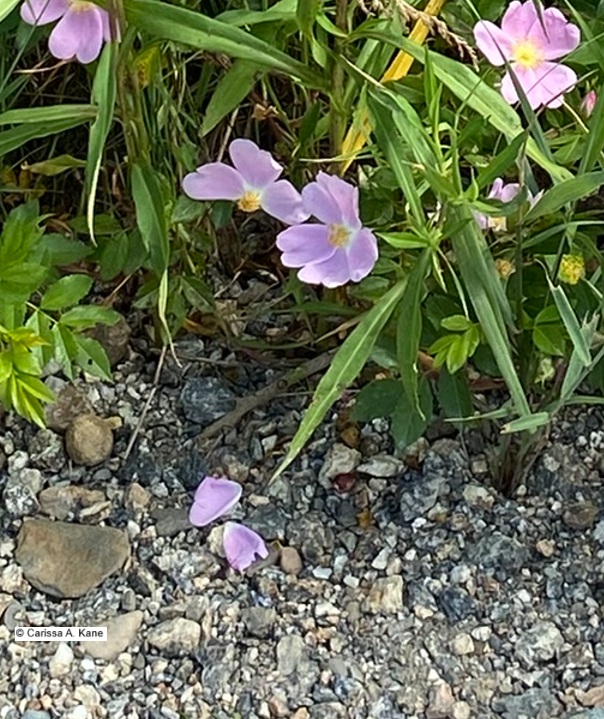
Walking along the path, flowers sprinkled among the greenery on either side bring both brightness and variation to the scene. In the middle, one flower leans toward another as if reaching out to the one looking down at petals lost. Holding on, seeking comfort, seeking peace; providing both to those walking through or passing by.
Stories, so many stories, in the present and in the past. Living, breathing stories, held by many hearts. And then there’s Peace, held within those many stories, seeking hearts to hold them well, souls to glean their wisdom, and bodies with the mind to march peace forward.
Let the peace of Christ control your hearts; let the word of Christ dwell in you richly. – Colossians 3:15a, 16a
In the Gospel passage for the Solemnity of the Most Holy Body and Blood of Christ (Luke 9:11b-17), it is written that as the end of the day is drawing near, Jesus’s disciples go to him with their plan on how to proceed with regards to the crowds who have followed Jesus and his disciples to Bethsaida, a town near the Sea of Galilee, and have witnessed Jesus’s preaching and healing. The disciples say, “Dismiss the crowd so that they can go to the surrounding villages and farms and find lodging and provisions; for we are in a deserted place here.” However, Jesus seems to have other ideas. He responds, “Give them some food yourselves.”
Take a moment to consider how you might receive Jesus’s words in this situation. How might your response vary based on whether you are in a deserted place? What’s it like to consider yourself as part of the solution, no matter where you are?
Next, the disciples focus on what they might do, but recognize it’s not possible for them to do much with what they have:
“Five loaves and two fish are all we have, unless we ourselves go and buy food for all these people.”
Think of a situation where you feel that all you have is not enough to address it. Now, envision Jesus coming into the situation and inviting you to tell him more about it. Start with the words, “All I have is …” Notice what you include (things, people, thoughts, feelings, etc.).
What happens within you as you name what you bring to the situation? How does Jesus receive you and respond?
Now imagine Jesus instructing his disciples, and you, “Have them sit down in groups…”. Then Jesus, with abundant love and patience, turns to you, and tells you more. Pray and converse with Jesus about what this might mean for you and your situation. Share any, and all, thoughts and feelings that arise within you.
In the Gospel passage, after the disciples listened to Jesus and did as he asked, it is written:
“Then taking the five loaves and the two fish, and looking up to heaven, he said the blessing over them, broke them, and gave them to the disciples to set before the crowd. They all ate and were satisfied. And when the leftover fragments were picked up, they filled twelve wicker baskets.”
What’s it like to contemplate the fact that with Jesus, all you have is enough, and can even be more than enough?
Take time today, and throughout the week, to set down whatever is on your plate or is occupying your mind. Then pause and invite Jesus to say the blessing over you and your concerns. Next, allow the peace and wisdom of Jesus, the Bread of Life, to wash over you, and reveal how what you have can meet this moment and the moments ahead, and be more than enough.
I am the living bread that came down from heaven, says the Lord; whoever eats this bread will live forever. – John 6:51
Celebrating the Sixth Sunday of Easter and moving toward the Solemnity of the Ascension of the Lord, the First Reading (Acts 15:1-2, 22-29) begins with:
Some who had come down from Judea were instructing the brothers, “Unless you are circumcised according to the Mosaic practice, you cannot be saved.”
But then after much debate, or “dissension,” Paul, Barnabas, and others go to meet with the apostles and the elders to discuss this issue further. From this, comes:
“It is the decision of the holy Spirit and of us not to place on you any burden beyond these necessities, namely, to abstain from meat sacrificed to idols, from blood, from meats of strangled animals, and from unlawful marriage. If you keep free of these, you will be doing what is right. Farewell.”
This is a great reminder of the need to leave room for the Holy Spirit. It can be tempting to want to understand or “know” something and then to consider it a closed book. Yet here we can see that the Lord’s way calls for openness, flexibility, and trust that the Holy Spirit can lead and guide us toward what is right and just according to God.
In the Second Reading (Revelation 21:10-14,22-23), describes the magnificence and glory of “the holy city of Jerusalem coming down out of heaven from God.” There is a place for every tribe and three gates facing each direction (east, north, south, and west). The foundation, stones representing each apostle of the Lord. Then, the following is written:
“I saw no temple in the city for its temple is the Lord God almighty and the Lamb. The city had no need of sun or moon to shine on it, for the glory of God gave it light, and its lamp was the Lamb.”
Perhaps a prompt, or a gentle nudge to recall, that although the things of earth can at times bring comfort or a sense of security, nothing can surpass the love and protection of God. It’s more than a lifetime guarantee!
The Gospel reading for this Sunday is as follows:
Jesus said to his disciples: “Whoever loves me will keep my word, and my Father will love him, and we will come to him and make our dwelling with him. Whoever does not love me does not keep my words; yet the word you hear is not mine but that of the Father who sent me. I have told you this while I am with you. The Advocate, the Holy Spirit, whom the Father will send in my name, will teach you everything and remind you of all that I told you. Peace I leave with you; my peace I give to you. Not as the world gives do I give it to you. Do not let your hearts be troubled or afraid. You heard me tell you, ‘I am going away and I will come back to you.’ If you loved me, you would rejoice that I am going to the Father; for the Father is greater than I. And now I have told you this before it happens, so that when it happens you may believe.” – John 14:23-29
What thoughts and desires arise within you when you contemplate this passage?
What’s it like when you consider loving the Lord as being equal to keeping the Lord’s word, openness to being taught and reminded of the Lord’s word by the Holy Spirit and receiving the gift of the Peace of Jesus?
Take some time to reflect on your Easter journey thus far, and your relationship with Jesus. How do moments of peace and moments of distance from peace that you’ve experienced differ? And how are you inspired toward greater love and peace through the above Scripture passages and your experience of the risen Lord?
Your Peace, the greatest gift next to Your lasting Love. Exemplar of goodness, kindness… integrity, those wise, could hope to be.
Upon reaching the Fourth Sunday of Advent, tempted to jump ahead or enticed toward being caught up in the final material touches that accompany Christmas and holiday celebrations is not an uncommon place to find oneself. Between day-in-day-day-out responsibilities and all that comes with the holidays, it can be hard to juggle all the things that call or try to call one’s attention at this time of year. However, taking some time to consider and pray with your desire for experiencing the peace and joy of this holy season as well as God’s desire for you, and then taking even just a few moments here and there throughout the coming week(s) can make a big difference.
At this time of year, it may seem like things, whether gifts, gestures, or responses, need to big, or bigger, or not at all. Yet, looking the readings for today (Micah 5:1-4a; Psalm 80:2-3, 15-16, 18-19; Hebrews 10:5-10; and Luke 1:39-45), they are a reminder of the most important part of all—the Source of peace and joy. And perhaps they can also be seen as an invitation to take notice of the source of one’s motivation and the state of one’s heart.
From the Book of Micah, we read:
“But you, Bethlehem-Ephrathah least among the clans of Judah, from you shall come forth for me one who is to be ruler in Israel; whose origin is from of old, from ancient times.” – Micah 5:1
When thinking of a ruler or a king, it’s natural to think in terms of grandeur. And in general, it seems human nature to be attracted to that which is, in some way, big, bright, or shiny. It’s easier to notice or pay attention to things that are “in your face” so to speak. Yet, the Prince of Peace is to come from the least among Judah’s clans.
In what ways are you open to the unexpected throughout the holidays? How do you desire to receive them as well as to recognize beauty and grandeur in both the big and the smaller moments?
The response for the Psalm is:
“Lord, make us turn to you; let us see your face and we shall be saved.” – Psalm 80:4
Take some time to reflect on, and pray with, the ways that the Lord restores, renews, and refreshes you. As you think about the coming week and the continuing holiday season, what are the places or situations where you might feel hesitant, anxious, or less inclined toward? Invite Jesus into these spaces and allow your heart and mind to be open to the direction toward which the Lord wishes to inspire you.
In the Letter to the Hebrews, St. Paul writes:
When Christ came into the world, he said: “Sacrifice and offering you did not desire, but a body you prepared for me; in holocausts and sin offerings you took no delight. Then I said, ‘As is written of me in the scroll, behold, I come to do your will, O God.’” – Hebrews 10:5-7
And in the Gospel according to Luke, Elizabeth is described as being “filled with the Holy Spirit” as she cries out:
“Blessed are you among women, and blessed is the fruit of your womb. And how does this happen to me, that the mother of my Lord should come to me? For at the moment the sound of your greeting reached my ears, the infant in my womb leaped for joy. Blessed are you who believed that what was spoken to you by the Lord would be fulfilled.” – Luke 1:42-45
What are some of the ways that the Holy Spirit has guided or enlightened you along the way this year?
Remembering that Mary has come to see Elizabeth after being visited by the Angel, Gabriel, and having responded yes to God’s will, what’s it like when you contemplate how the way that Mary responds—her will embracing God’s will and the two becoming One—extends beyond her and impacts others?
How are you affected or inspired by the notion that God’s will for Mary, is also God’s will for humanity?
Behold, I am the handmaid of the Lord. May it be done to me according to your word. – Luke 1:38
The Season of Advent and its related Scripture remind us of the twists and turns that life can take for anyone. They also provide an opportunity to see the faithfulness and goodness of God. In addition, they exemplify how being faithful to God involves being open to ways or paths that may differ, sometimes greatly, from the ones we may have planned or imagined for ourselves.
Take some time to think about what it has been like in the past for you to accept or make changes to the plans, ideas, and/or notions you have envisioned. What is it like in the present?
We all have things we would like to accomplish and look for ways, or paths, to do so. However, in proceeding in earnest and with good intentions as we strive, we can become mixed up when we don’t leave room for, can’t see, or are not open to the possibility of change(s) as being needed and for the better good. So when the twists and turns come, we can become even more attached to our own intentions and the ways we planned to accomplish them, instead of allowing the grace of God to help us to be open to making an adjustment or being open to a different way.
Sometimes, interference and the unexpected can push our buttons in ways that can make us behave as less than what we are… what we were created to be—beings in the image of God. When this happens, we can lose sight of the wideness of God, and the depth of God’s love, compassion, and mercy.
What are some memories you have of times when you met change, unexpected challenges, and/or uncertainty with a quiet calmness? How do those times compare to ones where, perhaps, quiet calmness and peace gave way to unrest?
Stand with the Lord at the threshold between the times of peace and the times of unrest that you’ve recalled. Ask Jesus to unveil the place(s) where maybe you couldn’t sense his presence or take direction, as well as the place(s) where you could. Express to the Lord your gratitude and your desire to remember whatever he wants you to hold onto from these instances as you enter the Advent Season and look to prepare for Christmas.
Make known to me your ways, Lord; teach me your paths. – Psalm 25:4
In the Gospel passage for the Thirty-third Sunday in Ordinary Time (Mark 13:24-32), Jesus says, “Learn a lesson from the fig tree. When its branch becomes tender and sprouts leaves, you know that summer is near.” (v. 24). These words are part of his response to a question asked of him by the disciples, Peter, James, John, and Andrew.
Away from the others, and just after Jesus commented to his disciples on the destruction of the temple, they had asked him, “Tell us, when will this happen, and what sign will there be when all these things are about to come to an end?” (Mark 13:4). The first thing that Jesus says to them is, “See that no one deceives you.” (Mk 13:5). As he continues to tell them the signs and what will happen (trials and tribulations such as war, persecutions, etc.), he also continues to give them instructions as to how to handle themselves and the situations they will face. He says:
“… do not be alarmed” (v. 7)
“Watch out for yourselves.” or be aware (v. 9)
“… do not worry beforehand about what you are to say. But say whatever will be given to you at that hour. For it will not be you who are speaking but the holy Spirit.” (v. 11)
“Be watchful!” (v. 23)
Then he says these words that are part of the Gospel for today, “Learn a lesson from the fig tree. When its branch becomes tender and sprouts leaves, you know that summer is near.” (v. 28). And although Jesus says this as he continues to tell Peter, James, John, and Andrew about the signs that will occur at the end times, the gospel passage ends with Jesus saying, “But of that day or hour, no one knows, neither the angels in heaven, nor the Son, but only the Father.” (v. 32). In other words, perhaps Jesus is reminding us not to focus on the signs, but rather to focus on his instructions.
His last instruction, “Learn a lesson from the fig tree,” is intriguing. In chapter 11 of Mark’s Gospel, Jesus curses a fig tree for being fruitless:
“The next day as they were leaving Bethany he was hungry. Seeing from a distance a fig tree in leaf, he went over to see if he could find anything on it. When he reached it he found nothing but leaves; it was not the time for figs. And he said to it in reply, ‘May no one ever eat of your fruit again!’ And his disciples heard it.” (Mark 11:12-14).
In this earlier passage, there is a mention of time, “… it was not the time for figs.” And now, when Jesus is telling some of his disciples about the signs of the end times and instructing them on how to be prepared, he again, refers to figs and time (and not knowing the exact time of the end).
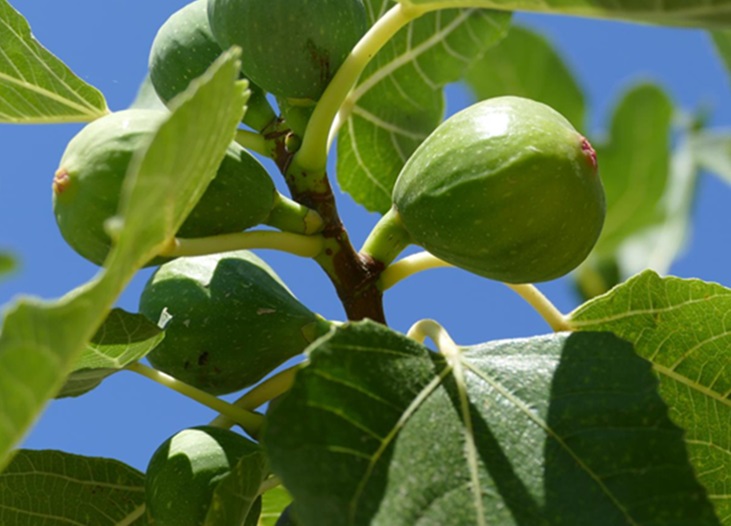
A few interesting things about figs and time… Fig trees, like other fruit trees, have leaves, but unlike other fruit trees, their fruit flowers internally. Also, each fig contains a collection of many flowers and seeds. And while one may think of a fig as a piece of fruit, they are actually an infructescence—a multiple fruit—that in a sense, is always in the process of blooming.
So, in both times of uncertainty and times of comfort, see that no one deceives you, do not worry, and learn from the fig tree, continuing to grow from within, knowing that the fruit will come at the time that is appointed.
“Lord, my allotted portion and my cup, you have made my destiny secure.” – Psalm 16:5
From where chaos comes, Base passion and design, Stirring ill will, division, Seeds sowing lies. Looking, always looking, To seep and settle in.
From where chaos spreads, Human passions and designs, From what we, as masters, embrace, What we give into, And what we withstand.
From where peace comes, Divine passion and design. Love weaving in and out, Through time and space. Ushering good tidings, Encouraging good will.
From where peace spreads, Human passions and designs, From what we, as servants, embrace, What we give into, And what we withstand.
“Until he extends his circle of compassion to include all living things, man will not himself find peace.” – Albert Schweitzer
For where jealousy and selfish ambition exist, there is disorder and every foul practice. But the wisdom from above is first of all pure, then peaceable, gentle, compliant, full of mercy and good fruits, without inconstancy or insincerity. And the fruit of righteousness is sown in peace for those who cultivate peace. – James 3:16-18
What’s known, And what is not. Calculating possibilities.
Looking then leaping, A snapshot in time. Measuring risk, and seeking reward.
Guarantees, Warranties, Yet, nothing is certain.
The seeker being sought, The Sought, searching seekers. Meeting up, teeing up, And, finding what is lost.
“…to live in a manner worthy of the call you have received, with all humility and gentleness, with patience, bearing with one another through love, striving to preserve the unity of the spirit through the bond of peace…” – Ephesians 4:1-3








You must be logged in to post a comment.