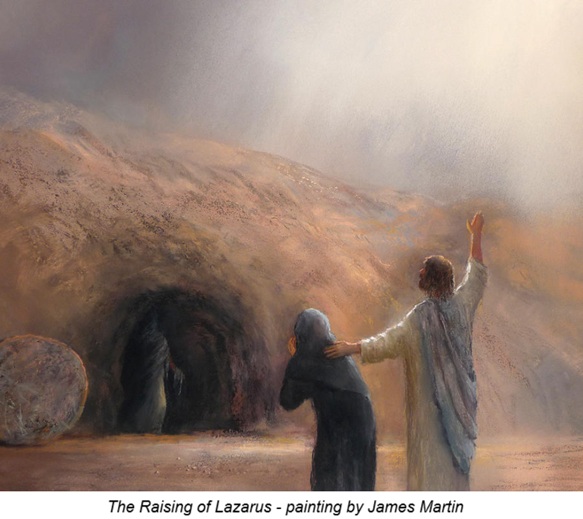
The Raising of Lazarus

The Hope that Raises and Restores…

Approaching the Fifth Sunday of Lent, take a moment to consider the past few weeks and the times you have felt closest to the Lord as well as those times you have felt distanced. Of the situations that come to mind, what jumps out the most in terms of the characteristics of the Lord that you experienced and the ones that, in hindsight, you may have been seeking without knowing it at the time? Take what you notice to prayer, trusting that although the time has passed, conversation with the Lord can still bear fruit, providing insight, wisdom, and whatever else you may need at this moment, and going forward.

As you prepare to consider the readings for this Sunday, invite the Lord to continue the conversation and time together.

In the First Reading from Ezekiel 37:12-14, we have the ending verses of a section referred to as “Vision of the Dry Bones”. The passage is a conversation between the prophet and the Lord where the dry bones are likened to the loss of hope in the Lord, and Ezekiel is instructed as to what he is to tell to the people. As Ezekiel follows each of the Lord’s directives, the vision moves toward the bones being restored to life.

The directives to the dry bones spoken by the prophet are in Word:

“Dry bones, hear the word of the Lord!” (v. 4);

and Spirit:

“Listen! I will make breath enter you so you may come to life.” (v. 5).

The dry bones come to life and the Lord says to Ezekiel: “They are saying, ‘Our bones are dried up, our hope is lost, and we are cut off.’” (v.11)

This is where the First Reading starts. The Lord further instructs Ezekiel, giving him the words to address the need for restoration/renewal, hope, and connection.

Among the words of the Lord, in these verses, to be prophesied are:

“I will put my spirit in you that you may come to life, and I will settle you in your land. Then you shall know that I am the Lord. I have spoken; I will do it” (v. 14)

How are your mind and your heart touched by the words and imagery in this passage? Share what you think and feel at this moment with the Lord. Ask the Lord for openness to receiving his insights about restoration, renewal, hope, and/or connection in your life, your community, and the world at large.

Continuing to stay with the conversation, consider the response to the Psalm, “With the Lord there is mercy and fullness of redemption.” (Psalm 130:7). What are a few ways that you have received the Lord’s mercy and a sense of redemption? How do you feel as you recall those times? In what ways might they instill greater hope in you or inspire you today?

In the Second Reading (Romans 8:8-11), part of what St. Paul writes to the Romans is:

“But you are not in the flesh; on the contrary, you are in the spirit, if only the Spirit of God dwells in you. Whoever does not have the Spirit of Christ does not belong to him. But if Christ is in you, although the body is dead because of sin, the spirit is alive because of righteousness.” – v. 9-10

How do you desire for the Spirit of God, that dwells in you, to be with you and to help you to not only hold onto and connect to, but to also be energized by and to be a reflection of the Lord’s mercy, hope, and inspiration? Share with the Lord whatever is in your heart at this time. Also, take time to allow the Lord to reveal what’s on his heart.

The following verses are an excerpt from the Gospel Reading (John 11:1-45):

Jesus said, “Take away the stone.”
Martha, the dead man’s sister, said to him,
“Lord, by now there will be a stench;
he has been dead for four days.”
Jesus said to her,
“Did I not tell you that if you believe
you will see the glory of God?”
So they took away the stone.
And Jesus raised his eyes and said,
“Father, I thank you for hearing me.
I know that you always hear me;
but because of the crowd here I have said this,
that they may believe that you sent me.”
And when he had said this,
He cried out in a loud voice,
“Lazarus, come out!”
The dead man came out,
tied hand and foot with burial bands,
and his face was wrapped in a cloth.
So Jesus said to them,
“Untie him and let him go.”
Now many of the Jews who had come to Mary
and seen what he had done began to believe in him. – John 11:39-44

Contemplating this passage in the light of your prayers, conversation with the Lord, and what you noticed from the prior readings above, what is the stone that Jesus wants to take away? In what ways might Jesus want you to “untie” and “let go”?

As you pray with this, ask for openness to the Lord’s guidance and for whatever you feel you need to hear the Word of God, to listen, and to receive the Spirit of God. What does the Lord desire for you so that the goodness that dwells within you, continues to sustain you, your hope in the Lord, and extends to others.
The Raising of Lazarus

I am the resurrection and the life; whoever believes in me, even if he dies, will live, and everyone who lives and believes in me will never die. Do you believe this? – John 11:25-26

Beyond What’s Readily Visible…

As we reach Laetare (“rejoice”) Sunday, the thought of rejoicing during a time of such unrest, outright war, and great concern throughout the world can seem so far away and of another world. However, isn’t that part of what faith is all about? Trusting that there is something more. Placing our hope in the One who hears our cries, lifts us up, and gives us guidance and strength as we strive for eternal life. Rejoicing in the Lord who, without fail, is with us.

Take some time to think about what you’re grateful for and to remember the ways in which you have been blessed by the Lord. Then, inspired by the Lord’s faithfulness, pray for whatever enters your mind and heart, knowing that you are praying to the Lord for whom nothing is impossible.

Continuing on, be mindful of the Lord who is ever present and loves us unconditionally as we look at the readings for the Fourth Sunday of Lent.

In the First Reading (1 Samuel 16:1b, 6-7, 10-13a), the Lord sends Samuel to Bethlehem to anoint David king. When Samuel arrives in Bethlehem all he knows is that one of Jesse’s sons is to be anointed and that the Lord will help him to know which one. As soon as Samuel sees the first son, Eliab, he assumes this is the one to be anointed. However, Eliab is not the one.

“But the Lord said to Samuel: Do not judge from his appearance or from his lofty stature, because I have rejected him. God does not see as a mortal, who sees the appearance. The Lord looks into the heart.” – v. 7

What have you been holding in your heart this past week? What about today? What do you imagine is on God’s heart?

As the reading continues, the remaining sons of Jesse are then presented to Samuel, but none of them are the one that he was sent to anoint. This leads Samuel to ask Jesse if he has any other sons. Jesse reveals that there is another son and then sends for David, his youngest, at Samuel’s instruction. Sure enough, David is the one whom the Lord has chosen.

At first sight, Samuel was certain that Eliab had to be the one the Lord had chosen. Yet, in the end, the son the Lord had chosen wasn’t present and had to be sent for. Imagine how unexpected going through the seven sons who were present and not being told, “this is the one,” must have been for Samuel. What do you think led him to ask Jesse if he had any other sons?

What kinds of things do you notice at first sight? How do you experience the unexpected? In what ways do you sense or seek the Lord’s presence in what you notice? In the unexpected?

The Psalm for Laetare Sunday is the following:

The Lord is my shepherd; I shall not want.
In verdant pastures he gives me repose;
beside restful waters he leads me;
he refreshes my soul.
He guides me in right paths
for his name’s sake.
Even though I walk in the dark valley
I fear no evil; for you are at my side
With your rod and your staff
that give me courage.
You spread the table before me
in the sight of my foes;
you anoint my head with oil;
my cup overflows.
Only goodness and kindness follow me
all the days of my life;
and I shall dwell in the house of the Lord
for years to come. – Psalm 23: 1-6

Reflecting on the characteristics of the Lord that are expressed in the Psalm, in what way do you most need the Lord to shepherd you today?

Turning to the Second Reading, it is written:

You were once darkness,
but now you are light in the Lord.
Live as children of light,
for light produces every kind of goodness
and righteousness and truth.
Try to learn what is pleasing to the Lord.
Take no part in the fruitless works of darkness;
rather expose them, for it is shameful even to mention
the things done by them in secret;
but everything exposed by the light becomes visible,
for everything that becomes visible is light.
Therefore, it says:
“Awake, O sleeper,
and arise from the dead,
and Christ will give you light.” – Ephesians 5:8-14

Allow yourself to envision being enveloped in the light of the Lord. As you take in the goodness of the Lord, your heart becomes full of peace, love, and hope. How do you desire to respond? How does the Lord envision you as an extension of God’s peace, love, and hope?

The Gospel passage is John 9:1-41, The Man Born Blind. Read this passage from your Bible.

What part(s) of this passage resonated with you most? What part(s) surprised you or struck you differently than in the past? How does what you noticed or what’s being stirred within you relate to what’s in your heart and what’s weighing on your heart?

What insight does the Lord want to share with you so that you are better able to consider what’s beyond visible and to see more and more with the eyes of your God-given heart?


I am the light of the world, says the Lord;
whoever follows me will have the light of life. – John 8:12

Sunset

And When They Raised Their Eyes…

Late afternoon the other day as sunset was moving in, the sky displayed a beautiful spread of colors in between the homes and trees, utility poles and power lines. Through all the obstacles intruding on the view, there was light, not only persevering, but also bringing hope, showing up in shades of glory, working among its surroundings, in a most remarkable way.

When was the last time your attention was caught by light? Recall where you were and what was happening at the time. How were your heart and mind stirred by the experience? As you remember it, how are you touched by it today?

The following verses from the Gospel reading for the Second Sunday of Lent (Matthew 17:1-9) come after Peter, James, and John witness the Transfiguration of Jesus. The three disciples saw remarkable light as they watched Jesus, transfigured, speaking with the prophets, Moses and Elijah. Peter is all about wanting to build three tents at the site—one each for Jesus, Moses, and Elijah.

Take some time to consider what you seek to preserve and what kinds of things lead you to a sense of reverence or admiration?

While he was still speaking, behold,
a bright cloud cast a shadow over them,
then from the cloud came a voice that said,
“This is my beloved Son, with whom I am well pleased;
listen to him.”
When the disciples heard this, they fell prostrate
and were very much afraid. – v. 5-6

Envision yourself on the mountain alongside the three disciples. Like them, you hear the voice and fall to the ground, face down in fear. In that moment, it’s as if you’re alone. But then, Jesus puts his hand on your shoulder and says, “Rise, and do not be afraid.” (v. 7). You lift your head and the first thing you see, are Jesus’s eyes, tenderly looking into your eyes. You reach for and grab his hand as he helps you to stand up. Next, the two of you sit down, and Jesus asks you to tell him what you are afraid of, what is weighing on you or puts your gaze down toward the ground. What do you say? And how does Jesus respond?

What do you need from Jesus to continue raising your eyes toward Him?

Continue the conversation, taking time to reveal what’s on your heart and pausing to really listen to what Jesus wants you to know. When this exchange with Jesus feels complete, allow for some words or a gesture between you and Jesus as you prepare to rejoin the disciples for the trek back down the mountain.

What does Jesus want you to carry with you or to remember most at this moment?

Sunset

And when the disciples raised their eyes, they saw no one else but Jesus alone. – Matthew 17:8

The sun rising over the top of darkness created by trees

Pray…

If this, then that permeates across all spaces,
Creating fear, stirring up all kinds of notions,
Extracting excuses, and some hare-brained ideas,
Running roughshod, shredding norms, raging all about.
That mirror on the wall? It’s turning, twisting,
And swiftly rotting away from the inside out.
Say, who’s the Lear-est?, “What can you do for me-man”?

Stop running every which way, but right side up.
Pause. Take a minute and step away. Make a change.
Seek Grace. Take it in. Soak it up. Receive the gift.
In a world traditionally conditional,
Only unconditional love, honest and true,
Steadies steps, bridges gaps, raises strength for the day,
making whole whatever’s fractured, broken, or faux.

The sun rising over the top of darkness created by trees

It is written: “The Lord, your God, shall you worship and him alone shall you serve.” – Matthew 4:10

Path leading toward waterfall

Following Faithfully…

Beating still, beating quietly, beating nonetheless,
Attention becomes the disciple of intention.
A stir within, roars within, formation from within.
Look and listen closely as true passion is revealed.

Following the leader? Where? To what good do they lead?
Igniting hearts? Uniting hearts? On whose behalf?
All hearts can and must choose for whom and for what they burn.
Discern! Discern! Deception has so many voices.

Does the message uplift all of us, like the true one
Who gracefully overcomes the small, in all of us,
Helping the steadfast to be ready, set, and to ask,
How does this represent the good teacher serving all?

Path leading toward waterfall

The Lord keeps faith forever,
secures justice for the oppressed,
gives food to the hungry.
The Lord sets captives free.
The Lord gives sight to the blind;
the Lord raises up those who were bowed down.
The Lord loves the just;
the Lord protects strangers.
The fatherless and the widow the Lord sustains,
but the way of the wicked he thwarts.
The Lord shall reign forever;
your God, O Zion, through all generations. Alleluia. – Psalm 146:6-10

From the heart of God

To those who accepted Him…

In the Gospel passage for the Second Sunday in Ordinary Time, John the Baptist gives witness, or testimony, to Jesus being the Son of God.

John the Baptist saw Jesus coming toward him and said,
“Behold, the Lamb of God, who takes away the sin of the world.
He is the one of whom I said,
‘A man is coming after me who ranks ahead of me
because he existed before me.’
I did not know him,
but the reason why I came baptizing with water
was that he might be made known to Israel.”
John testified further, saying,
“I saw the Spirit come down like a dove from heaven
and remain upon him.
I did not know him,
but the one who sent me to baptize with water told me,
‘On whomever you see the Spirit come down and remain,
he is the one who will baptize with the Holy Spirit.’
Now I have seen and testified that he is the Son of God.” – John 1:29-34

Notice how the passage starts with Jesus coming toward John and John, seeing Him, stating what he has come to know—Jesus is the Son of God. John doesn’t just make this statement or claim, out of thin air. The day before, as written in the previous verses of this Gospel, he was asked who he is, to which he responds, “I am ‘the voice of one crying out in the desert, ‘Make straight the way of the Lord,’ as Isaiah the prophet said.” (John 1:23). He continues, explaining to the priests, Levites, and Pharisees sent to question him that he is not the Messiah. John knows his God-given role and accepts it.

Praying with and reflecting on this passage, what have you come to know about your God-given role, and how does the grace of God reaffirm you in it, and help you to accept and live it out?

Contemplating John’s explanation of how he has come to know that Jesus is the Messiah, what do you make of John saying twice in this passage, “I did not know him”? What strikes you about the words that follow each, “I did not know him”?

I did not know him,
but the reason why I came baptizing with water
was that he might be made known to Israel.”
John testified further, saying,
“I saw the Spirit come down like a dove from heaven
and remain upon him.
I did not know him,
but the one who sent me to baptize with water told me,
‘On whomever you see the Spirit come down and remain,
he is the one who will baptize with the Holy Spirit.’

When you find yourself in a situation of not knowing, how do your instincts and what you know come together with, and make room for, God’s wisdom? How about when you find yourself in a situation where you think, or are sure, that you know?

The Gospel passage ends with John saying, “Now I have seen and testified that he is the Son of God.” Recount whatever comes to mind about what you have seen or experienced that is of God, and how you have come to know.

What is your testimony to God? (Keep in mind that there are many ways in which testimony can be given to God.) How do you desire to give witness to what you have come to know?

From the heart of God

Here am I, Lord; I come to do your will. – Psalm 40: 8a, 9a

Strands of lights rising up from the snow at night.

Bound for the Greater Good…

The Baptism of the Lord in the Gospel according to Matthew describes an interaction between Jesus and John the Baptist. John is a prophet who has his own disciples, and of whom it is written, “At that time Jerusalem, all Judea, and the whole region around the Jordan were going out to him and were being baptized by him in the Jordan River as they acknowledged their sins.” (Matthew 3:5-6). And Jesus is the Christ, the Anointed one, of whom John said, “the one who is coming after me is mightier than I. I am not worthy to carry his sandals. He will baptize you with the holy Spirit and fire.” (Matthew 3:11). Yet, as it is written, they meet and engage with each other without pretense or posturing.

Read and reflect on the Gospel passage for the Baptism of the Lord (below), receiving it as an invitation to prayerfully consider human interactions, both your own and those that you witness. Ask the Lord for insight and wisdom as you do so.

Jesus came from Galilee to John at the Jordan
to be baptized by him.
John tried to prevent him, saying,
“I need to be baptized by you,
and yet you are coming to me?”
Jesus said to him in reply,
“Allow it now, for thus it is fitting for us
to fulfill all righteousness.”
Then he allowed him.
After Jesus was baptized,
he came up from the water and behold,
the heavens were opened for him,
and he saw the Spirit of God descending like a dove
and coming upon him.
And a voice came from the heavens, saying,
“This is my beloved Son, with whom I am well pleased.” –
Matthew 3:13-17

What divine qualities do the words and actions of John the Baptist and Jesus exemplify in this exchange? What strikes you most?

Next, put yourself in John’s shoes as the prophet of whom it is written, “A voice proclaims: In the wilderness prepare the way of the Lord! Make straight in the wasteland a highway for our God!” (Isaiah 40:3). What’s it like to encounter Jesus, knowing that He is the one of whom you’ve been preaching and waiting for? and knowing that it is time for you to step back while He steps forward? What thoughts and feelings arise when you envision saying to Jesus, “I need to be baptized by you” and he replies, “Allow it now. For thus it is fitting for us to fulfill all righteousness”?

Now, ask Jesus to help you to envision His experience in this passage. In what ways might His perspective enlighten your interactions and/or assessments of interactions to which you have been a witness?

How might you be inspired by the example of Jesus and John the Baptist in interactions and when you encounter something or someone known, new, or different?

Strands of lights rising up from the snow at night.

“You are sent into this world to believe in yourself as God’s chosen one and then to help your brothers and sisters know that they are also beloved sons and daughters of God who belong together. You’re sent into this world to be a people of reconciliation. You are sent to heal, to break down the walls between you and your neighbors, locally, nationally, and globally. Before all distinctions, the separations, and the walls built on foundations of fear, there was a unity in the mind and heart of God. Out of that unity, you are sent into this world for a little while to claim that you and every other human being belongs to the same God of Love who lives from eternity to eternity.” – Henri Nouwen

Christmas Lighted gardens

Homage…

Each year, again, we seek
something more, something new.
Building up. Tearing down.
Holding more than our own
as Glory Be’s to You.

Drawing lines in the sand,
fast and loose with quick claims,
Quit it. Learn a new beat.
Reverence, deference,
in honor of what/who?

Big? Bold? Leaves love to die,
but Love, ever faithful,
with us always, urging
mercy, peace, and goodwill,
for all, not just the few.

Christmas Lighted gardens

We saw his star at its rising and have come to do him homage. – Matthew 2:2

His Warmth…

Although the colder air that accompanies this time of year in the Northeast can be quite refreshing, after some time, it can leave one wanting for the warmth of shelter, a soft blanket, or hot beverage to offset the chill.

In the Gospel passage for the Fourth Sunday of Advent (Matthew 1:18-24), we learn about the warmth of St. Joseph’s response to his betrothed, with whom he had not yet lived or had relations with, being pregnant. Imagine the response, gossip, or chill in the air, created by those around Mary and Joseph. Yet, even before his dream in which the Lord appeared, reassuring him of Mary’s faithfulness, Joseph had decided to respond in a way that was filled with warmth, gentleness, and mercy:

This is how the birth of Jesus Christ came about.
When his mother Mary was betrothed to Joseph,
but before they lived together,
she was found with child through the Holy Spirit.
Joseph her husband, since he was a righteous man,
yet unwilling to expose her to shame,
decided to divorce her quietly. –
v. 18-19

Envision yourself in Joseph’s shoes. He is described here as being righteous. What do you make of his initial decision to quietly divorce?

Reflecting on situations that are on your mind and in your heart, how do you seek righteousness? What does it look like? And what qualities does it manifest?

As the Gospel passage continues, Joseph has a dream in which the Lord visits him.

“Joseph, son of David,
do not be afraid to take Mary your wife into your home.
For it is through the Holy Spirit
that this child has been conceived in her.
She will bear a son and you are to name him Jesus,
because he will save his people from their sins.” –
v. 20-21

Recall a time when you had made a decision and then something occurred that reaffirmed your decision or created a new sense of the situation. What happened? What were you praying for, and how did things turn out? How were you saved or blessed? What was the warmth of God like?

Invite the Lord to revisit this with you. What grace from this experience awaits you today?

Spend some time contemplating the verses below and noticing what word, phrase, or image speaks to your heart most:

All this took place to fulfill what the Lord had said through the prophet:
Behold, the virgin shall conceive and bear a son,
and they shall name him Emmanuel,
which means “God is with us.” –
v. 22-23

Continuing to pray with what caught your attention, ask the Lord to grant you insight so that you may see, or have a greater sense of, “God is with us.”

Before ending this prayer time, return to the image of St. Joseph.

When Joseph awoke,
he did as the angel of the Lord had commanded him
and took his wife into his home. –
v. 24

As you strive to be faithful to God, what inspires you? What do you need from the Lord to draw comfort and strength from Him, as you journey through your days, while also reflecting the warmth of His presence.

Let the Lord enter; he is king of glory. – Psalm 24:7c,10b

A heart with a white center

What are you looking for…

With the news of yet another mass shooting in the United States along with violence and conflict around the world, on top of any personal challenges, from which no one is spared, a sense of doom or a feeling of imprisonment can hang in the air and weigh on one’s heart and mind. Yet, as we enter the Third Week of Advent, Gaudete (Rejoice) Sunday, our faith encourages us to remain a people of hope, holding firm to the Lord, and continuing to strive to be living testaments to the Way, knowing that there is something greater, and that God is with us.

In today’s Gospel (Matthew 11:2-11), it is written:

“Are you the one who is to come, or should we look for another?” – v. 3

This is the question that an imprisoned John the Baptist, having heard about “the works of the Christ,” (v.2) had his disciples ask Jesus.

With the events occurring around you, and in the world today, what are you looking for?

Taking a step back, in the First Reading (Isaiah 35:1-6a, 10), it is written:

Strengthen the hands that are feeble,
make firm the knees that are weak,
say to those whose hearts are frightened:
Be strong, fear not!
Here is your God,
he comes with vindication;
with divine recompense
he comes to save you.
– Isaiah 35:3-4

Spend some time recalling some of the ways that you have been strengthened by the Lord. What happens as you allow yourself to remember?

Read aloud today’s Psalm (146:6-10):

The Lord God keeps faith forever,
secures justice for the oppressed,
gives food to the hungry.
The Lord sets captives free.
The Lord gives sight to the blind;
the Lord raises up those who were bowed down.
The Lord loves the just;
the Lord protects strangers.
The fatherless and the widow he sustains,
but the way of the wicked he thwarts.
The Lord shall reign forever;
your God, O Zion, through all generations.

Reflecting on the qualities of God expressed in the Psalm, bring forth your own petitions, praying for the cares and concerns that are pulling at your heart at this time. Following each one, say the response, “Lord, come and save us.”

In the Letter of Saint James, from today’s Second Reading, it is written:

Be patient, brothers and sisters,
until the coming of the Lord.
See how the farmer waits for the precious fruit of the earth,
being patient with it
until it receives the early and the late rains.
You too must be patient.
Make your hearts firm,
because the coming of the Lord is at hand.
Do not complain, brothers and sisters, about one another,
that you may not be judged.
Behold, the Judge is standing before the gates.
Take as an example of hardship and patience, brothers and sisters,
the prophets who spoke in the name of the Lord.
– James 5:7-10

Share with Jesus, the ways or situations in which you are feeling challenged when it comes to patience, complaining/criticizing, and/or a heart firm in the Lord. Allow Jesus to impart his wisdom regarding this.

When you are ready for this prayer period to come to a close, offer an expression of gratitude, and ask the Lord to help you to draw inspiration from the experiences recalled and the insights gained during your prayer.

A heart with a white center

Lord, help me to discern what’s important as I face the moments before me today, and in the days to come. Help my choices to reflect your goodness, and my prayers to reflect your heart.