The readings for the Fifth Sunday in Ordinary Time begin with a passage from the Book of Job where the subject, Job, continues to express dissatisfaction as he tries to come to terms with, and understand the reason for, the trials and tribulations he is and has been experiencing.
Job spoke, saying: Is not man’s life on earth a drudgery? Are not his days those of hirelings? He is a slave who longs for the shade, a hireling who waits for his wages. So I have been assigned months of misery, and troubled nights have been allotted to me. If in bed I say, “When shall I arise?” then the night drags on; I am filled with restlessness until the dawn. My days are swifter than a weaver’s shuttle; they come to an end without hope. Remember that my life is like the wind; I shall not see happiness again. – Job 7: 1-4, 6-7
Thinking about this passage, what resonates with you most? How do you feel about Job’s plight and about God’s role in it?
Recall a time when you felt challenged, and your faith tested. In what ways was God present to you, even if you were not aware or able to name God’s presence as such at that time? What would you say it was about that experience that affected your faith or trust in God? Take some time to share with God what’s on your mind and in your heart at this moment.
The response for the Responsorial Psalm this Sunday is, “Praise the Lord, who heals the brokenhearted.” (Psalm 147 cf. 3a). We all experience heartache and heartbreak as we journey through life. What situation in your life is outright disturbing your heart or creating a sense of unrest or uneasiness? What do you desire from God regarding this situation? What might God want you to know or to consider? In what ways can you envision this situation as an opportunity to deepen your faith and relationship with God?
In the First Letter of St. Paul to the Corinthians, verse 22 of chapter 9, we read, “To the weak I became weak, to win over the weak. I have become all things to all, to save at least some.” What’s it like to consider this, in light of today’s world, as an invitation to getting along in service to God and for the sake of being a living testament to the Gospel? Sticking with this, what would you want to ask St. Paul about this passage and the challenges he faced? What do you need from God as you strive to be a disciple of Jesus in today’s world? Pray for God’s desire for you, in terms of how you navigate the division and issues in today’s world, to be placed in your heart, imparting wisdom throughout each day.
Next, as we move to the Gospel passage for the Fifth Sunday in Ordinary Time (Mark 1:29-39), we have Jesus’ healing Simon’s mother-in-law as well as a multitude of people. Upon being healed, Simon’s mother-in-law gets back to the business of serving others. We also learn that Jesus separates from the crowd to go pray. Once he is found, Jesus gets back to the business of preaching and healing people as he moves on to the neighboring villages. Take time to contemplate this passage in terms of the necessity of prayer and downtime or time away. What happens when there is an interruption in your routine? In what ways are you open to change? How do you experience the dynamic nature of God through interruptions and changes around you?
“In Christianity, God is not a static thing—not even a person—but a dynamic, pulsating activity, a life, almost a kind of drama. Almost, if you will not think me irreverent, a kind of dance.” – C.S. Lewis
First there was one deer, nibbling on a nearby plant. Then surveying the yard, another on the other side. Finally, there appeared two more, subtly joining in from the woods behind. Gently they made their way around the yard, pausing at the slightest of noises to look around and assess their surroundings, their sense of being too. Discerning between the sights and sounds their eyes and ears receive, responding in ways both wise and worthy. Standing still in the face of sounds both soft and firm, but kind, while retreating from those loud and harsh, and well, unbridled. Their awareness so keen, their dignity unwavering, and their presence so peaceful. Life listening and living Life at its fullest—Spirit meeting spirit, Spirit leading spirit.
How do you receive and listen to the noises around you and across the world? How or by what are your reactions and responses inspired?
Samuel was sleeping in the temple of the Lord where the ark of God was. The Lord called to Samuel, who answered, “Here I am.” Samuel ran to Eli and said, “Here I am. You called me.” “I did not call you,” Eli said. “Go back to sleep.” So he went back to sleep. Again the Lord called Samuel, who rose and went to Eli. “Here I am,” he said. “You called me.” But Eli answered, “I did not call you, my son. Go back to sleep.”
At that time Samuel was not familiar with the Lord, because the Lord had not revealed anything to him as yet. The Lord called Samuel again, for the third time. Getting up and going to Eli, he said, “Here I am. You called me.” Then Eli understood that the Lord was calling the youth. So he said to Samuel, “Go to sleep, and if you are called, reply, Speak, Lord, for your servant is listening.” When Samuel went to sleep in his place, the Lord came and revealed his presence, calling out as before, “Samuel, Samuel!” Samuel answered, “Speak, for your servant is listening.”
Samuel grew up, and the Lord was with him, not permitting any word of his to be without effect. – 1 Samuel 3:3b-10, 19
The readings for the Seventeenth Sunday in Ordinary Time offer an opportunity to consider priorities and the values that elevate some over others.
In the first reading (1 Kgs 3:5, 7-12), we can see that Solomon acknowledges that although he is king, he needs God’s grace if his desire to rule wisely is going to be fulfilled. He knows that to do right requires more than his own knowledge, perception, and opinions. He understands that he needs to be able to have a sense of more than what he can surmise, and this is why he asks God for a discerning heart (and mind) when he could’ve asked for anything else at all. His top priority is not solely for himself, but for the benefit of all whom he serves as king.
In the psalm, we read the response, “Lord, I love your commands.” (Ps 119:97a). Again, we see reliance on God, as well as value and priority placed on God’s words as providing what is necessary. The psalmist tells of how God’s words are precious, carrying kindness and compassion, and expresses a desire to honor God’s words by living them (“For in all your precepts I go forward; every false way I hate” – Ps 119:128). Then the psalmist says, “The revelation of your words sheds light, gives understanding to the simple.” (Ps 119:130). Again, we see evidence of fulfillment of a desire for truth and understanding as well as a continued desire to be led by God. It’s important to remember that the psalmist has experienced the grace of God directly, just like Solomon. It is in the words of God through intimate, personal exchanges that Solomon and the psalmist come to know in a particular moment what is good and right and wise in God’s eyes.
When we read further, in the second reading, St. Paul stresses relationship with God. In essence, he is saying that when priorities and values are centered in and through God, we become like the Love who created us.
“We know that all things work for good for those who love God, who are called according to his purpose. For those he foreknew he also predestined to be conformed to the image of his Son, so that he might be the firstborn among many brothers and sisters. And those he predestined he also called; and those he called he also justified; and those he justified he also glorified.” – Rom 8:28-30
This brings us to the Gospel reading (Mt 13:44-52) and an invitation to prayer and reflection on priorities and values.
Jesus said to his disciples: “The kingdom of heaven is like a treasure buried in a field, which a person finds and hides again, and out of joy goes and sells all that he has and buys that field. Again, the kingdom of heaven is like a merchant searching for fine pearls. When he finds a pearl of great price, he goes and sells all that he has and buys it. Again, the kingdom of heaven is like a net thrown into the sea, which collects fish of every kind. When it is full they haul it ashore and sit down to put what is good into buckets. What is bad they throw away. Thus it will be at the end of the age. The angels will go out and separate the wicked from the righteous and throw them into the fiery furnace, where there will be wailing and grinding of teeth.
“Do you understand all these things?” They answered, “Yes.” And he replied, “Then every scribe who has been instructed in the kingdom of heaven is like the head of a household who brings from his storeroom both the new and the old.” – Mt 13:44-52
The word of God is the revelation of God, and through our graced experiences, we participate in the living word of God. Take some time to pray and reflect on your life through the lens of being a participant in the word of God? What comes to mind? What feelings arise from within? And in what ways do you feel inspired by the word of God, yesterday… today… as you think about the future?
The readings for the Thirty-third Sunday in Ordinary Time extend an opportunity to think about one’s relationship with Jesus and reflect on how justice and perseverance come into play. In the first reading (Mal 3:19-20a), we read the phrase, “the sun of justice with its healing rays.” How have you experienced the healing rays of justice? In what ways do you impart the fruits of that healing in your daily life?
In the responsorial psalm (Ps 98:5-6, 7-8, 9), we read:
Let the rivers clap their hands, the mountains shout with them for joy, Before the Lord who comes, who comes to govern the earth, To govern the world with justice and the peoples with fairness. – Psalm 98:8-9
Envision something that recently brought you joy and excitement. How did it impact the people and the environment around you? Was everyone happy? Was anyone affected in a way that was not beneficial? Where do sense Jesus was in this situation?
Now, let’s take a step back. Consider this: What is your understanding and experience of justice and fairness? Can you think of some examples of the two? Do they include situations where there may be no personal benefit involved? How is your understanding and application of justice and fairness influenced by the example of Jesus’s life, death, and resurrection, and the many parables he told?
In the second reading (2Thes 3:7-12), St. Paul reminds the Thessalonians of how he, Silvanus, and Timothy have behaved and urges them to do likewise.
Brothers and sisters: You know how one must imitate us. For we did not act in a disorderly way among you, nor did we eat food received free from anyone. On the contrary, in toil and drudgery, night and day we worked, so as not to burden any of you. Not that we do not have the right. Rather, we wanted to present ourselves as a model for you, so that you might imitate us. In fact, when we were with you, we instructed you that if anyone was unwilling to work, neither should that one eat. We hear that some are conducting themselves among you in a disorderly way, by not keeping busy but minding the business of others. Such people we instruct and urge in the Lord Jesus Christ to work quietly and to eat their own food. – 2Thes 3:7-12
As you contemplate St. Paul’s words to the Thessalonians calling on them to focus on their work and to persevere in faith so as not to become idle and then “disorderly,” by getting caught up or interfering in the business of others, what strikes you most? With the current state of many things in the world, what insight(s) can you draw from this passage? In what ways do you experience Jesus in the places that have been capturing your focus these days?
Looking to the Gospel passage (Lk 21:5-19 included below), Jesus speaks of what’s to come, understood as the end of days. He essentially tells those who are listening, do not fall prey to being distracted by the signs and chaos around you, and do not be worried about how to respond or react, but rather, stay focused on me, and I will help you to know what to say… what to do. The passage closes with Jesus saying, “By your perseverance you will secure your lives.” How do you know the difference between being driven by the perseverance of faith in Jesus and being driven by your own sheer will masked as perseverance of faith in Jesus?
The Gospel verses taken together, tell us that the answers are not predetermined or black and white, but are all encompassing, pure, and speak to the uniqueness of each moment that can often escape the human mind and heart. Jesus, through his abundant love and wisdom, knows the importance, and all the implications of each moment, far better than anyone else could ever know. So, when we stay focused on Jesus with a desire to follow him, we can overcome any obstacles in ways that imitate the example of Jesus and honor the glory of God. And in doing so, we receive the grace we need to meet each moment.
What’s it like to envision justice and perseverance of faith in Jesus as a call of discipleship to surrender to Jesus in each moment, remembering his example, no matter what the moment holds, with a willingness to evolve, allowing room for movement? How might this influence the things you celebrate, and the things you don’t?
“Power at its best is love implementing the demands of justice, and justice at its best is power correcting everything that stands against love.” – Martin Luther King, Jr.
While some people were speaking about how the temple was adorned with costly stones and votive offerings, Jesus said, “All that you see here– the days will come when there will not be left a stone upon another stone that will not be thrown down.”
Then they asked him, “Teacher, when will this happen? And what sign will there be when all these things are about to happen?” He answered, “See that you not be deceived, for many will come in my name, saying, ‘I am he,’ and ‘The time has come.’ Do not follow them! When you hear of wars and insurrections, do not be terrified; for such things must happen first, but it will not immediately be the end.” Then he said to them, “Nation will rise against nation, and kingdom against kingdom. There will be powerful earthquakes, famines, and plagues from place to place; and awesome sights and mighty signs will come from the sky.
“Before all this happens, however, they will seize and persecute you, they will hand you over to the synagogues and to prisons, and they will have you led before kings and governors because of my name. It will lead to your giving testimony. Remember, you are not to prepare your defense beforehand, for I myself shall give you a wisdom in speaking that all your adversaries will be powerless to resist or refute. You will even be handed over by parents, brothers, relatives, and friends, and they will put some of you to death. You will be hated by all because of my name, but not a hair on your head will be destroyed. By your perseverance you will secure your lives.” – Lk 21:5-19
It’s said that only 10% of the energy received from the sun by a plant or tree (a.k.a. a producer) is transferred to the consumer of that plant or tree, and as one moves up the chain, although 10% keeps getting passed along to the next level, the amount of energy becomes less. This means that the further away from the original source one is, more consumption or effort is necessary to achieve or capture the same amount of energy that the plant or tree receives as a producer. As for the 90% of the energy that is retained by producers, it is used for growth and reproduction as well as some of it simply escaping as heat into the atmosphere.
It’s intriguing to think about only 1/10th of the energy received from the original source, the sun, as being passed along from the 1st level to the next, and only 1/10th of that lesser amount going to the next level, and so on. Yet, despite this comparatively small portion shrinking at each level, life not only goes on, but also evolves. It calls to mind last Sunday’s Gospel when in response to the disciples asking for an increase in faith Jesus said, “If you have faith the size of a mustard seed, you would say to [this] mulberry tree, ‘Be uprooted and planted in the sea,’ and it would obey you.” (Lk 17:5-6). It also leads to this Sunday’s readings and a key component of faith.
Although the way of the world might urge one and all to seek what is big, bold, or grand, and to make it known, the readings for the Twenty-eighth Sunday in Ordinary Time (shown below) offer an opportunity to contemplate humility. In the first reading (2 Kgs 5:14-17), Naaman, a successful and celebrated commander of King Aram’s army, is cured of leprosy by submerging himself in the Jordan seven times at the direction of the prophet Elisha. Yet, it is only by taking time to go back and look behind the scenes at the prior verses of this passage, that one can see or be reminded that it was at the urging of servants that Naaman made his way to Elisha, eventually overcame his notions and resistance to listening to the prophet, entered the waters of the Jordan, and was healed. Had Naaman dismissed his servants’ perspectives without consideration and continued to be bound up by his judgments, preferences, and ideas about the unexpected and less than grand actions Elisha instructed him to take, the healing would not have been possible. It’s important to consider humility as requiring an openness to considerations that originate and/or extend beyond oneself.
Turning to the second reading (2 Tim 2:8-13), St. Paul continues to exhort and encourage Timothy, to draw strength from the truth, keeping and carrying on the faith. While St. Paul is recognized for the tendency to be long on words, his point is always focused on the glory of God and eternal life. In this passage he writes, “Remember Jesus Christ, raised from the dead, a descendant of David: such is my gospel, for which I am suffering, even to the point of chains, like a criminal. But the word of God is not chained.” (v. 8-9). What’s it like to reflect on this vision or belief that, even though forces that seek to hold back, limit, or impose restraints on God-given freedom exist, the word of God, and therefore God, remains unchained and is not held back. How do you invite or allow the ever-unchained God into your times of challenge to comfort, sustain, and empower you? What’s it like to embrace or re-embrace, “I can’t, but God can,” and experience humility in this way?
Now, moving on to the Gospel According to Luke (Lk 17:11-19), we come back to a passage involving not 1, but 10 lepers. Jesus meets them as he is making his way to Jerusalem. They all call out to Jesus, asking for pity and they all listen when he tells them, “Go show yourselves to the priests.” (v. 14). However, only one of them becomes aware that he has been healed and goes back to Jesus to express gratitude. Jesus asks where the other 9 who were cleansed are, and goes on to tell the leper who returned, and whom he identifies as a foreigner, that his faith has saved him.” As you think about this passage, what is your first thought or feeling? What strikes you most?
It can be effortless to jump to a place of judgment either toward the one who returned or the 9 who did not. What happens though when you look again and shift your attention in this passage solely to Jesus? As you continue to reflect on this week’s readings, notice where you tend to look for or to celebrate examples of humility in your life? Share your observations with Jesus?
Humility beckons us away from focusing too much on thinking about who or where we are and draws us toward truth and unity. We are called not to shrink, but to open our hearts to all, to seek God (the Source) in all things, remembering to strive to embrace what is eternal while living within the limited reality of this world. Humility is not only letting God be God, but also asking for the grace to relinquish what we can, trust that we are more than what’s measurable, and that what’s left is and will be enough.
First Reading: Naaman went down and plunged into the Jordan seven times at the word of Elisha, the man of God. His flesh became again like the flesh of a little child, and he was clean of his leprosy.
Naaman returned with his whole retinue to the man of God. On his arrival he stood before Elisha and said, “Now I know that there is no God in all the earth, except in Israel. Please accept a gift from your servant.”
Elisha replied, “As the Lord lives whom I serve, I will not take it;” and despite Naaman’s urging, he still refused. Naaman said: “If you will not accept, please let me, your servant, have two mule-loads of earth, for I will no longer offer holocaust or sacrifice to any other god except to the Lord.” – 2 Kgs 5:14-17
Second Reading: Beloved: Remember Jesus Christ, raised from the dead, a descendant of David: such is my gospel, for which I am suffering, even to the point of chains, like a criminal. But the word of God is not chained. Therefore, I bear with everything for the sake of those who are chosen, so that they too may obtain the salvation that is in Christ Jesus, together with eternal glory. This saying is trustworthy: If we have died with him we shall also live with him; if we persevere we shall also reign with him. But if we deny him he will deny us. If we are unfaithful he remains faithful, for he cannot deny himself. – 2 Tm 2:8-13
Gospel Reading: As Jesus continued his journey to Jerusalem, he traveled through Samaria and Galilee. As he was entering a village, ten lepers met him. They stood at a distance from him and raised their voices, saying, “Jesus, Master! Have pity on us!” And when he saw them, he said, “Go show yourselves to the priests.” As they were going they were cleansed. And one of them, realizing he had been healed, returned, glorifying God in a loud voice; and he fell at the feet of Jesus and thanked him. He was a Samaritan. Jesus said in reply, “Ten were cleansed, were they not? Where are the other nine? Has none but this foreigner returned to give thanks to God?” Then he said to him, “Stand up and go; your faith has saved you.” – Lk 17:11-19
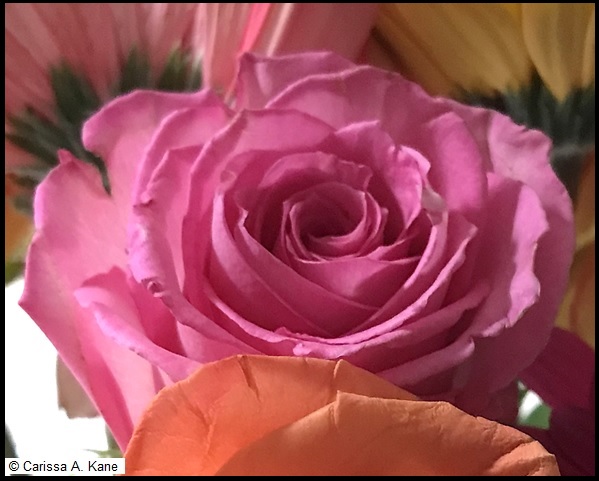
Kahlil Gibran wrote, “The optimist sees the rose and not its thorns; the pessimist stares at the thorns, oblivious of the rose.” Looking at the circumstances occurring around the world today, one might wonder how on earth it is possible to not see thorns and weeds run amok. However, also happening around the world at the same time as all these daunting occurrences are ones that inspire and give cause to celebrate.
Perhaps within these days, too, there is opportunity to hold a broader view and to seek the hope that is awaiting in each moment, in each act of love, kindness, mercy, and compassion. But first, a pause. Maybe there is a letting go or taking up that needs some space to allow it to unfold. These kinds of times are also often great for working through unrest and moving closer, if not to the side of peace.
Imagine a rose without thorns. Is it perfect? Is it incomplete? Either way, honesty urges taking in the entire picture, whether of something familiar or something unknown. For that is when truth comes into view, and with it, a return to what is real. Yet, all along the way, Wisdom softly calls, although we may evolve, sometimes resist, or dig in, there is always something greater happening here. In fact, there is always something greater happening everywhere. Yes, and it is worthwhile to behold.
Lord, you have been our refuge through all generations. – Psalm 90:1
Recall an experience of bumping into someone that you know, in a place and at a time that you normally wouldn’t expect to see them? Initially, you might be surprised for good or less, or perhaps it might take a few moments to fully recognize the person. Maybe some memories of them come to mind.
Next, imagine that you kept encountering that same person over the course of several weeks. What would you think? What would you feel?
Now envision being one of Jesus’ disciples and having the experience of Jesus’ appearing to you, here and there, in the time between his Resurrection and Ascension. How would you react or respond after the profound experience of his crucifixion, his Resurrection, and being in the environment of belief and disbelief created by it all?
Would you be devoted to trying to see a pattern to Jesus’ appearances to try to predict when you might see him next? Would you commit yourself to trying to figure out the reasons why he was appearing? How hard would you work to come to some sort of knowledge about these occurrences? In what ways would you characterize your approach?
Focusing more closely on Jesus and his third appearance at the Sea of Tiberias (John 21), how determined would your mind be, and how open would your heart be, to the presence of Jesus who is in the form of the person on the shore, unknown and at a distance? How about to yourself or the person on the shore, thought of as being known? Would you cast the net again? What would you discover?
Simon Peter said to them, “I am going fishing.” They said to him, “We also will come with you.” So they went out and got into the boat, but that night they caught nothing. When it was already dawn, Jesus was standing on the shore; but the disciples did not realize that it was Jesus. Jesus said to them, “Children, have you caught anything to eat?” They answered him, “No.” So he said to them, “Cast the net over the right side of the boat and you will find something.” So they cast it, and were not able to pull it in because of the number of fish. So the disciple whom Jesus loved said to Peter, “It is the Lord.” When Simon Peter heard that it was the Lord, he tucked in his garment, for he was lightly clad, and jumped into the sea. – Jn 21:3-7
In what ways do you allow Jesus to be present to you in the unexpected? In what ways do you invite Jesus to help you to be present, to hold situations up to the light, to receive God’s wisdom so that you can embody the thoughts and feelings needed not only to embrace the moment, but also to receive and recognize the grace it holds, and how to share it?
Sometimes, there are so many questions, and it can seem like so much work. Yet, as April turns to May and the Feast of St. Joseph The Worker arrives, so also does the opportunity to experience not only the light of longer days, but also renewal through the touch of Grace—peace, light, hope, and inspiration—that continues to blossom with the Easter season, and beyond.
How does grace touch and move your heart? And how is it reflected in your work?
World’s breakneck pace, Stop that race. Put on the brakes. Hungry, greedy sharks, Stop the noise. Stop the thunder. Stop breeding misplaced hunger. We are broken, and run down. Lord, turn us around.
Step off that ladder. Come down from that pedestal. Look up from your work. Sister, help your brother, One and all, help each other. Stand up now, and be fed. Be true, and be led. Lord, bring us around.
Wisdom, seeking Wisdom? The time is right, as always. Be moved to higher ground. Turn it over, and then again. For although we are many, We are not. We are one. So, why not come together? Even better, be united. Lay down sides, Take up faith, not fate, And cry out loud, Lord, turn it around.
But as it is, there are many parts, yet one body. – 1 Cor 12:20
It can be easy to envision the poor widow putting her coins into the treasury, knowing the value to be considered far less than others had contributed. One might even draw a picture that perhaps includes elements representing shame, grief, loss, loneliness, and so on, overcome by giving all she had (“her whole livelihood”) and Jesus celebrating her for that. Then, from that picture, one might possibly be drawn toward a singular conclusion about verses 41-44 of chapter 12 in the Gospel according to Mark as a call to examine one’s level of charity.
It’s interesting though to reflect further on this passage. There are no words attributed to the widow, and no mention of a personal encounter between her and Jesus. The passage starts with an observation by Jesus that turns into a teaching directly to his disciples, not the poor widow, or anyone else who was putting money into the treasury. It is about more than coins and goes beyond levels of giving, extending to something greater.
Going back to the beginning of the Poor Widow’s Contribution, in verse 41, it is written, “Jesus sat down opposite the treasury and observed how the crowd put money into the treasury.” There are no interactions with those who are giving. Rather, Jesus takes in what is transpiring.
He sees the difference between the way the poor widow and the crowd, especially those with greater possessions (“Many rich people put in large sums.”), are carrying themselves. He then draws his disciples close, reveals what he sees, and tries to help them to see it as well. Jesus’s teaching, as always, is about showing the Way and helping those who follow him to become more aware, see more clearly, make better choices, and live more authentically.
Jesus wants the disciples, and us, to see that what the poor widow has given, she has given from “her whole livelihood”—her heart. This is the source of the widow’s might and is where our strength comes from as well. It is where the Lord resides.
I will place my law within them, and write it upon their hearts; I will be their God, and they shall be my people. – Jeremiah 31:33
By giving the two coins, the widow is giving her heart to the Lord, not allowing herself to be defined by her possessions, the opinions of others, or worldly cares, but instead sacrificing and letting them go, and listening to the law within her—placing trust for her well-being, first and foremost, in the Lord.
How can we look past the coins, and do the same?
In the course of his teaching Jesus said to the crowds, “Beware of the scribes, who like to go around in long robes and accept greetings in the marketplaces, seats of honor in synagogues, and places of honor at banquets. They devour the houses of widows and, as a pretext recite lengthy prayers. They will receive a very severe condemnation.”
Jesus sat down opposite the treasury and observed how the crowd put money into the treasury. Many rich people put in large sums. A poor widow also came and put in two small coins worth a few cents. Calling his disciples to himself, he said to them, “Amen, I say to you, this poor widow put in more than all the other contributors to the treasury. For they have all contributed from their surplus wealth, but she, from her poverty, has contributed all she had, her whole livelihood.” – Mark 12:38-44
It’s said that the owl’s wisdom lies in its waiting, watching, and listening. In its patient, persistent process, its senses are fine-tuned, making it easier to recognize and distinguish between and among things. The owl’s very own nature leads and nurtures the animal, teaching it to tap more deeply into what it genuinely needs to survive and thrive.
This in-born nature that helps the owl to be at its best, also resides within all living things. And when tuned into, exercised, and held onto, it helps all living things to operate at their best, most authentic self. For human beings especially, the task at hand is to sort through and root out all that interferes with this natural, God-given ability.
In the Book of Wisdom, King Solomon shares:
“I prayed, and prudence was given me; I pleaded, and the spirit of wisdom came to me” – Wisdom 7:7.
While this is a great example of “ask and you shall receive,” it is also an example of the gift of humility. Oftentimes, it is humility that opens the door to wisdom. King Solomon humbled himself, he “prayed” and “pleaded” for wisdom, a gift that no amount of money in the world could buy. Throughout the Bible, and throughout history, there is no wisdom, without humility. For it is a gift that can only be received at the time and place where an open, willing, and humble heart meets the humility of God—unconditional love.
So how does one move toward this place? For starters, perhaps by praying for the grace to become more aware. Kahlil Gibran wrote, “Wisdom stands at the turn in the road and calls upon us publicly, but we consider it false and despise its adherents.”
Thinking about current day events, where do you see wisdom? In what places do you meet unconditional love… truth and peace together?
Looking back to history, Psalm 90 begins:
“A prayer of Moses, the man of God. Lord, you have been our refuge through all generations. Before the mountains were born, the earth and the world brought forth, from eternity to eternity you are God” (verses 1-2).
Wisdom draws Moses’ heart to give voice to God’s faithfulness, and seek God’s help, “Teach us to count our days aright, that we may gain wisdom of heart,” (verse 12), mercy, “Make us glad as many days as you humbled us, for as many years as we have seen trouble,” (verse 15), and grace, “May the favor of the Lord our God be ours. Prosper the work of our hands! Prosper the work of our hands!” (verse 17).
When you reflect on the work of your hands, what aspects of God (loving, patient, gentle, kind, honest, peaceful, faithful, life-giving, etc.) resonate in them? When you look at the world around you and the things in which you choose to participate, which ones bring you closer to the image of God, Love, in which you were created? In what ways do you feel inspired by the humility and generative nature of God, for whom all things are possible?
If You don’t build it, we labor in vain, Without Your Spirit, we stand with no strength. I know my life is passing away, but the works of Your hands are what will remain. Let the favor of the Lord rest upon us…
O Lord, establish the work of our hands! O Lord, establish the work of our hands!
Teach us to number the length of our days, Pour out Your power, we’ll pour out Your praise. Teach us to run, to finish the race, for only what’s done in love will remain. Let the favor of the Lord rest upon us…
O Lord, establish the work of our hands! O Lord, establish the work of our hands!
Al – le – lu – ia, al – le – luia, al – le – luia Al – le – lu – ia, al – le – luia, al – le – luia
















You must be logged in to post a comment.