In the Gospel passage for the Solemnity of the Most Holy Body and Blood of Christ (Luke 9:11b-17), it is written that as the end of the day is drawing near, Jesus’s disciples go to him with their plan on how to proceed with regards to the crowds who have followed Jesus and his disciples to Bethsaida, a town near the Sea of Galilee, and have witnessed Jesus’s preaching and healing. The disciples say, “Dismiss the crowd so that they can go to the surrounding villages and farms and find lodging and provisions; for we are in a deserted place here.” However, Jesus seems to have other ideas. He responds, “Give them some food yourselves.”
Take a moment to consider how you might receive Jesus’s words in this situation. How might your response vary based on whether you are in a deserted place? What’s it like to consider yourself as part of the solution, no matter where you are?
Next, the disciples focus on what they might do, but recognize it’s not possible for them to do much with what they have:
“Five loaves and two fish are all we have, unless we ourselves go and buy food for all these people.”
Think of a situation where you feel that all you have is not enough to address it. Now, envision Jesus coming into the situation and inviting you to tell him more about it. Start with the words, “All I have is …” Notice what you include (things, people, thoughts, feelings, etc.).
What happens within you as you name what you bring to the situation? How does Jesus receive you and respond?
Now imagine Jesus instructing his disciples, and you, “Have them sit down in groups…”. Then Jesus, with abundant love and patience, turns to you, and tells you more. Pray and converse with Jesus about what this might mean for you and your situation. Share any, and all, thoughts and feelings that arise within you.
In the Gospel passage, after the disciples listened to Jesus and did as he asked, it is written:
“Then taking the five loaves and the two fish, and looking up to heaven, he said the blessing over them, broke them, and gave them to the disciples to set before the crowd. They all ate and were satisfied. And when the leftover fragments were picked up, they filled twelve wicker baskets.”
What’s it like to contemplate the fact that with Jesus, all you have is enough, and can even be more than enough?
Take time today, and throughout the week, to set down whatever is on your plate or is occupying your mind. Then pause and invite Jesus to say the blessing over you and your concerns. Next, allow the peace and wisdom of Jesus, the Bread of Life, to wash over you, and reveal how what you have can meet this moment and the moments ahead, and be more than enough.
I am the living bread that came down from heaven, says the Lord; whoever eats this bread will live forever. – John 6:51
The magi, or three wise men, are first drawn to Jerusalem by the star signifying the birth of a newborn king. Once there, they encounter Herod, who acting on fear, deceptively seeks to have them locate this king so that he may bring about his demise; not pay homage as he has claimed.
For the wise men, this journey began with the beckon of a bright, new star. Then, from Jerusalem and their exchange with Herod, that same star leads them further onward, guiding them to Bethlehem, and Jesus Christ. And after paying homage and offering gifts to the newborn king, it is a dream that directs them back home, rather than returning to Jerusalem to reveal the location of the newborn king to Herod.
Along the way, and at each stop, the wise men, like us, undoubtedly had choices to make. What, do you imagine, inspired them to keep following the star from its rising all the way to Jerusalem? And then onward to Bethlehem?
What led them to listen to the dream and go home a different way rather than returning by way of Jerusalem, stopping to give Herod the information he wanted from them?
After taking some time to contemplate the Gospel passage for the Epiphany of the Lord (Matthew 2:1-12), reflect on the choices that you may be facing at this time and how you go about making decisions.
What influences your decisions and from where do you take direction or draw inspiration? What are the factors that motivate you? How do they reflect a posture of paying homage to the Lord? (Perhaps they are born out of, or hold at their roots, love, patience, or something similar.)
Take what you notice into prayer, inviting Jesus to share Light and Wisdom with you. Pray with any feelings or desires that arise in you. And when this prayer time comes a close, ask Jesus to reveal one parting word, phrase, or image that will help to draw and lead you, like that star, to where you ought to be.
We saw his star at its rising and have come to do him homage. – Matthew 2:2
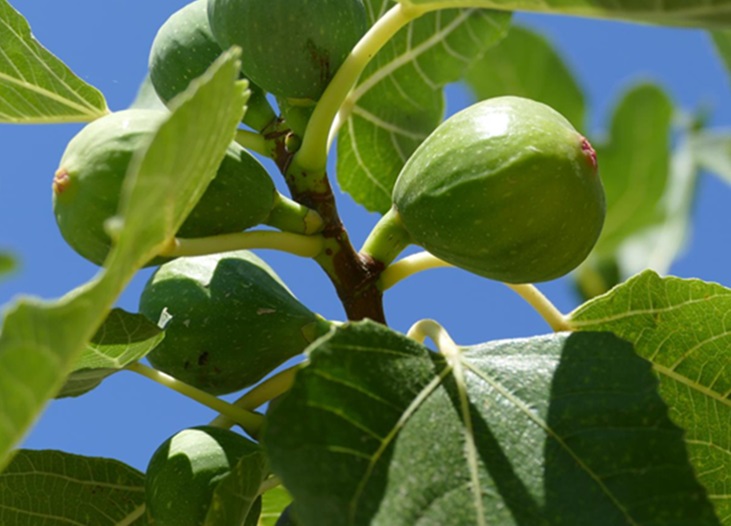
In the Gospel passage for the Thirty-third Sunday in Ordinary Time (Mark 13:24-32), Jesus says, “Learn a lesson from the fig tree. When its branch becomes tender and sprouts leaves, you know that summer is near.” (v. 24). These words are part of his response to a question asked of him by the disciples, Peter, James, John, and Andrew.
Away from the others, and just after Jesus commented to his disciples on the destruction of the temple, they had asked him, “Tell us, when will this happen, and what sign will there be when all these things are about to come to an end?” (Mark 13:4). The first thing that Jesus says to them is, “See that no one deceives you.” (Mk 13:5). As he continues to tell them the signs and what will happen (trials and tribulations such as war, persecutions, etc.), he also continues to give them instructions as to how to handle themselves and the situations they will face. He says:
“… do not be alarmed” (v. 7)
“Watch out for yourselves.” or be aware (v. 9)
“… do not worry beforehand about what you are to say. But say whatever will be given to you at that hour. For it will not be you who are speaking but the holy Spirit.” (v. 11)
“Be watchful!” (v. 23)
Then he says these words that are part of the Gospel for today, “Learn a lesson from the fig tree. When its branch becomes tender and sprouts leaves, you know that summer is near.” (v. 28). And although Jesus says this as he continues to tell Peter, James, John, and Andrew about the signs that will occur at the end times, the gospel passage ends with Jesus saying, “But of that day or hour, no one knows, neither the angels in heaven, nor the Son, but only the Father.” (v. 32). In other words, perhaps Jesus is reminding us not to focus on the signs, but rather to focus on his instructions.
His last instruction, “Learn a lesson from the fig tree,” is intriguing. In chapter 11 of Mark’s Gospel, Jesus curses a fig tree for being fruitless:
“The next day as they were leaving Bethany he was hungry. Seeing from a distance a fig tree in leaf, he went over to see if he could find anything on it. When he reached it he found nothing but leaves; it was not the time for figs. And he said to it in reply, ‘May no one ever eat of your fruit again!’ And his disciples heard it.” (Mark 11:12-14).
In this earlier passage, there is a mention of time, “… it was not the time for figs.” And now, when Jesus is telling some of his disciples about the signs of the end times and instructing them on how to be prepared, he again, refers to figs and time (and not knowing the exact time of the end).
A few interesting things about figs and time… Fig trees, like other fruit trees, have leaves, but unlike other fruit trees, their fruit flowers internally. Also, each fig contains a collection of many flowers and seeds. And while one may think of a fig as a piece of fruit, they are actually an infructescence—a multiple fruit—that in a sense, is always in the process of blooming.
So, in both times of uncertainty and times of comfort, see that no one deceives you, do not worry, and learn from the fig tree, continuing to grow from within, knowing that the fruit will come at the time that is appointed.
“Lord, my allotted portion and my cup, you have made my destiny secure.” – Psalm 16:5
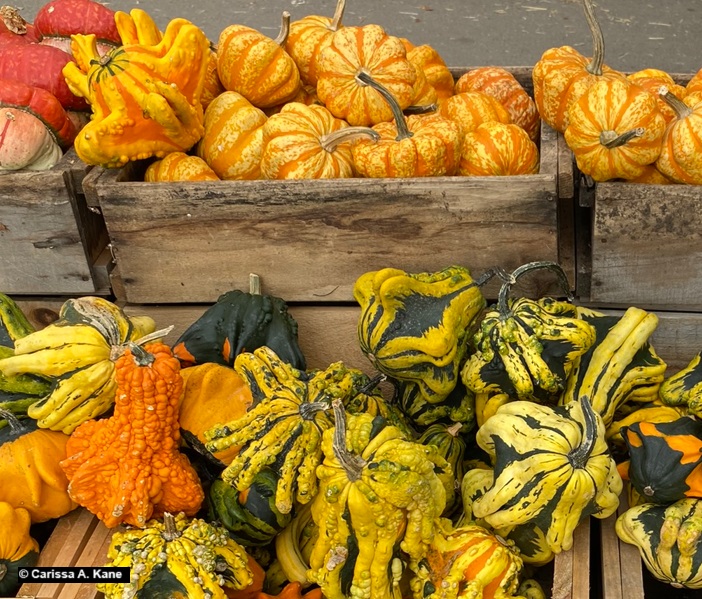
Walking past crates of pumpkins and gourds at a local farm, the different colors and shapes are stunning. It’s interesting to think that such variety can grow out of the seemingly blah ground. Yet, when examined more closely, the soil, although drab compared to its yield, is actually quite diverse and multidimensional, holding various nutrients necessary to growth.
Turning to the readings for the Twenty-eighth Sunday in Ordinary Time, we are provided with an invitation to contemplate the relationship and impact of prayer, openness to Wisdom, and placing hope in God on environment and yield.
First, in the Book of Wisdom, we are encouraged to seek Wisdom above all else. It is written:
I prayed, and prudence was given me; I pleaded, and the spirit of wisdom came to me. I preferred her to scepter and throne, and deemed riches nothing in comparison with her, nor did I liken any priceless gem to her; because all gold, in view of her, is a little sand, and before her, silver is to be accounted mire. Beyond health and comeliness I loved her, and I chose to have her rather than the light, because the splendor of her never yields to sleep. Yet all good things together came to me in her company, and countless riches at her hands. – Wisdom (7:7-11
Notice how the passage begins with praying and pleading, or in other words a humble posture. Not only that, but there is also the choice to seek Wisdom as well as to abide by it; this is further described throughout the passage. However, to be open to Wisdom, one must be open to the possibility that things are not what they seem or that there might be a better way. In addition, one must also be willing to loosen the grip, or let go of other notions, even if just temporarily, so as to allow Wisdom to shine the Light and make things clear.
In Psalm 90, the Psalmist also writes of Wisdom, reminding us of its source—God’s kindness (love)—and characteristics as well as its impact—prosperity through God’s grace.
Teach us to number our days aright, that we may gain wisdom of heart. Return, O Lord! How long? Have pity on your servants! Fill us at daybreak with your kindness, that we may shout for joy and gladness all our days. Make us glad, for the days when you afflicted us, for the years when we saw evil. Let your work be seen by your servants and your glory by their children; and may the gracious care of the Lord our God be ours; prosper the work of our hands for us! Prosper the work of our hands! – Psalm 90:12-17
Although we cannot control the timing and placement of Wisdom, we can pray and plead for it, be aware of its characteristics, and open ourselves to it, and the graces it holds. In the Letter of St. Paul to the Hebrews, we are reminded of the power of God’s word.
Brothers and sisters: Indeed the word of God is living and effective, sharper than any two-edged sword, penetrating even between soul and spirit, joints and marrow, and able to discern reflections and thoughts of the heart. No creature is concealed from him, but everything is naked and exposed to the eyes of him to whom we must render an account. – Hebrews 4:12-13
As human beings, our natural tendency is to fall into wanting to possess (control) or to fall into being possessed (controlled) by or too attached to things. However, God is not subject to this Achilles heel of ours. God, and God’s word, is “living and effective” because God is not bound, tied up, or confused, like we can be. Rather, God is all-knowing and constantly evolving, adjusting, and adapting to meet us where we are. This is not to inflict punishment or take away freedom, but to lift us up and fill us with an abundance of love and mercy, making the way for Wisdom to help us see clearly, and to use our free will to operate and navigate this world with love and mercy.
Looking at the Gospel passage for this week, we are reminded that faith and faithfulness to God not only extends beyond oneself, but that they also require flexibility and an openness to change, which is hindered when attachments to people, places, or things, outside of God exist.
As Jesus was setting out on a journey, a man ran up, knelt down before him, and asked him, “Good teacher, what must I do to inherit eternal life?” Jesus answered him, “Why do you call me good? No one is good but God alone. You know the commandments: You shall not kill; you shall not commit adultery; you shall not steal; you shall not bear false witness; you shall not defraud; honor your father and your mother.” He replied and said to him, “Teacher, all of these I have observed from my youth.” Jesus, looking at him, loved him and said to him, “You are lacking in one thing. Go, sell what you have, and give to the poor and you will have treasure in heaven; then come, follow me.” At that statement his face fell, and he went away sad, for he had many possessions.
Jesus looked around and said to his disciples, “How hard it is for those who have wealth to enter the kingdom of God!” The disciples were amazed at his words. So Jesus again said to them in reply, “Children, how hard it is to enter the kingdom of God! It is easier for a camel to pass through the eye of a needle than for one who is rich to enter the kingdom of God.” They were exceedingly astonished and said among themselves, “Then who can be saved?” Jesus looked at them and said, “For human beings it is impossible, but not for God. All things are possible for God.” – Mark 10:17-27
In the passage above, the man who approaches Jesus likely finds a great deal of security and comfort through his possessions, so much so that he walks away. In what ways can you understand how the man’s attachment prevents him from talking more with Jesus, or even asking Jesus for help? Notice how Jesus acknowledges that what he asked the man to do is not easy. Take some time to share with Jesus any challenges you may be facing with sharing the wealth—whether it is in the form of making a sacrifice to actively show care and concern for those in need, sharing something that you’re carrying all on your own and is weighing you down, or something else you’ve refrained from bringing to Jesus. Envision yourself as the man who walked away, and then, turn back around and bring yourself and your concerns back to Jesus.
We all have struggles, challenges, and hardships, yet at the same time, life and prosperity, and so many signs of it, also occur. It’s not an all or nothing, one way or the other, too late kind of world, but rather, it’s a world created by a God who is broadminded, far-reaching, for whom nothing is impossible, showing care and concern for everything and everyone, who tells us, place your hope in me, because, with me, anything is possible.
A long time ago, in a place that’s near, but that seems so far away, an experience that left a lasting impression occurred. I was preparing to leave for college orientation and one of my aunts was at my family’s home visiting. She came into mine and my sister’s room as I was packing some clothes and we had a conversation. I don’t recall how long it lasted or even what we were talking about, but I do recall how it felt to have here there. She was so caring and genuinely interested in being present to me in those moments. I often think of that day with fondness and remember feeling so loved by her, both then, and every time it’s come to mind since then. There were pearls of wisdom, simply in her presence.
I’m not sure that I ever told her how much that time together meant to me, but I will always remember it, along with her hugs, as if embracing one with all her heart and soul—the very definition of Love.
In the second reading for the 7th Sunday of Easter (1 John 4:11-16), it is written:
“Beloved, if God so loved us, we also must love one another. No one has ever seen God. Yet, if we love one another, God remains in us, and his love is brought to perfection in us.”
Consider taking some time to reflect on the verses above and how they come into play in daily life including interactions with those who are known by you and those who are yet to be known by you (strangers). In what ways might you better cooperate with God in working to bring love to perfection in you as well as through you?
To get somewhere, one needs to know where they are in relation to where they want to be and then to come up with a travel plan. However, oftentimes the path or trajectory shifts or ends up being different due to changing circumstances such as weather, terrain, and/or other unexpected issues. And while there are rules of navigation, the ability to adapt and adjust is crucial just as much as precision is.
One way to consider the readings for the Fifth Sunday of Lent is not only as tools, but precision tools for navigation. In the first reading (Jeremiah 31:31-34), the prophet reveals that God is making some adjustments. This is not a change in commitment level or objective, but rather a change in approach.
“I will place my law within them, and write it upon their hearts; I will be their God, and they shall be my people. They will no longer teach their friends and relatives, “Know the Lord!” Everyone, from least to greatest, shall know me—oracle of the Lord—for I will forgive their iniquity and no longer remember their sin.” (verses 33-34)
God’s communication is going to be directed straight to God’s people (not requiring a “go-between” or a 3rd person account), making it more personal and approachable as well as accepting and forgiving—all hallmarks of a healthy relationship.
In the responsorial psalm (Psalm 51:3-4, 12-13, 14-15), the psalmist expresses a desire for God to wash away their wrongdoing and states:
“A clean heart create for me, O God, and a steadfast spirit renew within me. Cast me not out from your presence, and your Holy Spirit take not from me.” (verses 12-13)
Since a heart cannot be clean or pure when it’s holding onto transgressions, resentments, or cold feelings toward oneself or others, the psalmist first asks for God’s mercy (for these things holding them back to be lifted from them). Once the obstacle(s) is removed, the way toward a heart that is unwavering in faithfulness to God is opened because the heart is better able to receive the wisdom and guidance of the Holy Spirit.
In the Letter to the Hebrews, St. Paul uses two words, in the passage for the second reading (Hebrews 5:7-9), that are sometimes received less enthusiastically than words like mercy and compassion. They are “reverence” and “obedience.” St. Paul writes of Jesus: “…he was heard because of his reverence” and “…he learned obedience from what he suffered”. Jesus’s relationship with God was open and honest; it was sacred. Jesus walked this earth, rooted in a desire to do God’s will and always seeking God as his source of strength and wisdom to face what he needed to face. When taken in the light of Jesus’ example, these words, “reverence” and “obedience”, when chosen with one’s free will express an attitude of humility and faithfulness to God, and of God to us.
Coming to the Gospel (John 12:20-33), Jesus’s words here strike at the heart of navigating. That is, holding onto or maintaining focus on the end goal despite the challenges that arise along the way.
It is written:
“Jesus answered them, “The hour has come for the Son of Man to be glorified. Amen, amen, I say to you, unless a grain of wheat falls to the ground and dies, it remains just a grain of wheat; but if it dies, it produces much fruit.” (verse 23-24).
If one is going to get to their destination, they can’t stay in one place or state of being. A change, shift or movement toward what one desires is necessary.
“I am troubled now. Yet what should I say? ‘Father, save me from this hour’? But it was for this purpose that I came to this hour.” (verse 27)
Jesus knows his purpose or mission through his relationship with God. What are you and God aiming for as you navigate? (If unsure, consider what is fulfilling or rings true with the soul, bringing a sense of peace.)
“Father, glorify your name.” Then a voice came from heaven, “I have glorified it and will glorify it again.” (verse 28)
When two wills move together, there is resonance in words and actions. However, there can only be one pilot.
“Now is the time of judgment on this world; now the ruler of this world will be driven out.” (verse 31)
Jesus knows who’s leading the way and encourages us toward awareness as well.
May the strength of God pilot us, may the wisdom of God instruct us, may the hand of God protect us, may the word of God direct us. Be always ours this day and for evermore. – St. Patrick
It can be easy at times to focus so much on a plan or a routine that one might fall away from the point of having it in the first place. Without even realizing it, the point or the goal can be supplanted by a step(s) laid out to achieve it. This can be especially true during Lent when there’s a tendency to make greater efforts to be intentional about prayer, fasting, and almsgiving.
The scripture passages for today can be taken as an invitation to consider what one’s prayer, fasting, almsgiving, etc. leads them to. For example, in the first reading (Isaiah 58:1-9a), the Prophet Isaiah tells the people what the Lord has said with regards to fasting. The Lord wants to share thoughts and let the people know the attitude and approach that is desired.
Is this not, rather, the fast that I choose: releasing those bound unjustly, untying the thongs of the yoke; Setting free the oppressed, breaking off every yoke? Is it not sharing your bread with the hungry, bringing the afflicted and the homeless into your house; Clothing the naked when you see them, and not turning your back on your own flesh? Then your light shall break forth like the dawn, and your wound shall quickly be healed; Your vindication shall go before you, and the glory of the Lord shall be your rear guard. Then you shall call, and the Lord will answer, you shall cry for help, and he will say: “Here I am!” – Isaiah 58:6-9a
Spend some time contemplating these verses and current events or situations from a broader perspective (e.g. the world, your country) to a more personal one (e.g. your community, family, individual). As you contemplate each area, share your thoughts with the Lord and bring to prayer whatever comes to mind.
Closing prayer: Lord, grant me, and all your people, the grace to know when our steps are leading us away from the goal—You. Draw us closer and provide us with the wisdom and the strength to let go of whatever may be holding us back. Help us to change course when we’ve gone astray, and to be re-directed so that You and Your ways may always be our foundation and guiding light. We ask this in Jesus’ name. Amen.











You must be logged in to post a comment.