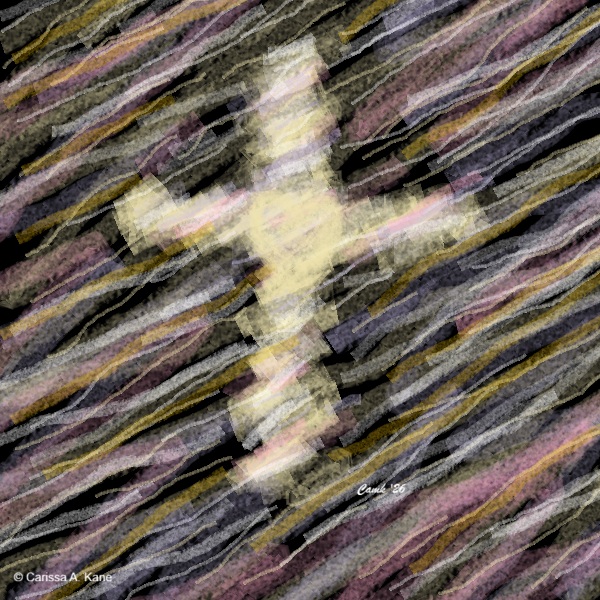
Throughout the night, shadows make their way, And by the light of day, they cast doubt. Sad, sorry, tragic! They think they know. They slink, they slide, they lie, steal, and cheat.
Snuffing out light and stomping on hope, Making little of all the deceit. They rely on breaking down goodness, Splitting up what once stood together.
They view resistance, a futile thing, Failing to recognize the power, The strength and speed, of Light that’s within. Feed the poor, care for the downtrodden.
Light travels and bends, it radiates, generously spreads out across time. Some wills have shadows that can’t stand truth. Only Thine will to be done through Christ.
I am the light of the world, says the Lord; whoever follows me will have the light of life. – John 8:12
It’s human nature to try to assign meaning to the things that happen in life. We all have experiences that can leave us wondering, “What was that all about?”. They are situations or encounters that may or may not eventually become more fully known or revealed. However, oftentimes, instead of waiting for that moment to come, where everything comes together and starts to make sense, we rush ahead making our own sense of it.
In those times of “What was that all about?”, temptation seeks to make the situation neatly fit into our own understanding or way of looking at things. That is, the temptation is to see what one wants to see through the lens through which one chooses to see it, rather than allowing time for the grace of God to open the eyes of one’s heart.
In the Second Reading for the Third Sunday in Ordinary Time (1 Corinthians 1:10-13, 17), St. Paul writes:
“For Christ did not send me to baptize but to preach the gospel, and not with the wisdom of human eloquence, so that the cross of Christ might not be emptied of its meaning.” – 1 Corinthians 1:17
What words or images come to mind when you consider the meaning of the cross of Christ, and what values do they imply?
How are you influenced by, and how do you remain mindful of, the meaning and those values as you go about each day?
In what ways do you leave room for the possibility that there’s more that you need to consider regarding a situation? How might you rely upon the grace of God more fully?
In the verses that proceed the one above, St. Paul appeals to the church of God—the people—in Corinth not to succumb to temptation, which seeks to separate them and pit them against each other. He starts off by imploring them to be united:
“I urge you, brothers and sisters, in the name of our Lord Jesus Christ, that all of you agree in what you say, and that there be no divisions among you, but that you be united in the same mind and in the same purpose.” – 1 Corinthians 1:10-11
St. Paul’s audience is the early Christian community in Corinth. Surely, they had more than just a few disagreements! Don’t people almost always though? Despite this, people always also have much in common.
Take some time to contemplate areas of disagreement that you may have with family, friends, and/or others. After naming the point(s) of contention, think about at least one thing you have in common and that you both value. How might that become, or continue to be, a source of unity? Pray with the desire that enters your heart as you consider this.
In the Gospel passage for this Sunday (Matthew 4:12-23), in part, it is written:
As he was walking by the Sea of Galilee, he saw two brothers, Simon who is called Peter, and his brother Andrew, casting a net into the sea; they were fishermen. He said to them, “Come after me, and I will make you fishers of men.” At once they left their nets and followed him. He walked along from there and saw two other brothers, James, the son of Zebedee, and his brother John. They were in a boat, with their father Zebedee, mending their nets. He called them, and immediately they left their boat and their father and followed him. He went around all of Galilee, teaching in their synagogues, proclaiming the gospel of the kingdom, and curing every disease and illness among the people. – v. 18-23.
Notice how Jesus called two sets of brothers. Chances are that within each set as well as taken all together, the brothers, didn’t see eye to eye on everything. However, they were all called, and they all left something behind or had to let go of something.
Simon (Peter) and his brother, Andrew, James and his brother, John, certainly must have had their differences, but they all made the individual choice to place their focus on following Jesus, who taught in the synagogues, proclaimed the Gospel, and “cured every disease and illness among the people.” They embraced the Way. And in doing so, they were able to draw closer to God, they were strengthened through their differences, and they stayed united rather than becoming divided.
The Lord is my light and my salvation; whom should I fear? The Lord is my life’s refuge; of whom should I be afraid? – Psalm 27:1
The Baptism of the Lord in the Gospel according to Matthew describes an interaction between Jesus and John the Baptist. John is a prophet who has his own disciples, and of whom it is written, “At that time Jerusalem, all Judea, and the whole region around the Jordan were going out to him and were being baptized by him in the Jordan River as they acknowledged their sins.” (Matthew 3:5-6). And Jesus is the Christ, the Anointed one, of whom John said, “the one who is coming after me is mightier than I. I am not worthy to carry his sandals. He will baptize you with the holy Spirit and fire.” (Matthew 3:11). Yet, as it is written, they meet and engage with each other without pretense or posturing.
Read and reflect on the Gospel passage for the Baptism of the Lord (below), receiving it as an invitation to prayerfully consider human interactions, both your own and those that you witness. Ask the Lord for insight and wisdom as you do so.
Jesus came from Galilee to John at the Jordan to be baptized by him. John tried to prevent him, saying, “I need to be baptized by you, and yet you are coming to me?” Jesus said to him in reply, “Allow it now, for thus it is fitting for us to fulfill all righteousness.” Then he allowed him. After Jesus was baptized, he came up from the water and behold, the heavens were opened for him, and he saw the Spirit of God descending like a dove and coming upon him. And a voice came from the heavens, saying, “This is my beloved Son, with whom I am well pleased.” – Matthew 3:13-17
What divine qualities do the words and actions of John the Baptist and Jesus exemplify in this exchange? What strikes you most?
Next, put yourself in John’s shoes as the prophet of whom it is written, “A voice proclaims: In the wilderness prepare the way of the Lord! Make straight in the wasteland a highway for our God!” (Isaiah 40:3). What’s it like to encounter Jesus, knowing that He is the one of whom you’ve been preaching and waiting for? and knowing that it is time for you to step back while He steps forward? What thoughts and feelings arise when you envision saying to Jesus, “I need to be baptized by you” and he replies, “Allow it now. For thus it is fitting for us to fulfill all righteousness”?
Now, ask Jesus to help you to envision His experience in this passage. In what ways might His perspective enlighten your interactions and/or assessments of interactions to which you have been a witness?
How might you be inspired by the example of Jesus and John the Baptist in interactions and when you encounter something or someone known, new, or different?
“You are sent into this world to believe in yourself as God’s chosen one and then to help your brothers and sisters know that they are also beloved sons and daughters of God who belong together. You’re sent into this world to be a people of reconciliation. You are sent to heal, to break down the walls between you and your neighbors, locally, nationally, and globally. Before all distinctions, the separations, and the walls built on foundations of fear, there was a unity in the mind and heart of God. Out of that unity, you are sent into this world for a little while to claim that you and every other human being belongs to the same God of Love who lives from eternity to eternity.” – Henri Nouwen
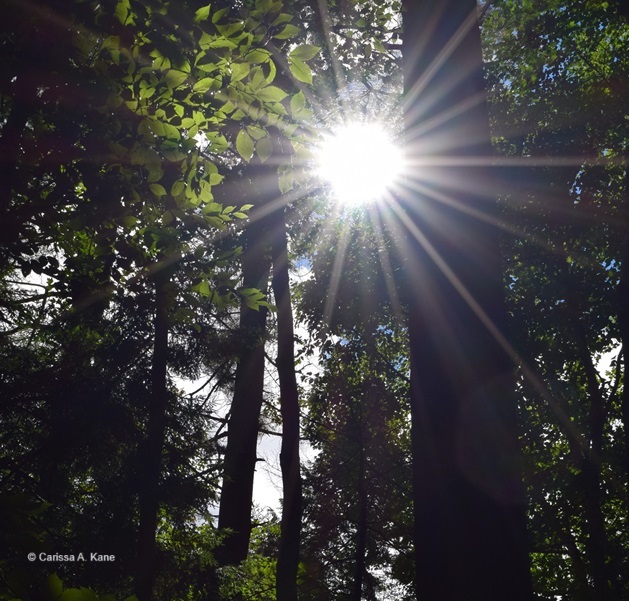
Trees straight ahead standing tall, Making way for what may come, What was, and what is beyond. So willing to share the scene With the bright and countless leaves.
Together in their welcome To fellow lives passing through, Trees and leaves hold each other, One another, as Love holds them too.
The Lord is a God of justice, who knows no favorites. – Sirach 35:12
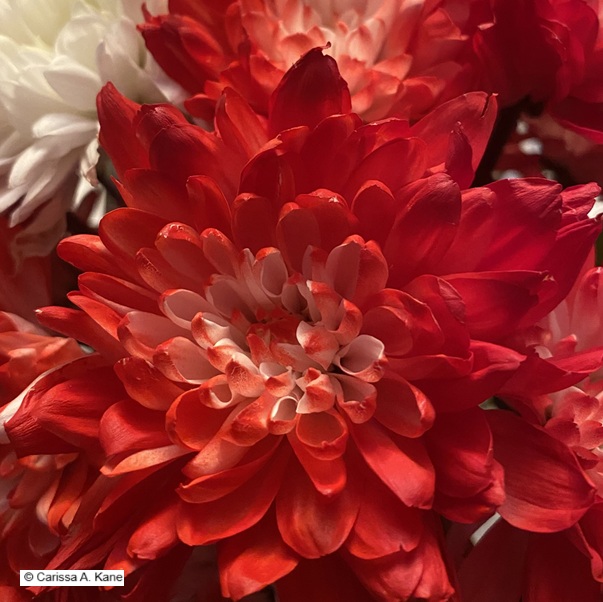
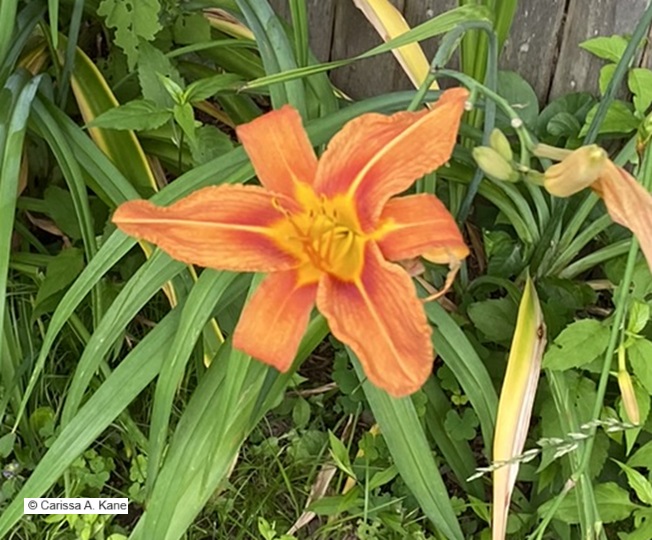
As the days passed by, the flowers, still bright, holding onto life, begin to show the length of days and nights, separate, away from the source of life.
Leaves dropping from stems, petals shriveling, on the outside first. Time ticks, closing in. Hold on as they may, away from their roots, they limp as they linger.
In the First Reading for the Seventh Sunday in Ordinary Time (1 Samuel 26:2, 7-9, 12-13, 22-23), David and Abishai find themselves in a position of advantage, having the opportunity to kill Saul, who, along with his soldiers are in a deep sleep. However, despite Saul having grown distant from who he was at the beginning of his rule, and having become David’s enemy, David restrains himself and shows mercy. He says to Abishai, “Do not harm him, for who can lay a hand on the Lord’s anointed and remain innocent?” (v. 9).
Spend some time with the first reading and consider that as beings created in God’s image, in a sense, we are all anointed.
The response for the Psalm is, “The Lord is kind and merciful.” (Psalm 103:8). Reflect on the ways that the Lord has been kind and merciful to you. How does your experience inspire you in terms of the way you view situations and people? In what ways do you feel compelled to be kind and merciful to others? Are there areas where the Lord might want to work with you on expanding upon or reassessing this?
Turning to the Second Reading (1 Corinthians 15:45-49), St. Paul writes of Adam and Jesus, but he is also writing about the call to conversion and discipleship.
As was the earthly one, so also are the earthly, and as is the heavenly one, so also are the heavenly. Just as we have borne the image of the earthly one, we shall also bear the image of the heavenly one. – verses 48-49
Envisioning your life as one line and the events/happenings during your life as another line on a continuum, think about the major events/happenings that have had a direct impact on you. What’s the difference between the times when you have maintained a sense of inner strength (or know-how) and peace, and the times you haven’t?
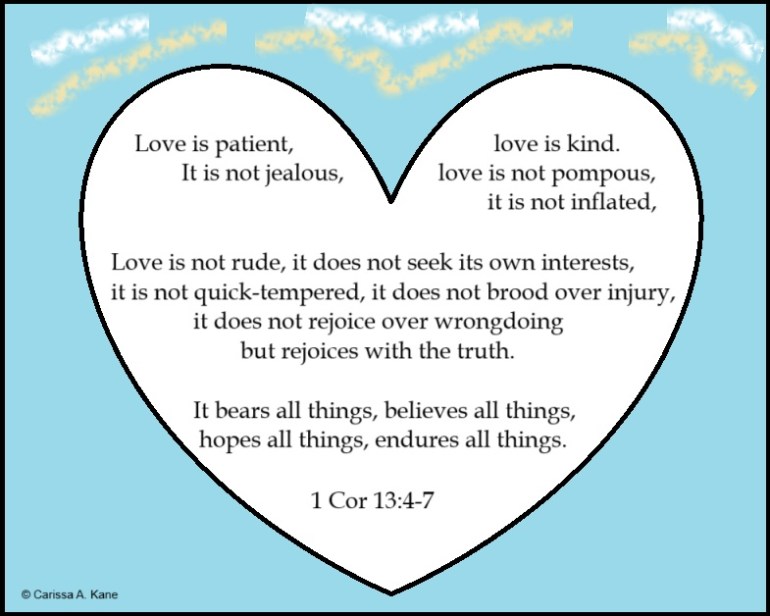
In the Gospel Reading (Luke 6:27-38), Jesus reminds us that Love is what sustains us. Not embracing cynicism, seeking or plotting revenge, settling or keeping scores. Rather, those are the things that tear us away from Love and the root of goodness and life—God.
How might you draw closer to Love in the challenges you face today? And how might the Lord desire to join you in an area of challenge?
The Lord is kind and merciful, slow to anger, abounding in mercy. – Psalm 103:8
Blessed are we, created in the image of the Lord, Who comes down from the mountain, To stand with us on level ground. Bestower of grace on all, Willing spirits will receive Him. Words of Wisdom and Hope He speaks, Bringing Light and Life to the soul.
Care for the poor, Feed the hungry, Comfort those in need. Way of ways, it is not easy.
Hold fast to only One—the Lord. Falling not for hollow banter, Careful of the ruse; it’s not True. Look not to glorify others, Rather, seek Wisdom from the Source. Big and bold isn’t always best, and Stay awake is what the Lord commanded.
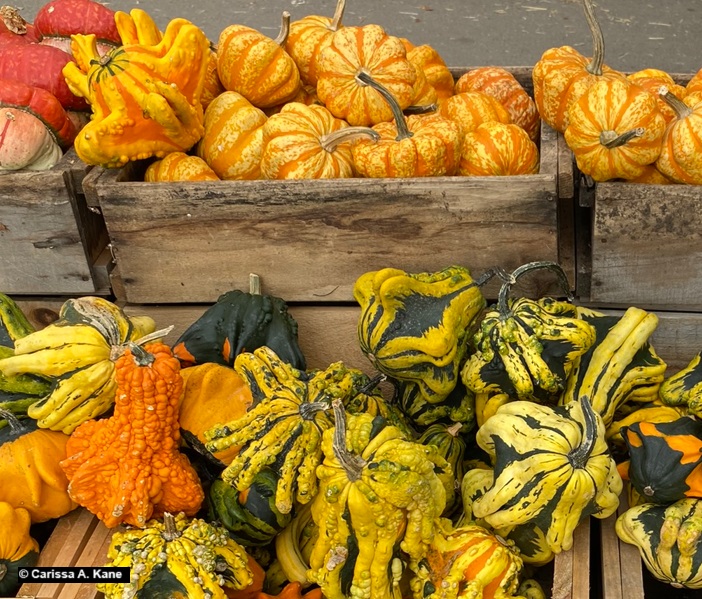
Walking past crates of pumpkins and gourds at a local farm, the different colors and shapes are stunning. It’s interesting to think that such variety can grow out of the seemingly blah ground. Yet, when examined more closely, the soil, although drab compared to its yield, is actually quite diverse and multidimensional, holding various nutrients necessary to growth.
Turning to the readings for the Twenty-eighth Sunday in Ordinary Time, we are provided with an invitation to contemplate the relationship and impact of prayer, openness to Wisdom, and placing hope in God on environment and yield.
First, in the Book of Wisdom, we are encouraged to seek Wisdom above all else. It is written:
I prayed, and prudence was given me; I pleaded, and the spirit of wisdom came to me. I preferred her to scepter and throne, and deemed riches nothing in comparison with her, nor did I liken any priceless gem to her; because all gold, in view of her, is a little sand, and before her, silver is to be accounted mire. Beyond health and comeliness I loved her, and I chose to have her rather than the light, because the splendor of her never yields to sleep. Yet all good things together came to me in her company, and countless riches at her hands. – Wisdom (7:7-11
Notice how the passage begins with praying and pleading, or in other words a humble posture. Not only that, but there is also the choice to seek Wisdom as well as to abide by it; this is further described throughout the passage. However, to be open to Wisdom, one must be open to the possibility that things are not what they seem or that there might be a better way. In addition, one must also be willing to loosen the grip, or let go of other notions, even if just temporarily, so as to allow Wisdom to shine the Light and make things clear.
In Psalm 90, the Psalmist also writes of Wisdom, reminding us of its source—God’s kindness (love)—and characteristics as well as its impact—prosperity through God’s grace.
Teach us to number our days aright, that we may gain wisdom of heart. Return, O Lord! How long? Have pity on your servants! Fill us at daybreak with your kindness, that we may shout for joy and gladness all our days. Make us glad, for the days when you afflicted us, for the years when we saw evil. Let your work be seen by your servants and your glory by their children; and may the gracious care of the Lord our God be ours; prosper the work of our hands for us! Prosper the work of our hands! – Psalm 90:12-17
Although we cannot control the timing and placement of Wisdom, we can pray and plead for it, be aware of its characteristics, and open ourselves to it, and the graces it holds. In the Letter of St. Paul to the Hebrews, we are reminded of the power of God’s word.
Brothers and sisters: Indeed the word of God is living and effective, sharper than any two-edged sword, penetrating even between soul and spirit, joints and marrow, and able to discern reflections and thoughts of the heart. No creature is concealed from him, but everything is naked and exposed to the eyes of him to whom we must render an account. – Hebrews 4:12-13
As human beings, our natural tendency is to fall into wanting to possess (control) or to fall into being possessed (controlled) by or too attached to things. However, God is not subject to this Achilles heel of ours. God, and God’s word, is “living and effective” because God is not bound, tied up, or confused, like we can be. Rather, God is all-knowing and constantly evolving, adjusting, and adapting to meet us where we are. This is not to inflict punishment or take away freedom, but to lift us up and fill us with an abundance of love and mercy, making the way for Wisdom to help us see clearly, and to use our free will to operate and navigate this world with love and mercy.
Looking at the Gospel passage for this week, we are reminded that faith and faithfulness to God not only extends beyond oneself, but that they also require flexibility and an openness to change, which is hindered when attachments to people, places, or things, outside of God exist.
As Jesus was setting out on a journey, a man ran up, knelt down before him, and asked him, “Good teacher, what must I do to inherit eternal life?” Jesus answered him, “Why do you call me good? No one is good but God alone. You know the commandments: You shall not kill; you shall not commit adultery; you shall not steal; you shall not bear false witness; you shall not defraud; honor your father and your mother.” He replied and said to him, “Teacher, all of these I have observed from my youth.” Jesus, looking at him, loved him and said to him, “You are lacking in one thing. Go, sell what you have, and give to the poor and you will have treasure in heaven; then come, follow me.” At that statement his face fell, and he went away sad, for he had many possessions.
Jesus looked around and said to his disciples, “How hard it is for those who have wealth to enter the kingdom of God!” The disciples were amazed at his words. So Jesus again said to them in reply, “Children, how hard it is to enter the kingdom of God! It is easier for a camel to pass through the eye of a needle than for one who is rich to enter the kingdom of God.” They were exceedingly astonished and said among themselves, “Then who can be saved?” Jesus looked at them and said, “For human beings it is impossible, but not for God. All things are possible for God.” – Mark 10:17-27
In the passage above, the man who approaches Jesus likely finds a great deal of security and comfort through his possessions, so much so that he walks away. In what ways can you understand how the man’s attachment prevents him from talking more with Jesus, or even asking Jesus for help? Notice how Jesus acknowledges that what he asked the man to do is not easy. Take some time to share with Jesus any challenges you may be facing with sharing the wealth—whether it is in the form of making a sacrifice to actively show care and concern for those in need, sharing something that you’re carrying all on your own and is weighing you down, or something else you’ve refrained from bringing to Jesus. Envision yourself as the man who walked away, and then, turn back around and bring yourself and your concerns back to Jesus.
We all have struggles, challenges, and hardships, yet at the same time, life and prosperity, and so many signs of it, also occur. It’s not an all or nothing, one way or the other, too late kind of world, but rather, it’s a world created by a God who is broadminded, far-reaching, for whom nothing is impossible, showing care and concern for everything and everyone, who tells us, place your hope in me, because, with me, anything is possible.
What’s known, And what is not. Calculating possibilities.
Looking then leaping, A snapshot in time. Measuring risk, and seeking reward.
Guarantees, Warranties, Yet, nothing is certain.
The seeker being sought, The Sought, searching seekers. Meeting up, teeing up, And, finding what is lost.
“…to live in a manner worthy of the call you have received, with all humility and gentleness, with patience, bearing with one another through love, striving to preserve the unity of the spirit through the bond of peace…” – Ephesians 4:1-3
On the Solemnity of the Most Holy Body and Blood of Christ also known as Corpus Christi, the Collect (opening prayer) is: “O God, who in this wonderful Sacrament have left us a memorial of your Passion, grant us, we pray, so to revere the sacred mysteries of your Body and Blood that we may always experience in ourselves the fruits of your redemption.”
Spend some time reflecting on this prayer and on the Sacrament of the Eucharist. What does it mean to you and how has it impacted you? Remember how you have experienced the fruits of the Lord’s redemption. What wonders has the Lord worked in your life? Take a few moments to express gratitude for these experiences and the awareness of them.
In the hymn One Bread, One Body, the lyrics direct us to mindfulness of our call, one and all, to unity as God’s people (the church):
One bread, one body, one Lord of all One cup of blessing which we bless And we, though many, throughout the Earth We are one body in this one Lord – John Foley, SJ (excerpt from One Bread, One Body)
Recall a time(s) when you have experienced unity and the fruits of the Lord’s redemption with others? In what ways have you witnessed the hand of the Lord? Give thanks for these times of common ground and the remembrance of them.
What hopes and desires do you have at this moment for awareness and unity in your life? your community? your country? and the world? Share these with the Lord. Ask the Lord for the grace to further appreciate and be inspired by experiences of the outpouring of His love.
Pray for one and all to have an open heart and mind to the well-being of all creation, and above all, to draw closer to God so as to embody (to speak and act in accord with) God’s desires as expressed through the example of Jesus.
How shall I make a return to the Lord for all the good he has done for me? The cup of salvation I will take up, and I will call upon the name of the Lord. – Psalm 116:12-13









 HopeThatFloats
You must be logged in to post a comment.