Scenic Mountain Lookout

But for the Lord…

Reflecting on the past week, think about a couple of things that really grabbed your attention whether out of concern, celebration, etc. What was it that pulled you in, caught your eye or ear, and/or touched your heart?

What is it like now as you recall these things?

In the First Reading for the Eighteenth Sunday in Ordinary Time, Isaiah 55:1-3, it is written:

Come to me heedfully, listen, that you may have life. – verse 3a

Continuing to think about the past week, how have you been attentive to the Lord? In what moment(s) have you felt closest to the Lord? What have you shared and what insights have come to light through listening and prayer?

The Psalm for this Sunday (Psalm 145: 8-9, 15-18) reminds us of the way the Lord meets our needs:

The Lord is gracious and merciful,
slow to anger and of great kindness.
The Lord is good to all
and compassionate toward all his works.
The eyes of all look hopefully to you,
and you give them their food in due season;
you open your hand
and satisfy the desire of every living thing.
The Lord is just in all his ways
and holy in all his works.
The Lord is near to all who call upon him,
to all who call upon him in truth.

Take some time to consider the qualities described in these verses and the ways you have experienced the Lord meeting your needs. Allow time to express the sentiments that arise within as you recall these graced moments.

In the Second Reading (Romans 8:35, 37-39), St. Paul writes:

Brothers and sisters:
What will separate us from the love of Christ?
Will anguish, or distress, or persecution,
or famine, or nakedness, or peril, or the sword? – verse 35

The answer—nothing. There is absolutely nothing; no matter how big or powerful or existential. There is nothing that can “separate us from the love of God in Christ Jesus our Lord.” (v. 39).

Take a few moments to let that sink in!

When ready, reflect again on the past week and name the moment(s) where you felt closest to the Lord. How was that moment(s) different than a moment where perhaps you didn’t feel as close to the Lord?

In the Gospel passage, Matthew 14:13-21 (included below), Jesus has stepped away from the crowds after learning of John the Baptist’s death. However, he is followed by them to the place to which he has retreated. He knows they’re following him from the start. And what does he do? He doesn’t go further away, turn his back on them, or tell them, “Go away”, “Come back tomorrow”, “Maybe another time”, or “Too late”.

Instead, Jesus’s “heart was moved with pity for them, and he cured their sick.” Not only that, but also as the day grows even longer and into the evening, rather than sending the crowd away or taking leave of them, he feeds them—all 5,000—with five loaves of bread and two fish.

What speaks to you most about this passage?

Spend the next few minutes envisioning the Lord’s care, strength, hope, love, and wisdom being poured upon you and filling your heart, body, and soul. Allow yourself to encounter the warmth and generosity of the Lord.

What do you imagine the Lord wants you to know about the things that caught your attention this past week? And the ones that will catch your attention in the week ahead?

Scenic Mountain Lookout

When Jesus heard of the death of John the Baptist,
he withdrew in a boat to a deserted place by himself.
The crowds heard of this and followed him on foot from their towns.
When he disembarked and saw the vast crowd,
his heart was moved with pity for them, and he cured their sick.
When it was evening, the disciples approached him and said,
“This is a deserted place and it is already late;
dismiss the crowds so that they can go to the villages
and buy food for themselves.”
Jesus said to them, “There is no need for them to go away;
give them some food yourselves.”
But they said to him,
“Five loaves and two fish are all we have here.”
Then he said, “Bring them here to me,”
and he ordered the crowds to sit down on the grass.
Taking the five loaves and the two fish, and looking up to heaven,
he said the blessing, broke the loaves,
and gave them to the disciples,
who in turn gave them to the crowds.
They all ate and were satisfied,
and they picked up the fragments left over—
twelve wicker baskets full.
Those who ate were about five thousand men,
not counting women and children. – Matthew 14:13-21
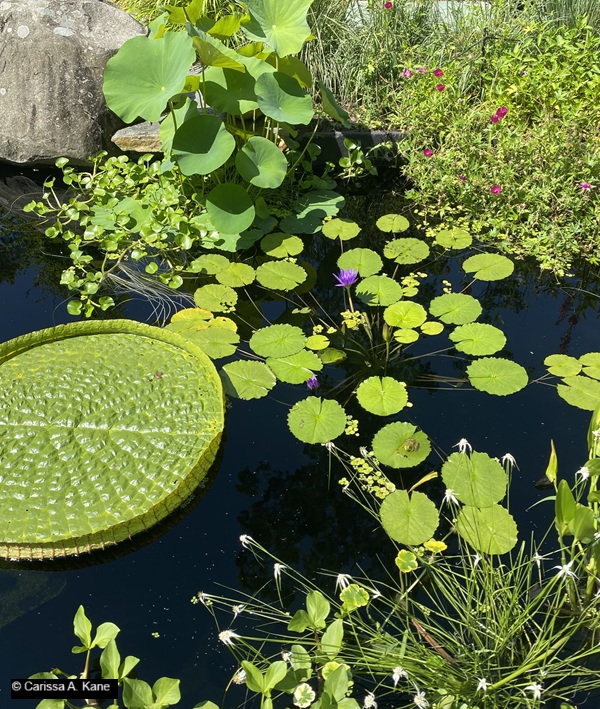
Lilypads

In the Image of its Creator…

Leaves upon leaves,
Earth, sky, and ground,
Different shapes,
Shades, and sizes,
Come together.

Growing along,
Getting along,
Going along,
Hosting along,
Stay together.

Like the lily
In that One pond,
Live in service,
Remain faithful
To creation.

Lilypads

Put on then, as God’s chosen ones, holy and beloved, heartfelt compassion, kindness, humility, gentleness, and patience, bearing with one another and forgiving one another, if one has a grievance against another; as the Lord has forgiven you, so must you also do. And over all these put on love, that is, the bond of perfection. – Colossians 3:12-14

Everything In Between

Everything In Between…

As a young person, August was synonymous with some last hurrahs and the winding down of what we considered summer; the passage of time between the ending of one school year and the beginning of another. The readings for the 18th Sunday in Ordinary Time offer an opportunity to consider more deeply, where God is in the in-between moments.

In the First Reading (Ex 16:2-4, 12-15), the Israelites are in between leaving Egypt and arriving to the Promised Land. They express feeling even more destitute than they did as slaves, complaining about the lack of provisions.

“Would that we had died at the Lord’s hand in the land of Egypt,
as we sat by our fleshpots and ate our fill of bread!
But you had to lead us into this desert
to make the whole community die of famine!” – The Israelites to Moses and Aaron, Ex 16:3  

Oftentimes, the in-between moments can feel worse than the known moments that precede or follow them. God is aware of the complaints of the people as well as the position that Moses and Aaron are in, and God responds by meeting all of their needs (those of the people as well as Moses and Aaron), and thus helping them to hang on and continue the journey. How do you express your needs in prayer? And how has God provided for you in times when perhaps you felt like you couldn’t take more of whatever you may have been experiencing or felt stuck in between?

Looking to the Psalm (Ps 78:3-4, 23-24, 25, 54), we are called to remember and to share the stories of God’s faithfulness.

What we have heard and know,
and what our fathers have declared to us,
We will declare to the generation to come
the glorious deeds of the Lord and his strength
and the wonders that he wrought. – v. 3-4

It is our belief in God and our experiences of the Divine which strengthen and increase our faith. By recalling and sharing these experiences, we not only help to pass along faith and tradition, but also to build awareness and gratitude in ourselves and of those who journey alongside us, in terms of the personal ways in which God works, and the depth of God’s care and love for creation.

The response for the psalm is, “The Lord gave them bread from heaven.” (v. 24b). The people did not know what manna was and it is described as “fine flakes on the ground” (Ex 16:15). Take some time to reflect on what has been your bread from heaven—ways in which God has provided for you that perhaps you didn’t initially recognize, or were unexpected and/or different from what you thought you needed.  

In the Second Reading (Eph 4:17,20-24), St. Paul exhorts the people:

“you must no longer live as the Gentiles do,
in the futility of their minds;” – v. 17    

This is a key component to faith. That is the fact that, along the way in seeking to find and fulfill one’s purpose, human reasoning alone is not enough. For the human mind alone, cannot fully comprehend or discern what is best. The only way, as St. Paul says is to be renewed in Christ:

“…be renewed in the spirit of your minds,
and put on the new self, created in God’s way in righteousness and holiness of truth.” (v. 23-24)

Recall a time when you felt stuck or challenged by a situation. What happened and how did your faith come into play? How might you be renewed in Christ regarding a situation you’re facing now?

Turning to the Gospel for the 18th Week in Ordinary Time (Jn 6:24-35), we are told about the crowds going out to find Jesus when they realize he is no longer in their midst. They end up finding him across the sea, and Jesus says to them:

“Amen, amen, I say to you,
you are looking for me not because you saw signs
but because you ate the loaves and were filled.
Do not work for food that perishes
but for the food that endures for eternal life,
which the Son of Man will give you.
For on him the Father, God, has set his seal.” – v. 26-27  

Jesus is referring to the crowd’s experience of eating their fill when he multiplied the loaves of bread and fish (Jn 6:1-15) and calling them, and us, to consider, or examine, what satisfies us, what is it that we are seeking, and to what lengths or degree do we go (or have we gone) to find or obtain it. Take some time to consider this in the light of what is currently going on in your life and in the world. What are you seeking and to what extent? How does this differ from or fit in with the past? How is God present to you in this process, and what comes to mind when thinking about it as an in-between moment?

Everything In Between

Love is the bridge between you and everything. – Rumi

In the Fabric…

It’s challenging, to say the least, to live in a world where tangible assets not only overwhelmingly drive motivation, but also speculation and modes of operation. And even more than that, status and materialism push humankind toward pursuits that are often so far removed from the stirrings and movements of grace that seek to connect and strengthen hearts.

St. Ignatius of Loyola wrote, “For it is not knowing much, but realizing and relishing things interiorly, that contents and satisfies the soul.” Yet, as suggested in Ecclesiastes, the human condition is such that we continue to toil under the sun to know more, do more, win more, and so on. But for what kind of gain? and at what cost?

Here is one who has labored with wisdom and knowledge and skill,
and yet to another who has not labored over it,
he must leave property.
This also is vanity and a great misfortune.
For what profit comes to man from all the toil and anxiety of heart
with which he has labored under the sun?
All his days sorrow and grief are his occupation;
even at night his mind is not at rest.
This also is vanity. – Ecc 2:21-23

Looking around, or tuning in to the pulse of society, one can only wonder, with that beat, what kind of “more” will ever be enough? And in the process, what happens to the hearts involved? There’s ebb and flow of course, but in what ways and to what degree do they drift? And at what point does the unfamiliar become all too familiar?

Turning to Psalm 95, the psalmist writes, “If today you hear God’s voice, harden not your hearts.” Before that, a call to turn back to the One who knows.

Teach us to number our days aright,
that we may gain wisdom of heart. – Ps 90:12

Remember, ask and you shall receive. However, as always, there’s choice in how one responds.

St. Paul urges us forward, let go of that which binds one to the earth and drags one down. Instead, be grounded to, as well as through, that which is elevated and fulfilling in a far greater way.

If then you were raised with Christ, seek what is above, where Christ is seated at the right hand of God.
Think of what is above, not of what is on earth. – Col 3:1-2

Be true… be not only baptized into Christ, but also put on Christ. Think about it. How does the heart and mind of Christ infuse your soul? How does it influence choices as you face challenges and navigate this world?

In the Gospel according to Luke (chapter 12:13-21), Jesus tells the parable of the rich man who had such a surplus at harvest that he replaced his barns with even bigger ones so he could essentially rest on his laurels and live off all that he had store up. While this parable can lead one to reflect on possessions and sharing or helping others from what one has, it can also be a catalyst to considering more closely how one’s pursuits affect the fabric of one’s being. Aside from the tangible, from what has one’s heart moved away? To what has one’s heart moved toward? And most importantly, where is God in all of that?