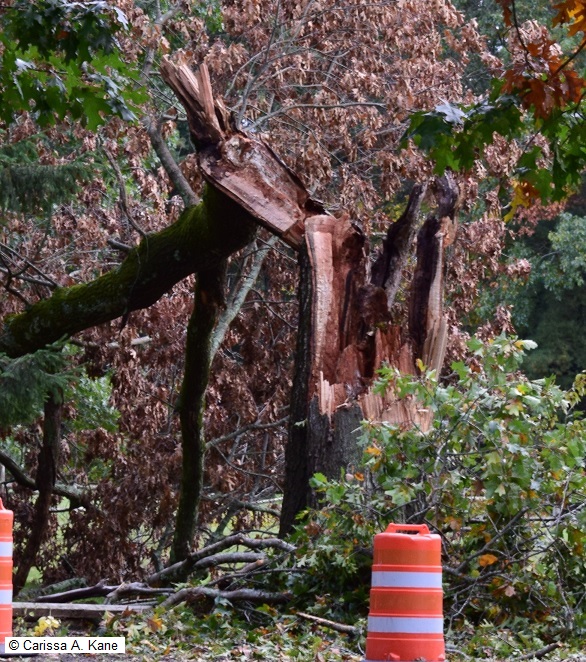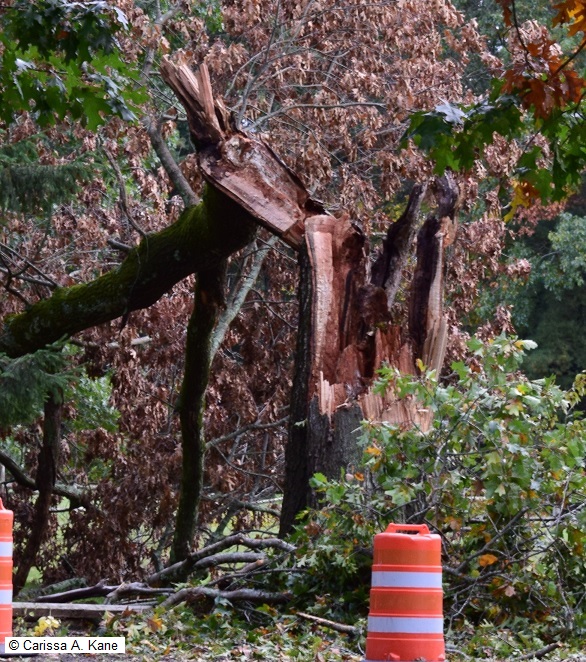
This week, during a rainy, windy evening, suddenly there was a loud and thunderous noise. Jumping up to look out the window, the street and lantern lights made visible a blur of branches and leaves on a large oak tree as it made its way down to the ground. Thankfully, despite the cars traveling in both directions on the road, at the time, no one was hurt. Traffic ended up being re-routed and within hours the Department of Public Works pushed all the debris off the road so that cars could once again travel freely up and down the street.
Now, this tree had a very large limb dry up during months of drought in the area and in the weeks prior to this one, it had partially fallen away from the trunk. From the street, one could see it was resting on the ground while still hanging on, as if by a thread. However, it wasn’t until the remainder of the tree fell to the ground, that one could see the dried-out limb not only hanging on still, but also looking like a giant pair of legs, perhaps trying to run by or break free from the rest of the tree.
Today, taking in the sight that lies beyond construction barrels put into place to forewarn or keep back passers-by, but seeming more like a beacon calling forth, it’s interesting how these legs and their trunk appear so much bigger than they seemed when the tree was standing tall. It seems there’s so much more to discover about them now that they are down to earth, unmasked in a sense. Their depth, their breadth, their character, shine brighter than before… legs posing as if in an athletic move of some kind or another. Are they coming? Are they going? Maybe they’re doing both. Or, perhaps, it’s a maneuver, careful to resist trampling the branches and leaves all around them.
Shifting focus, fallen branches spread about, pointing in many ways; some with shriveled, brown leaves holding on, and then others with green or yellow leaves, holding on as well. Common ground on the ground, connected at the core, together. Next, a splintered trunk displaying hearty, woody layers that, though broken, still look fresh and full of life.
Imagine now, all these things once hidden, or less likely to be noticed, now laying on or partly resting on the floor, as if drawing closer to one another, to reveal an image not of heaven, but of faith on earth.
My help comes from the Lord, the maker of heaven and earth. – Psalm 121:2
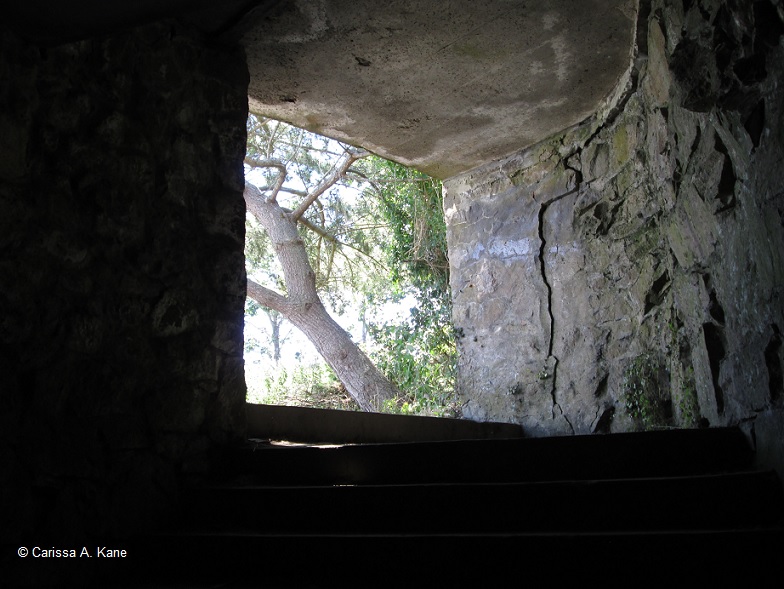
Heading out to somewhere that was new to us, we carried an excitement along the way. After quite some time on foot and feeling a little weary, we unexpectedly came to a tunnel. We had no idea how long it was or what was involved in getting through it. On top of that, all we could see was that it was pitch black inside. However, knowing it was part of the route and using one of the tools we had, a cellphone flashlight, we proceeded step by step, shining the light so we could see, and making our way through each curve until eventually we saw light coming from the opening on the other side.
However, if we didn’t have a flashlight, or a tool, to help us navigate through the darkness, I’m not sure we would have gone through that tunnel. Instead, we probably would’ve found a way around it or turned around and headed back to where we began. And, while finding a way around an obstacle or avoiding it, may be harmless in some cases, in others it is not. Sometimes the measures one may take to circumnavigate or escape a situation, may also lead to compromising, in one way or another, the well-being of oneself and/or others.
Considering the readings for the Twenty-seventh Sunday in Ordinary Time, they provide advice, wisdom, and encouragement to strive to serve God, not man, and to trust in God’s plan and in God’s ways. This is important no matter the time or place, but most especially in troubling or challenging times and environments.
If the knowledge that there is light at the end of the tunnel, and a way to make it through darkness, was enough to sustain courage, integrity, and faithfulness on its own, humankind would not fall prey to the shortcuts, traps, and tricks along the way. Faith is the tool that holds the keys and keeps one and all together; hearts, souls, and minds. It enables one “to be more than,” infused with grace, driven by truth and trust to face challenges, and find and follow the way through darkness; oftentimes leading one to discover a depth they never knew existed within them.
Take some time to read the Scripture passages from the Twenty-seventh Sunday in Ordinary Time (Hab 1:2-3; 2:2-4, Ps 95:1-2, 6-7, 8-9, 2 Tm 1:6-8, 13-14, and Lk 17:5-10 – shown below). Contemplate them in relation to today’s world. What are your concerns? What are some of the phrases or images that inspire you? Allow your heart and mind to draw together. Invite Jesus into the process and see what happens.
How long, O Lord? I cry for help but you do not listen! I cry out to you, “Violence!” but you do not intervene. Why do you let me see ruin; why must I look at misery? Destruction and violence are before me; there is strife, and clamorous discord. Then the Lord answered me and said: Write down the vision clearly upon the tablets, so that one can read it readily. For the vision still has its time, presses on to fulfillment, and will not disappoint; if it delays, wait for it, it will surely come, it will not be late. The rash one has no integrity; but the just one, because of his faith, shall live. – Hab 1:2-3; 2:2-4
R. If today you hear his voice, harden not your hearts. Come, let us sing joyfully to the Lord; let us acclaim the Rock of our salvation. Let us come into his presence with thanksgiving; let us joyfully sing psalms to him. R. If today you hear his voice, harden not your hearts. Come, let us bow down in worship; let us kneel before the Lord who made us. For he is our God, and we are the people he shepherds, the flock he guides. R. If today you hear his voice, harden not your hearts. Oh, that today you would hear his voice: “Harden not your hearts as at Meribah, as in the day of Massah in the desert, Where your fathers tempted me; they tested me though they had seen my works.” R. If today you hear his voice, harden not your hearts. – Ps 95:1-2, 6-7, 8-9
Beloved: I remind you, to stir into flame the gift of God that you have through the imposition of my hands. For God did not give us a spirit of cowardice but rather of power and love and self-control. So do not be ashamed of your testimony to our Lord, nor of me, a prisoner for his sake; but bear your share of hardship for the gospel with the strength that comes from God. Take as your norm the sound words that you heard from me, in the faith and love that are in Christ Jesus. Guard this rich trust with the help of the Holy Spirit that dwells within us. – 2 Tm 1:6-8, 13-14
The apostles said to the Lord, “Increase our faith.” The Lord replied, “If you have faith the size of a mustard seed, you would say to this mulberry tree, ‘Be uprooted and planted in the sea,’ and it would obey you. “Who among you would say to your servant who has just come in from plowing or tending sheep in the field, ‘Come here immediately and take your place at table’? Would he not rather say to him, ‘Prepare something for me to eat. Put on your apron and wait on me while I eat and drink. You may eat and drink when I am finished’? Is he grateful to that servant because he did what was commanded? So should it be with you. When you have done all you have been commanded, say, ‘We are unprofitable servants; we have done what we were obliged to do.'” – Lk 17:5-10
Recall an experience of bumping into someone that you know, in a place and at a time that you normally wouldn’t expect to see them? Initially, you might be surprised for good or less, or perhaps it might take a few moments to fully recognize the person. Maybe some memories of them come to mind.
Next, imagine that you kept encountering that same person over the course of several weeks. What would you think? What would you feel?
Now envision being one of Jesus’ disciples and having the experience of Jesus’ appearing to you, here and there, in the time between his Resurrection and Ascension. How would you react or respond after the profound experience of his crucifixion, his Resurrection, and being in the environment of belief and disbelief created by it all?
Would you be devoted to trying to see a pattern to Jesus’ appearances to try to predict when you might see him next? Would you commit yourself to trying to figure out the reasons why he was appearing? How hard would you work to come to some sort of knowledge about these occurrences? In what ways would you characterize your approach?
Focusing more closely on Jesus and his third appearance at the Sea of Tiberias (John 21), how determined would your mind be, and how open would your heart be, to the presence of Jesus who is in the form of the person on the shore, unknown and at a distance? How about to yourself or the person on the shore, thought of as being known? Would you cast the net again? What would you discover?
Simon Peter said to them, “I am going fishing.” They said to him, “We also will come with you.” So they went out and got into the boat, but that night they caught nothing. When it was already dawn, Jesus was standing on the shore; but the disciples did not realize that it was Jesus. Jesus said to them, “Children, have you caught anything to eat?” They answered him, “No.” So he said to them, “Cast the net over the right side of the boat and you will find something.” So they cast it, and were not able to pull it in because of the number of fish. So the disciple whom Jesus loved said to Peter, “It is the Lord.” When Simon Peter heard that it was the Lord, he tucked in his garment, for he was lightly clad, and jumped into the sea. – Jn 21:3-7
In what ways do you allow Jesus to be present to you in the unexpected? In what ways do you invite Jesus to help you to be present, to hold situations up to the light, to receive God’s wisdom so that you can embody the thoughts and feelings needed not only to embrace the moment, but also to receive and recognize the grace it holds, and how to share it?
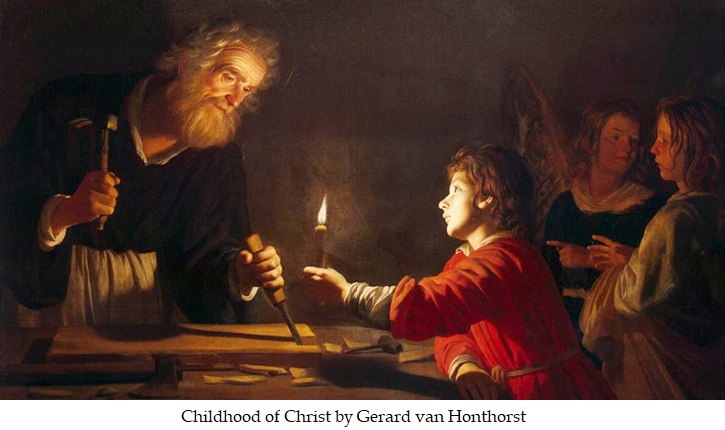
Sometimes, there are so many questions, and it can seem like so much work. Yet, as April turns to May and the Feast of St. Joseph The Worker arrives, so also does the opportunity to experience not only the light of longer days, but also renewal through the touch of Grace—peace, light, hope, and inspiration—that continues to blossom with the Easter season, and beyond.
How does grace touch and move your heart? And how is it reflected in your work?
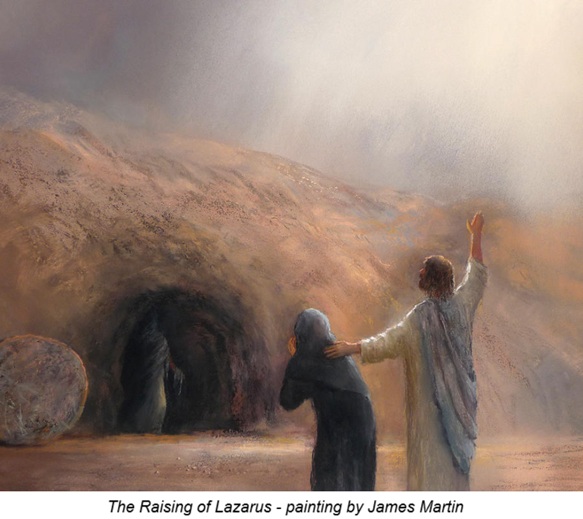
In chapter 5 of the Gospel according to Mark, the saving power of Jesus is revealed in the healing of the man with unclean spirits (the Gerasene demoniac), the woman who had been hemorrhaging for 12 years, and the daughter of Jairus, a synagogue official. In all three cases, Jesus acts differently than what is expected, in that he is not afraid to meet and embrace those who have met misfortune, and are viewed as less than, and he does not treat anyone or anything as a lost cause or beyond repair. Because of this, even though what he has to offer is beneficial, to those who are married to one way of being he is seen as someone to be weary of and who is dangerous.
When Jesus heals the demoniac, sending the unclean spirits into a herd of swine who then head over the bank and into the sea where they meet their demise, folks become afraid. They cannot see the miracle in the healing that has taken place and ask him to leave. He does get in the boat and depart back to the other side. However, he also remains. The man he healed takes heed in Jesus’s instructions to him. In staying behind, Jesus is with him, and the man gives witness to what the Lord has done for him.
When the hemorrhaging woman touches his cloak, Jesus, who is on the way to heal the synagogue official’s daughter, stops, and takes time not only to seek and find the woman he has just healed, but also to engage with her. Despite fear, the woman comes forward to own, or to claim, the truth. In doing so, she is met, not with a critical, harsh, or condescending response, but rather with affirmation. She believed in Jesus and was willing to take a leap and trust in the healing that she sensed he could bring, when she dared to reached out to touch his garment as he passed by. With Jesus, there is no such thing as too little, too late, not worthwhile, or not enough time.
When it is announced that the synagogue official’s daughter is dead, and that he is no longer needed, Jesus does not turn away. He tells the girl’s father, “Do not be afraid. Just have faith.” (v. 36). Despite the news and being ridiculed by others, Jesus proceeds to their house and wakes the girl up. With Jesus, nothing is impossible.
As a Christian, one is called to follow Jesus, embracing the Way, and striving, through the grace of God, to live it. As challenging, uncomfortable, or unpopular as it may be, oftentimes, this requires change and evolution. Sometimes it may mean the opposite or a variation of the new ways and examples happening in the world, and at other times, it may mean the opposite or a variation of the old ways. Either way, the constant is Love, and the question is whether we trust God enough to let Love be the author.
It’s an incredible mystery of God’s love that the more you know how deeply you are loved, the more you will see how deeply your sisters and your brothers in the human family are loved. – Henri Nouwen
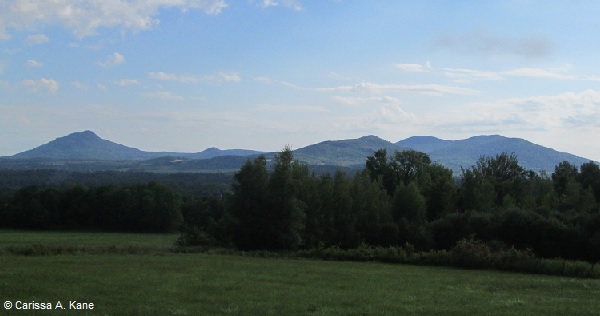
Driving through a countryside, a few years ago, on a quiet summer day, we started to come across farm after farm sprinkled with round bales of hay. Not seeing much activity, we continued the journey, enjoying being surrounded by the scenery and its peace.
Then, after some time, we came to a place where the farmland, still wide open and stretching far ahead, seemed to suddenly meet the mountains. It seemed both so out of place and so appropriate at the same time. A beautiful sight to behold and, having never traveled this road before, completely unexpected.
Taking in our surroundings, I started to wonder what it was like at the foot of that mountain that seemed so way off in the distance. What might be waiting there, or on the other side?
While I may have been tempted to stay where I was and speculate from afar, maybe even labeling what was there—obstacle or challenge… perfect match… gift unclaimed… perhaps, none, some, or all, of the above, it was the beauty that lies within, connecting to the beauty directly before my eyes, that drew me in, reaching into my soul, and calling to me… remember.
What lies behind us and what lies in front of us pales in comparison to what lies within us. – Ralph Waldo Emerson
On the last and greatest day of the feast, Jesus stood up and exclaimed, “Let anyone who thirsts come to me and drink. As Scripture says:
Rivers of living water will flow from within him who believes in me.”
He said this in reference to the Spirit that those who came to believe in him were to receive. There was, of course, no Spirit yet, because Jesus had not yet been glorified. – John 7:37-39
Believe it or not, it seems easier to believe that which is tangible. Thus, the saying, “I’ll believe it when I see it!” Yet, in reality, what one believes actually comes from within. Belief is born out of that which echoes the perceived experience of one’s heart and mind.
As perception changes, the things that resonate and to which one is receptive change too. As a result, internally, one is moved to also change, hopefully for the better. Thus the words of Maya Angelou, “Do the best you can until you know better. Then when you know better, do better.”
This is really what human nature is all about—we are created to continually evolve—called to conversion each and every day. It is important to remember that when it comes to love, and what is truly good, honorable, and just, there is always room for growth! How much? That’s up to the individual—again it comes back to perception.
During Lent and throughout the year, the practicing, and living out, of what one believes, can, and often does, take so many forms. After all, faith is living… breathing… active. It is not intended to be stale, or fixed in place or time, but to be celebrated with body, heart, and mind. Not to be carried along, but to carry us through and to broaden the depth with which we see God, ourselves, and other, as one.
Seek, and you will find what brings you closer. It’s not about “should” or “if,” but rather what is. The journey is yours and God’s together. Trust, and you will discover.
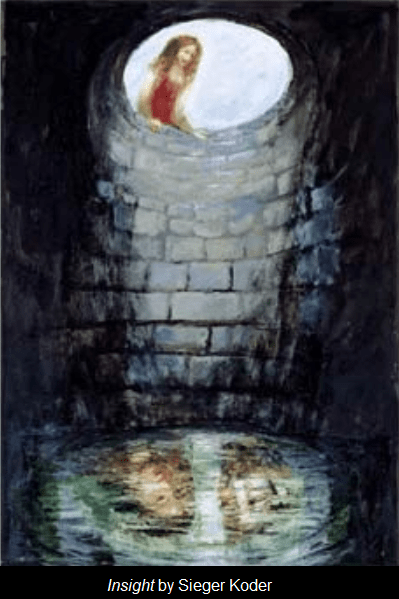
Jesus came to a town of Samaria called Sychar, near the plot of land that Jacob had given to his son Joseph. Jacob’s well was there. Jesus, tired from his journey, sat down there at the well. It was about noon.
A woman of Samaria came to draw water. Jesus said to her, “Give me a drink.” His disciples had gone into the town to buy food. The Samaritan woman said to him, “How can you, a Jew, ask me, a Samaritan woman, for a drink?” —For Jews use nothing in common with Samaritans.— Jesus answered and said to her, “If you knew the gift of God and who is saying to you, ‘Give me a drink, ‘ you would have asked him and he would have given you living water.” The woman said to him, “Sir, you do not even have a bucket and the cistern is deep; where then can you get this living water? Are you greater than our father Jacob, who gave us this cistern and drank from it himself with his children and his flocks?” Jesus answered and said to her, “Everyone who drinks this water will be thirsty again; but whoever drinks the water I shall give will never thirst; the water I shall give will become in him a spring of water welling up to eternal life.” The woman said to him, “Sir, give me this water, so that I may not be thirsty or have to keep coming here to draw water.”
Jesus said to her, “Go call your husband and come back.” The woman answered and said to him, “I do not have a husband.” Jesus answered her, “You are right in saying, ‘I do not have a husband.’ For you have had five husbands, and the one you have now is not your husband. What you have said is true.” The woman said to him, “Sir, I can see that you are a prophet. Our ancestors worshiped on this mountain; but you people say that the place to worship is in Jerusalem.” Jesus said to her, “Believe me, woman, the hour is coming when you will worship the Father neither on this mountain nor in Jerusalem. You people worship what you do not understand; we worship what we understand, because salvation is from the Jews. But the hour is coming, and is now here, when true worshipers will worship the Father in Spirit and truth; and indeed the Father seeks such people to worship him. God is Spirit, and those who worship him must worship in Spirit and truth.” The woman said to him, “I know that the Messiah is coming, the one called the Christ; when he comes, he will tell us everything.” Jesus said to her, “I am he, the one speaking with you.”
At that moment his disciples returned, and were amazed that he was talking with a woman, but still no one said, “What are you looking for?” or “Why are you talking with her?” The woman left her water jar and went into the town and said to the people, “Come see a man who told me everything I have done. Could he possibly be the Christ?” They went out of the town and came to him. Meanwhile, the disciples urged him, “Rabbi, eat.” But he said to them, “I have food to eat of which you do not know.” So the disciples said to one another, “Could someone have brought him something to eat?” Jesus said to them, “My food is to do the will of the one who sent me and to finish his work. Do you not say, ‘In four months the harvest will be here’? I tell you, look up and see the fields ripe for the harvest. The reaper is already receiving payment and gathering crops for eternal life, so that the sower and reaper can rejoice together. For here the saying is verified that ‘One sows and another reaps.’ I sent you to reap what you have not worked for; others have done the work, and you are sharing the fruits of their work.”
Many of the Samaritans of that town began to believe in him because of the word of the woman who testified, “He told me everything I have done.” When the Samaritans came to him, they invited him to stay with them; and he stayed there two days. Many more began to believe in him because of his word, and they said to the woman, “We no longer believe because of your word; for we have heard for ourselves, and we know that this is truly the savior of the world.” – John 4:5-42
Each year as Christmas approaches, I fondly recall a childhood ritual of time spent with a couple of my siblings, huddled around a department store’s holiday edition catalog. The three of us would look at what seemed like endless pages of different games and toys, dreaming of what it would be like to call them our own. At the same time though, we knew that was not going to happen.
Still, each year, we would come together, at the kitchen table or lying on our stomachs on the rug in the family room, captivated by the pictures and descriptions. We were all on, or around, the same page, and not a page was turned until all three of us were ready to move on. Of course, sometimes, we would negotiate and come back to particular page or skip ahead to a different section, but always, we stayed together.
It’s interesting what sharing, can bring to a situation. Although my older sister, younger brother, and I were frequently drawn to different games or toys, we were consistently drawn together. Over the years, the experience of sharing our time with each other as well as our excitement and interest… hopes and dreams, made it seem like anything was possible in the sacred space we shared.
This year, in a pandemic ridden world, where space is better not shared, perhaps another kind of invitation lies in waiting—a bridge of sorts. Maybe a chance to find that which has been overlooked, or what might otherwise be lost. An opportunity to remember or to see more than what we think we know.
As a child looking at those pages of games and toys, I thought it was the catalog that brought such great excitement. However, while it was intriguing back then, now I understand it differently. So often, time and distance can bring perspective in a way that reveals truth or deeper understanding of any matter.
On the 3rd Sunday of Advent, a time of waiting and reflecting, we read in the Gospel according to John that John the Baptist said, “…there is one among you whom you do not recognize…” (John 1:26-27), to the priests and Levites sent to question him. He was speaking of Jesus. Yet, we know that even today, there are moments where each of us can say to ourselves, “there is one among you whom you do not recognize.” Whether it is a person, place, or thing, when we think of it, how do we speak of, and to, Jesus?
A man named John was sent from God. He came for testimony, to testify to the light, so that all might believe through him. He was not the light, but came to testify to the light.
And this is the testimony of John. When the Jews from Jerusalem sent priests and Levites to him to ask him, “Who are you?” He admitted and did not deny it, but admitted, “I am not the Christ.” So they asked him, “What are you then? Are you Elijah?” And he said, “I am not.” “Are you the Prophet?” He answered, “No.” So they said to him, “Who are you, so we can give an answer to those who sent us? What do you have to say for yourself?” He said: “I am the voice of one crying out in the desert, ‘make straight the way of the Lord,’” as Isaiah the prophet said.” Some Pharisees were also sent. They asked him, “Why then do you baptize if you are not the Christ or Elijah or the Prophet?” John answered them, “I baptize with water; but there is one among you whom you do not recognize, the one who is coming after me, whose sandal strap I am not worthy to untie.” This happened in Bethany across the Jordan, where John was baptizing. – John 1:6-8, 19-28
Challenged to see beyond this dreadful thing, the ups and downs around it, and the many other “less than” that exist, as we attempt to rise to the occasion, buds continue to bloom and trees begin to fill in as leaves start to grow. Eggs hatch, and first steps, or first swims, carry on. And as babies become toddlers, the continuum of childhood through adulthood is undisturbed… not deterred, as we all grow, in ways that may differ, or sometimes be the same.
In the face of COVID-19, the precious and the chosen remain, both in this life, and in eternal life. Amid days, leading to months of uncertainty at the hands of this pandemic, lie the new and the renewed at the hands of the Almighty, through the hearts of humanity… and all things living.
“As it was in the beginning, is now, and ever shall be, world without end. Amen.” Glory be to God.
O Me! O Life! – by Walt Whitman
Oh me! Oh life! of the questions of these recurring,
Of the endless trains of the faithless, of cities fill’d with the foolish,
Of myself forever reproaching myself, (for who more foolish than I, and who more faithless?)
Of eyes that vainly crave the light, of the objects mean, of the struggle ever renew’d,
Of the poor results of all, of the plodding and sordid crowds I see around me,
Of the empty and useless years of the rest, with the rest me intertwined,
The question, O me! so sad, recurring—What good amid these, O me, O life?
Answer.
That you are here—that life exists and identity,
That the powerful play goes on, and you may contribute a verse.
Out on a drive, trying to catch some fresh air and see something different, or perhaps even new, I came across a sign like the one below.
The words seemed so striking, causing me to pause. How poetic, given the times in which we are and the ways in which the world is moving along these days. Although, the world is likely moving just the same as ever. As its occupants, it can seem like the world has stopped, or come to a crawl, because we have needed to slow down, if not halt altogether in some regards.
Moving along… somewhere else, at another juncture, on another “not larger than life” road, a different sign. Same meaning, but seemingly more helpful in times like these.
A hopeful note. As if to say, “In time, this too shall pass.”
Life often shifts along the road. We find ourselves sometimes needing to let go, and other times needing to wait, or to hold on… but always needing to believe and to persevere with faith, trust, and hope.
Out of the depths I cry to you, O Lord;
Lord, hear my voice!
Let your ears be attentive
to my voice in supplication.
If you, O Lord, mark iniquities,
Lord, who can stand?
But with you is forgiveness,
that you may be revered.
I trust in the Lord;
my soul trusts in his word.
More than sentinels wait for the dawn,
let Israel wait for the Lord.
For with the Lord is kindness
and with him is plenteous redemption;
And he will redeem Israel
from all their iniquities. – Psalm 130:1-8
Lord, as we walk through each day, help us to use our voices in ways that matter, bringing help, and providing love and nurture, wherever we may be heard. Help us to continue calling out to you, trusting that you hear our prayers, in the joyful as well as the difficult and challenging moments, and help us to hear… to listen carefully, with grateful hearts, for your voice and your glory in all things. For this, we pray…
You must be logged in to post a comment.