Beyond What’s Readily Visible…

As we reach Laetare (“rejoice”) Sunday, the thought of rejoicing during a time of such unrest, outright war, and great concern throughout the world can seem so far away and of another world. However, isn’t that part of what faith is all about? Trusting that there is something more. Placing our hope in the One who hears our cries, lifts us up, and gives us guidance and strength as we strive for eternal life. Rejoicing in the Lord who, without fail, is with us.

Take some time to think about what you’re grateful for and to remember the ways in which you have been blessed by the Lord. Then, inspired by the Lord’s faithfulness, pray for whatever enters your mind and heart, knowing that you are praying to the Lord for whom nothing is impossible.

Continuing on, be mindful of the Lord who is ever present and loves us unconditionally as we look at the readings for the Fourth Sunday of Lent.

In the First Reading (1 Samuel 16:1b, 6-7, 10-13a), the Lord sends Samuel to Bethlehem to anoint David king. When Samuel arrives in Bethlehem all he knows is that one of Jesse’s sons is to be anointed and that the Lord will help him to know which one. As soon as Samuel sees the first son, Eliab, he assumes this is the one to be anointed. However, Eliab is not the one.

“But the Lord said to Samuel: Do not judge from his appearance or from his lofty stature, because I have rejected him. God does not see as a mortal, who sees the appearance. The Lord looks into the heart.” – v. 7

What have you been holding in your heart this past week? What about today? What do you imagine is on God’s heart?

As the reading continues, the remaining sons of Jesse are then presented to Samuel, but none of them are the one that he was sent to anoint. This leads Samuel to ask Jesse if he has any other sons. Jesse reveals that there is another son and then sends for David, his youngest, at Samuel’s instruction. Sure enough, David is the one whom the Lord has chosen.

At first sight, Samuel was certain that Eliab had to be the one the Lord had chosen. Yet, in the end, the son the Lord had chosen wasn’t present and had to be sent for. Imagine how unexpected going through the seven sons who were present and not being told, “this is the one,” must have been for Samuel. What do you think led him to ask Jesse if he had any other sons?

What kinds of things do you notice at first sight? How do you experience the unexpected? In what ways do you sense or seek the Lord’s presence in what you notice? In the unexpected?

The Psalm for Laetare Sunday is the following:

The Lord is my shepherd; I shall not want.
In verdant pastures he gives me repose;
beside restful waters he leads me;
he refreshes my soul.
He guides me in right paths
for his name’s sake.
Even though I walk in the dark valley
I fear no evil; for you are at my side
With your rod and your staff
that give me courage.
You spread the table before me
in the sight of my foes;
you anoint my head with oil;
my cup overflows.
Only goodness and kindness follow me
all the days of my life;
and I shall dwell in the house of the Lord
for years to come. – Psalm 23: 1-6

Reflecting on the characteristics of the Lord that are expressed in the Psalm, in what way do you most need the Lord to shepherd you today?

Turning to the Second Reading, it is written:

You were once darkness,
but now you are light in the Lord.
Live as children of light,
for light produces every kind of goodness
and righteousness and truth.
Try to learn what is pleasing to the Lord.
Take no part in the fruitless works of darkness;
rather expose them, for it is shameful even to mention
the things done by them in secret;
but everything exposed by the light becomes visible,
for everything that becomes visible is light.
Therefore, it says:
“Awake, O sleeper,
and arise from the dead,
and Christ will give you light.” – Ephesians 5:8-14

Allow yourself to envision being enveloped in the light of the Lord. As you take in the goodness of the Lord, your heart becomes full of peace, love, and hope. How do you desire to respond? How does the Lord envision you as an extension of God’s peace, love, and hope?

The Gospel passage is John 9:1-41, The Man Born Blind. Read this passage from your Bible.

What part(s) of this passage resonated with you most? What part(s) surprised you or struck you differently than in the past? How does what you noticed or what’s being stirred within you relate to what’s in your heart and what’s weighing on your heart?

What insight does the Lord want to share with you so that you are better able to consider what’s beyond visible and to see more and more with the eyes of your God-given heart?

I am the light of the world, says the Lord;
whoever follows me will have the light of life. – John 8:12
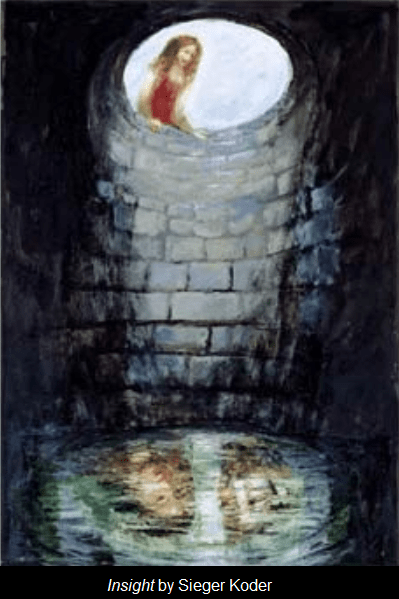
More than water at the Well…

The readings for the Third Sunday of Lent can be seen as an invitation to pray and reflect on our encounters with God and others, the conversations that arise during them as well as after, and how we determine what we hold onto and listen to.

After the prophet Moses led the Israelites out of Egypt and into the wilderness, they started to become disgruntled. God provided food for them in the form of quail and manna, however, as the days passed their unhappiness grew as they still did not know what was next and where they would end up. Their existence became a grind and a growing number of the people began to feel like maybe they would have been better off not following Moses; perhaps their current situation was worse than being enslaved in Egypt.

The First Reading (Exodus 17:3-7) has Moses receiving complaints and being well aware of the growing displeasure among the people. He’s in a “What now?” moment.

So Moses cried out to the Lord,
“What shall I do with this people?
a little more and they will stone me!” – v. 4

What strikes you most from the verse above? What are your conversations with God like during your “What now?” moments?

In the following verse, the Lord responds to Moses and tells him what to do. What do you notice about the Lord’s answer?

“Go over there in front of the people,
along with some of the elders of Israel,
holding in your hand, as you go,
the staff with which you struck the river.
I will be standing there in front of you on the rock in Horeb.
Strike the rock, and the water will flow from it
for the people to drink.” – v. 5-6

In what ways do you trust God to provide for you and others during challenging times? How about during less difficult times?

Recall a time when you cried out to God, and God provided for both you and others.

The First Reading ends with:

The place was called Massah and Meribah,
because the Israelites quarreled there
and tested the Lord, saying,
“Is the Lord in our midst or not?” – v. 7

What do you make of the people quarreling? How do you imagine something like that could impact a sense of trust in the community? And in God?

The response for the Psalm is:

“If today you hear God’s voice, harden not your hearts.” – Ps 95:8.

Again, thinking about your conversations with God, what level of transparency do they reflect? Are there areas where you may be holding back, or you feel like God is? Take some prayer time to express your thoughts and feelings on this and to allow room for God’s insight to be shared with you.

The Second Reading (Romans 5:1-2, 5-8), begins with: “Brothers and sisters:”

If you were to use this greeting, who would be included as brothers and sisters?

This letter to the Romans continues:

Since we have been justified by faith,
we have peace with God through our Lord Jesus Christ,
through whom we have gained access by faith
to this grace in which we stand,
and we boast in hope of the glory of God.

Have there been times when you have felt justified by faith? What made you feel that way or what were the signs? And what was it like?

The passage is completed with the following verses:

And hope does not disappoint,
because the love of God has been poured out into our hearts
through the Holy Spirit who has been given to us.
For Christ, while we were still helpless,
died at the appointed time for the ungodly.
Indeed, only with difficulty does one die for a just person,
though perhaps for a good person one might even find courage to die.
But God proves his love for us
in that while we were still sinners Christ died for us.

How has God’s love been poured out into your heart? What has the impact been? And how do your choices reflect that love to God, yourself, and to others?

In the Gospel Reading (John 4:5-42), we read about Jesus, a Jew, and the woman at the well, a Samaritan. Each comes from a line of people who normally steer clear of each other. Thinking about this atypical exchange back then and life today, how do you desire to respond to the “atypical”?

Next, consider Jesus’s words around water and food, things that last a limited amount of time before one needs to acquire more, as an invitation to look more closely at what’s been on your plate and the concerns you are carrying. As you do so, contemplate what you are seeking and from where you are seeking it.

What does the Lord want to reveal to you?

Lord, you are truly the Savior of the world; give me living water, that I may never thirst again. – John 4:42, 15

Sunset

And When They Raised Their Eyes…

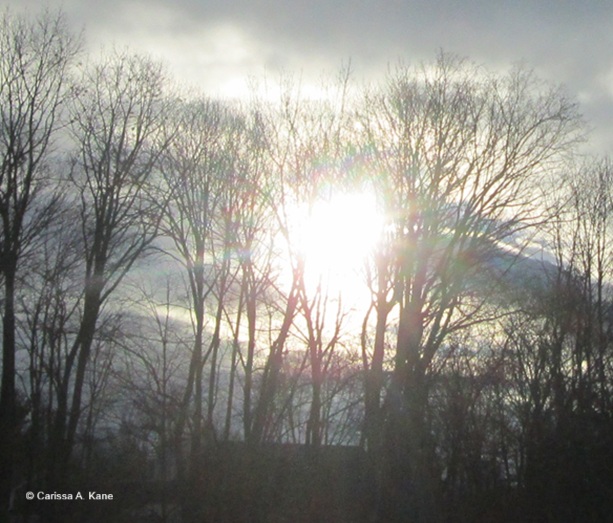
Late afternoon the other day as sunset was moving in, the sky displayed a beautiful spread of colors in between the homes and trees, utility poles and power lines. Through all the obstacles intruding on the view, there was light, not only persevering, but also bringing hope, showing up in shades of glory, working among its surroundings, in a most remarkable way.

When was the last time your attention was caught by light? Recall where you were and what was happening at the time. How were your heart and mind stirred by the experience? As you remember it, how are you touched by it today?

The following verses from the Gospel reading for the Second Sunday of Lent (Matthew 17:1-9) come after Peter, James, and John witness the Transfiguration of Jesus. The three disciples saw remarkable light as they watched Jesus, transfigured, speaking with the prophets, Moses and Elijah. Peter is all about wanting to build three tents at the site—one each for Jesus, Moses, and Elijah.

Take some time to consider what you seek to preserve and what kinds of things lead you to a sense of reverence or admiration?

While he was still speaking, behold,
a bright cloud cast a shadow over them,
then from the cloud came a voice that said,
“This is my beloved Son, with whom I am well pleased;
listen to him.”
When the disciples heard this, they fell prostrate
and were very much afraid. – v. 5-6

Envision yourself on the mountain alongside the three disciples. Like them, you hear the voice and fall to the ground, face down in fear. In that moment, it’s as if you’re alone. But then, Jesus puts his hand on your shoulder and says, “Rise, and do not be afraid.” (v. 7). You lift your head and the first thing you see, are Jesus’s eyes, tenderly looking into your eyes. You reach for and grab his hand as he helps you to stand up. Next, the two of you sit down, and Jesus asks you to tell him what you are afraid of, what is weighing on you or puts your gaze down toward the ground. What do you say? And how does Jesus respond?

What do you need from Jesus to continue raising your eyes toward Him?

Continue the conversation, taking time to reveal what’s on your heart and pausing to really listen to what Jesus wants you to know. When this exchange with Jesus feels complete, allow for some words or a gesture between you and Jesus as you prepare to rejoin the disciples for the trek back down the mountain.

What does Jesus want you to carry with you or to remember most at this moment?

Sunset

And when the disciples raised their eyes, they saw no one else but Jesus alone. – Matthew 17:8

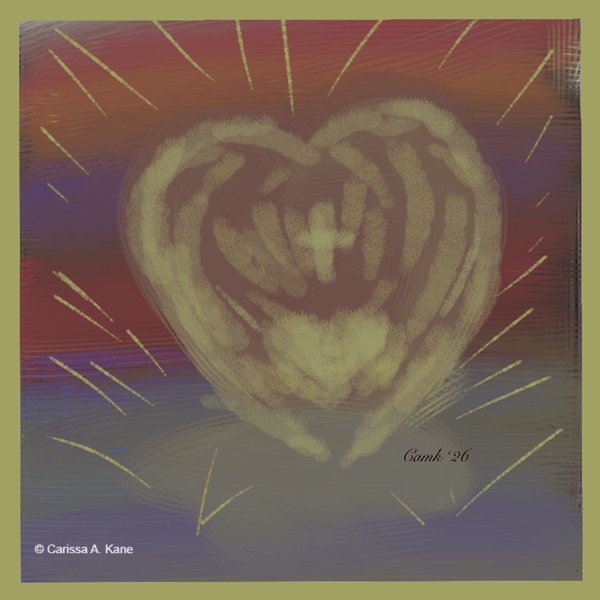
Heart image

Seek With All Your Heart…

In the First Reading for the Sixth Sunday in Ordinary Time, it is written:

If you choose you can keep the commandments, they will save you;
if you trust in God, you too shall live;
he has set before you fire and water
to whichever you choose, stretch forth your hand.
Before man are life and death, good and evil,
whichever he chooses shall be given him.
Immense is the wisdom of the Lord;
he is mighty in power, and all-seeing.
The eyes of God are on those who fear him;
he understands man’s every deed.
No one does he command to act unjustly,
to none does he give license to sin. – Sirach 15:15-20

Take some time to reflect on your words and actions this past week. Consider to what or to whom you “stretched forth your hand” as you went about the week. Invite Jesus to reflect with you. As you review situations that come to mind, how is your heart touched? How do you imagine Jesus’s heart is touched?

The final verse in this week’s Psalm is verse 34 of Psalm 119:

Give me understanding to keep your law, to observe it with all my heart.

There are 613 laws within the first 5 books of the Old Testament (the Torah), there are 10 commandments revealed by God at Mount Sinai, and there are Jesus’s words and example among which is:

You shall love the Lord, your God, with all your heart, with all your soul, and with all your mind.
This is the greatest and the first commandment.
The second is like it: You shall love your neighbor as yourself.
The whole law and the prophets depend on these two commandments. – Matthew 22:37-40

Taking what you have learned through both Scripture and personal experience, how would you describe the heart of God?

In the Second Reading (1 Corinthians 2:6-10), St. Paul gives voice to the fact that knowledge born of the earthly is different than wisdom, pure and true, which is a gift that emanates from God.

But as it is written:
What eye has not seen, and ear has not heard,
and what has not entered the human heart,
what God has prepared for those who love him,
this God has revealed to us through the Spirit.
For the Spirit scrutinizes everything, even the depths of God. – verses 9-10

Contemplate these verses. Notice where your heart is drawn and what comes to mind. As you do so, enter into conversation with Jesus. Reveal your innermost thoughts and feelings and ask him for whatever you need (healing, peace, insight, etc.).

In the Gospel for this week (Matthew 5:17-37), Jesus tells his disciples:

“Do not think that I have come to abolish the law or the prophets.
I have come not to abolish but to fulfill.
Amen, I say to you, until heaven and earth pass away,
not the smallest letter or the smallest part of a letter
will pass from the law,
until all things have taken place.
Therefore, whoever breaks one of the least of these commandments
and teaches others to do so
will be called least in the kingdom of heaven.
But whoever obeys and teaches these commandments
will be called greatest in the kingdom of heaven.
I tell you, unless your righteousness surpasses
that of the scribes and Pharisees,
you will not enter the kingdom of heaven.” – verses 17-20

As you navigate the world around you, how is your heart informed and motivated by God’s laws and commandments, and the spirit of them, along with Jesus’s words and example?

The Gospel passage continues with Jesus stating a few examples of what the disciples have heard or what’s been said of the law of God followed by “But I say to you…”:

“You have heard that it was said to your ancestors,
You shall not kill; and whoever kills will be liable to judgment.
But I say to you…”

“You have heard that it was said,
You shall not commit adultery.
But I say to you…”

“It was also said,
Whoever divorces his wife must give her a bill of divorce.
But I say to you…”

“Again you have heard that it was said to your ancestors,
Do not take a false oath,
but make good to the Lord all that you vow.
But I say to you…” – excerpted verses 21-37

In these verses, Jesus is teaching the disciples a deeper understanding of what they have heard or what’s been said; what they’ve come to know. He’s shifting the focus to connect the law/commandments back to their divine intent—preserving the goodness of God in our hearts.

How might the wisdom of God bring a new understanding or bring greater depth to what you have heard or what’s been said? In what ways might your heart exercise more like the heart of God, the intent of God’s law and commandments, and the teachings and example of Jesus?

Lord, God, creator of all, stretch forth our hearts,
So that your goodness and mercy may shine through.
Let our words and deeds, give you honor and praise.
May they spread hope and love, light and peace, to all.

Heart image

Blessed those who keep the Lord’s testimonies, who seek the Lord with all their heart. – Psalm 119:2

Path leading toward waterfall

Following Faithfully…

Beating still, beating quietly, beating nonetheless,
Attention becomes the disciple of intention.
A stir within, roars within, formation from within.
Look and listen closely as true passion is revealed.

Following the leader? Where? To what good do they lead?
Igniting hearts? Uniting hearts? On whose behalf?
All hearts can and must choose for whom and for what they burn.
Discern! Discern! Deception has so many voices.

Does the message uplift all of us, like the true one
Who gracefully overcomes the small, in all of us,
Helping the steadfast to be ready, set, and to ask,
How does this represent the good teacher serving all?

Path leading toward waterfall

The Lord keeps faith forever,
secures justice for the oppressed,
gives food to the hungry.
The Lord sets captives free.
The Lord gives sight to the blind;
the Lord raises up those who were bowed down.
The Lord loves the just;
the Lord protects strangers.
The fatherless and the widow the Lord sustains,
but the way of the wicked he thwarts.
The Lord shall reign forever;
your God, O Zion, through all generations. Alleluia. – Psalm 146:6-10

What It’s All About…

It’s human nature to try to assign meaning to the things that happen in life. We all have experiences that can leave us wondering, “What was that all about?”. They are situations or encounters that may or may not eventually become more fully known or revealed. However, oftentimes, instead of waiting for that moment to come, where everything comes together and starts to make sense, we rush ahead making our own sense of it.

In those times of “What was that all about?”, temptation seeks to make the situation neatly fit into our own understanding or way of looking at things. That is, the temptation is to see what one wants to see through the lens through which one chooses to see it, rather than allowing time for the grace of God to open the eyes of one’s heart.

In the Second Reading for the Third Sunday in Ordinary Time (1 Corinthians 1:10-13, 17), St. Paul writes:

“For Christ did not send me to baptize but to preach the gospel,
and not with the wisdom of human eloquence,
so that the cross of Christ might not be emptied of its meaning.” – 1 Corinthians 1:17

What words or images come to mind when you consider the meaning of the cross of Christ, and what values do they imply?

How are you influenced by, and how do you remain mindful of, the meaning and those values as you go about each day?

In what ways do you leave room for the possibility that there’s more that you need to consider regarding a situation? How might you rely upon the grace of God more fully?  

In the verses that proceed the one above, St. Paul appeals to the church of God—the people—in Corinth not to succumb to temptation, which seeks to separate them and pit them against each other. He starts off by imploring them to be united:

“I urge you, brothers and sisters, in the name of our Lord Jesus Christ,
that all of you agree in what you say,
and that there be no divisions among you,
but that you be united in the same mind and in the same purpose.” – 1 Corinthians 1:10-11

St. Paul’s audience is the early Christian community in Corinth. Surely, they had more than just a few disagreements! Don’t people almost always though? Despite this, people always also have much in common.

Take some time to contemplate areas of disagreement that you may have with family, friends, and/or others. After naming the point(s) of contention, think about at least one thing you have in common and that you both value. How might that become, or continue to be, a source of unity? Pray with the desire that enters your heart as you consider this.

In the Gospel passage for this Sunday (Matthew 4:12-23), in part, it is written:

As he was walking by the Sea of Galilee, he saw two brothers,
Simon who is called Peter, and his brother Andrew,
casting a net into the sea; they were fishermen.
He said to them,
“Come after me, and I will make you fishers of men.”
At once they left their nets and followed him.
He walked along from there and saw two other brothers,
James, the son of Zebedee, and his brother John.
They were in a boat, with their father Zebedee, mending their nets.
He called them, and immediately they left their boat and their father
and followed him.
He went around all of Galilee,
teaching in their synagogues, proclaiming the gospel of the kingdom,
and curing every disease and illness among the people. – v. 18-23.  

Notice how Jesus called two sets of brothers. Chances are that within each set as well as taken all together, the brothers, didn’t see eye to eye on everything. However, they were all called, and they all left something behind or had to let go of something.

Simon (Peter) and his brother, Andrew, James and his brother, John, certainly must have had their differences, but they all made the individual choice to place their focus on following Jesus, who taught in the synagogues, proclaimed the Gospel, and “cured every disease and illness among the people.” They embraced the Way. And in doing so, they were able to draw closer to God, they were strengthened through their differences, and they stayed united rather than becoming divided.   

The Lord is my light and my salvation; whom should I fear?
The Lord is my life’s refuge; of whom should I be afraid? – Psalm 27:1

From the heart of God

To those who accepted Him…

In the Gospel passage for the Second Sunday in Ordinary Time, John the Baptist gives witness, or testimony, to Jesus being the Son of God.

John the Baptist saw Jesus coming toward him and said,
“Behold, the Lamb of God, who takes away the sin of the world.
He is the one of whom I said,
‘A man is coming after me who ranks ahead of me
because he existed before me.’
I did not know him,
but the reason why I came baptizing with water
was that he might be made known to Israel.”
John testified further, saying,
“I saw the Spirit come down like a dove from heaven
and remain upon him.
I did not know him,
but the one who sent me to baptize with water told me,
‘On whomever you see the Spirit come down and remain,
he is the one who will baptize with the Holy Spirit.’
Now I have seen and testified that he is the Son of God.” – John 1:29-34

Notice how the passage starts with Jesus coming toward John and John, seeing Him, stating what he has come to know—Jesus is the Son of God. John doesn’t just make this statement or claim, out of thin air. The day before, as written in the previous verses of this Gospel, he was asked who he is, to which he responds, “I am ‘the voice of one crying out in the desert, ‘Make straight the way of the Lord,’ as Isaiah the prophet said.” (John 1:23). He continues, explaining to the priests, Levites, and Pharisees sent to question him that he is not the Messiah. John knows his God-given role and accepts it.

Praying with and reflecting on this passage, what have you come to know about your God-given role, and how does the grace of God reaffirm you in it, and help you to accept and live it out?

Contemplating John’s explanation of how he has come to know that Jesus is the Messiah, what do you make of John saying twice in this passage, “I did not know him”? What strikes you about the words that follow each, “I did not know him”?

I did not know him,
but the reason why I came baptizing with water
was that he might be made known to Israel.”
John testified further, saying,
“I saw the Spirit come down like a dove from heaven
and remain upon him.
I did not know him,
but the one who sent me to baptize with water told me,
‘On whomever you see the Spirit come down and remain,
he is the one who will baptize with the Holy Spirit.’

When you find yourself in a situation of not knowing, how do your instincts and what you know come together with, and make room for, God’s wisdom? How about when you find yourself in a situation where you think, or are sure, that you know?

The Gospel passage ends with John saying, “Now I have seen and testified that he is the Son of God.” Recount whatever comes to mind about what you have seen or experienced that is of God, and how you have come to know.

What is your testimony to God? (Keep in mind that there are many ways in which testimony can be given to God.) How do you desire to give witness to what you have come to know?

From the heart of God

Here am I, Lord; I come to do your will. – Psalm 40: 8a, 9a

Christmas Lighted gardens

Homage…

Each year, again, we seek
something more, something new.
Building up. Tearing down.
Holding more than our own
as Glory Be’s to You.

Drawing lines in the sand,
fast and loose with quick claims,
Quit it. Learn a new beat.
Reverence, deference,
in honor of what/who?

Big? Bold? Leaves love to die,
but Love, ever faithful,
with us always, urging
mercy, peace, and goodwill,
for all, not just the few.

Christmas Lighted gardens

We saw his star at its rising and have come to do him homage. – Matthew 2:2

Water flowing from under an iced over pond

The Way He Moves…

From the warmth of Christmas,
Hearts brighten and faces glow;
Generosity abounds.

The origin of one and all
Drawing out our spirits;
His Spirit placed within.

Water flowing from under an iced over pond

Let the peace of Christ control your hearts;
Let the word of Christ dwell in you richly.
– Colossians 3:15a, 16a

Reflecting on this Christmas and the days surrounding it, envision your heart resting within the heart of the Lord. What feelings and experiences come to mind? How was your heart moved?

The following is the Gospel passage for the Feast of the Holy Family of Jesus, Mary and Joseph:

When the magi had departed, behold,
the angel of the Lord appeared to Joseph in a dream and said,
“Rise, take the child and his mother, flee to Egypt,
and stay there until I tell you.
Herod is going to search for the child to destroy him.”
Joseph rose and took the child and his mother by night
and departed for Egypt.
He stayed there until the death of Herod,
that what the Lord had said through the prophet might be fulfilled,
Out of Egypt I called my son.

When Herod had died, behold,
the angel of the Lord appeared in a dream
to Joseph in Egypt and said,
“Rise, take the child and his mother and go to the land of Israel,
for those who sought the child’s life are dead.”
He rose, took the child and his mother,
and went to the land of Israel.
But when he heard that Archelaus was ruling over Judea
in place of his father Herod,
he was afraid to go back there.
And because he had been warned in a dream,
he departed for the region of Galilee.
He went and dwelt in a town called Nazareth,
so that what had been spoken through the prophets
might be fulfilled,
He shall be called a Nazorean.
– Matthew 2:13-15, 19-23

What speaks to your heart most from the above passage? What quality or characteristic would you assign to it?

Again, thinking of Christmas, the birth of our Lord, and the days surrounding it, what do you desire to carry forward? What does the Lord desire for you?

The sun through the bare trees

Walking in the Light…

The readings for the First Sunday of Advent begin with the prophet Isaiah’s vision:

This is what Isaiah, son of Amoz,
saw concerning Judah and Jerusalem.
In days to come,
the mountain of the Lord’s house
shall be established as the highest mountain
and raised above the hills.
All nations shall stream toward it;
many peoples shall come and say:
“Come, let us climb the Lord’s mountain,
to the house of the God of Jacob,
that he may instruct us in his ways,
and we may walk in his paths.”
For from Zion shall go forth instruction,
and the word of the Lord from Jerusalem.
He shall judge between the nations,
and impose terms on many peoples.
They shall beat their swords into plowshares
and their spears into pruning hooks;
one nation shall not raise the sword against another,
nor shall they train for war again.
O house of Jacob, come,
let us walk in the light of the Lord!” – Isaiah 2:1-5

What does your vision of walking in the light of the Lord look like?

Picture yourself ascending the mountain to receive instruction from the Lord. Be attuned to the stirrings of your heart as you do so. Thinking about your ways (words, actions, and general way of being), ask the Lord to join.

Letting the Lord be the judge, what adjustments might help you to greater reflect the image of God?

The Responsorial Psalm is from Psalm 122 (verses 1-9):

R. Let us go rejoicing to the house of the Lord.

I rejoiced because they said to me,
“We will go up to the house of the Lord.”
And now we have set foot
within your gates, O Jerusalem.

R. Let us go rejoicing to the house of the Lord.

Jerusalem, built as a city
with compact unity.
To it the tribes go up,
the tribes of the Lord.

R. Let us go rejoicing to the house of the Lord.

According to the decree for Israel,
to give thanks to the name of the Lord.
In it are set up judgment seats,
seats for the house of David.

R. Let us go rejoicing to the house of the Lord.

Pray for the peace of Jerusalem!
May those who love you prosper!
May peace be within your walls,
prosperity in your buildings.

R. Let us go rejoicing to the house of the Lord.

Because of my brothers and friends
I will say, “Peace be within you!”
Because of the house of the Lord, our God,
I will pray for your good.

R. Let us go rejoicing to the house of the Lord.

What phrase(s) draws your attention most? In what way does it strike a chord with you? Spend some time praying with this verse(s). How are you inspired? Share the thoughts and feelings that arise with the Lord. Ask the Lord to deepen your understanding and the grace to embody the wisdom of this psalm.

In the Second Reading (Romans 13:11-14), St. Paul writes that time is of the essence as he urges the Christians in Rome to embrace that which is eternal, the Light of Christ, over “works of darkness” (verse 12). Knowing that works of darkness can enter through the disguise of light and that the Light of Christ is not stagnant, in what ways do you invite the Lord to be with you as you make decisions, and how do you keep the Lord in your heart and on your mind, as you proceed through the tasks of each day? Ask the Lord to help you in areas you find challenging and to awaken you to areas of potential growth.

The Gospel for the First Sunday of Advent is from Matthew, chapter 24, verses 37-44:

Jesus said to his disciples:
“As it was in the days of Noah,
so it will be at the coming of the Son of Man.
In those days before the flood,
they were eating and drinking,
marrying and giving in marriage,
up to the day that Noah entered the ark.
They did not know until the flood came and carried them all away.
So will it be also at the coming of the Son of Man.
Two men will be out in the field;
one will be taken, and one will be left.
Two women will be grinding at the mill;
one will be taken, and one will be left.
Therefore, stay awake!
For you do not know on which day your Lord will come.
Be sure of this: if the master of the house
had known the hour of night when the thief was coming,
he would have stayed awake
and not let his house be broken into.
So too, you also must be prepared,
for at an hour you do not expect, the Son of Man will come.”

“Stay awake!”, “be prepared,” the time is unknown to you. It could happen in the next breath, far into the future, or somewhere in between. What is your initial reaction to this Gospel passage? And, in what ways does it move you?

Part of awareness and preparation involves thinking about when something will be coming or how long it might last. However, no matter how much one might plan, things can change. And while there are things that one can do regularly to be ready, faithfulness to God is about holding fast to the Lord with an openness or flexibility that allows one to cooperate with His grace. In this way, impediments to staying awake and being prepared are cast out, rather than interfering with discernment and a greater sense of God’s will.

What gets in the way of your openness to change, or things being different than what you thought, hoped for, or planned? Think of a situation where you were open to change. What was that like? And what role did prayer play in it?

Now think of a situation where you were resistant or hesitant to change because what you saw was different than your way of thinking, your approach, or what you pictured. What were you clinging to that removed the choice of being flexible? Ask the Lord to step through this situation with you and for the willingness to accept His point of view, whether it includes reaffirmation, further instruction, or gentle correction.

Continue to reflect on and pray with the insights revealed to you throughout the week. Ask for the grace to be inspired and guided by the will of God, and the desire to draw closer to God this Advent.

The sun through the bare trees

Show us, Lord, your mercy; grant us your salvation. – Psalm 85:8