In a lot of ways, it’s human nature to see preparing in terms of stocking up on tangible assets such as food, beverage, health, and other household supplies. However, the preparation Jesus is talking about in chapter 24, verses 37-44 of the Gospel according to Matthew (included below) , is about not being so attached to that kind of mindset, but rather to focus on embracing what can be attained not through material means, but through a heart that is maturing in its capacity to love and to be loved. This is something that is not accomplished by how much one does or the number of prayers that one might say, but rather by how one’s prayer influences decisions, actions, and interactions, so as to strive to live in such a way that one reflects the heart of God here on earth.
It’s not that preparing to have what one needs to sustain oneself physically is not good. It’s that it can be easy for that to become a bigger part of one’s concerns and for the mind to take over, leading to a heart that’s less than what it is created to be. One that is more self-serving than it is open to being a servant of God. Comparatively, when one can start with their heart, inviting God into the mix, everything else can fall into place. The result being that one has what they need, and not only sees the places where they are able to give, but also has a desire to do so.
As we enter the first week of Advent, in what ways do you need the heart of God to be revealed to you? And how do you desire to be a presence of the heart of God in each moment, in the coming weeks and beyond?
Jesus said to his disciples: “As it was in the days of Noah, so it will be at the coming of the Son of Man. In those days before the flood, they were eating and drinking, marrying and giving in marriage, up to the day that Noah entered the ark. They did not know until the flood came and carried them all away. So will it be also at the coming of the Son of Man. Two men will be out in the field; one will be taken, and one will be left. Two women will be grinding at the mill; one will be taken, and one will be left. Therefore, stay awake! For you do not know on which day your Lord will come. Be sure of this: if the master of the house had known the hour of night when the thief was coming, he would have stayed awake and not let his house be broken into. So too, you also must be prepared, for at an hour you do not expect, the Son of Man will come.” – Mt 24:37-44
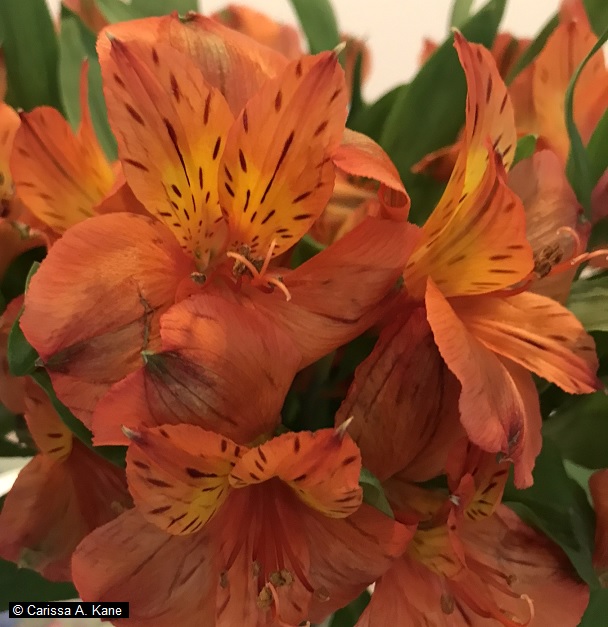
Listen to the flowers As they huddle together. From one petal to another, Be attentive they say, Perhaps in various states of array, All rising from one stem, but in their own way. Looking around, what do they see? What’s happening? What’s that, you say? Cacophony must not dissuade. Take heart and persevere, Regardless of whatever, either, or any way. From one petal to another, Life goes on, and Eternity prevails In taking great care And consideration of each other. Listen to the flowers, From one petal to another, They are one, though many, As they “humble” together.
“Your neighbor is your other self dwelling behind a wall. In understanding, all walls shall fall down. Who knows but that your neighbor is your better self wearing another body? See that you love him as you would yourself. He too is a manifestation of the Most High, whom you do not know.” – Kahlil Gibran
It’s said that only 10% of the energy received from the sun by a plant or tree (a.k.a. a producer) is transferred to the consumer of that plant or tree, and as one moves up the chain, although 10% keeps getting passed along to the next level, the amount of energy becomes less. This means that the further away from the original source one is, more consumption or effort is necessary to achieve or capture the same amount of energy that the plant or tree receives as a producer. As for the 90% of the energy that is retained by producers, it is used for growth and reproduction as well as some of it simply escaping as heat into the atmosphere.
It’s intriguing to think about only 1/10th of the energy received from the original source, the sun, as being passed along from the 1st level to the next, and only 1/10th of that lesser amount going to the next level, and so on. Yet, despite this comparatively small portion shrinking at each level, life not only goes on, but also evolves. It calls to mind last Sunday’s Gospel when in response to the disciples asking for an increase in faith Jesus said, “If you have faith the size of a mustard seed, you would say to [this] mulberry tree, ‘Be uprooted and planted in the sea,’ and it would obey you.” (Lk 17:5-6). It also leads to this Sunday’s readings and a key component of faith.
Although the way of the world might urge one and all to seek what is big, bold, or grand, and to make it known, the readings for the Twenty-eighth Sunday in Ordinary Time (shown below) offer an opportunity to contemplate humility. In the first reading (2 Kgs 5:14-17), Naaman, a successful and celebrated commander of King Aram’s army, is cured of leprosy by submerging himself in the Jordan seven times at the direction of the prophet Elisha. Yet, it is only by taking time to go back and look behind the scenes at the prior verses of this passage, that one can see or be reminded that it was at the urging of servants that Naaman made his way to Elisha, eventually overcame his notions and resistance to listening to the prophet, entered the waters of the Jordan, and was healed. Had Naaman dismissed his servants’ perspectives without consideration and continued to be bound up by his judgments, preferences, and ideas about the unexpected and less than grand actions Elisha instructed him to take, the healing would not have been possible. It’s important to consider humility as requiring an openness to considerations that originate and/or extend beyond oneself.
Turning to the second reading (2 Tim 2:8-13), St. Paul continues to exhort and encourage Timothy, to draw strength from the truth, keeping and carrying on the faith. While St. Paul is recognized for the tendency to be long on words, his point is always focused on the glory of God and eternal life. In this passage he writes, “Remember Jesus Christ, raised from the dead, a descendant of David: such is my gospel, for which I am suffering, even to the point of chains, like a criminal. But the word of God is not chained.” (v. 8-9). What’s it like to reflect on this vision or belief that, even though forces that seek to hold back, limit, or impose restraints on God-given freedom exist, the word of God, and therefore God, remains unchained and is not held back. How do you invite or allow the ever-unchained God into your times of challenge to comfort, sustain, and empower you? What’s it like to embrace or re-embrace, “I can’t, but God can,” and experience humility in this way?
Now, moving on to the Gospel According to Luke (Lk 17:11-19), we come back to a passage involving not 1, but 10 lepers. Jesus meets them as he is making his way to Jerusalem. They all call out to Jesus, asking for pity and they all listen when he tells them, “Go show yourselves to the priests.” (v. 14). However, only one of them becomes aware that he has been healed and goes back to Jesus to express gratitude. Jesus asks where the other 9 who were cleansed are, and goes on to tell the leper who returned, and whom he identifies as a foreigner, that his faith has saved him.” As you think about this passage, what is your first thought or feeling? What strikes you most?
It can be effortless to jump to a place of judgment either toward the one who returned or the 9 who did not. What happens though when you look again and shift your attention in this passage solely to Jesus? As you continue to reflect on this week’s readings, notice where you tend to look for or to celebrate examples of humility in your life? Share your observations with Jesus?
Humility beckons us away from focusing too much on thinking about who or where we are and draws us toward truth and unity. We are called not to shrink, but to open our hearts to all, to seek God (the Source) in all things, remembering to strive to embrace what is eternal while living within the limited reality of this world. Humility is not only letting God be God, but also asking for the grace to relinquish what we can, trust that we are more than what’s measurable, and that what’s left is and will be enough.
First Reading: Naaman went down and plunged into the Jordan seven times at the word of Elisha, the man of God. His flesh became again like the flesh of a little child, and he was clean of his leprosy.
Naaman returned with his whole retinue to the man of God. On his arrival he stood before Elisha and said, “Now I know that there is no God in all the earth, except in Israel. Please accept a gift from your servant.”
Elisha replied, “As the Lord lives whom I serve, I will not take it;” and despite Naaman’s urging, he still refused. Naaman said: “If you will not accept, please let me, your servant, have two mule-loads of earth, for I will no longer offer holocaust or sacrifice to any other god except to the Lord.” – 2 Kgs 5:14-17
Second Reading: Beloved: Remember Jesus Christ, raised from the dead, a descendant of David: such is my gospel, for which I am suffering, even to the point of chains, like a criminal. But the word of God is not chained. Therefore, I bear with everything for the sake of those who are chosen, so that they too may obtain the salvation that is in Christ Jesus, together with eternal glory. This saying is trustworthy: If we have died with him we shall also live with him; if we persevere we shall also reign with him. But if we deny him he will deny us. If we are unfaithful he remains faithful, for he cannot deny himself. – 2 Tm 2:8-13
Gospel Reading: As Jesus continued his journey to Jerusalem, he traveled through Samaria and Galilee. As he was entering a village, ten lepers met him. They stood at a distance from him and raised their voices, saying, “Jesus, Master! Have pity on us!” And when he saw them, he said, “Go show yourselves to the priests.” As they were going they were cleansed. And one of them, realizing he had been healed, returned, glorifying God in a loud voice; and he fell at the feet of Jesus and thanked him. He was a Samaritan. Jesus said in reply, “Ten were cleansed, were they not? Where are the other nine? Has none but this foreigner returned to give thanks to God?” Then he said to him, “Stand up and go; your faith has saved you.” – Lk 17:11-19
Facing the ocean from the walk above or the sand upon the beach it’s easy to stay in place and feel content, and to do so without anywhere near the effort taken to get there. Not only that, but also to slide toward becoming removed from reality—all the lives that exist in various states on and all around the beach and the city or town that encompasses it—and the opportunity to take a life-giving part in it. It’s interesting to think about how swiftly one can be transported to “a world without cares,” with the sound of each wave that breaks upon the shore or the refreshing feeling as each wave washes over everything in its path.
Now, what’s it like to imagine that perhaps this (being caught up in the surroundings) is what it was like for the rich man in the Gospel according to Luke (chapter 16, verses 19-31), before he died?
When we read the Gospel for the Twenty-sixth Sunday in Ordinary Time (below), we learn that a poor man named Lazarus was a constant fixture at the rich man’s door. However, we are not told anything about an interaction(s) between the rich man and Lazarus. This is likely because what matters more than whether the rich man was unaware of, ignored, was indifferent to, or held disdain for Lazarus, is the distance that his worldly aims and wealth put between his ability to help and his desire to do so.
While the rich man was alive, he experienced what is sold in today’s world as “the good life.” However, it led him to becoming insulated from a complete picture of reality (not everyone has it good). And without that, it’s understandable that it would be harder for him not only to choose more wisely, but also to recognize that his openness to, and desire for living in ways that are generative had become diminished.
Neither the rich man nor his brothers could learn from the past (Moses and the prophets), not because the knowledge and wisdom wasn’t available to them, but because their hearts were divided. This—the chasm—is what prevented them from receiving the grace they really needed and making choices for the greater good.
May we be more aware and set our hearts on God to strip away the falsehoods that lead us astray, and to close the chasm that pulls us apart.
Jesus said to the Pharisees: “There was a rich man who dressed in purple garments and fine linen and dined sumptuously each day. And lying at his door was a poor man named Lazarus, covered with sores, who would gladly have eaten his fill of the scraps that fell from the rich man’s table. Dogs even used to come and lick his sores. When the poor man died, he was carried away by angels to the bosom of Abraham. The rich man also died and was buried, and from the netherworld, where he was in torment, he raised his eyes and saw Abraham far off and Lazarus at his side. And he cried out, ‘Father Abraham, have pity on me. Send Lazarus to dip the tip of his finger in water and cool my tongue, for I am suffering torment in these flames.’ Abraham replied, ‘My child, remember that you received what was good during your lifetime while Lazarus likewise received what was bad; but now he is comforted here, whereas you are tormented. Moreover, between us and you a great chasm is established to prevent anyone from crossing who might wish to go from our side to yours or from your side to ours.’ He said, ‘Then I beg you, father, send him to my father’s house, for I have five brothers, so that he may warn them, lest they too come to this place of torment.’ But Abraham replied, ‘They have Moses and the prophets. Let them listen to them.’ He said, ‘Oh no, father Abraham, but if someone from the dead goes to them, they will repent.’ Then Abraham said, ‘If they will not listen to Moses and the prophets, neither will they be persuaded if someone should rise from the dead.'” – Luke 16:19-31
Breaking hearts, Breaking hope. Acting without thought. Wondering without feeling. What kind of way is that? What kind of life is that?
Dribbles and drabbles, The weight of punches and kicks, Bit by bit and day over day, Knocking down, Breathing threats, And more than wrath. What gives? Who?… No, what is being satisfied? How much? How many? Will it ever be enough? Even the mirror turns away. Come on now, Wake up and try to see. That’s no kind of life. That’s no kind of way.
Take a roundabout, But stop somewhere in the middle. Make a life, make a way. Swim upstream for a change. Make it new, make it better. Ask for courage, take in grace, Wash away the mud. Stand next to, and up, for those in need. That’s the way to travel, Kind—that’s the Way to Life.
You cannot serve both God and mammon. – Luke 13:16
Some days the clouds rise upward, an example of striving and reaching higher, as if believing in the best, for the best. Knowing better, doing better. On others though, they seem to drift across the sky, as if allowing themselves to be carried along in a somewhat orderly, but carefree kind of way. Maybe that’s good too.
There are also days when the clouds seem to sit in place, still as can be. Then there are ones where they seem to vanish entirely, leaving only a shade of blue or gray behind. Although perhaps tempting to toss these kinds of days, where the clouds seem less than what they can be, aside, they also hold a message or way of being that can be very much in need.
At the end of a week that saw the passing of Queen Elizabeth II, who signified an age and a large part of the history around the world, on the same day as the Feast of the Nativity of the Blessed Virgin Mary, and that leads into the anniversary of the September 11, 2001 attacks and tragic events, impacting so many around the world, the readings for the Twenty-fourth Sunday in Ordinary Time (Ex 32:7-11, 13-14; Ps 51:3-4, 12-13, 17, 19; 1 Tm 1:12-17; and Lk 15:1-32), remind us about the truth of how relevant and valued we are to God and each other.
With a heart and mind drawn to history, let’s focus on the first reading and the passage in the Book of Exodus in which Moses implores God to refrain from taking wrath against the Israelites who are falling away and have been worshipping false idols. We can see that Moses intercedes on their behalf by speaking the truth of their shared history with God and calling for that to take precedence. This is something he keeps returning to and keeps trying to remind others about, along the journey. Moses remembers aloud God’s promise of life—a long line of descendants—and a place to live—land as a perpetual heritage—to Abraham, Isaac, and Israel. This is not to say that the people who have gone astray can or should do whatever they want, but rather to highlight the importance and necessity of commitment to each other and God as well as for faithfulness to include interceding on behalf of others for what is truly good and just. It’s a real sense of “you are our God… we are your people… together, we belong to you and each other.”
God listens to Moses, considers what he has to say, and turns away from the wrath he had intended to do. Through it all, the key is that Moses holds onto the truth, we are all relevant and valued—and refuses to be separated from the Israelites or from God. It’s all about the attitude toward relationship and unity. A great example of how One can make a difference.
So, the question that repeats itself throughout the ages, regardless of what’s happening in the clouds or the landscape all around me is… Is my desire to be united with God and others greater than my desire for the things that ultimately serve mostly or only me? And, in what ways do I believe in and commit to the best, for the best?
The Lord said to Moses, “Go down at once to your people, whom you brought out of the land of Egypt, for they have become depraved. They have soon turned aside from the way I pointed out to them, making for themselves a molten calf and worshiping it, sacrificing to it and crying out, ‘This is your God, O Israel, who brought you out of the land of Egypt!’ “I see how stiff-necked this people is, ” continued the Lord to Moses. Let me alone, then, that my wrath may blaze up against them to consume them. Then I will make of you a great nation.”
But Moses implored the Lord, his God, saying, “Why, O Lord, should your wrath blaze up against your own people, whom you brought out of the land of Egypt with such great power and with so strong a hand? Remember your servants Abraham, Isaac, and Israel, and how you swore to them by your own self, saying, ‘I will make your descendants as numerous as the stars in the sky; and all this land that I promised, I will give your descendants as their perpetual heritage.'” So the Lord relented in the punishment he had threatened to inflict on his people. – Ex 32:7-11, 13-14
Walking along the pace is brisk in some places and much slower and methodical at others. The path so concrete, laid out as clear as day, but then seemingly disappearing, leaving those travelling it to take stock… to figure the way forward that safely, or maybe wisely, fits them best. Yet, sometimes the “where I am” and “where I want to be” do not meet, or maybe just not yet.
A process that makes time, and the taking of it, not only a good thing, but also a necessary thing. Overall, a journey building upon itself before coming to the end of the trek, or this one, on this plane, at least, and landing on stable ground, or rather learning to be steady on whatever the ground may be.
While some building may call for a single column as if marking the way, some calls are for branching out, and lending support. Still rising, tall and strong, a new look on a familiar way, always moving, continuing the journey, sometimes quick, slower at others, maybe even coming to a pause, but ultimately, always moving toward, if not with, greater depth.
Make straight paths for your feet, that what is lame may not be dislocated but healed. – Heb 12:13
Recently, I took a trip to roam. Yet, I found myself surrounded by lots of moving pieces and it was hard not to get caught up in the pace around me. In a crowded space, quick not being quick enough, too many I’s to dot, too many T’s to cross, and seemingly no time or place for pause. But then, oftentimes there isn’t, until the room for it is made.
“The inspiration you seek is already within you. Be silent and listen.” – Rumi
How tempting it can be sometimes to fall into place and do as others do, or conversely, step out of line and walk away. However, what often gets lost is the balance that allows for the ground that is known as middle. It is the place where things are less extreme, grips and grasps are loosened, and real freedom is experienced. Not beholden to what is less than, the middle is the place that gives permission for mind and heart to meet, and for the soul to connect. And only then, in action there is peace.
“…it is something very near to you, already in your mouths and in your hearts; you have only to carry it out.” – Dt 30:14
I believe that sometimes society seems to be hanging by a thread, but that’s not all I believe…
I believe that God creates similarities, differences, and various dimensions intentionally, rather than carbon copies, or only one kind or way of being.
I believe freedom resides within and is a gift from God entrusted to each, to do with as one wills—as in free will.
I believe that it’s up to each to choose for themselves that which affects, most especially, oneself.
I believe and, also trust, that God has more wisdom than all of us together, seeing things we cannot see and understanding in ways which humans simply cannot.
I believe that to love like Jesus is to love like God—with great depth and breadth, yet personal and unique onto each of us as if we were the only one.
I believe that where hearts and minds are open to the Spirit that is Holy, unity and diversity not only live, but also thrive.
I believe that true victory does not rob others from choosing for themselves, and that what some may celebrate as a “win,” God does not.
I believe the compassion and mercy of God is all encompassing, and that clearly humankind’s is often not.
Most of all, I believe that the greater glory belongs to God, all of “this” will fade away, and that ultimately, through the hearts that are willing, God’s unifying way of love, compassion, and mercy prevails.
I believe that sometimes society seems to be hanging by a thread, but maybe sometimes that’s what we need to be.
And Mary kept all these things, reflecting on them in her heart. – Luke 2:19














 HopeThatFloats
You must be logged in to post a comment.