Be Dazzled…

The readings for the Second Sunday of Lent take us on a journey from sacrifice or letting go to service, embracing identity, and finally becoming one with it. In the first reading, Abraham shows a willingness to sacrifice or let go of whatever his ideas or plans might have been to listen to God and do as God asks (Genesis 22:1-18). Remember, Sarah and Abraham, in their more senior years and against all odds, had their son Isaac after having been barren. Imagine what it must have been like for Abraham to then be asked to sacrifice or let go of his and Sarah’s long-awaited arrival. Yet, Abraham exemplifies a faith that places trust in God (and God alone) above all. He proceeds to take steps toward what God has asked of him. As they left the servants behind and walked along, Isaac asks his father where the sheep is for their offering. Abraham replies, “God will provide the sheep for the burnt offering.” Once they finish building an altar and placing the wood, Abraham moves toward sacrificing his and Sarah’s only child. However, the angel stops him as Isaac’s demise is not what God wills. As Abraham said, God does provide the sheep for sacrifice: “Abraham looked up and saw a single ram caught by its horns in the thicket. So Abraham went and took the ram and offered it up as a burnt offering in place of his son.” And the wisdom of his response to God’s requests and promptings shows that being faithful is to nurture a will that is open to and guided by God. For it is this kind of will that does not lead to demise or destruction.

Continuing to look to what it is to be faithful to God, the response for the Psalm is “I will walk before the Lord, in the land of the living” (Psalm 116:9). How do you feel motivated by Abraham’s example of striving to serve God with a united heart and mind? Try to envision or embody the spirit of walking before God in all that you say and do this week.

Turning to the second reading (Romans 8:31b-34), St. Paul encourages us to remember and embrace our identity when he writes: “If God is for us, who can be against us?” When one is operating with a desire to do God’s will and in the scope of being part of creation in God’s image, there is a sense of inner strength, awareness, and reverence for what is good and just while at the same time a sense of lightness and freedom or free will. It is important to pause every so often to examine what’s going on internally and from where one’s words and actions are flowing. Invite Jesus to the conversation and ask the Lord for the grace to be aligned compatibly with God in each situation you face.

In this week’s Gospel, we read about the Transfiguration of Jesus (Mark 9:2-10), the ultimate image of embracing one’s identity and becoming one with it for the greater good.

Jesus took Peter, James, and John
and led them up a high mountain apart by themselves.
And he was transfigured before them,
and his clothes became dazzling white,
such as no fuller on earth could bleach them.
Then Elijah appeared to them along with Moses,
and they were conversing with Jesus.
Then Peter said to Jesus in reply,
“Rabbi, it is good that we are here!
Let us make three tents:
one for you, one for Moses, and one for Elijah.”
He hardly knew what to say, they were so terrified.
Then a cloud came, casting a shadow over them;
from the cloud came a voice,
“This is my beloved Son. Listen to him.”
Suddenly, looking around, they no longer saw anyone
but Jesus alone with them.

As they were coming down from the mountain,
he charged them not to relate what they had seen to anyone,
except when the Son of Man had risen from the dead.
So they kept the matter to themselves,
questioning what rising from the dead meant.
– Mark 9:2-10
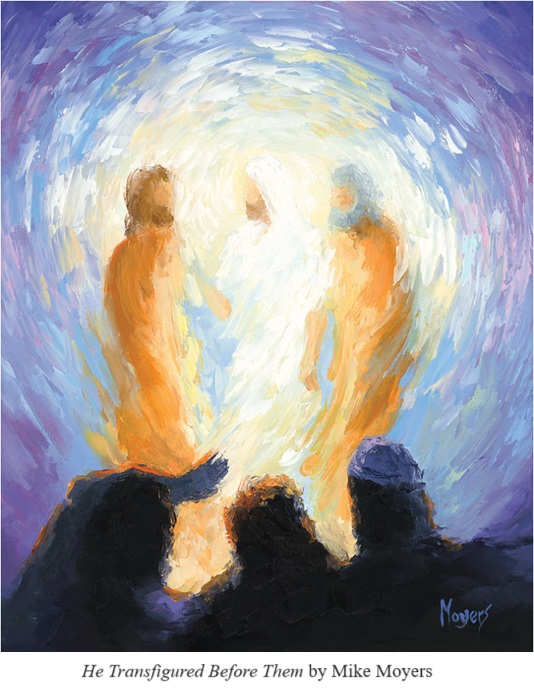
Recall a time where you felt affirmed or reaffirmed and had a sense of confidence in who you are as God’s beloved, leading to spiritual growth or renewal. Ask the Lord for the grace of that experience to extend to today, offering you wisdom, insight, and openness to whatever you may need.


Friday after Ash Wednesday…

It can be easy at times to focus so much on a plan or a routine that one might fall away from the point of having it in the first place. Without even realizing it, the point or the goal can be supplanted by a step(s) laid out to achieve it. This can be especially true during Lent when there’s a tendency to make greater efforts to be intentional about prayer, fasting, and almsgiving.

The scripture passages for today can be taken as an invitation to consider what one’s prayer, fasting, almsgiving, etc. leads them to. For example, in the first reading (Isaiah 58:1-9a), the Prophet Isaiah tells the people what the Lord has said with regards to fasting. The Lord wants to share thoughts and let the people know the attitude and approach that is desired.

Is this not, rather, the fast that I choose:
releasing those bound unjustly,
untying the thongs of the yoke;
Setting free the oppressed,
breaking off every yoke?
Is it not sharing your bread with the hungry,
bringing the afflicted and the homeless into your house;
Clothing the naked when you see them,
and not turning your back on your own flesh?
Then your light shall break forth like the dawn,
and your wound shall quickly be healed;
Your vindication shall go before you,
and the glory of the Lord shall be your rear guard.
Then you shall call, and the Lord will answer,
you shall cry for help, and he will say: “Here I am!”
– Isaiah 58:6-9a

Spend some time contemplating these verses and current events or situations from a broader perspective (e.g. the world, your country) to a more personal one (e.g. your community, family, individual). As you contemplate each area, share your thoughts with the Lord and bring to prayer whatever comes to mind.   

Closing prayer: Lord, grant me, and all your people, the grace to know when our steps are leading us away from the goal—You. Draw us closer and provide us with the wisdom and the strength to let go of whatever may be holding us back. Help us to change course when we’ve gone astray, and to be re-directed so that You and Your ways may always be our foundation and guiding light. We ask this in Jesus’ name. Amen.

Growth mindset

Thursday after Ash Wednesday…

In the Book of Deuteronomy, chapter 30, verses 15-20, after having presented God’s commandments to the people, Moses exhorts them to choose life over death by embracing and living by God’s “commandments, statutes and decrees”. This brings up an interesting question. Outside of obvious situations where the distinction is clear between a choice that is life giving and one that is not, how does one determine what they are really choosing, and perhaps more importantly, why?

There are few things in life that are clear cut and without the possibility for change. Yet, the human tendency leans toward wanting things to be one way or the other, to fit comfortably into categories or boxes, and to be “known for all time”. However, this leaves little to no room for new information or consideration of different circumstances.

Sometimes it can be helpful to flip things around, contemplating them from another angle or two and considering different points of view. Oftentimes, what is thought to be wrong, so different, or out of line, underneath the surface or layers upon first look, can be not so wrong, different, or out of line, at all.

During Lent, we try to renew or refresh our spirit and growth mindset. We open our hearts and minds to seeing and being anew and strengthening our faith and discipleship ways. We are reminded of what it is we profess to believe and why, as well as the desire to choose what is life giving so that even in death, we experience Life.

Take some time to contemplate Moses’ words about choosing life or death alongside the following poem from the Persian poet Rumi.

“I died as mineral and became a plant,
I died as plant and rose to animal,
I died as animal and I was human,
Why should I fear? When was I less by dying?
Yet once more I shall die human,
To soar with angels blessed above.
And when I sacrifice my angel soul
I shall become what no mind ever conceived.
As a human, I will die once more,
Reborn, I will with the angels soar.
And when I let my angel body go,
I shall be more than mortal mind can know.”
– Rumi

What influences your choices? How do you draw inspiration from the example of Jesus in making them? What grace(s) do you desire in this area? Invite Jesus into this conversation, taking time to listen and asking to be open to and to notice whatever insights might be revealed.

Blessed are those who trust in the Lord; the Lord will be their trust. – Jeremiah 17:7

Ever Evolving…

The readings for the Fifth Sunday in Ordinary Time begin with a passage from the Book of Job where the subject, Job, continues to express dissatisfaction as he tries to come to terms with, and understand the reason for, the trials and tribulations he is and has been experiencing.

Job spoke, saying:
Is not man’s life on earth a drudgery?
Are not his days those of hirelings?
He is a slave who longs for the shade,
a hireling who waits for his wages.
So I have been assigned months of misery,
and troubled nights have been allotted to me.
If in bed I say, “When shall I arise?”
then the night drags on;
I am filled with restlessness until the dawn.
My days are swifter than a weaver’s shuttle;
they come to an end without hope.
Remember that my life is like the wind;
I shall not see happiness again. – Job 7: 1-4, 6-7  

Thinking about this passage, what resonates with you most? How do you feel about Job’s plight and about God’s role in it?

Recall a time when you felt challenged, and your faith tested. In what ways was God present to you, even if you were not aware or able to name God’s presence as such at that time? What would you say it was about that experience that affected your faith or trust in God? Take some time to share with God what’s on your mind and in your heart at this moment.

The response for the Responsorial Psalm this Sunday is, “Praise the Lord, who heals the brokenhearted.” (Psalm 147 cf. 3a). We all experience heartache and heartbreak as we journey through life. What situation in your life is outright disturbing your heart or creating a sense of unrest or uneasiness? What do you desire from God regarding this situation? What might God want you to know or to consider? In what ways can you envision this situation as an opportunity to deepen your faith and relationship with God?

In the First Letter of St. Paul to the Corinthians, verse 22 of chapter 9, we read, “To the weak I became weak, to win over the weak. I have become all things to all, to save at least some.” What’s it like to consider this, in light of today’s world, as an invitation to getting along in service to God and for the sake of being a living testament to the Gospel? Sticking with this, what would you want to ask St. Paul about this passage and the challenges he faced? What do you need from God as you strive to be a disciple of Jesus in today’s world? Pray for God’s desire for you, in terms of how you navigate the division and issues in today’s world, to be placed in your heart, imparting wisdom throughout each day.  

Next, as we move to the Gospel passage for the Fifth Sunday in Ordinary Time (Mark 1:29-39), we have Jesus’ healing Simon’s mother-in-law as well as a multitude of people. Upon being healed, Simon’s mother-in-law gets back to the business of serving others. We also learn that Jesus separates from the crowd to go pray. Once he is found, Jesus gets back to the business of preaching and healing people as he moves on to the neighboring villages. Take time to contemplate this passage in terms of the necessity of prayer and downtime or time away. What happens when there is an interruption in your routine? In what ways are you open to change? How do you experience the dynamic nature of God through interruptions and changes around you?

“In Christianity, God is not a static thing—not even a person—but a dynamic, pulsating activity, a life, almost a kind of drama. Almost, if you will not think me irreverent, a kind of dance.” – C.S. Lewis

Something About the Way…

Traveling through time,
Year after year, tick upon tock,
Broken down into moments,
One leading into the next,
Some greener than the others,
But all steady in their passing.
Once gone, they are away,
As if lost, forever missing.
Yet, amid the shades of darkness,
Light lives, cradled deep within,
Both ready and most willing,
Shining ever, and for all.
Walking with great care,
Thoughtful hearts take notice,
Finding Whom they seek,
Steady in their passing.

“We saw his star at its rising and have come to do him homage.” – Matthew 2:2

Holy, Holy, Holy…

Let the peace of Christ control your hearts;
Let the word of Christ dwell in you richly. – Col 3:15a, 16a

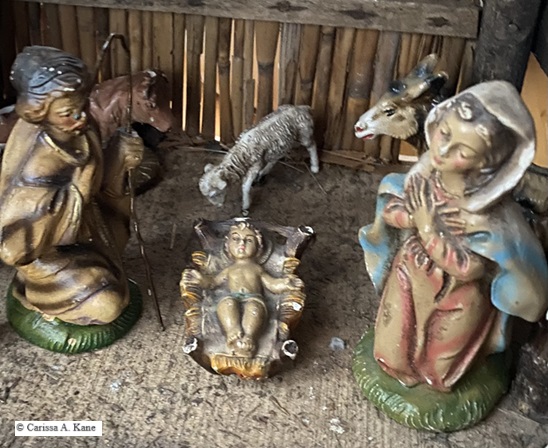
The verses above are used for the Gospel acclamation for the Feast of the Holy Family (usually celebrated the Sunday after Christmas). Oftentimes, the nativity of Jesus and the spirit of Christmas can be accompanied by thoughts of serenity and peace as well as images of idyllic creches and decorations. In such a setting, it can be rather easy to allow the peace of Christ and the word of Christ to flourish within when riding the joy of Christmas or any other anticipated or celebratory day or event. Yet, reality is such that life is a mixed bag and the unexpected, sometimes the dreaded, can come along at any moment, making it more challenging to be open to or inspired by the peace and word of Christ.

Imagine the joy and astonishment of Mary and Joseph at the birth of Jesus and what they initially encountered in the aftermath of his birth as people paid homage. Are there times in your life that come to mind and to which you can relate this experience? Times that have given rise to great joy, overwhelming peace, and/or the feeling of being so amazed.  

Now, here we are, a week later, and in our liturgical celebration, we hear about Simeon and Anna paying homage to Christ and at the same time foretelling what’s to come (Lk 2:2-40).

“and Simeon blessed them and said to Mary his mother, ‘Behold, this child is destined for the fall and rise of many in Israel, and to be a sign that will be contradicted (and you yourself a sword will pierce) so that the thoughts of many hearts may be revealed’.” (v.34-35)  

And coming forward at that very time, she gave thanks to God and spoke about the child to all who were awaiting the redemption of Jerusalem. (v. 38)

What’s it like to reflect on the fact that even though Jesus is the Christ, the reality is that it’s not going to be all roses and sunshine for Jesus, Mary, and Joseph either? It can be tempting to forget or to overlook reality, and to see the Holy Family as not only holy, but also as untouched. Take some time now to invite the Holy Family into whatever is happening at this time in your life. In what ways can you draw strength and inspiration from Jesus, Mary, and Joseph? What’s it like to consider that your experiences, your life, your family, and that of all those around you, are holy too?

Envision the peace and the word of Christ entering into the conversation and dwelling with, within, and all around you, drawing you, and all, closer to God.

Put on, as God’s chosen ones, holy and beloved,
heartfelt compassion, kindness, humility, gentleness, and patience,
bearing with one another and forgiving one another,
if one has a grievance against another;
as the Lord has forgiven you, so must you also do.
And over all these put on love,
that is, the bond of perfection.
And let the peace of Christ control your hearts,
the peace into which you were also called in one body.
And be thankful.
Let the word of Christ dwell in you richly,
as in all wisdom you teach and admonish one another,
singing psalms, hymns, and spiritual songs
with gratitude in your hearts to God.
And whatever you do, in word or in deed,
do everything in the name of the Lord Jesus,
giving thanks to God the Father through him.  – Col 3:12-17

Peace thru the Goodness of the Lord…

In a year where the Fourth Sunday of Advent falls on the same day as Christmas Eve (with the Christmas Vigil Mass), and in a world where it seems that there is a constant push toward an absolute one way or the other, but rarely a celebration of a little here, a little there, or somewhere in between, there lies a reminder of a better way.

Each year the Season of Advent is thought of as a period of waiting and Christmas as a period of celebrating the arrival of Jesus Christ, our Savior. And while we remember and participate in rituals each year, it can be easy to overlook the essence of these practices and to get lost in the ways in which we have come to proceed through them. With this, the opportunity to fully receive what is Divinely offered can become less.

Oftentimes, the greatest desire that many of us hold is the desire for peace (inner peace, peace within families/communities, world peace, etc.). And it is not uncommon to move, knowingly or not, toward external things or activities and attach a sense of peace to them, rather than to the joy they might bring to us as well as the real source of that joy and the peace that accompanies it—the Spirit of God.

Keeping in mind that peace is not possible without an openness to coexistence and unity, in what ways is your heart and mind open to peace? What strengths/challenges do you experience with regards to coexistence and unity in various situations? Where does this come up in your prayer life, and how is your sense of peace affected?  

In a few days, when the Fourth Sunday of Advent and Christmas Eve (with the celebration of the Christmas Vigil Mass) share the day, envision it as an invitation to unity and, through it, peace. Take some time to reflect on the notion that what you desire is what you need, and what you are waiting for is already, in a sense, here. Then take some time to celebrate the goodness of the Lord.

Forever I will sing the goodness of the Lord. – Psalm 89:2A

Under The Influence…

It seems that human nature tends toward comparison and judgment along with practices that help one to “find their place” and obtain some level of comfort. However, although these skills might be helpful in deciphering and navigating the world around us, they can also lead to complacency, and a sedentary or fixed way of seeing and being. The readings for the Solemnity of Christ the King offer an opportunity to reflect upon choices, judgments, and viewpoints, and to consider by what or whom they are influenced. Or, in other words, to contemplate who is leading you.     

In the First Reading (Ezekiel 34:11-12, 15-17), the deep level of care and protective nature of God is expressed.

“Thus says the Lord God: I myself will look after and tend my sheep.” (v. 11).

The passage continues to describe God’s desire to rescue, find, and heal as well as God’s promise to make judgments and course correct those who are wrong or have gone astray.

How do you feel about this notion? What’s it like to leave the judgment and course correction to God? Are there areas in which it is more of a challenge than others? Spend some time in prayer asking for guidance around replacing judgments that veer away from God’s desire for you and for a clearer vision of what role God desires for you.

In the Responsorial Psalm (Psalm 23:1-3,5-6), we stay with the image of the Shepherd who takes care of and provides for his sheep. The psalmist writes of the Lord as refreshing their soul, guiding them in right paths, and blessing them so that “goodness and kindness follow” them. The psalmist then says, “I shall dwell in the house of the Lord for years to come” (v. 6).

What do you think they mean? What do you imagine that would be like? How would it feel? In what places or situations have you experienced similar feelings?  

“The Lord is my shepherd; there is nothing I shall want.” (v. 1).

In what ways do you feel inspired when you imagine God’s loving presence permeating all experiences and capable of extending beyond all that might otherwise be a barrier?

Looking to the Second Reading (1 Corinthians 15:20-26, 28), St. Paul writes about Christ the King who helps us to life by helping us to overcome death, in its various forms, while at the same time leaving the ultimate judgment to God.  

“then comes the end, when he hands over the kingdom to his God and Father, when he has destroyed every sovereignty and every authority and power. For he must reign until he has put all his enemies under his feet. The last enemy to be destroyed is death. When everything is subjected to him, then the Son himself will also be subjected to the one who subjected everything to him, so that God may be all in all.” (v. 24-26, 28).   

What happens when you think about Jesus, to whom God subjected all things, handing the kingdom back to God (v. 24) and subjecting Himself to God? What’s it like for you to let go of something that you have obtained or been given? Where is God in that decision or process?

Now turning to the Gospel (Matthew 25:31-46), Jesus talks to his disciples about the final judgment and separation between sheep (the righteous) and goats. Notice how the criteria that Jesus describes are all things that can be done to take care of and protect others.

“For I was hungry and you gave me food, I was thirsty and you gave me drink, a stranger and you welcomed me, naked and you clothed me, ill and you cared for me, in prison and you visited me.” (v. 35-36).

There is always more than just “I,” “me,” and “mine,” and part of striving for the Kingdom of God is not only to know this, but also to live in a way that shows respect, dignity, appreciation, and care for others. Also, it’s not about being perfect or being able to amass a long list of service to others, but rather about focusing efforts on being in service of God by surrendering one’s heart and mind to being under the influence, united with, and led by God.

The Lord is my shepherd; there is nothing I shall want. – Ps 23:1

It Takes Everyone…

Reading Scripture it’s not too hard to envision the Pharisees and scribes as having a persona of lofty authoritarians who are learned, serious, and on the surface appearing to be so proper. Yet, Jesus points out that their actions do not align with their words. In the Gospel for the Thirty-first Sunday in Ordinary Time, Jesus tells the crowd and the disciples to observe and do as the Pharisees and scribes say, but do not act as they do. Do not hold down or seek to elevate yourself above others. Jesus then goes on to say, “you have but one teacher, and you are all brothers.” You have but one Father, but one master, Christ, and that the greater glory is not in being served or glorifying yourself, but rather in being of service to others, and therefore of service to God.

Reflecting on this Gospel and considering other Scripture passages as well, it may seem obvious that the Pharisees and scribes were not about what they proclaimed. Perhaps they fell victim to the notion that they had already arrived, were afraid of losing what they had attained, or some other thing that shrunk their hearts and made them sterner with others, and lax in their own prayer and practices, making them less likely to be inspired by God and more likely to be misguided and led astray.

Despite this, the actions of the Pharisees and scribes don’t make them worthless or deserving of being canceled. We can hold them accountable but must remember they are still part of God’s creation. They also need love, mercy, and prayers.

Jesus says to observe and listen to what they say. Maybe he’s reminding us that God can still work through them. Their transgressions are not bigger than God.

Praying with this passage brought to mind an instance from grade school, in my 2nd grade classroom, where being orderly was of the utmost importance to the teacher, most especially when it came to the inside of a student’s desk. All the students knew what was expected, and it seemed that all of us really tried to meet this expectation. However, there were a couple of students who had a very hard time with being organized. So, one day, the teacher was walking around the classroom, teaching a lesson, and without warning, flipped and dumped out the contents of this student’s desk, startling everyone, to say the least, and sending books, paper, pencils, and so on, all over the place. The student was then yelled at for being so disorganized, the teacher turned the desk back upright, and told the student to pick everything up, and put it back in the desk, neatly. The student, who was normally quiet, shrunk even more, their cheeks turned red, and tears were coming down their face as they began doing as they were told. The rest of us 7- and 8-year-olds, just sat there horrified. None of us dared to try to help the student for fear of what would happen if we did. It’s interesting how fear can interfere. It’s also interesting how judgment can be too.

When I think about this instance, in the light of this Gospel, I wonder, what was the point, or the lesson being taught that day? What made it so important that the inside of our desks be orderly, to the extent that a student who was trying their best and just being themself, be demeaned like that, and the room be made so disorderly, in efforts to obtain order? However, faith also calls me to hold and look at the entire picture, including before and beyond that instance and to recall that I also had what one would call a lot of positive experiences in that classroom.

Looking at the Pharisees and scribes, Jesus points out a disconnect not only between their words and their actions, but also in their hearts. He cautions the crowd, and us, to not be fooled or distracted toward self-serving ways. To not rely on external things, such as possessions or positions of authority, to gain good graces or a particular outcome, but rather to rely on the grace and guidance of God. Jesus is saying, if we’re going to be led by anybody or anything, or if we’re going to follow anybody or anything, first and foremost, let it be God.

But there’s more… humility.

When we think about this Gospel passage, it can be tempting to cast stones at the Pharisees and the scribes, thinking of ourselves as perhaps being far removed from them, especially in the “us” and “them”, divided times I which we live. Yet, in our certainty and in our knowing, we too can become susceptible to an attitude or posture that interferes and creates static, making us less receptive to being led by God, more likely for other things to come before, or in place of God, and making us less loving, compassionate, and forgiving.

It’s unlikely that the Pharisees and scribes set out to fall into a haze, becoming less aware, open, or able to continue learning through experiences, and blocked, at least at that time, from continually drawing closer to God. However, in certainties and in knowing about what ought to be, it can be easy to become closed off to what is, and the open, honest dialogue that helps us to know when we are moving toward a will that is not in alignment with God, and that is of disservice, rather than what is best.

“Humility is an attitude of honesty with God, oneself, and of all reality. It enables us to be at peace in the presence of our powerlessness and to rest in the forgetfulness of self.” – Thomas Keating

Jesus spoke to the crowds and to his disciples, saying,
“The scribes and the Pharisees
have taken their seat on the chair of Moses.
Therefore, do and observe all things whatsoever they tell you,
but do not follow their example.
For they preach but they do not practice.
They tie up heavy burdens hard to carry
and lay them on people’s shoulders,
but they will not lift a finger to move them.
All their works are performed to be seen.
They widen their phylacteries and lengthen their tassels.
They love places of honor at banquets, seats of honor in synagogues,
greetings in marketplaces, and the salutation ‘Rabbi.’
As for you, do not be called ‘Rabbi.’
You have but one teacher, and you are all brothers.
Call no one on earth your father;
you have but one Father in heaven.
Do not be called ‘Master’;
you have but one master, the Christ.
The greatest among you must be your servant.
Whoever exalts himself will be humbled;
but whoever humbles himself will be exalted.” – Matthew 23:1-12

The Strength to Get Along…

Taken by the contrasting colors of the leaves against the soothing blue backdrop of the sky, it’s interesting how well they get along.

In the Gospel passage for the Thirtieth Sunday in Ordinary Time, the heart of Jesus’ response can be seen as an invitation to consider love, and how it is revealed through, and in, relationships. Jesus reminds us that being faithful to God is more than striving to love and serve God. It also involves striving to love or to take care of oneself as well as one’s neighbor.

When the Pharisees heard that Jesus had silenced the Sadducees,
they gathered together, and one of them,
a scholar of the law tested him by asking,
“Teacher, which commandment in the law is the greatest?”
He said to him,
“You shall love the Lord, your God,
with all your heart,
with all your soul,
and with all your mind.
This is the greatest and the first commandment.
The second is like it:
You shall love your neighbor as yourself.
The whole law and the prophets depend on these two commandments.” – Mt 22:34-40

Reflecting upon the past week, in what ways did you strive to love and serve God? What thoughts and feelings surface as you recall the situations where the love of God was most present to you? Allow yourself to envision God’s response to a heart, your heart, operating in love and service.

Continuing to stay with the moments of the past week, are there ways you took care of yourself through them? Take some time to consider more fully how each experience came about. What might God want you to know about them? How might you pray in response?  

What moments come to mind as ones where the love you have received extended beyond yourself whether in thought or deed?

Still reviewing the past week, who or what would you include as your neighbors (family, community members, any fellow human being, animals, nature, etc.)? What did you appreciate in them? For each way that you might have struggled to appreciate them or that you felt more than a little challenged by them, try to return to naming something you appreciated.

How do you feel inspired by the things that you have contemplated during this time? And what do you desire to carry forward?

I love you, Lord, my strength. – Psalm 18:2