In the Gospel for the Fourteenth Sunday in Ordinary Time (Mark 6:1-6), as Jesus is teaching in the synagogue in Nazareth (his hometown), the people there are rather cynical due to their preconceived notions about what someone teaching with authority needs to be or look like, or where they need to come from. This is nothing new though. A common misstep of humankind throughout history has often been allowing for the appearance of strength, status, or other superficial measures to supersede the things that really matter, such as substance.
In this Gospel passage, we learn that Jesus couldn’t do much in Nazareth. It is written of Jesus, “He was amazed by their lack of faith.” What do you think is meant by that? What do you think made the people so closed off to Jesus, his approach, and what he was trying to teach them?
Whatever it was, there was a lack of openness to the Spirit of God exuding from Jesus. Perhaps the people couldn’t accept his words as truth or take to heart and ponder them, because they challenged them to consider things differently. However, with God, relationships are all about being mutual. And so, Jesus works with those in Nazareth who are open to the Spirit, and then moves on to places where the people are more open to him and the Way. Nothing is forced upon the Nazoreans, or those who disagree, and as always, Jesus models an example of respecting free will and trusting his Father to be the ultimate judge and decider of their fate. Anything else would lead to Jesus putting himself over God and would lead to further division and chaos.
Jesus can see this, but most of the people in the synagogue are too caught up in their own ideas and ideologies to notice the substance of Jesus’s teaching. Perhaps they recognize that it’s more than just another day in the synagogue, but their faith has shifted into a fixed version of the way things ought to be based on what they can wrap their minds around, rather than remaining fixed on God and, therefore, flexible to receive the Spirit’s guidance toward what may be new and different but is still of God.
When one comes to expect, or demands, the same of every day or has become self-centered and self-preserving above all else, faith becomes stagnant and fixed, for with God, Jesus, and the Holy Spirit, there’s always something happening for the good of all, there is breadth and depth, there is newness and life… there is acceptance, and it is always more than just another day.
Therefore, I am content with weaknesses, insults, hardships, persecutions, and constraints, for the sake of Christ; for when I am weak, then I am strong. – 2 Corinthians 12:10
In the Gospel passage for the Twelfth Sunday in Ordinary Time, Jesus’s disciples reach out to him as the boat they are in is taking on water in the middle of a storm. Jesus says to the wind and the raging sea, “Quiet! Be Still!” and just like that, the storm settles down. This is something he could have done without saying any words, but Jesus, always the teacher, gives his disciples, and us, both an example to follow and words to ponder.
After quieting the storm, Jesus asks his disciples, “Why are you terrified? Do you not yet have faith?” He is not reprimanding them or trying to make them feel bad, but rather he is asking them to reflect on the situation, and trying to help them to know, and to remember, that he is there with them and for them, and so, there is nothing to fear. Without Jesus, the storm can rage on, whether loud and brash or quiet and discreet. It is Jesus’s presence that both quells the storm and brings peace into the quiet and stillness.
On that day, as evening drew on, Jesus said to his disciples: “Let us cross to the other side.” Leaving the crowd, they took Jesus with them in the boat just as he was. And other boats were with him. A violent squall came up and waves were breaking over the boat, so that it was already filling up. Jesus was in the stern, asleep on a cushion. They woke him and said to him, “Teacher, do you not care that we are perishing?” He woke up, rebuked the wind, and said to the sea, “Quiet! Be still!” The wind ceased and there was great calm. Then he asked them, “Why are you terrified? Do you not yet have faith?” They were filled with great awe and said to one another, “Who then is this whom even wind and sea obey?” – Mark 4:35-41
So strong, so brave, so full of Life, So strong, so brave, so full of Light. Each day a treasure to behold, Some sweet, and some that smart, Some unlike any of the others. So many days along the way, Melting one into the other. As you fell, we fell, always together, Like flowers dropping off their stems, Holding onto shape and color, Faithful always, and to the end. So strong, so brave, still so full of Life. So strong, so brave, still so full of Light.
For we walk by faith, not by sight. – 2 Corinthians 5:7
In the First Reading for the Solemnity of the Holy Trinity (Deuteronomy 4:32-34, 39-40), Moses reminds the people of how God has been present to them in Egypt and the magnitude of what God has done for them. He then implores them to use these experiences to remain focused on God as well as God’s ways thru adherence to God’s statutes and commandments. There can be a tendency to think of statutes and commandments as confining, but when taken into consideration along with the bigger picture of God’s dedication and love for all of creation, they can be seen as providing concrete ways to create unity and exercise respect and dignity with a goal of freedom and protection for one and all.
With God there is always more than one side. The relationship is mutual and considers all parties. There are statutes and commandments, but there are also God’s actions, not just telling humanity how to be, but also leading the way and showing us by example. The verses in the Psalm (Ps 33:4-5, 6, 9, 18-19, 20, 22) describe the Lord’s words, actions, and persona as: upright, trustworthy, just, right, kind, effective, protective, and helpful. These attributes are also infused in the statutes and commandments. They are extended to us by God and in turn we are to extend them to each other.
In the Second Reading (Romans 8:14-17), St. Paul reminds us of our part in the Trinity. As “children of God” and “Joint heirs with Christ” we are not to be enslaved by fear, but rather to live in and be led by the Spirit of God. The passage begins with a salutation of “Brothers and Sisters.” This is not an uncommon greeting. Readings from the letters of St. Paul often begin with a salutation of “Brothers and Sisters,” perhaps to continually express the overall desire and focus on the goal of unity with the Lord and one and another. Imagine starting all your communications with “Brothers and Sisters” or adding “Brothers and Sisters” to communications you receive. How might that shape what you write/say and how you receive what is written/said to you?
Moving on to the Gospel passage known as the Commissioning of the Disciples (Matthew 28:16-20), the disciples, who have gone to Galilee as instructed by Jesus, encounter the risen Jesus. It is written, “they worshipped, but they doubted.” (verse 17). What’s it like to think that despite the existence of doubt, they were still seen as worthy, encountered Jesus, and were given the opportunity to serve as Jesus’ disciples? When situations arise, it can be tempting to give rise to doubt or to fall into a one thing or another, or all or nothing mindset. However, with the Lord, all are worthy, there are often many ways and different degrees to serve, and faith always triumphs over doubt.
Overall, the Solemnity of the Most Holy Trinity presents an opportunity to acknowledge, contemplate, and celebrate how one experiences the Father and the Son and the Holy Spirit. When you consider each aspect of the Trinity, what characteristics or attributes come to mind? How have you experienced these in your life and how has your prayer been influenced by them? In what ways are you inspired by the Holy Trinity individually and in your relationships? How might the Trinity influence you to overcome uncertainty or division and work toward unity, to better communicate or deepen relationships, or in any related discernment?
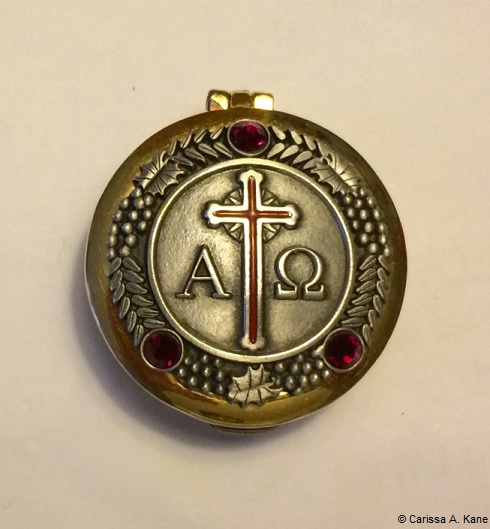
“I am the Alpha and the Omega,” says the Lord God, “the one who is and who was and who is to come, the almighty.” – Revelation 1:8
The goodness of your breath O God, filled me up, heart and soul and body, and got me started. The faithfulness of your presence Carries me along, and your spirit, Moves me to what is best.
How much? How many? What rank? It does not matter; not a single bit. Besides, who am I to measure?
You lead me through both highs and lows. You teach me how to be, and what to cherish. I am lifted up and over by your love and care. Amazing how you do it. Amazing! The glory is forever yours, and yours alone, Yet, you always share it.
When you send forth your spirit, they are created, and you renew the face of the earth. – Psalm 104:30
Holy days and holidays ushered in between the rush, bring a slowing down, or temporary halt at best. Then, it’s back to the pace of pressure; quick and fast, As if the Lord did not make every day.
This is the day the Lord has made; let us rejoice in it and be glad. – Psalm 118:24
Neither grave, nor the gravity, Could hold Him down. That cross, though heavy, Not heavy enough, Nor could it ever be. A temporary thing, A passage, passing with time, The Begotten not gone.
That stone, though big, Not big enough, Nor could it ever be. A temporary thing, A passage, passing with time. The Begotten hidden, Not seen, not heard, But certainly not gone.
Then, Easter. Arriving between the quiet, Entering amid the stillness, And everything changes. Everything becomes new again, In the remembering of what is. Nothing ever stronger than What was, What is, and What shall ever be.
Just as Light cannot be kept from shining, And Truth, refusing to remain hidden, There is no greater shield or power than that created by Creator. We are more than passengers on borrowed time. More than temporary things or passages, passing with time. And in Him, with Him, and thru Him, Neither grave, nor the gravity, Can hold us down.
Breaking, broke, broken, Rescued, healed, awoken, Ever taken with your Way. For the sake of all, It’s all the same. No one more than the other, Each onto its own, But gathered in Your name.
Your grace O Lord, The longing of our hearts. Eloi, Eloi, lema sabachthani. At times, perhaps, We think we know, Yet thinking doesn’t make it so.
Your grace O Lord, The longing of our hearts. We feel one way or another, Sometimes many ways at once, Yet feeling doesn’t make it so.
Your grace O Lord, The longing of our hearts. With us, within us, Always within reach.
Your grace O Lord, Makes known your Way, The desire in our hearts, Yours and ours together, Rising up, makes it so.











You must be logged in to post a comment.