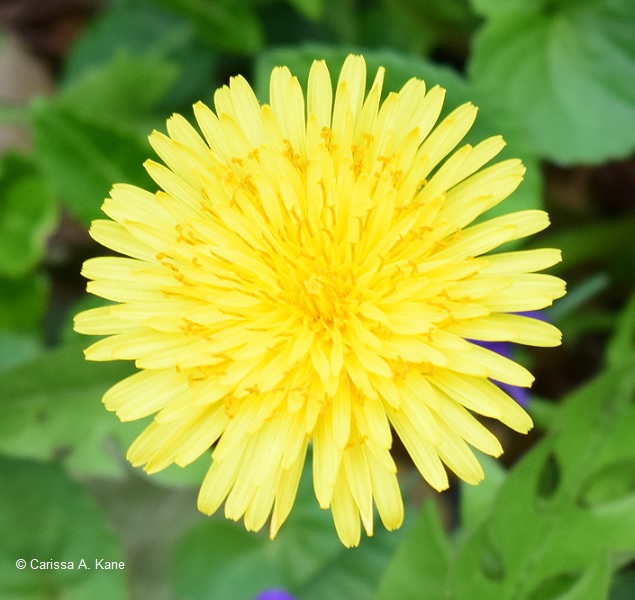
Upon first sight a threat, A battle to be had, A thing to put to rest. Yet, drawing closer A picture to behold. Golden, like the rule, If only it were practiced. So many points to reflect upon, Held together at the center And spreading out, As if to say, I have so many ways, I am full of life, But still have room to grow. Here for now, as if forever, as I am, But please know better, All is ever changing. Working toward the air, Poetry in motion, To be blown about, And all around, Making waves, Albeit gentle, From one life to another. Eternal presence, Dwelling for the masses, Extending hope And willing for your freedom. Not to be distorted, Or held hostage for your needs, But rather carried with great mercy, And my love, The example of compassion.
The Lord is my shepherd; there is nothing I shall want. – Psalm 23:1
Today, April 22, 2023, as we head into the 3rd Sunday of Easter, we celebrate Earth Day. The earth has been around for over 4.5 billion years, and Earth day? It has been celebrated for 53 years—since 1970.
Despite the comparatively young age of Earth Day, an appreciation for, and the call to honor and preserve the beauty of our planet, nature, and all creation has been ongoing for a far greater time than has been documented. In fact, it’s part of the plan, and path of life. Yet, as with many things, it can become a battle ground… a place for sides to be formed, to rise up against each other, to hold firm, to lose sight, and to stall any attempts at dialogue and resolution, never mind love and mercy.
In the readings for the 3rd Sunday of Easter (Acts 2:14, 22-23; Ps 16:1-2,5, 7-8, 9-10, 11; 1 Pt 1:17-21, and Lk 24:13-35), there lies an invitation to connect more strongly with the path of life as being bigger, and sweeping more broadly, than the circle in which any one individual, or group, travels. So often when we think we know, we don’t. The issues at hand are always more than what we can see, and the way that any one individual may or may not be affected, cannot be used to color the experience of all of humankind. How, after all, is it possible to be open to Divinity, without being open to possibilities?
Turning to Scripture, it seems that those who sought to crucify Jesus, were so sure that he was a threat. It’s clear that His ways were not in line enough with theirs and one can imagine how that might jeopardize their sense of identity, authority, power, and control. We can see how their ability to move in ways that embraced and imbued love, truth, justice, and mercy was hindered by their inability to recognize that they were seeing and acting through their own, limited understanding. There was no room for God on the path to which they were so deeply committed, and this led to them receiving and reacting in fear and seeking even greater control, rather than responding with love.
On the other hand, Jesus, who reacted with love and was inspired by God, could not be held down, even by death.
This man, delivered up by the set plan and foreknowledge of God, you killed, using lawless men to crucify him. But God raised him up, releasing him from the throes of death, because it was impossible for him to be held by it. For David says of him: I saw the Lord ever before me, with him at my right hand I shall not be disturbed. Therefore my heart has been glad and my tongue has exulted; my flesh, too, will dwell in hope, because you will not abandon my soul to the netherworld, nor will you suffer your holy one to see corruption. You have made known to me the paths of life; you will fill me with joy in your presence. – Acts 2:23-28
This is the message of our faith, and the model that we are to follow. Our faith and hope is to be placed in God, and doing so, our words and actions will reflect the Way of God. The Way where our eyes are opened and our hearts burn with desire to be in the service of Love, wherever it leads.
On the road to Emmaus, the two disciples requested of Jesus, “Stay with us” (Lk 24:29).
In our striving, we must do the same, and like the disciples, we must also leave room for the breaking of bread and having hearts that are open to receive, with the love of Jesus, whatever may be revealed.
“You cannot get through a single day without having an impact on the world around you. What you do makes a difference, and you have to decide what kind of difference you want to make.” – Jane Goodall
As pockets of clouds drifted across the clear night sky, the moon, at its fullest continued to reflect hope and promise in each passing moment, inspiring hope and promise with each passing thought. What is, what would be, what could be, beholden to One, the only One. There is I Am.
The response to the Psalm for the Third Sunday of Lent is, “If today you hear God’s voice, harden not your hearts.” (Ps 95:8). What does a hardened heart look like? Physically, it is one in which arteries may be clogged, or the lining may be thickening, to name a couple attributes. Overall though, it is a heart that is blocked in one way or another from working optimally or as designed. Spiritually, a hardened heart is also blocked in one way or another from working fully, as intended by God.
So how does one recognize a hardened heart? Well, as with many things, there are indicators as well as tests that can alert one to the status of their heart. And in faith, the directions always start at the beginning. “If today you hear God’s voice…”
What does God’s voice look, or sound like to you? What adjectives would you use to describe God?
Now, taking Light to life, what happens when you try to assign those same adjectives to describe the heart behind your words and actions throughout the day, the week, and more? In what situations do they fit? And in what situations, is there an invitation for greater growth and movement toward taking on the heart of Jesus?
A Lenten Prayer: Heart of Jesus, open our eyes and ears. Heart of Jesus, show us what our hearts are looking past. Heart of Jesus, help us to acknowledge what is, what would be, what could be. Heart of Jesus, guide us in your way. Heart of Jesus, bind our hearts to yours.
Into the night and all day too, The glow of lights sprinkled here and there, but really, almost everywhere. This peace, this joy, ever present, Sometimes noticed more than others, Sometimes not at all, Nevertheless, a presence always there. The heart, holding all together, Ups and downs, yeas and nays, Judgments, and lessons learned. Steady in the flow of life, Brave but never brazen. Standard bearer, but more, Usher of truth and light. There through it all, From year to year, And age to age.
Holy Spirit, help us turn the page, As the bells ring, And a new year begins, Renew our listening, Renew our resolve. Show us love, Show us kindness. Bring us peace, Bring us newness. Help us to work with Grace, To change what we need to change, And to carry hope, wherever we go. Help us, bit by bit, to turn our world around.
May God be gracious to us and bless us; may God’s face shine upon us. – Psalm 67:2
Literally, the second the light turns green, horns are honking. Sometimes, it is from cars two or three deep in line! Imagine if instead of cars on the roads, it was just people, single file, moving on foot. Stop or go to the rhythm of the traffic lights. Perhaps it would be more like the game musical chairs than the one named “Simon Says,” but in today’s world, likely more dangerous, and certainly far more intense.
While in situations like driving, signs of impatience can be much easier to spot, at other times it can be harder to see when patience is absent or slipping away. The second reading for the Third Sunday of Advent (Jas 5:7-10), begins with, “Be patient, brothers and sisters.” It seems so fitting that during one of the busiest times of the year for many people, these verses in the Letter of James contain a form of the word, and urges patience four times, once each in three out of the four verses. And, as for the one verse that doesn’t use the word, it calls us to ponder one of the ways that human beings tend to handle displeasure with one another (“Do not complain, brothers, about one another, that you may not be judged.” – v.9).
Think of a recent experience where you were on the receiving end of your own or someone else’s impatience or displeasure. What happened? And what judgments were involved?
Now, think of a recent experience where you were the one responding with impatience or displeasure. What was going on? And what opinions or beliefs were involved?
In each situation, how might an increase of your own patience have improved the situation or the aftermath of it?
When pausing to think of recent experiences where patience was lacking or displeasure arose, on someone else’s part or on your part, which experience was easier to recall? Which experience came to mind more quickly?
It can be tempting to see patience in terms of something someone has or does not have. However, like any other attribute, it’s possible for it to exist in some situations and not in others. This is important because oftentimes it can be easy to think, “I’m patient,” or “I’m…” this or that based on a small sampling of situations that one’s ego might readily serve up to “pass the test” and move us along from further introspection and possibly attaining additional growth and greater freedom; things that are impossible without honestly looking across and considering the spectrum of one’s life experiences.
An Advent Prayer: Lord, help me to allow you to direct the pace of each day. Through my stopping and going, and all that may occur between, may my actions and responses reflect grace and genuine patience and understanding that flows from you, regardless of what I may or may not receive in return. And help me to continue to look to you, that you may grant me the grace to notice and appreciate the beauty and goodness of all creation, and the heart and soul of those I encounter each day.
Be patient, brothers and sisters, until the coming of the Lord. See how the farmer waits for the precious fruit of the earth, being patient with it until it receives the early and the late rains. You too must be patient. Make your hearts firm, because the coming of the Lord is at hand. Do not complain, brothers and sisters, about one another, that you may not be judged. Behold, the Judge is standing before the gates. Take as an example of hardship and patience, brothers and sisters, the prophets who spoke in the name of the Lord. – James 5:7-10
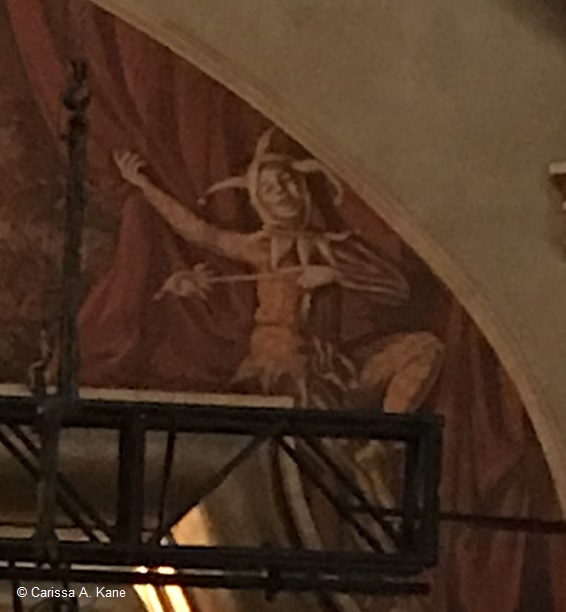
Waiting for the show to begin, But maybe it never stopped. Still, wondering what the next scene may hold, And noticing how the stage is set. Then, up high and to the right, Along the border, Sidelined and on the corner, A character, in all honesty, Sitting there, also waiting, To tell the story, And to make it known, Whether funny or not, The truth behind and around, As well as within it.
God made Truth with many doors to welcome every believer who knocks on them. – Kahlil Gibran
“Among the tales of sorrow and of ruin that came down to us from the darkness of those days there are yet some in which amid weeping there is joy and under the shadow of death light that endures.” – J.R.R. Tolkien
The above quote seems so apropos for the world of today despite it being written many decades ago. Interesting how in every age there are things about which one can say, what’s old is new, and what’s new is old, or in other words some things are timeless.
Entering the 3rd week of Advent, the readings invite us to avail ourselves of God’s promise,
The Lord, your God, is in your midst, a mighty savior; he will rejoice over you with gladness, and renew you in his love, he will sing joyfully because of you, as one sings at festivals. – Zep 3:17-18a
To step over the darkness of our times,
God indeed is my savior; I am confident and unafraid. My strength and my courage is the Lord, and he has been my savior. – Is 12:2
And into the ever-present joy and light of the Lord.
Brothers and sisters: Rejoice in the Lord always. I shall say it again: rejoice! Your kindness should be known to all. The Lord is near. Have no anxiety at all, but in everything, by prayer and petition, with thanksgiving, make your requests known to God. Then the peace of God that surpasses all understanding will guard your hearts and minds in Christ Jesus. – Phil 4:4-7
As we wait in hope for the coming of the Lord, in what ways does the wisdom of God’s word resonate? How is the Spirit of the Lord present in these moments of waiting? In what ways do they create inspiration? And where do they spark peace and love… joy and light?
The crowds asked John the Baptist, “What should we do?” He said to them in reply, “Whoever has two cloaks should share with the person who has none. And whoever has food should do likewise.” Even tax collectors came to be baptized and they said to him, “Teacher, what should we do?” He answered them, “Stop collecting more than what is prescribed.” Soldiers also asked him, “And what is it that we should do?” He told them, “Do not practice extortion, do not falsely accuse anyone, and be satisfied with your wages.”
Now the people were filled with expectation, and all were asking in their hearts whether John might be the Christ. John answered them all, saying, “I am baptizing you with water, but one mightier than I is coming. I am not worthy to loosen the thongs of his sandals. He will baptize you with the Holy Spirit and fire. His winnowing fan is in his hand to clear his threshing floor and to gather the wheat into his barn, but the chaff he will burn with unquenchable fire.” Exhorting them in many other ways, he preached good news to the people. – Luke 3:10-18
In chapter 18 (verses 33-37) of the Gospel according to John, Pilate asks Jesus who he is and what has done, and Jesus’ answer, as always, is all about truth. And that’s what faith is really all about—Truth and learning not only to recognize it, but also to listen to, and be led by it. In the verses that follow this passage, Pilate knows the Truth—Jesus has done no wrong, but he does not choose to listen and allow himself to be led by it.
On the Feast of Christ the King, this passage presents a great opportunity for prayer and reflection on who we are and what we do as followers of our Lord Jesus Christ. Both collectively and individually, as we approach the season of Advent and the Nativity of Christ our Lord, in what ways do the things we do and the presence of heart and mind with which we do them, reflect the goodness of God? And to what extent are they the result of truly listening and being led by Grace?
Amid one’s hopes and dreams and into the flow of reality, how do the choices of yesterday, infused with faith and the grace of God, inform and shape those of tomorrow?
So Pilate went back into the praetorium and summoned Jesus and said to him, “Are you the King of the Jews?” Jesus answered, “Do you say this on your own or have others told you about me?” Pilate answered, “I am not a Jew, am I? Your own nation and the chief priests handed you over to me. What have you done?” Jesus answered, “My kingdom does not belong to this world. If my kingdom did belong to this world, my attendants would be fighting to keep me from being handed over to the Jews. But as it is, my kingdom is not here.” So Pilate said to him, “Then you are a king?” Jesus answered, “You say I am a king. For this I was born and for this I came into the world, to testify to the truth. Everyone who belongs to the truth listens to my voice.” – John 18:33-37
The path began at a clearing, steps molded into the landscape, a way ahead with little unknown. It was easy to proceed. However, once those steps reached their end, the terrain gradually became less friendly… less inviting. Continuing deeper in, the area overcome with overgrowth, the air overcome with temptation. Push ahead with determination or turn back in trepidation. Perhaps, another way, take stock, retreat into the moment, and explore. Look inside and ponder, “What are you looking for?”
In the Gospel according to Mark, chapter 10, verse 51, Jesus asks Bartimaeus, “What do you want me to do for you?” He doesn’t presume what Bartimaeus, the blind man, wants from him, even though it may seem obvious. He gives Bartimaeus the opportunity to engage with him and to give voice to his desire.
In the moments leading up to this encounter, Bartimaeus is in the midst of a crowd and cannot see who or what is around him, so he doesn’t know where Jesus is. Despite this, he has heard that Jesus is there, and he begins calling out to him, “Jesus, son of David, have pity on me” (verse 47). The people around him are trying to get him to stop calling out to Jesus, but Bartimaeus is not distracted by them. He stays focused on what he is looking for—his vision, and he knows that only Jesus can heal and restore it.
In today’s hazy world, overcome with overgrowth, temptation in the air, and distractions all around, Jesus is present, wanting to heal and restore vision, and not only to make the path clear for all, but also to be the path for all. Jesus is waiting, even in less friendly, less inviting spaces, wanting us to tell him about it, and wanting to hear the response to, “What do you want me to do for you?”
As Jesus was leaving Jericho with his disciples and a sizable crowd, Bartimaeus, a blind man, the son of Timaeus, sat by the roadside begging. On hearing that it was Jesus of Nazareth, he began to cry out and say, “Jesus, son of David, have pity on me.” And many rebuked him, telling him to be silent. But he kept calling out all the more, “Son of David, have pity on me.” Jesus stopped and said, “Call him.” So they called the blind man, saying to him, “Take courage; get up, Jesus is calling you.” He threw aside his cloak, sprang up, and came to Jesus. Jesus said to him in reply, “What do you want me to do for you?” The blind man replied to him, “Master, I want to see.” Jesus told him, “Go your way; your faith has saved you.” Immediately he received his sight and followed him on the way. – Mark 10:46-52
You must be logged in to post a comment.