Eastertide through days and nights, forty… fifty… ever more. It is truly right and just, here, above, and all around. Presence of mind, truthful heart; the soul of goodness triumphs.
Genuine faith, obeying, not tyrant, nor king—Savior. Wanting good for goodness sake, bearing with things, not grasping, nor pulling apart, as if at odds, and fighting within.
In a boat fishing around, who’s there? What sides are you on? Is it right, or something else? Casting nets, or casting stones? From where does your wisdom come? What sentiments control you?
When they had finished breakfast, Jesus said to Simon Peter, “Simon, son of John, do you love me more than these?” Simon Peter answered him, “Yes, Lord, you know that I love you.” Jesus said to him, “Feed my lambs.”
He then said to Simon Peter a second time, “Simon, son of John, do you love me?” Simon Peter answered him, “Yes, Lord, you know that I love you.” Jesus said to him, “Tend my sheep.”
Jesus said to him the third time, “Simon, son of John, do you love me?” Peter was distressed that Jesus had said to him a third time, “Do you love me?” and he said to him, “Lord, you know everything; you know that I love you.” Jesus said to him, “Feed my sheep. – John 21:15-17
The magi, or three wise men, are first drawn to Jerusalem by the star signifying the birth of a newborn king. Once there, they encounter Herod, who acting on fear, deceptively seeks to have them locate this king so that he may bring about his demise; not pay homage as he has claimed.
For the wise men, this journey began with the beckon of a bright, new star. Then, from Jerusalem and their exchange with Herod, that same star leads them further onward, guiding them to Bethlehem, and Jesus Christ. And after paying homage and offering gifts to the newborn king, it is a dream that directs them back home, rather than returning to Jerusalem to reveal the location of the newborn king to Herod.
Along the way, and at each stop, the wise men, like us, undoubtedly had choices to make. What, do you imagine, inspired them to keep following the star from its rising all the way to Jerusalem? And then onward to Bethlehem?
What led them to listen to the dream and go home a different way rather than returning by way of Jerusalem, stopping to give Herod the information he wanted from them?
After taking some time to contemplate the Gospel passage for the Epiphany of the Lord (Matthew 2:1-12), reflect on the choices that you may be facing at this time and how you go about making decisions.
What influences your decisions and from where do you take direction or draw inspiration? What are the factors that motivate you? How do they reflect a posture of paying homage to the Lord? (Perhaps they are born out of, or hold at their roots, love, patience, or something similar.)
Take what you notice into prayer, inviting Jesus to share Light and Wisdom with you. Pray with any feelings or desires that arise in you. And when this prayer time comes a close, ask Jesus to reveal one parting word, phrase, or image that will help to draw and lead you, like that star, to where you ought to be.
We saw his star at its rising and have come to do him homage. – Matthew 2:2
Today is the Solemnity of our Lord Jesus Christ, King of the Universe. The response for the Psalm is, “The Lord is King; he is robed in majesty.” (Psalm 93:1a). Take some time to reflect on this. What is this King like?
As you continue to envision the Lord as King, think about what you have learned about Jesus through both Scripture and experience. How has his majesty impacted your life, and influenced your choices?
In today’s Gospel (John 18:33b-37), Jesus is being interrogated by Pilate. This is after Peter has denied knowing Jesus for the third time and the cock has crowed.
In response to Pilate asking, “Then you are a king?”, Jesus replies,
“You say I am a king. For this I was born and for this I came into the world, to testify to the truth. Everyone who belongs to the truth listens to my voice.” – John 13:37
Think about how Jesus testifies to the truth—to God—in his life, through his words and actions, and the choices he makes. What do you admire most about Jesus? And how does he inspire you?
Mindful of being someone who belongs to the truth, robed in majesty, and continuing to hold onto the qualities of Jesus that you admire and are inspired by, consider how you are listening to Jesus’s voice in today’s world, by entering into a conversation with Jesus. Invite him to show you the ways in which you are listening to his voice. Ask him to reveal any blind spots that may be interfering with your ability to listen and/or creating misunderstanding of his voice and to what it testifies.
After a sufficient period of time, when the conversation has run its course, what is your prayer to Jesus as you prepare to go forth?
Now, giving Jesus the last word, what is his prayer for you?
The Lord is king; he is robed in majesty. – Psalm 93:1a
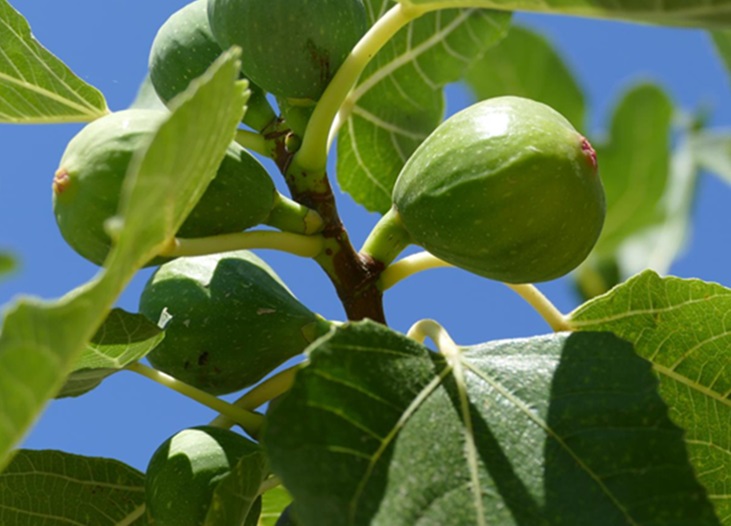
In the Gospel passage for the Thirty-third Sunday in Ordinary Time (Mark 13:24-32), Jesus says, “Learn a lesson from the fig tree. When its branch becomes tender and sprouts leaves, you know that summer is near.” (v. 24). These words are part of his response to a question asked of him by the disciples, Peter, James, John, and Andrew.
Away from the others, and just after Jesus commented to his disciples on the destruction of the temple, they had asked him, “Tell us, when will this happen, and what sign will there be when all these things are about to come to an end?” (Mark 13:4). The first thing that Jesus says to them is, “See that no one deceives you.” (Mk 13:5). As he continues to tell them the signs and what will happen (trials and tribulations such as war, persecutions, etc.), he also continues to give them instructions as to how to handle themselves and the situations they will face. He says:
“… do not be alarmed” (v. 7)
“Watch out for yourselves.” or be aware (v. 9)
“… do not worry beforehand about what you are to say. But say whatever will be given to you at that hour. For it will not be you who are speaking but the holy Spirit.” (v. 11)
“Be watchful!” (v. 23)
Then he says these words that are part of the Gospel for today, “Learn a lesson from the fig tree. When its branch becomes tender and sprouts leaves, you know that summer is near.” (v. 28). And although Jesus says this as he continues to tell Peter, James, John, and Andrew about the signs that will occur at the end times, the gospel passage ends with Jesus saying, “But of that day or hour, no one knows, neither the angels in heaven, nor the Son, but only the Father.” (v. 32). In other words, perhaps Jesus is reminding us not to focus on the signs, but rather to focus on his instructions.
His last instruction, “Learn a lesson from the fig tree,” is intriguing. In chapter 11 of Mark’s Gospel, Jesus curses a fig tree for being fruitless:
“The next day as they were leaving Bethany he was hungry. Seeing from a distance a fig tree in leaf, he went over to see if he could find anything on it. When he reached it he found nothing but leaves; it was not the time for figs. And he said to it in reply, ‘May no one ever eat of your fruit again!’ And his disciples heard it.” (Mark 11:12-14).
In this earlier passage, there is a mention of time, “… it was not the time for figs.” And now, when Jesus is telling some of his disciples about the signs of the end times and instructing them on how to be prepared, he again, refers to figs and time (and not knowing the exact time of the end).
A few interesting things about figs and time… Fig trees, like other fruit trees, have leaves, but unlike other fruit trees, their fruit flowers internally. Also, each fig contains a collection of many flowers and seeds. And while one may think of a fig as a piece of fruit, they are actually an infructescence—a multiple fruit—that in a sense, is always in the process of blooming.
So, in both times of uncertainty and times of comfort, see that no one deceives you, do not worry, and learn from the fig tree, continuing to grow from within, knowing that the fruit will come at the time that is appointed.
“Lord, my allotted portion and my cup, you have made my destiny secure.” – Psalm 16:5
In the Gospel passage for the Twelfth Sunday in Ordinary Time, Jesus’s disciples reach out to him as the boat they are in is taking on water in the middle of a storm. Jesus says to the wind and the raging sea, “Quiet! Be Still!” and just like that, the storm settles down. This is something he could have done without saying any words, but Jesus, always the teacher, gives his disciples, and us, both an example to follow and words to ponder.
After quieting the storm, Jesus asks his disciples, “Why are you terrified? Do you not yet have faith?” He is not reprimanding them or trying to make them feel bad, but rather he is asking them to reflect on the situation, and trying to help them to know, and to remember, that he is there with them and for them, and so, there is nothing to fear. Without Jesus, the storm can rage on, whether loud and brash or quiet and discreet. It is Jesus’s presence that both quells the storm and brings peace into the quiet and stillness.
On that day, as evening drew on, Jesus said to his disciples: “Let us cross to the other side.” Leaving the crowd, they took Jesus with them in the boat just as he was. And other boats were with him. A violent squall came up and waves were breaking over the boat, so that it was already filling up. Jesus was in the stern, asleep on a cushion. They woke him and said to him, “Teacher, do you not care that we are perishing?” He woke up, rebuked the wind, and said to the sea, “Quiet! Be still!” The wind ceased and there was great calm. Then he asked them, “Why are you terrified? Do you not yet have faith?” They were filled with great awe and said to one another, “Who then is this whom even wind and sea obey?” – Mark 4:35-41
On the Solemnity of the Most Holy Body and Blood of Christ also known as Corpus Christi, the Collect (opening prayer) is: “O God, who in this wonderful Sacrament have left us a memorial of your Passion, grant us, we pray, so to revere the sacred mysteries of your Body and Blood that we may always experience in ourselves the fruits of your redemption.”
Spend some time reflecting on this prayer and on the Sacrament of the Eucharist. What does it mean to you and how has it impacted you? Remember how you have experienced the fruits of the Lord’s redemption. What wonders has the Lord worked in your life? Take a few moments to express gratitude for these experiences and the awareness of them.
In the hymn One Bread, One Body, the lyrics direct us to mindfulness of our call, one and all, to unity as God’s people (the church):
One bread, one body, one Lord of all One cup of blessing which we bless And we, though many, throughout the Earth We are one body in this one Lord – John Foley, SJ (excerpt from One Bread, One Body)
Recall a time(s) when you have experienced unity and the fruits of the Lord’s redemption with others? In what ways have you witnessed the hand of the Lord? Give thanks for these times of common ground and the remembrance of them.
What hopes and desires do you have at this moment for awareness and unity in your life? your community? your country? and the world? Share these with the Lord. Ask the Lord for the grace to further appreciate and be inspired by experiences of the outpouring of His love.
Pray for one and all to have an open heart and mind to the well-being of all creation, and above all, to draw closer to God so as to embody (to speak and act in accord with) God’s desires as expressed through the example of Jesus.
How shall I make a return to the Lord for all the good he has done for me? The cup of salvation I will take up, and I will call upon the name of the Lord. – Psalm 116:12-13
The Gospel reading for the Fourth Sunday in Ordinary Time follows Jesus and the first disciples (Simon, Andrew, James and John called away from mending their fishing nets) as they enter into Capernaum, the place whose name means “village of comfort”. In this passage from the Gospel According to Mark (chapter 1, verses 21-28), Jesus’ way of being and his teaching capture the attention of the people. What he offers is new and different and comes with signs, as Jesus and the disciples enter a synagogue where he teaches with authenticity and frees a man who is under the hold of an unclean spirit.
Then they came to Capernaum, and on the sabbath Jesus entered the synagogue and taught. The people were astonished at his teaching, for he taught them as one having authority and not as the scribes. In their synagogue was a man with an unclean spirit; he cried out, “What have you to do with us, Jesus of Nazareth? Have you come to destroy us? I know who you are—the Holy One of God!” Jesus rebuked him and said, “Quiet! Come out of him!” The unclean spirit convulsed him and with a loud cry came out of him. All were amazed and asked one another, “What is this? A new teaching with authority. He commands even the unclean spirits and they obey him.” His fame spread everywhere throughout the whole region of Galilee. – Mk 1:21-28
It’s interesting to consider this passage in terms of human nature. Presumably the people in Capernaum (village of comfort), know one another. What do you imagine it was like when Jesus and his disciples, strangers, entered their space in general, but more specifically, their sacred space—the synagogue? How do you respond when someone new or unknown enters your space? What kinds of things determine your response?
Returning to the Gospel, in this passage one can infer that the people in the synagogue were drawn to Jesus and his message because despite being in the village of comfort, beyond the surface, their real needs were not being met.
“The people were astonished at his teaching, for he taught them as one having authority and not as the scribes.”
What Jesus was saying, as he taught, spoke to the people of Capernaum. His words and his way touch their hearts, and they recognize him as being authentic. Reflecting on this past week, what kinds of words and things, and who, has touched your heart? What tends to strike a chord with you?
Coming back to the Gospel and the synagogue, next there is a man with an unclean spirit. Notice how the man and the spirit influencing him are intertwined. The man cries out, but the pronoun is “us”.
“he cried out, “What have you to do with us, Jesus of Nazareth? Have you come to destroy us?”
Yet, drawn into the presence of Jesus, the two become distinguishable. And, of everyone who is present (outside of the disciples), it is only the unclean spirit who recognizes and names what’s really happening. The unclean spirit knows who Jesus is, and perhaps, senses its doom.
I know who you are—the Holy One of God!
In what ways do you invite Jesus to help you discern and recognize situations where good and evil may have become intertwined?
Jesus expels the unclean spirit, setting the man free. The people are in awe and try to make sense of what they have witnessed. Word of Jesus spreads as they recognize Jesus’ way as being both new and powerful, or authoritative. Are they caught up in Jesus’ way, in the way the unclean spirit obeyed him, in Jesus being the Holy One of God?… What is it that is moving them and leads to Jesus becoming famous? What are they celebrating?
Revisit the things that tend to strike a chord with you and ask Jesus to reveal the places of comfort that may be creating a cloud of disguise and interfering with what is best. Express your desire to be led by the Light of God. Ask Jesus to help you to know what is influencing you.
The people who sit in darkness have seen a great light; on those dwelling in a land overshadowed by death, light has arisen. – Matthew 4:16
In a lot of ways, it’s human nature to see preparing in terms of stocking up on tangible assets such as food, beverage, health, and other household supplies. However, the preparation Jesus is talking about in chapter 24, verses 37-44 of the Gospel according to Matthew (included below) , is about not being so attached to that kind of mindset, but rather to focus on embracing what can be attained not through material means, but through a heart that is maturing in its capacity to love and to be loved. This is something that is not accomplished by how much one does or the number of prayers that one might say, but rather by how one’s prayer influences decisions, actions, and interactions, so as to strive to live in such a way that one reflects the heart of God here on earth.
It’s not that preparing to have what one needs to sustain oneself physically is not good. It’s that it can be easy for that to become a bigger part of one’s concerns and for the mind to take over, leading to a heart that’s less than what it is created to be. One that is more self-serving than it is open to being a servant of God. Comparatively, when one can start with their heart, inviting God into the mix, everything else can fall into place. The result being that one has what they need, and not only sees the places where they are able to give, but also has a desire to do so.
As we enter the first week of Advent, in what ways do you need the heart of God to be revealed to you? And how do you desire to be a presence of the heart of God in each moment, in the coming weeks and beyond?
Jesus said to his disciples: “As it was in the days of Noah, so it will be at the coming of the Son of Man. In those days before the flood, they were eating and drinking, marrying and giving in marriage, up to the day that Noah entered the ark. They did not know until the flood came and carried them all away. So will it be also at the coming of the Son of Man. Two men will be out in the field; one will be taken, and one will be left. Two women will be grinding at the mill; one will be taken, and one will be left. Therefore, stay awake! For you do not know on which day your Lord will come. Be sure of this: if the master of the house had known the hour of night when the thief was coming, he would have stayed awake and not let his house be broken into. So too, you also must be prepared, for at an hour you do not expect, the Son of Man will come.” – Mt 24:37-44
I believe that sometimes society seems to be hanging by a thread, but that’s not all I believe…
I believe that God creates similarities, differences, and various dimensions intentionally, rather than carbon copies, or only one kind or way of being.
I believe freedom resides within and is a gift from God entrusted to each, to do with as one wills—as in free will.
I believe that it’s up to each to choose for themselves that which affects, most especially, oneself.
I believe and, also trust, that God has more wisdom than all of us together, seeing things we cannot see and understanding in ways which humans simply cannot.
I believe that to love like Jesus is to love like God—with great depth and breadth, yet personal and unique onto each of us as if we were the only one.
I believe that where hearts and minds are open to the Spirit that is Holy, unity and diversity not only live, but also thrive.
I believe that true victory does not rob others from choosing for themselves, and that what some may celebrate as a “win,” God does not.
I believe the compassion and mercy of God is all encompassing, and that clearly humankind’s is often not.
Most of all, I believe that the greater glory belongs to God, all of “this” will fade away, and that ultimately, through the hearts that are willing, God’s unifying way of love, compassion, and mercy prevails.
I believe that sometimes society seems to be hanging by a thread, but maybe sometimes that’s what we need to be.
And Mary kept all these things, reflecting on them in her heart. – Luke 2:19











 HopeThatFloats
You must be logged in to post a comment.