The Season of Advent and its related Scripture remind us of the twists and turns that life can take for anyone. They also provide an opportunity to see the faithfulness and goodness of God. In addition, they exemplify how being faithful to God involves being open to ways or paths that may differ, sometimes greatly, from the ones we may have planned or imagined for ourselves.
Take some time to think about what it has been like in the past for you to accept or make changes to the plans, ideas, and/or notions you have envisioned. What is it like in the present?
We all have things we would like to accomplish and look for ways, or paths, to do so. However, in proceeding in earnest and with good intentions as we strive, we can become mixed up when we don’t leave room for, can’t see, or are not open to the possibility of change(s) as being needed and for the better good. So when the twists and turns come, we can become even more attached to our own intentions and the ways we planned to accomplish them, instead of allowing the grace of God to help us to be open to making an adjustment or being open to a different way.
Sometimes, interference and the unexpected can push our buttons in ways that can make us behave as less than what we are… what we were created to be—beings in the image of God. When this happens, we can lose sight of the wideness of God, and the depth of God’s love, compassion, and mercy.
What are some memories you have of times when you met change, unexpected challenges, and/or uncertainty with a quiet calmness? How do those times compare to ones where, perhaps, quiet calmness and peace gave way to unrest?
Stand with the Lord at the threshold between the times of peace and the times of unrest that you’ve recalled. Ask Jesus to unveil the place(s) where maybe you couldn’t sense his presence or take direction, as well as the place(s) where you could. Express to the Lord your gratitude and your desire to remember whatever he wants you to hold onto from these instances as you enter the Advent Season and look to prepare for Christmas.
Make known to me your ways, Lord; teach me your paths. – Psalm 25:4
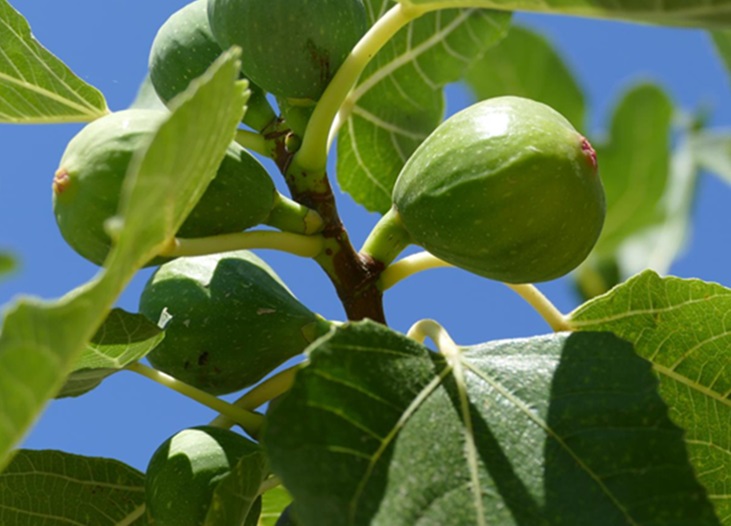
In the Gospel passage for the Thirty-third Sunday in Ordinary Time (Mark 13:24-32), Jesus says, “Learn a lesson from the fig tree. When its branch becomes tender and sprouts leaves, you know that summer is near.” (v. 24). These words are part of his response to a question asked of him by the disciples, Peter, James, John, and Andrew.
Away from the others, and just after Jesus commented to his disciples on the destruction of the temple, they had asked him, “Tell us, when will this happen, and what sign will there be when all these things are about to come to an end?” (Mark 13:4). The first thing that Jesus says to them is, “See that no one deceives you.” (Mk 13:5). As he continues to tell them the signs and what will happen (trials and tribulations such as war, persecutions, etc.), he also continues to give them instructions as to how to handle themselves and the situations they will face. He says:
“… do not be alarmed” (v. 7)
“Watch out for yourselves.” or be aware (v. 9)
“… do not worry beforehand about what you are to say. But say whatever will be given to you at that hour. For it will not be you who are speaking but the holy Spirit.” (v. 11)
“Be watchful!” (v. 23)
Then he says these words that are part of the Gospel for today, “Learn a lesson from the fig tree. When its branch becomes tender and sprouts leaves, you know that summer is near.” (v. 28). And although Jesus says this as he continues to tell Peter, James, John, and Andrew about the signs that will occur at the end times, the gospel passage ends with Jesus saying, “But of that day or hour, no one knows, neither the angels in heaven, nor the Son, but only the Father.” (v. 32). In other words, perhaps Jesus is reminding us not to focus on the signs, but rather to focus on his instructions.
His last instruction, “Learn a lesson from the fig tree,” is intriguing. In chapter 11 of Mark’s Gospel, Jesus curses a fig tree for being fruitless:
“The next day as they were leaving Bethany he was hungry. Seeing from a distance a fig tree in leaf, he went over to see if he could find anything on it. When he reached it he found nothing but leaves; it was not the time for figs. And he said to it in reply, ‘May no one ever eat of your fruit again!’ And his disciples heard it.” (Mark 11:12-14).
In this earlier passage, there is a mention of time, “… it was not the time for figs.” And now, when Jesus is telling some of his disciples about the signs of the end times and instructing them on how to be prepared, he again, refers to figs and time (and not knowing the exact time of the end).
A few interesting things about figs and time… Fig trees, like other fruit trees, have leaves, but unlike other fruit trees, their fruit flowers internally. Also, each fig contains a collection of many flowers and seeds. And while one may think of a fig as a piece of fruit, they are actually an infructescence—a multiple fruit—that in a sense, is always in the process of blooming.
So, in both times of uncertainty and times of comfort, see that no one deceives you, do not worry, and learn from the fig tree, continuing to grow from within, knowing that the fruit will come at the time that is appointed.
“Lord, my allotted portion and my cup, you have made my destiny secure.” – Psalm 16:5
From where chaos comes, Base passion and design, Stirring ill will, division, Seeds sowing lies. Looking, always looking, To seep and settle in.
From where chaos spreads, Human passions and designs, From what we, as masters, embrace, What we give into, And what we withstand.
From where peace comes, Divine passion and design. Love weaving in and out, Through time and space. Ushering good tidings, Encouraging good will.
From where peace spreads, Human passions and designs, From what we, as servants, embrace, What we give into, And what we withstand.
“Until he extends his circle of compassion to include all living things, man will not himself find peace.” – Albert Schweitzer
For where jealousy and selfish ambition exist, there is disorder and every foul practice. But the wisdom from above is first of all pure, then peaceable, gentle, compliant, full of mercy and good fruits, without inconstancy or insincerity. And the fruit of righteousness is sown in peace for those who cultivate peace. – James 3:16-18
What’s known, And what is not. Calculating possibilities.
Looking then leaping, A snapshot in time. Measuring risk, and seeking reward.
Guarantees, Warranties, Yet, nothing is certain.
The seeker being sought, The Sought, searching seekers. Meeting up, teeing up, And, finding what is lost.
“…to live in a manner worthy of the call you have received, with all humility and gentleness, with patience, bearing with one another through love, striving to preserve the unity of the spirit through the bond of peace…” – Ephesians 4:1-3
In the Gospel passage for the Twelfth Sunday in Ordinary Time, Jesus’s disciples reach out to him as the boat they are in is taking on water in the middle of a storm. Jesus says to the wind and the raging sea, “Quiet! Be Still!” and just like that, the storm settles down. This is something he could have done without saying any words, but Jesus, always the teacher, gives his disciples, and us, both an example to follow and words to ponder.
After quieting the storm, Jesus asks his disciples, “Why are you terrified? Do you not yet have faith?” He is not reprimanding them or trying to make them feel bad, but rather he is asking them to reflect on the situation, and trying to help them to know, and to remember, that he is there with them and for them, and so, there is nothing to fear. Without Jesus, the storm can rage on, whether loud and brash or quiet and discreet. It is Jesus’s presence that both quells the storm and brings peace into the quiet and stillness.
On that day, as evening drew on, Jesus said to his disciples: “Let us cross to the other side.” Leaving the crowd, they took Jesus with them in the boat just as he was. And other boats were with him. A violent squall came up and waves were breaking over the boat, so that it was already filling up. Jesus was in the stern, asleep on a cushion. They woke him and said to him, “Teacher, do you not care that we are perishing?” He woke up, rebuked the wind, and said to the sea, “Quiet! Be still!” The wind ceased and there was great calm. Then he asked them, “Why are you terrified? Do you not yet have faith?” They were filled with great awe and said to one another, “Who then is this whom even wind and sea obey?” – Mark 4:35-41
Breaking, broke, broken, Rescued, healed, awoken, Ever taken with your Way. For the sake of all, It’s all the same. No one more than the other, Each onto its own, But gathered in Your name.
Your grace O Lord, The longing of our hearts. Eloi, Eloi, lema sabachthani. At times, perhaps, We think we know, Yet thinking doesn’t make it so.
Your grace O Lord, The longing of our hearts. We feel one way or another, Sometimes many ways at once, Yet feeling doesn’t make it so.
Your grace O Lord, The longing of our hearts. With us, within us, Always within reach.
Your grace O Lord, Makes known your Way, The desire in our hearts, Yours and ours together, Rising up, makes it so.
To get somewhere, one needs to know where they are in relation to where they want to be and then to come up with a travel plan. However, oftentimes the path or trajectory shifts or ends up being different due to changing circumstances such as weather, terrain, and/or other unexpected issues. And while there are rules of navigation, the ability to adapt and adjust is crucial just as much as precision is.
One way to consider the readings for the Fifth Sunday of Lent is not only as tools, but precision tools for navigation. In the first reading (Jeremiah 31:31-34), the prophet reveals that God is making some adjustments. This is not a change in commitment level or objective, but rather a change in approach.
“I will place my law within them, and write it upon their hearts; I will be their God, and they shall be my people. They will no longer teach their friends and relatives, “Know the Lord!” Everyone, from least to greatest, shall know me—oracle of the Lord—for I will forgive their iniquity and no longer remember their sin.” (verses 33-34)
God’s communication is going to be directed straight to God’s people (not requiring a “go-between” or a 3rd person account), making it more personal and approachable as well as accepting and forgiving—all hallmarks of a healthy relationship.
In the responsorial psalm (Psalm 51:3-4, 12-13, 14-15), the psalmist expresses a desire for God to wash away their wrongdoing and states:
“A clean heart create for me, O God, and a steadfast spirit renew within me. Cast me not out from your presence, and your Holy Spirit take not from me.” (verses 12-13)
Since a heart cannot be clean or pure when it’s holding onto transgressions, resentments, or cold feelings toward oneself or others, the psalmist first asks for God’s mercy (for these things holding them back to be lifted from them). Once the obstacle(s) is removed, the way toward a heart that is unwavering in faithfulness to God is opened because the heart is better able to receive the wisdom and guidance of the Holy Spirit.
In the Letter to the Hebrews, St. Paul uses two words, in the passage for the second reading (Hebrews 5:7-9), that are sometimes received less enthusiastically than words like mercy and compassion. They are “reverence” and “obedience.” St. Paul writes of Jesus: “…he was heard because of his reverence” and “…he learned obedience from what he suffered”. Jesus’s relationship with God was open and honest; it was sacred. Jesus walked this earth, rooted in a desire to do God’s will and always seeking God as his source of strength and wisdom to face what he needed to face. When taken in the light of Jesus’ example, these words, “reverence” and “obedience”, when chosen with one’s free will express an attitude of humility and faithfulness to God, and of God to us.
Coming to the Gospel (John 12:20-33), Jesus’s words here strike at the heart of navigating. That is, holding onto or maintaining focus on the end goal despite the challenges that arise along the way.
It is written:
“Jesus answered them, “The hour has come for the Son of Man to be glorified. Amen, amen, I say to you, unless a grain of wheat falls to the ground and dies, it remains just a grain of wheat; but if it dies, it produces much fruit.” (verse 23-24).
If one is going to get to their destination, they can’t stay in one place or state of being. A change, shift or movement toward what one desires is necessary.
“I am troubled now. Yet what should I say? ‘Father, save me from this hour’? But it was for this purpose that I came to this hour.” (verse 27)
Jesus knows his purpose or mission through his relationship with God. What are you and God aiming for as you navigate? (If unsure, consider what is fulfilling or rings true with the soul, bringing a sense of peace.)
“Father, glorify your name.” Then a voice came from heaven, “I have glorified it and will glorify it again.” (verse 28)
When two wills move together, there is resonance in words and actions. However, there can only be one pilot.
“Now is the time of judgment on this world; now the ruler of this world will be driven out.” (verse 31)
Jesus knows who’s leading the way and encourages us toward awareness as well.
May the strength of God pilot us, may the wisdom of God instruct us, may the hand of God protect us, may the word of God direct us. Be always ours this day and for evermore. – St. Patrick
Let the peace of Christ control your hearts; Let the word of Christ dwell in you richly. – Col 3:15a, 16a
The verses above are used for the Gospel acclamation for the Feast of the Holy Family (usually celebrated the Sunday after Christmas). Oftentimes, the nativity of Jesus and the spirit of Christmas can be accompanied by thoughts of serenity and peace as well as images of idyllic creches and decorations. In such a setting, it can be rather easy to allow the peace of Christ and the word of Christ to flourish within when riding the joy of Christmas or any other anticipated or celebratory day or event. Yet, reality is such that life is a mixed bag and the unexpected, sometimes the dreaded, can come along at any moment, making it more challenging to be open to or inspired by the peace and word of Christ.
Imagine the joy and astonishment of Mary and Joseph at the birth of Jesus and what they initially encountered in the aftermath of his birth as people paid homage. Are there times in your life that come to mind and to which you can relate this experience? Times that have given rise to great joy, overwhelming peace, and/or the feeling of being so amazed.
Now, here we are, a week later, and in our liturgical celebration, we hear about Simeon and Anna paying homage to Christ and at the same time foretelling what’s to come (Lk 2:2-40).
“and Simeon blessed them and said to Mary his mother, ‘Behold, this child is destined for the fall and rise of many in Israel, and to be a sign that will be contradicted (and you yourself a sword will pierce) so that the thoughts of many hearts may be revealed’.” (v.34-35)
And coming forward at that very time, she gave thanks to God and spoke about the child to all who were awaiting the redemption of Jerusalem. (v. 38)
What’s it like to reflect on the fact that even though Jesus is the Christ, the reality is that it’s not going to be all roses and sunshine for Jesus, Mary, and Joseph either? It can be tempting to forget or to overlook reality, and to see the Holy Family as not only holy, but also as untouched. Take some time now to invite the Holy Family into whatever is happening at this time in your life. In what ways can you draw strength and inspiration from Jesus, Mary, and Joseph? What’s it like to consider that your experiences, your life, your family, and that of all those around you, are holy too?
Envision the peace and the word of Christ entering into the conversation and dwelling with, within, and all around you, drawing you, and all, closer to God.
Put on, as God’s chosen ones, holy and beloved, heartfelt compassion, kindness, humility, gentleness, and patience, bearing with one another and forgiving one another, if one has a grievance against another; as the Lord has forgiven you, so must you also do. And over all these put on love, that is, the bond of perfection. And let the peace of Christ control your hearts, the peace into which you were also called in one body. And be thankful. Let the word of Christ dwell in you richly, as in all wisdom you teach and admonish one another, singing psalms, hymns, and spiritual songs with gratitude in your hearts to God. And whatever you do, in word or in deed, do everything in the name of the Lord Jesus, giving thanks to God the Father through him. – Col 3:12-17
In a year where the Fourth Sunday of Advent falls on the same day as Christmas Eve (with the Christmas Vigil Mass), and in a world where it seems that there is a constant push toward an absolute one way or the other, but rarely a celebration of a little here, a little there, or somewhere in between, there lies a reminder of a better way.
Each year the Season of Advent is thought of as a period of waiting and Christmas as a period of celebrating the arrival of Jesus Christ, our Savior. And while we remember and participate in rituals each year, it can be easy to overlook the essence of these practices and to get lost in the ways in which we have come to proceed through them. With this, the opportunity to fully receive what is Divinely offered can become less.
Oftentimes, the greatest desire that many of us hold is the desire for peace (inner peace, peace within families/communities, world peace, etc.). And it is not uncommon to move, knowingly or not, toward external things or activities and attach a sense of peace to them, rather than to the joy they might bring to us as well as the real source of that joy and the peace that accompanies it—the Spirit of God.
Keeping in mind that peace is not possible without an openness to coexistence and unity, in what ways is your heart and mind open to peace? What strengths/challenges do you experience with regards to coexistence and unity in various situations? Where does this come up in your prayer life, and how is your sense of peace affected?
In a few days, when the Fourth Sunday of Advent and Christmas Eve (with the celebration of the Christmas Vigil Mass) share the day, envision it as an invitation to unity and, through it, peace. Take some time to reflect on the notion that what you desire is what you need, and what you are waiting for is already, in a sense, here. Then take some time to celebrate the goodness of the Lord.
Forever I will sing the goodness of the Lord. – Psalm 89:2A
The 3rd Sunday of Advent is referred to as Gaudete Sunday, as we move closer to Christmas, anticipating the joy and celebration of the birth of Jesus, the new Adam. The readings for this Sunday (Isaiah 61:1-2A, 6-7; Responsorial Psalm – Luke 1:46-50, 53-54, 1 Thessalonians 5:16-24, and John 1:6-8, 19-28) call upon us to embrace and rejoice in the Spirit of the Lord. What does that look like? How do you know when you’re embracing and rejoicing in the Spirit of the Lord?
In the Gospel, John the Baptist is asked by priests and Levites, “Who are you?” (John 1:22). Part of John’s response is, “I am the voice of one crying out in the desert, ‘make straight the way of the Lord,’” (John 1:23). Reflecting on John’s response, what do you imagine it was like for him? How would you respond to the question, “Who are you?” In what ways would your response be the same or different depending on who asks the question?
What’s it like to ponder that the same God who created John and inspired his words and actions, desires to do the same for all of us?
Continuing to consider this, in what places or situations do you desire your words and actions to be influenced more by God? What are the places or situations where you experience peace, joy, and a sense that your desire and God’s are united?
Prayer: Gracious and merciful Lord, over the course of the next few weeks, with all the busyness of the Advent and Christmas Season, help us to be open to your inspiration and to cooperate with the glue that is your Grace, so that we might discover that there is joy in each moment.
“Man is born broken; he lives by mending. The grace of God is the glue.” – Eugene O’Neill
You must be logged in to post a comment.