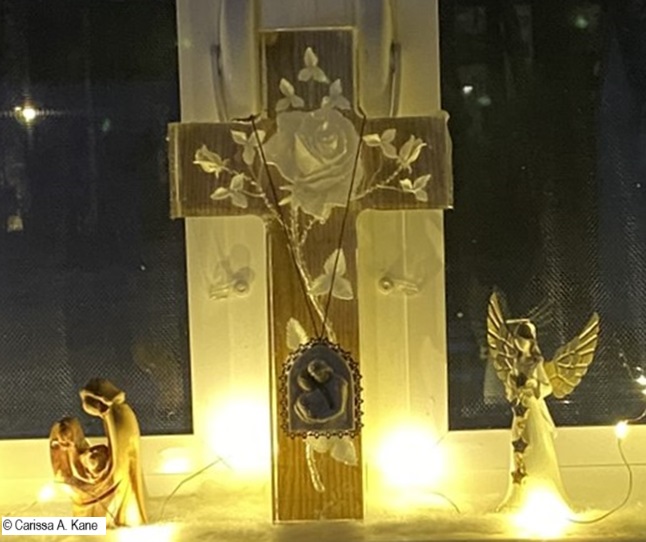
From the warmth of Christmas, Hearts brighten and faces glow; Generosity abounds.
The origin of one and all Drawing out our spirits; His Spirit placed within.
Let the peace of Christ control your hearts; Let the word of Christ dwell in you richly. – Colossians 3:15a, 16a
Reflecting on this Christmas and the days surrounding it, envision your heart resting within the heart of the Lord. What feelings and experiences come to mind? How was your heart moved?
The following is the Gospel passage for the Feast of the Holy Family of Jesus, Mary and Joseph:
When the magi had departed, behold, the angel of the Lord appeared to Joseph in a dream and said, “Rise, take the child and his mother, flee to Egypt, and stay there until I tell you. Herod is going to search for the child to destroy him.” Joseph rose and took the child and his mother by night and departed for Egypt. He stayed there until the death of Herod, that what the Lord had said through the prophet might be fulfilled, Out of Egypt I called my son.
When Herod had died, behold, the angel of the Lord appeared in a dream to Joseph in Egypt and said, “Rise, take the child and his mother and go to the land of Israel, for those who sought the child’s life are dead.” He rose, took the child and his mother, and went to the land of Israel. But when he heard that Archelaus was ruling over Judea in place of his father Herod, he was afraid to go back there. And because he had been warned in a dream, he departed for the region of Galilee. He went and dwelt in a town called Nazareth, so that what had been spoken through the prophets might be fulfilled, He shall be called a Nazorean. – Matthew 2:13-15, 19-23
What speaks to your heart most from the above passage? What quality or characteristic would you assign to it?
Again, thinking of Christmas, the birth of our Lord, and the days surrounding it, what do you desire to carry forward? What does the Lord desire for you?
“The Holy Scriptures were not given to us that we should enclose them in books, but that we should engrave them upon our hearts.” ― St. John Chrysostom
Praying with the scripture readings for the Feast of the Exaltation of the Holy Cross (Numbers 21:4b-9; Psalm 78:1b-2, 34-38; Philippians 2:6-11; and John 3:3-17), contemplate what it means to engrave them upon your heart.
In the First Reading, we hear of the Israelites, at wit’s end, upset by their situation in the desert, and making it known to Moses. We also learn of the punishing arrival of saraph serpents, leading to the surmise of many, and the subsequent realization of sin and prayer for relief. Following this, Moses prays for the people to be spared from the serpents, and the Lord replies, “Make a saraph and mount it on a pole, and if any who have been bitten look at it, they will live.” (Numbers 21:8).
What do you make of the notion that to be cured, or to overcome the serpent’s bite, requires looking at the bronze serpent mounted on the pole?
Take some time to consider a situation or area in which your patience is worn thin, or where you have been bitten. What has your reaction or response been? And how might you ask for, and receive, God’s grace to move toward peace and healing—a better way?
The response for the Psalm (Psalm 78:1b-2, 34-38) is, “Do not forget the works of the Lord!” (Ps 78:7b). Like it was in the desert for the Israelites and Moses, it can be tempting for anyone to react or respond out of feelings of discontent or anger, when it feels like needs are not being met or answers are nowhere to be found. This psalm invites us to recall what is true. None of us are without mistakes and missteps along the way. Still though, God is merciful and forgiving. This psalm encourages us to recall and remember the ways that God has been, and is, steadfast toward us.
Think about your experience of God turning something bad into something good?
Throughout the week, in moments with or without concern or upset, pause to acknowledge and give praise to God for God’s faithfulness to you. Allow yourself the space and invite God into it, to help you to see the entire picture, and to remember what is true.
In the Letter of St. Paul to the Philippians (Philippians 2:6-11), it is written:
Christ Jesus, though he was in the form of God, did not regard equality with God something to be grasped. Rather, he emptied himself, taking the form of a slave, coming in human likeness; and found human in appearance, he humbled himself, becoming obedient to death, even death on a cross. Because of this, God greatly exalted him and bestowed on him the name that is above every name, that at the name of Jesus every knee should bend, of those in heaven and on earth and under the earth, and every tongue confess that Jesus Christ is Lord, to the glory of God the Father.
Continuing to pray with the thoughts, feelings, and situations that have come to mind and heart thus far, where might the words emptied, humbled, exalted, and bestowed—the past tense verbs used by St. Paul to describe actions of Jesus and God—be applicable or come into play? Ask the Lord to help you to identify ways that these words operate in your life, and what purpose they might be serving.
Turning to the Gospel passage (John 3:13-17), Jesus is mid-conversation with Nicodemus, a Pharisee who has come to see Jesus in the darkness of night. Nicodemus is trying to understand what Jesus means by, “no one can see the kingdom of God without being born from above.” (Jn 3:3).
What does being born from above mean to you?
For the Feast of the Exaltation of the Holy Cross, we are reminded of where, and who, we currently are—our place as well as our call—eternal life through Jesus.
In the Gospel passage, Jesus refers to Moses lifting up the bronze serpent in the desert and says, “so must the Son of Man be lifted up, so that everyone who believes in him may have eternal life.” (Jn 3:14-15). He knows that Nicodemus will be familiar with and understand what has been written in Scripture. However, an earmark of Jesus is to elevate and help us along toward living Scripture. This is what he is trying to do, when he follows up with:
“For God so loved the world that he gave his only Son, so that everyone who believes in him might not perish but might have eternal life. For God did not send his Son into the world to condemn the world, but that the world might be saved through him.” (Jn 3:16-17).
Enter into conversation with Jesus about these two verses, inviting him to elevate and help you along in your journey toward living Scripture, or living it more fully. When your prayer time comes to a close, add the following:
We adore you, O Christ, and we bless you, because by your Cross you have redeemed the world. – St. Francis of Assisi
The readings for the Fifteenth Sunday in Ordinary Time present food for thought and prayer about what’s written, how it’s read, and what is brought to life from it. In the first reading (Deuteronomy 30:10-14), Moses urges the people to heed God’s voice and the commandments and statutes passed on to them and written in “this book of law”. He points out that God’s voice and words are not out of reach, but instead, he says, “No, it is something very near to you, already in your mouths and in your hearts; you have only to carry it out.” (v. 14).
Spend a few minutes with this verse. Then, think about this past week, an ongoing situation that is before you, or something that you have coming up. Invite the Lord to help you parse through all the thoughts and feelings of which you become aware as you ponder.
For the responsorial psalm, there are two from which to choose (Psalm 69:14, 17, 30-31, 33-34, 36, 37 or Psalm 19:8, 9, 10, 11). Read each of the responses listed below in silence.
Turn to the Lord in your need, and you will live. (cf. Ps 69:33)
Your words, Lord, are Spirit and life. (Ps 19:9a)
Next, read each response aloud. Notice if one response draws you in, or catches your attention, more than the other.
Bring into your prayer a Psalm response(s) and ask the Lord to guide you and lead you to greater awareness as you continue your contemplation from above. [Allow yourself to go with whichever response you land on first or feel more drawn to. It might be both, or even another verse that comes to mind.]
In the second reading (Colossians 1:15-20), St. Paul writes:
Christ Jesus is the image of the invisible God, the firstborn of all creation. For in him were created all things in heaven and on earth, the visible and the invisible, whether thrones or dominions or principalities or powers; all things were created through him and for him. He is before all things, and in him all things hold together. He is the head of the body, the church. He is the beginning, the firstborn from the dead, that in all things he himself might be preeminent. For in him all the fullness was pleased to dwell, and through him to reconcile all things for him, making peace by the blood of his cross through him, whether those on earth or those in heaven.
Sometimes it can be tricky, and trying, to face big and small choices every day among relationships, dilemmas, situations, etc. Think about how you have been managing. What brings you comfort? And, from where do you draw strength?
Pause to hold the words St. Paul writes of Jesus and remember that “Christ Jesus is the image of the invisible God”, and that you are created in the image of the invisible, and indivisible, God. What happens when you let that reality saturate your heart? Bring to prayer the thoughts and feelings that arise.
Turning to the Gospel passage (Luke 10:25-37), it begins:
There was a scholar of the law who stood up to test Jesus and said, “Teacher, what must I do to inherit eternal life?” Jesus said to him, “What is written in the law? How do you read it?” He said in reply, “You shall love the Lord, your God, with all your heart, with all your being, with all your strength, and with all your mind, and your neighbor as yourself.” He replied to him, “You have answered correctly; do this and you will live.”
Notice how Jesus points the scholar, and us, to the Word of God (“What is written in the law”), how it is processed internally (“How do you read it?”), and how it is lived out (“do this and you will live.”).
Like the scholar, we can know what is written in the law, but if we skip over considering how we are reading it—heart, mind, and soul, how can we possibly live it out authentically, united with God in both Word and Spirit, as intended?
But because he wished to justify himself, he said to Jesus, “And who is my neighbor?” Jesus replied, “A man fell victim to robbers as he went down from Jerusalem to Jericho. They stripped and beat him and went off leaving him half-dead. A priest happened to be going down that road, but when he saw him, he passed by on the opposite side. Likewise a Levite came to the place, and when he saw him, he passed by on the opposite side. But a Samaritan traveler who came upon him was moved with compassion at the sight. He approached the victim, poured oil and wine over his wounds and bandaged them. Then he lifted him up on his own animal, took him to an inn, and cared for him. The next day he took out two silver coins and gave them to the innkeeper with the instruction, ‘Take care of him. If you spend more than what I have given you, I shall repay you on my way back.’ Which of these three, in your opinion, was neighbor to the robbers’ victim?” He answered, “The one who treated him with mercy.” Jesus said to him, “Go and do likewise.” – Luke 10:29-37
Thinking about this passage and the Scripture in the readings and psalm before it, what is most on your mind and in heart at this moment?
Continuing to pray. Ask the Lord to reveal to you whatever God wills, and to help you to bring together what is written, how to read it, and what “Go and do likewise” looks like or means for you today.
Our Father, who art in heaven, hallowed be thy name; thy kingdom come, thy will be done on earth as it is in heaven. Give us this day our daily bread, and forgive us our trespasses, as we forgive those who trespass against us; and lead us not into temptation, but deliver us from evil. Amen.
Driving on the highway on a clear but overcast winter morning one moment. Aimlessly sliding across lanes in the next. But through the grace of God, control was regained and the trip continued. In an instant, never mind a day or more, all sorts of things such as situations, environments, etc. can change drastically.
We can know that something is coming and do our best to prepare for it. For example, cold weather can bring icy conditions. Yet even being aware and extra careful, one can’t make any, and all, ice on a road or highway visible to the naked eye. And sometimes, like it or not, there is ice that’s both invisible and inescapable, extending across a road.
So, what’s one to do in these kinds of unavoidable situations? Shrink away from them? Or face them?
The fact of the matter is that there isn’t any one way or one answer for most things. However, there is always a best way to meet the moment. And oftentimes, arriving at it requires relinquishing the notion of control. Whether sliding across the highway in the cold, or steering the wheel on a warm, sunny day, it is the grace and love of God that sustains us.
We all have experiences that can shake us, literally and in other ways. Ones that can create anxiety, fear, uncertainty, and more. Yet, in all of them, we may not be in control, but we always have a choice(s). We can always strive to focus on what is best, what is possible, and most especially the spirit in which we proceed.
Last week’s Gospel was about the Wedding feast at Cana (John 2:1-11). When Mary tells Jesus that the wine has run out, he responds in part, “My hour has not yet come.” Yet, Mary still tells the waiters to do as Jesus tells them. Jesus instructs the waiters. They follow his instructions—essentially becoming part of the miracle—and through the grace of God, the problem is resolved. It wasn’t time… but it was. The time for the goodness of God—love, mercy, compassion, etc.—is always.
In the Gospel for the Third Sunday in Ordinary Time (Luke 1:1-4; 4:14-21), we start by going back to the beginning of Luke’s Gospel. We are reminded of Luke’s motivation. In his own words, he is striving to preserve an accurate account of Jesus life and ministry. And part of that account follows as we read about Jesus in the time after his baptism and temptation in the desert.
Jesus returned to Galilee in the power of the Spirit, and news of him spread throughout the whole region. He taught in their synagogues and was praised by all. – Luke 4:14-15
What do you imagine Jesus, “in the power of the Spirit,” was like? What characteristics would you use to describe someone in the power of the Holy Spirit?
As the Gospel continues, Jesus enters the temple in Nazareth and proceeds to read from the scroll handed to him—the scroll of the prophet Isaiah.
He unrolled the scroll and found the passage where it was written: The Spirit of the Lord is upon me, because he has anointed me to bring glad tidings to the poor. He has sent me to proclaim liberty to captives and recovery of sight to the blind, to let the oppressed go free, and to proclaim a year acceptable to the Lord. Rolling up the scroll, he handed it back to the attendant and sat down, and the eyes of all in the synagogue looked intently at him. He said to them, “Today this Scripture passage is fulfilled in your hearing.” – Luke 4:17-21
Take some time to think about what you have learned and come to know about Jesus’s life and ministry. In what ways did Jesus’s words and actions fulfill this passage? How have you experienced these and other qualities of Jesus?
Whether it was at the wedding feast in Cana, in the temple in Nazareth, or elsewhere, and no matter what time it was, the Spirit in which Jesus lived and ministered was consistent and unwavering. And at the same time, he was fluid in meeting the moment with love and mercy, lifting all up as the glory of God, rather than making it his own.
Jesus’s life and teachings show us that the moment is always upon us, and the times is always right, to reflect the goodness of God. And more than that, our time is ours only thru the grace of God, and as such, it is always ripe with opportunity to be an expression of love and mercy in the world.
Take, Lord, and receive all my liberty, my memory, my understanding, and my entire will, All I have and call my own.
You have given all to me. To you, Lord, I return it.
Everything is yours; do with it what you will. Give me only your love and your grace, that is enough for me. – St. Ignatius, Suscipe
In the second reading for this Sunday, the Baptism of the Lord, Peter says to those gathered before him, “In truth, I see that God shows no partiality. Rather, in every nation whoever fears him and acts uprightly is acceptable to him.” (Acts 10:34-35).
Fear (or reverence) of the Lord can be a challenging concept. In fact, it can be tempting to mistake reverence as only being evidenced in what one can see. It can also be tempting to shrink it down to a fixed notion of what reverence looks like.
However, our faith calls us to remember, that we do not have the mind, or the insight of God. It is important to keep in mind that in our humanity, we can get hung up in appearances or distracted in what we think ought to be, and in the process, lose sight of the heart of any matter. It is only God who can truly judge, and help us to know, when and what to say or do in response to a situation(s).
And God, as we learn in the Scripture verses leading up to this Sunday’s second reading (Acts 10:9-33), does exactly this for Peter. God helps Peter to see that the faith that he holds so dear, is not just for those like him, but also for the gentiles. His experience on a rooftop during his midday prayer reveals the following:
He was hungry and wished to eat, and while they were making preparations he fell into a trance. He saw heaven opened and something resembling a large sheet coming down, lowered to the ground by its four corners. In it were all the earth’s four-legged animals and reptiles and the birds of the sky. A voice said to him, “Get up, Peter. Slaughter and eat.” But Peter said, “Certainly not, sir. For never have I eaten anything profane and unclean.” The voice spoke to him again, a second time, “What God has made clean, you are not to call profane.” This happened three times, and then the object was taken up into the sky. – verses 10-16
As Peter was pondering the vision, the Spirit said [to him], “There are three men here looking for you. So get up, go downstairs, and accompany them without hesitation, because I have sent them.” – verses 19-20
When Peter entered, Cornelius met him and, falling at his feet, paid him homage. Peter, however, raised him up, saying, “Get up. I myself am also a human being.” While he conversed with him, he went in and found many people gathered together and said to them, “You know that it is unlawful for a Jewish man to associate with, or visit, a Gentile, but God has shown me that I should not call any person profane or unclean. – verses 25-28
However, there’s more than that. God also helps Cornelius. Who like Peter, is not tethered to his own notions, and therefore is able to be open to being guided by the Spirit of God. It is written that Cornelius responds to Peter’s inquiry as to why he called him:
“Four days ago at this hour, three o’clock in the afternoon, I was at prayer in my house when suddenly a man in dazzling robes stood before me and said, ‘Cornelius, your prayer has been heard and your almsgiving remembered before God. Send therefore to Joppa and summon Simon, who is called Peter. He is a guest in the house of Simon, a tanner, by the sea.’ So I sent for you immediately, and you were kind enough to come. Now therefore we are all here in the presence of God to listen to all that you have been commanded by the Lord.” – verses 30-33
During the midday and afternoon hours of prayer, Peter and Cornelius had experiences of God that were different, but the same in Spirit. God gave them both direction, and despite it being an unusual or unexpected ask (for a Jew and a gentile, given practices, tradition, and cultural norms), both men in their fear or reverence of God, allowed themselves to cling to God and this new or different way, rather than a choice rooted in their worldly understanding—one that would have kept them separated… continuing with a wedge in place.
What wedges do you desire God to help humankind overcome today? Knowing that God’s grace flows in many directions on both small and large scales at the same time, what personal wedges would you like to overcome?
Take some time to reflect on this Scripture and how it relates to your experiences, both personal and more community or world-wide.
What happens when you think about God as placing emphasis on internal disposition or drive and how it motivates, informs, and influences one’s actions?
Envision the peace of God embracing you, calling your name, and saying, “You are my beloved; with you I am well pleased.” (Luke 3:22). Rest in the Lord and listen to what God desires for you.
When the kindness and generous love of God our savior appeared, not because of any righteous deeds we had done but because of his mercy, He saved us through the bath of rebirth and renewal by the Holy Spirit, whom he richly poured out on us through Jesus Christ our savior, so that we might be justified by his grace and become heirs in hope of eternal life. – Titus 3:4-7
The magi, or three wise men, are first drawn to Jerusalem by the star signifying the birth of a newborn king. Once there, they encounter Herod, who acting on fear, deceptively seeks to have them locate this king so that he may bring about his demise; not pay homage as he has claimed.
For the wise men, this journey began with the beckon of a bright, new star. Then, from Jerusalem and their exchange with Herod, that same star leads them further onward, guiding them to Bethlehem, and Jesus Christ. And after paying homage and offering gifts to the newborn king, it is a dream that directs them back home, rather than returning to Jerusalem to reveal the location of the newborn king to Herod.
Along the way, and at each stop, the wise men, like us, undoubtedly had choices to make. What, do you imagine, inspired them to keep following the star from its rising all the way to Jerusalem? And then onward to Bethlehem?
What led them to listen to the dream and go home a different way rather than returning by way of Jerusalem, stopping to give Herod the information he wanted from them?
After taking some time to contemplate the Gospel passage for the Epiphany of the Lord (Matthew 2:1-12), reflect on the choices that you may be facing at this time and how you go about making decisions.
What influences your decisions and from where do you take direction or draw inspiration? What are the factors that motivate you? How do they reflect a posture of paying homage to the Lord? (Perhaps they are born out of, or hold at their roots, love, patience, or something similar.)
Take what you notice into prayer, inviting Jesus to share Light and Wisdom with you. Pray with any feelings or desires that arise in you. And when this prayer time comes a close, ask Jesus to reveal one parting word, phrase, or image that will help to draw and lead you, like that star, to where you ought to be.
We saw his star at its rising and have come to do him homage. – Matthew 2:2
Ushering in the Second Week of Advent, the readings for this Sunday (Baruch 5:1-9; Psalm 126:1-6; Philippians 1:4-6, 8-11; and Luke 3:1-6) can be taken as a reminder of the all-encompassing nature of God, and a call to hope, faith, and letting God be God.
In the Book of the Prophet Baruch, we read:
Up, Jerusalem! stand upon the heights; look to the east and see your children gathered from the east and the west at the word of the Holy One, rejoicing that they are remembered by God. – Baruch 5:5
What’s it like to reflect on this image, “being gathered from the east and the west at the word of the Holy One”?
Recall some of the ways that you have been remembered by God and what God has done for you. Maybe there is a situation(s) where you have benefitted from or experienced God’s grace without even realizing it. How have you responded to God, both then and now?
When you think about challenges you may be facing or concerns that you currently have, what’s it like when you envision yourself enfolded in the “word of the Holy One” and as one “remembered by God”?
In the Second Reading, St. Paul offers a beautiful prayer for the Philippians.
And this is my prayer: that your love may increase ever more and more in knowledge and every kind of perception, to discern what is of value, so that you may be pure and blameless for the day of Christ, filled with the fruit of righteousness that comes through Jesus Christ for the glory and praise of God. – Philippians 1:9-11
However, just prior to this, in verse 8, St. Paul writes:
I am confident of this, that the one who began a good work in you will continue to complete it until the day of Christ Jesus.
Notice how St. Paul continually emphasizes or directs his audience (whom he addresses as “all the holy ones in Christ Jesus who are in Philippi, with the overseers and ministers” in verse 1) to God as the object (or focus) and the source of good and righteousness—at the beginning, the end, and everywhere in between.
What strikes you most, or what desires arise within you, as you consider St. Paul’s words as well as his approach in the Second Reading?
In the Gospel According to St. Luke, verses 1-6 of chapter 3, we turn to a listing of who’s “in charge” (Caesar, Pilot, and tetrarchs) at the time that John the Baptist is in the desert, fulfilling prophecy. We read:
As it is written in the book of the words of the prophet Isaiah: “A voice of one crying out in the desert: ‘Prepare the way of the Lord, make straight his paths. Every valley shall be filled and every mountain and hill shall be made low. The winding roads shall be made straight, and the rough ways made smooth, and all flesh shall see the salvation of God.”– Luke 3:4-6
Take some time to consider these verses in the light of the God who remembers you… who loves you… and whose living, breathing Word seeks to protect and guide you to salvation.
As you journey through this week, how do you wish to respond to the all-encompassing nature of God, and the call to hope, faith, and letting God be God?
The Lord has done great things for us; we are filled with joy. – Psalm 126:3
In the Gospel passage for the Thirty-third Sunday in Ordinary Time (Mark 13:24-32), Jesus says, “Learn a lesson from the fig tree. When its branch becomes tender and sprouts leaves, you know that summer is near.” (v. 24). These words are part of his response to a question asked of him by the disciples, Peter, James, John, and Andrew.
Away from the others, and just after Jesus commented to his disciples on the destruction of the temple, they had asked him, “Tell us, when will this happen, and what sign will there be when all these things are about to come to an end?” (Mark 13:4). The first thing that Jesus says to them is, “See that no one deceives you.” (Mk 13:5). As he continues to tell them the signs and what will happen (trials and tribulations such as war, persecutions, etc.), he also continues to give them instructions as to how to handle themselves and the situations they will face. He says:
“… do not be alarmed” (v. 7)
“Watch out for yourselves.” or be aware (v. 9)
“… do not worry beforehand about what you are to say. But say whatever will be given to you at that hour. For it will not be you who are speaking but the holy Spirit.” (v. 11)
“Be watchful!” (v. 23)
Then he says these words that are part of the Gospel for today, “Learn a lesson from the fig tree. When its branch becomes tender and sprouts leaves, you know that summer is near.” (v. 28). And although Jesus says this as he continues to tell Peter, James, John, and Andrew about the signs that will occur at the end times, the gospel passage ends with Jesus saying, “But of that day or hour, no one knows, neither the angels in heaven, nor the Son, but only the Father.” (v. 32). In other words, perhaps Jesus is reminding us not to focus on the signs, but rather to focus on his instructions.
His last instruction, “Learn a lesson from the fig tree,” is intriguing. In chapter 11 of Mark’s Gospel, Jesus curses a fig tree for being fruitless:
“The next day as they were leaving Bethany he was hungry. Seeing from a distance a fig tree in leaf, he went over to see if he could find anything on it. When he reached it he found nothing but leaves; it was not the time for figs. And he said to it in reply, ‘May no one ever eat of your fruit again!’ And his disciples heard it.” (Mark 11:12-14).
In this earlier passage, there is a mention of time, “… it was not the time for figs.” And now, when Jesus is telling some of his disciples about the signs of the end times and instructing them on how to be prepared, he again, refers to figs and time (and not knowing the exact time of the end).
A few interesting things about figs and time… Fig trees, like other fruit trees, have leaves, but unlike other fruit trees, their fruit flowers internally. Also, each fig contains a collection of many flowers and seeds. And while one may think of a fig as a piece of fruit, they are actually an infructescence—a multiple fruit—that in a sense, is always in the process of blooming.
So, in both times of uncertainty and times of comfort, see that no one deceives you, do not worry, and learn from the fig tree, continuing to grow from within, knowing that the fruit will come at the time that is appointed.
“Lord, my allotted portion and my cup, you have made my destiny secure.” – Psalm 16:5
In the Gospel passage for the Twenty-third Sunday in Ordinary Time (Mk 7:31-37), the people of a village bring a man who is deaf and has a speech impediment to Jesus and plead with him to lay his hand on him. What do you think made the people of the village do this? The deaf man could see, after all, and he could have found his own way to Jesus and asked for himself. What do imagine caused the people to get involved on the deaf man’s behalf? What are some things that lead you to get involved on the behalf of others?
We also read in this passage that Jesus “took him [the deaf man] off by himself away from the crowd.” (v. 33). Perhaps to remove the noise and distractions? Perhaps to engage in a more personal way with the man? Or maybe it was something else.
In the Scripture passage prior to this one, Jesus is trying to step away from the crowds when he is approached by the Syrophoenician woman asking for her daughter to be healed (Mk 7:24-30). This occurs after he has responded to the Pharisees questioning his disciples’ behavior; where Jesus replied in part, “Nothing that enters one from outside can defile that person; but the things that come out from within are what defile.” (Mk 7:15). Considering this teaching and carrying it forward into Jesus’s interactions with the Syrophoenician woman and the deaf man, reflect on the way he receives and responds to people, situations, and what’s going on around him.
How do you receive people, situations, and what’s going on around you? What inner attitudes or dispositions do you carry into interactions? What’s going on in your heart, and how does it affect your response?
Coming back to today’s Gospel Jesus says, “Ephphatha!” (“Be opened!”), and as a result, the deaf man can hear, and his speech impediment is gone. He is healed from his affliction through Jesus’s command, or call, to openness. So why then, does Jesus tell the man not to tell anyone? And how might this fit in with the idea of evangelization?
Maybe Jesus is calling us to be open to what’s going on around us and what God is trying to tell us as individuals, to further open and transform one’s own heart toward greater understanding and compassion. And with that, reminding us that evangelization comes through the grace of God and at times is aided, or complemented, by kind and loving hearts that are both fluid with and fixated on God.
Say to those whose hearts are frightened: Be strong, fear not! Here is your God, he comes with vindication; with divine recompense he comes to save you. – Isaiah 35:4














 HopeThatFloats
You must be logged in to post a comment.