Beating still, beating quietly, beating nonetheless, Attention becomes the disciple of intention. A stir within, roars within, formation from within. Look and listen closely as true passion is revealed.
Following the leader? Where? To what good do they lead? Igniting hearts? Uniting hearts? On whose behalf? All hearts can and must choose for whom and for what they burn. Discern! Discern! Deception has so many voices.
Does the message uplift all of us, like the true one Who gracefully overcomes the small, in all of us, Helping the steadfast to be ready, set, and to ask, How does this represent the good teacher serving all?
The Lord keeps faith forever, secures justice for the oppressed, gives food to the hungry. The Lord sets captives free. The Lord gives sight to the blind; the Lord raises up those who were bowed down. The Lord loves the just; the Lord protects strangers. The fatherless and the widow the Lord sustains, but the way of the wicked he thwarts. The Lord shall reign forever; your God, O Zion, through all generations. Alleluia. – Psalm 146:6-10
The magi, or three wise men, are first drawn to Jerusalem by the star signifying the birth of a newborn king. Once there, they encounter Herod, who acting on fear, deceptively seeks to have them locate this king so that he may bring about his demise; not pay homage as he has claimed.
For the wise men, this journey began with the beckon of a bright, new star. Then, from Jerusalem and their exchange with Herod, that same star leads them further onward, guiding them to Bethlehem, and Jesus Christ. And after paying homage and offering gifts to the newborn king, it is a dream that directs them back home, rather than returning to Jerusalem to reveal the location of the newborn king to Herod.
Along the way, and at each stop, the wise men, like us, undoubtedly had choices to make. What, do you imagine, inspired them to keep following the star from its rising all the way to Jerusalem? And then onward to Bethlehem?
What led them to listen to the dream and go home a different way rather than returning by way of Jerusalem, stopping to give Herod the information he wanted from them?
After taking some time to contemplate the Gospel passage for the Epiphany of the Lord (Matthew 2:1-12), reflect on the choices that you may be facing at this time and how you go about making decisions.
What influences your decisions and from where do you take direction or draw inspiration? What are the factors that motivate you? How do they reflect a posture of paying homage to the Lord? (Perhaps they are born out of, or hold at their roots, love, patience, or something similar.)
Take what you notice into prayer, inviting Jesus to share Light and Wisdom with you. Pray with any feelings or desires that arise in you. And when this prayer time comes a close, ask Jesus to reveal one parting word, phrase, or image that will help to draw and lead you, like that star, to where you ought to be.
We saw his star at its rising and have come to do him homage. – Matthew 2:2
From where chaos comes, Base passion and design, Stirring ill will, division, Seeds sowing lies. Looking, always looking, To seep and settle in.
From where chaos spreads, Human passions and designs, From what we, as masters, embrace, What we give into, And what we withstand.
From where peace comes, Divine passion and design. Love weaving in and out, Through time and space. Ushering good tidings, Encouraging good will.
From where peace spreads, Human passions and designs, From what we, as servants, embrace, What we give into, And what we withstand.
“Until he extends his circle of compassion to include all living things, man will not himself find peace.” – Albert Schweitzer
For where jealousy and selfish ambition exist, there is disorder and every foul practice. But the wisdom from above is first of all pure, then peaceable, gentle, compliant, full of mercy and good fruits, without inconstancy or insincerity. And the fruit of righteousness is sown in peace for those who cultivate peace. – James 3:16-18
Neither grave, nor the gravity, Could hold Him down. That cross, though heavy, Not heavy enough, Nor could it ever be. A temporary thing, A passage, passing with time, The Begotten not gone.
That stone, though big, Not big enough, Nor could it ever be. A temporary thing, A passage, passing with time. The Begotten hidden, Not seen, not heard, But certainly not gone.
Then, Easter. Arriving between the quiet, Entering amid the stillness, And everything changes. Everything becomes new again, In the remembering of what is. Nothing ever stronger than What was, What is, and What shall ever be.
Just as Light cannot be kept from shining, And Truth, refusing to remain hidden, There is no greater shield or power than that created by Creator. We are more than passengers on borrowed time. More than temporary things or passages, passing with time. And in Him, with Him, and thru Him, Neither grave, nor the gravity, Can hold us down.
On this 4th Sunday of Lent, Laetare Sunday, the readings invite us to consider the depth of God’s steadfastness and love. Focusing on the second reading, take some time to reflect on the qualities of God (rich in mercy, great love, etc.).
Brothers and sisters: God, who is rich in mercy, because of the great love he had for us, even when we were dead in our transgressions, brought us to life with Christ — by grace you have been saved —, raised us up with him, and seated us with him in the heavens in Christ Jesus, that in the ages to come He might show the immeasurable riches of his grace in his kindness to us in Christ Jesus. For by grace you have been saved through faith, and this is not from you; it is the gift of God; it is not from works, so no one may boast. For we are his handiwork, created in Christ Jesus for the good works that God has prepared in advance, that we should live in them. – Ephesians 2:4-10
How do you experience these qualities in your life? In your relationship with God and others, where do you give? and where do you withhold? Take some time to ponder being God’s handiwork.
“You often say, “I would give, but only to the deserving.” The trees in your orchard say not so, nor the flocks in your pasture. They give that they may live, for to withhold is to perish.” – Kahlil Gibran
The readings for the Third Sunday of Lent can be seen as a call to pay attention to the nature of relationships and what they lead or point to. In the First Reading (Exodus 20:1-17), God delivers the commandments, which are seemingly clear instructions, and by adhering to them, the people will prosper. Notice how God’s mercy far outweighs any punishment.
For I, the Lord, your God, am a jealous God, inflicting punishment for their ancestors’ wickedness on the children of those who hate me, down to the third and fourth generation; but showing love down to the thousandth generation of those who love me and keep my commandments. (Ex 20:5-6)
Also, notice that punishment is reserved for “those who hate me,” and their children. Hate is a pretty strong word and one can imagine some sort of pattern or learned behavior to reach that point or designation. In that light, perhaps this passage can be viewed as a Lenten invitation to be mindful of one’s actions, the sentiments from which they come, and what they might teach.
Looking at the Responsorial Psalm (Psalm 19:8-11), the response is “Lord, you have the words of everlasting life.” (Jn 6:68c). Again, drawing us to God’s words as priceless and wrapping up by trying to convey just how valuable they are: They are more precious than gold, than a heap of purest gold; sweeter also than syrup or honey from the comb. (Ps 19:11).
As for verses 8-10 of the Psalm, the first part of each line refers to the Lord’s “rules”—laws, decrees, precepts, commands, reverence, and ordinances. The second part of each phrase or sentence provides guidance by giving indicators that one can use to try to determine if they are obeying and honoring the Lord. How? By evaluating the situation and answering the question: Do I experience or have a sense of a refreshed soul/peace, wisdom, a rejoicing heart, enlightenment, endurance/inner strength, truth, or justice?
The law of the Lord is perfect, refreshing the soul; The decree of the Lord is trustworthy, giving wisdom to the simple.
The precepts of the Lord are right, rejoicing the heart; the command of the Lord is clear, enlightening the eye.
The fear of the Lord is pure, enduring forever; the ordinances of the Lord are true, all of them just.
In the Second Reading (1 Corinthians 1:22-25), St. Paul is encouraging the Corinthians, and us, to be careful about the way we go about seeking signs and wisdom. God certainly uses people, situations, and things to accomplish tasks and impart wisdom, however, as St. Paul says, “we proclaim Christ crucified.” That means, there is no substituting human thoughts, ideas, goals, etc. for God’s will and wisdom as the source or root that one allows to resonate with and guide their soul. Ultimately, things come down to what happens between each person and God, and one is not to blindly follow others thus giving what belongs to or originates with God (one’s soul and will) to another human being and/or their agenda.
In what ways do you take each situation to prayer with an openness to the fact that what is right and just in one situation may not be right and just or the best way in another situation? What’s it like to consider that the “rules” and their application are shaped by God’s love and mercy, and that this is by God’s design? In what ways do you leave room for love and mercy in situations and decisions?
Turning to the Gospel passage referred to as the Cleansing of the Temple (John 2:13-25), we can see Jesus’ disavowal of the perversion of the Temple and the rules and practices around and within it. The focus has become all about transactions and status. Jesus drives everyone out, saying to those profiting at the expense of the poor—those selling doves, “Take these out of here, and stop making my Father’s house a marketplace.” (Jn 2:16). In the verses that follow, Jesus refers to his body as the temple and foreshadows his crucifixion and resurrection. The passage ends with:
But Jesus would not trust himself to them because he knew them all, and did not need anyone to testify about human nature. He himself understood it well. (Jn 2:24-25)
Envision Jesus, who is the source of salvation and redemption, entering the temple area of your life—your heart. Imagine yourself receiving the peace, inner strength, and wisdom of Jesus as you sit together. What would you share? And, what would He who understands human nature well, impart to you in terms of what to drive out and what to keep?
First there was one deer, nibbling on a nearby plant. Then surveying the yard, another on the other side. Finally, there appeared two more, subtly joining in from the woods behind. Gently they made their way around the yard, pausing at the slightest of noises to look around and assess their surroundings, their sense of being too. Discerning between the sights and sounds their eyes and ears receive, responding in ways both wise and worthy. Standing still in the face of sounds both soft and firm, but kind, while retreating from those loud and harsh, and well, unbridled. Their awareness so keen, their dignity unwavering, and their presence so peaceful. Life listening and living Life at its fullest—Spirit meeting spirit, Spirit leading spirit.
How do you receive and listen to the noises around you and across the world? How or by what are your reactions and responses inspired?
Samuel was sleeping in the temple of the Lord where the ark of God was. The Lord called to Samuel, who answered, “Here I am.” Samuel ran to Eli and said, “Here I am. You called me.” “I did not call you,” Eli said. “Go back to sleep.” So he went back to sleep. Again the Lord called Samuel, who rose and went to Eli. “Here I am,” he said. “You called me.” But Eli answered, “I did not call you, my son. Go back to sleep.”
At that time Samuel was not familiar with the Lord, because the Lord had not revealed anything to him as yet. The Lord called Samuel again, for the third time. Getting up and going to Eli, he said, “Here I am. You called me.” Then Eli understood that the Lord was calling the youth. So he said to Samuel, “Go to sleep, and if you are called, reply, Speak, Lord, for your servant is listening.” When Samuel went to sleep in his place, the Lord came and revealed his presence, calling out as before, “Samuel, Samuel!” Samuel answered, “Speak, for your servant is listening.”
Samuel grew up, and the Lord was with him, not permitting any word of his to be without effect. – 1 Samuel 3:3b-10, 19
Let the peace of Christ control your hearts; Let the word of Christ dwell in you richly. – Col 3:15a, 16a
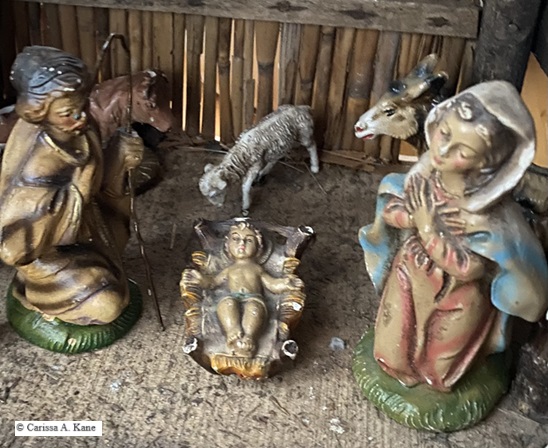
The verses above are used for the Gospel acclamation for the Feast of the Holy Family (usually celebrated the Sunday after Christmas). Oftentimes, the nativity of Jesus and the spirit of Christmas can be accompanied by thoughts of serenity and peace as well as images of idyllic creches and decorations. In such a setting, it can be rather easy to allow the peace of Christ and the word of Christ to flourish within when riding the joy of Christmas or any other anticipated or celebratory day or event. Yet, reality is such that life is a mixed bag and the unexpected, sometimes the dreaded, can come along at any moment, making it more challenging to be open to or inspired by the peace and word of Christ.
Imagine the joy and astonishment of Mary and Joseph at the birth of Jesus and what they initially encountered in the aftermath of his birth as people paid homage. Are there times in your life that come to mind and to which you can relate this experience? Times that have given rise to great joy, overwhelming peace, and/or the feeling of being so amazed.
Now, here we are, a week later, and in our liturgical celebration, we hear about Simeon and Anna paying homage to Christ and at the same time foretelling what’s to come (Lk 2:2-40).
“and Simeon blessed them and said to Mary his mother, ‘Behold, this child is destined for the fall and rise of many in Israel, and to be a sign that will be contradicted (and you yourself a sword will pierce) so that the thoughts of many hearts may be revealed’.” (v.34-35)
And coming forward at that very time, she gave thanks to God and spoke about the child to all who were awaiting the redemption of Jerusalem. (v. 38)
What’s it like to reflect on the fact that even though Jesus is the Christ, the reality is that it’s not going to be all roses and sunshine for Jesus, Mary, and Joseph either? It can be tempting to forget or to overlook reality, and to see the Holy Family as not only holy, but also as untouched. Take some time now to invite the Holy Family into whatever is happening at this time in your life. In what ways can you draw strength and inspiration from Jesus, Mary, and Joseph? What’s it like to consider that your experiences, your life, your family, and that of all those around you, are holy too?
Envision the peace and the word of Christ entering into the conversation and dwelling with, within, and all around you, drawing you, and all, closer to God.
Put on, as God’s chosen ones, holy and beloved, heartfelt compassion, kindness, humility, gentleness, and patience, bearing with one another and forgiving one another, if one has a grievance against another; as the Lord has forgiven you, so must you also do. And over all these put on love, that is, the bond of perfection. And let the peace of Christ control your hearts, the peace into which you were also called in one body. And be thankful. Let the word of Christ dwell in you richly, as in all wisdom you teach and admonish one another, singing psalms, hymns, and spiritual songs with gratitude in your hearts to God. And whatever you do, in word or in deed, do everything in the name of the Lord Jesus, giving thanks to God the Father through him. – Col 3:12-17
As the fire kicks in, it dances about. And the smoke? It fades away. All attention now To the brilliance Of its flames.
No ear has ever heard, no eye ever seen, any God but you working such deeds for those who wait for him. – Isaiah 64:3
The readings for the First Sunday of Advent call upon one and all to watch and wait… to pay attention. However, it can be very challenging to take heed to this message, especially at a time of year when everything is busier and there is pressure to fit more and more into whatever time one has. So, what are some ways that one can wade through the sea of distractions that float their way this Advent?
O God, restore us; light up your face and we shall be saved. – Psalm 80:4
First, get in touch with your desire for this Advent Season. Make time for some solitude and prayer so that you can get a better sense of your heart’s deepest wishes. What are your priorities? What are ways you can continue to pray and draw inspiration through each day of Advent?
God is faithful, and by him you were called to fellowship with his Son, Jesus Christ our Lord. – 1 Corinthians 1:9
Second, consider how you can be more intentional in moving through the season with your desires and an openness to God’s presence. What are you willing to invest with regards to time and space? Remember, more is not necessarily better. Also, the attitude with which one approaches a commitment, or a task, will affect the experience. So, try to take your coat off and put your bags down at the door, so to speak, as you enter. Take some time to unload and put aside whatever you’re coming from or holding onto so that you can receive whatever may be awaiting you.
Show us Lord, your love; and grant us your salvation. – Psalm 85:8 (Gospel Acclamation)
Before moving on, spend some time reflecting on the goodness of God. Recount your experience of God’s love (through prayer, nature, art, a meaningful exchange, etc.) over the past weeks and months. Allow yourself some time to bask in the grandeur of God.
What I say to you, I say to all: ‘Watch!’” – Mark 13:37
Third and last, Jesus instructed his disciples to keep watch and to be ready. It can be easy to take this as a directive and make it our own, but no matter how determined one might be, the risk becomes leaving God at the direction, and therefore missing the intent. This is not a solo endeavor! There is no way to effectively watch and be ready, without the grace of God.
This brings us back to desire! Scripture tells us that it is God who has chosen us (John 15:16). The season of Advent is an opportunity to remember and pay homage to this. It is an invitation to keep striving to avail oneself to the grace of God, not only to keep the faith, but to also to proceed with a willingness and openness to God’s ways and to grow in faith.
May we all use this Advent to choose, and keep choosing, God.














 HopeThatFloats
You must be logged in to post a comment.