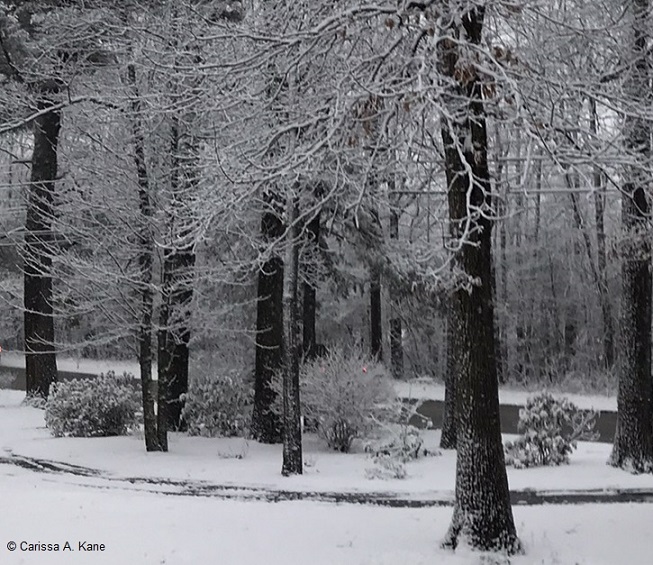
Covered with snow, the landscape so quiet, so still, so beautiful. The branches and shrubs become as if carefully wrapped, insulated from the elements, as well as by the elements. Becoming part of what’s on the outside pushing inward? Or, perhaps, it’s the outside becoming part of what’s inside and underneath, pushing outward? How will they lean, where will they fall, maybe, just maybe, they will stand upright, if anything at all.
A clean heart create for me, God; renew within me a steadfast spirit. – Ps 51:12
The Gospel for the First Sunday of Lent (Mt 4:1-11), is an account of the temptation of Jesus. We all experience variations of temptation throughout our lives. We all have weaknesses or tendencies that can lead us astray or take us away from being at or near our best, most genuine selves.
Looking to the example of Jesus, we can see his response to temptation, is first and foremost, to be aware and recognize it. Then second, to respond by remembering, and not only naming, but also reclaiming God as the source of all wellbeing. Jesus keeps God at the center throughout, and God’s grace enables him to overcome each temptation.
How can one apply this to real life experience in today’s world?
We can start by being aware and recognizing that temptation works in different ways. Sometimes it tries to move us toward “absolute” or limited views and the choices that flow from them, while at other times, temptation seeks to blur the lines between choices so that the best choice is left behind for the choice that seems good enough. Temptation tries, and keeps trying to find whatever hook will sink, to snag and pull one toward a more self-centered space and making a choice from there, instead of making it from a God-centered space where the choice is generative and beneficial beyond what one can surmise.
In the Gospel passage of the temptation of Jesus, Jesus shows us how to lean on the grace of God, and how to patiently endure to overcome temptation by living with God at the center—always in our hearts and minds. He reminds us that what has been written, holds true now, as well as forever.
One does not live on bread alone, but on every word that comes forth from the mouth of God. – Dt 8:3
He will command his angels concerning you and with their hands they will support you, lest you dash your foot against a stone. – Ps 91:11-12
You shall not put the Lord, your God, to the test. – Dt 6:16
The Lord, your God, shall you worship and him alone shall you serve. – Dt 6:13
Reflecting on each of Jesus’s responses above, what comes to mind in terms of your own experience of God’s grace in the face of a struggle or challenge you faced? Recall how God was present to you, and how you were, or became present to God? Share with God what that experience was like, and what it means to you today. What inspiration or insight might God want that experience to reveal to you today?
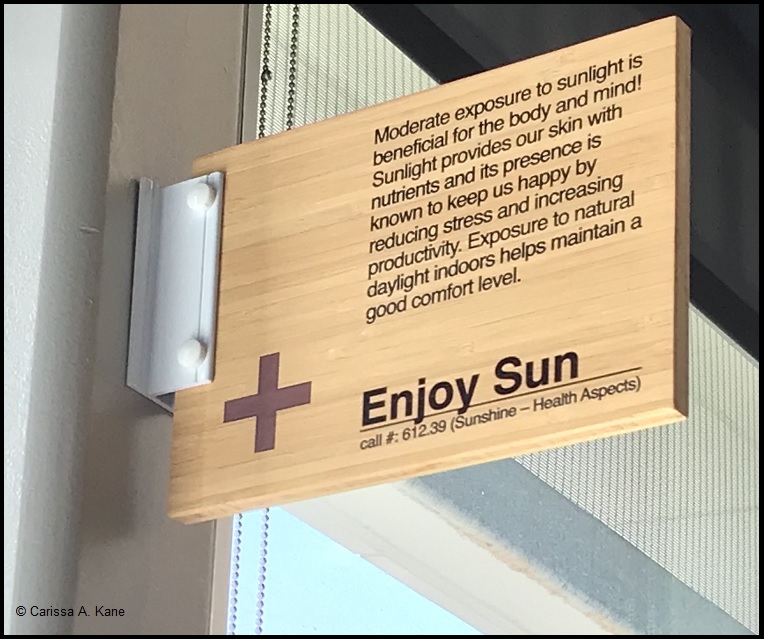
Standing up to take a break, stretch a little, and take a few steps around before returning to work in a temporary workspace for the day, the sign pictured below came into view. I read it and looked around some more. Taking in the environment and noticing more fully the ambience created by the natural light, gratitude and appreciation arose for the light and the souls who not only thought to share these interesting facts about sunlight and its benefits, but who also acted to shed the light, both in word and experience.
Oftentimes in the course of a day or week, we can be quick to move from task to task, and perhaps we miss the sign, put off the call, or rush through or past it, on the way to something else. Yet, much of the time, that thing, whatever it may be, that has a greater hold on our attention, robs us, “like a thief in the night,” of being present in a moment or for an opportunity to experience that which enlivens the soul, helps us to look beyond our own, often limited, schedules, scopes, or agendas, and reminds us of what’s really important—our connectedness, how we respect and appreciate each other—differences and all—and how we share our time and what we have, as blessings from Above.
Approaching the intersection of two busy streets, cones and temporary stop signs come into view, and then fallen lines disrupting service to the traffic lights that normally direct cars safely from one side to the other. It’s interesting how in driving or using other forms of transportation, one not only learns to look for signs, but also to be guided by them in reaching destinations safely.
Similarly, as one journeys through life, guidance comes, and prayers are often answered through signs, coming in various forms of interaction with God and others. Sometimes, in both times of light and times of darkness, whether personal or societal, it can be easy to miss signs, lose sight of, or take for granted, experiences of grace. The scripture readings throughout Advent and Christmas, remind us of God’s faithfulness and guiding presence, especially to Mary and Joseph, leading up to and beyond the birth of Jesus.
Through allowing or inviting God to be the source of their path and the sustenance of their hope, Mary and Joseph were not only drawn into their God-given purpose, but they were also led all the way through to its fulfillment… teaching us that the path can be difficult, the road uncertain, but that there can also be great joy when we embrace the spirit of Christmas—a heart full of light, and hope in the Lord.
All the ends of the earth have seen the saving power of God. – Psalm 98:3c
A Christmas Prayer: Lord, help me to remember your faithfulness, and to be open to the signs and guidance you place along my path. Turn my gaze always toward you, Emmanuel, as the source of all hope, that my heart may faithfully embrace the spirit of Christmas all year long, leading me to notice and appreciate the beauty and goodness of all creation, and the heart and soul of those I encounter each day.
Pieces, everything comes in pieces. Our coming and our going, Who we are and what we do, Hours, minutes, seconds of each day. Sometimes, taken as a whole, Might we miss or gloss over gold, The little things as not worth the time of day? Though precious is each moment, Taken alone and on its own, Might we miss or gloss over gold, The broader view as just another day? Pieces, broken down and shared, Everything is pieces, Of a picture big and small, Glossy gold and full of glimpses, Captured best holding one another, Drawing strength and beauty altogether, Being grateful for it all.
“Everything that is in the heavens, on earth, and under the earth is penetrated with connectedness, penetrated with relatedness.” – Hildegard Von Bingen
An Advent Prayer: Lord, help me to hold the pieces of my life together, big and small, easy and challenging and all that falls between, with great love and care, trusting that it is really You, the King of Glory (Ps 24:10b), who holds them all… who holds us all. And help me to continue to look to you, that you may grant me the grace to notice and appreciate the beauty and goodness of all creation, and the heart and soul of those I encounter each day.
Facing the ocean from the walk above or the sand upon the beach it’s easy to stay in place and feel content, and to do so without anywhere near the effort taken to get there. Not only that, but also to slide toward becoming removed from reality—all the lives that exist in various states on and all around the beach and the city or town that encompasses it—and the opportunity to take a life-giving part in it. It’s interesting to think about how swiftly one can be transported to “a world without cares,” with the sound of each wave that breaks upon the shore or the refreshing feeling as each wave washes over everything in its path.
Now, what’s it like to imagine that perhaps this (being caught up in the surroundings) is what it was like for the rich man in the Gospel according to Luke (chapter 16, verses 19-31), before he died?
When we read the Gospel for the Twenty-sixth Sunday in Ordinary Time (below), we learn that a poor man named Lazarus was a constant fixture at the rich man’s door. However, we are not told anything about an interaction(s) between the rich man and Lazarus. This is likely because what matters more than whether the rich man was unaware of, ignored, was indifferent to, or held disdain for Lazarus, is the distance that his worldly aims and wealth put between his ability to help and his desire to do so.
While the rich man was alive, he experienced what is sold in today’s world as “the good life.” However, it led him to becoming insulated from a complete picture of reality (not everyone has it good). And without that, it’s understandable that it would be harder for him not only to choose more wisely, but also to recognize that his openness to, and desire for living in ways that are generative had become diminished.
Neither the rich man nor his brothers could learn from the past (Moses and the prophets), not because the knowledge and wisdom wasn’t available to them, but because their hearts were divided. This—the chasm—is what prevented them from receiving the grace they really needed and making choices for the greater good.
May we be more aware and set our hearts on God to strip away the falsehoods that lead us astray, and to close the chasm that pulls us apart.
Jesus said to the Pharisees: “There was a rich man who dressed in purple garments and fine linen and dined sumptuously each day. And lying at his door was a poor man named Lazarus, covered with sores, who would gladly have eaten his fill of the scraps that fell from the rich man’s table. Dogs even used to come and lick his sores. When the poor man died, he was carried away by angels to the bosom of Abraham. The rich man also died and was buried, and from the netherworld, where he was in torment, he raised his eyes and saw Abraham far off and Lazarus at his side. And he cried out, ‘Father Abraham, have pity on me. Send Lazarus to dip the tip of his finger in water and cool my tongue, for I am suffering torment in these flames.’ Abraham replied, ‘My child, remember that you received what was good during your lifetime while Lazarus likewise received what was bad; but now he is comforted here, whereas you are tormented. Moreover, between us and you a great chasm is established to prevent anyone from crossing who might wish to go from our side to yours or from your side to ours.’ He said, ‘Then I beg you, father, send him to my father’s house, for I have five brothers, so that he may warn them, lest they too come to this place of torment.’ But Abraham replied, ‘They have Moses and the prophets. Let them listen to them.’ He said, ‘Oh no, father Abraham, but if someone from the dead goes to them, they will repent.’ Then Abraham said, ‘If they will not listen to Moses and the prophets, neither will they be persuaded if someone should rise from the dead.'” – Luke 16:19-31
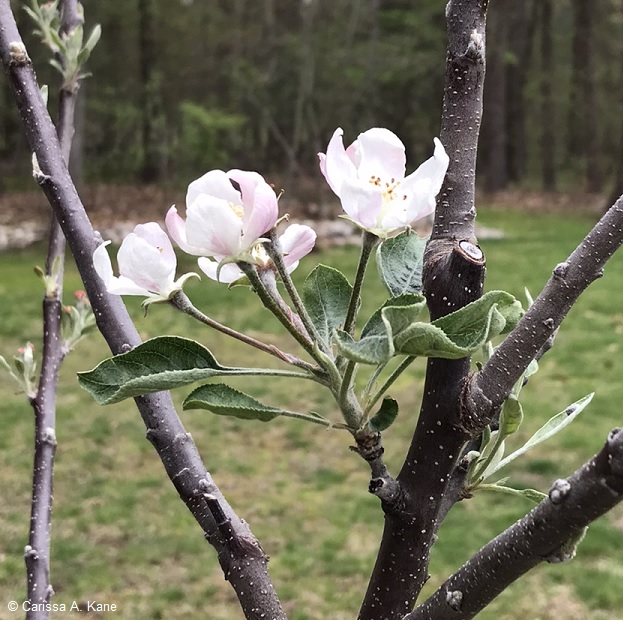
Watching as the branches fill in, flowers blossom, pollen wafts through the air, and Spring burgeons and unfolds, there is a sense of awe. In the Book of Revelation, it is written, “The One who sat on the throne said, ‘Behold, I make all things new.’” (Rev 21:5a). Not some things, or only certain things, but all things. Thinking about this, I cannot help but consider this concept further and ask, “Am I open to all things being made new by God?”
The flowers grow and open, pretty much wherever they are planted. And certainly, there are some conditions necessary for their maturity and well-being—light, water, nutrients, and some level of protection from harsher elements and realities. However, the things vital to their growth can be found or seep in even in unexpected places, and overall, flowers grow where they will.
In chapter 14, verses 21-27, of the Acts of the Apostles, we continue to learn of the experiences of Paul and Barnabas as they travel on, inspired by their discipleship desire. Their journey leads them back to Antioch, the place of resistance from where they were expelled in chapter 13.
It is written:
“From there they sailed to Antioch, where they had been commended to the grace of God for the work they had now accomplished. And when they arrived, they called the church together and reported what God had done with them and how he had opened the door of faith to the Gentiles.” – (verses 26-27)
Imagine. God called them to something more, launching something new from the very place that was not open to receiving them at the time. It turns out God had somewhere else in mind for them. How did they react or respond?
Paul and Barnabas were willing to let go of their notions and allow themselves to be led to other territories where they not only experienced what God had in mind, but also deepened their faith. Eventually, they were led back to Antioch, where, because of God who makes all things new, they were able to meet resistance with something more, something stronger, faithful witness to the Glory of God.
So just as flowers grow where they will, so too Paul and Barnabas… so too us. If we are open to it.
Recall an experience of bumping into someone that you know, in a place and at a time that you normally wouldn’t expect to see them? Initially, you might be surprised for good or less, or perhaps it might take a few moments to fully recognize the person. Maybe some memories of them come to mind.
Next, imagine that you kept encountering that same person over the course of several weeks. What would you think? What would you feel?
Now envision being one of Jesus’ disciples and having the experience of Jesus’ appearing to you, here and there, in the time between his Resurrection and Ascension. How would you react or respond after the profound experience of his crucifixion, his Resurrection, and being in the environment of belief and disbelief created by it all?
Would you be devoted to trying to see a pattern to Jesus’ appearances to try to predict when you might see him next? Would you commit yourself to trying to figure out the reasons why he was appearing? How hard would you work to come to some sort of knowledge about these occurrences? In what ways would you characterize your approach?
Focusing more closely on Jesus and his third appearance at the Sea of Tiberias (John 21), how determined would your mind be, and how open would your heart be, to the presence of Jesus who is in the form of the person on the shore, unknown and at a distance? How about to yourself or the person on the shore, thought of as being known? Would you cast the net again? What would you discover?
Simon Peter said to them, “I am going fishing.” They said to him, “We also will come with you.” So they went out and got into the boat, but that night they caught nothing. When it was already dawn, Jesus was standing on the shore; but the disciples did not realize that it was Jesus. Jesus said to them, “Children, have you caught anything to eat?” They answered him, “No.” So he said to them, “Cast the net over the right side of the boat and you will find something.” So they cast it, and were not able to pull it in because of the number of fish. So the disciple whom Jesus loved said to Peter, “It is the Lord.” When Simon Peter heard that it was the Lord, he tucked in his garment, for he was lightly clad, and jumped into the sea. – Jn 21:3-7
In what ways do you allow Jesus to be present to you in the unexpected? In what ways do you invite Jesus to help you to be present, to hold situations up to the light, to receive God’s wisdom so that you can embody the thoughts and feelings needed not only to embrace the moment, but also to receive and recognize the grace it holds, and how to share it?
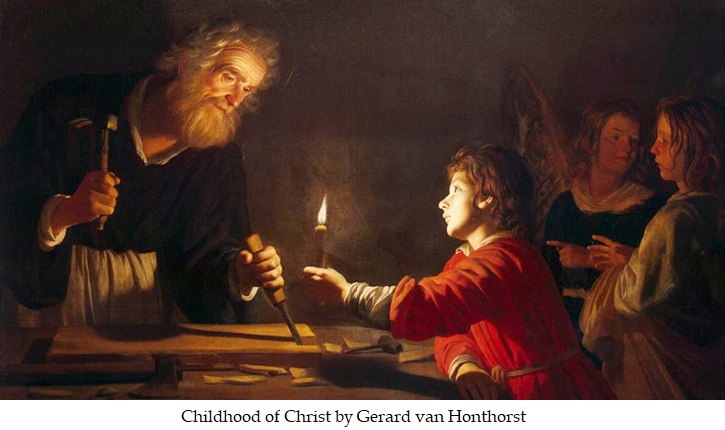
Sometimes, there are so many questions, and it can seem like so much work. Yet, as April turns to May and the Feast of St. Joseph The Worker arrives, so also does the opportunity to experience not only the light of longer days, but also renewal through the touch of Grace—peace, light, hope, and inspiration—that continues to blossom with the Easter season, and beyond.
How does grace touch and move your heart? And how is it reflected in your work?








 HopeThatFloats
You must be logged in to post a comment.