For a time, many things are only for a time. Some things forever gone, others, on hiatus. Sometimes returning, welcome on arrival, Sometimes returning, unwanted and in dread, Sometimes slithering, seeping in, seeping out, Creating a stir, unease or great unrest. But Light, the Great Protector, shines thru, Revealing all, shedding lies in time, And casting out, what Time ordains as passed.
The Gospel passage for the First Sunday of Lent (Luke 4:1-13) is referred to as the Temptation of Jesus. After his baptism, Jesus is led into the desert by the Holy Spirit for forty days. And after these days of fasting, he is tempted by the devil in three ways:
First, to use his status as the Son of God to relieve himself of his situation of hunger.
“If you are the Son of God, command this stone to become bread.” (verse 3)
Second, to exalt himself by paying homage, or worshipping, the devil to receive earthly power and glory.
“I shall give to you all this power and their glory; for it has been handed over to me, and I may give it to whomever I wish. All this will be yours, if you worship me.” (verses 6-7)
And third, to show doubt in God, by throwing himself from the parapet of the temple, and thereby testing Scripture:
“If you are the Son of God, throw yourself down from here, for it is written: ‘He will command his angels concerning you, to guard you, and: ‘With their hands they will support you, lest you dash your foot against a stone.’” (verses 9-11)
Jesus responds to these temptations as follows:
“It is written, ‘One does not live on bread alone.’” (verse 4)
“It is written ‘You shall worship the Lord, your God, and him alone shall you serve.’” (verse 8)
And lastly, when the devil tries to zero in on and twist Scripture verses to tempt Jesus away from the truth of who God is calling him to be, Jesus, again focuses on God—a higher purpose—responding:
“It also says, ‘You shall not put the Lord, your God, to the test.’” (verse 12)
The “Temptation of Jesus” Gospel passage ends with, “When the devil had finished every temptation, he departed from him for a time.” (verse 13)
Oftentimes, after going through a challenging situation or event, it is common to be grateful for that time to be over. It can also be tempting to walk away with a notion of achievement or learning from it in a way that we see as being complete. Yet, whether good or bad, there are times when the same, or a similar challenge returns, offering an opportunity to draw even closer to God, and to see or learn even more.
Take some time to consider how open you are to remembering what you’ve learned as well as to learning something new when repeat or similar situations of challenge occur?
Reflecting on Jesus’s words in response to each of the temptations he faced in the desert, what invitation(s) are there for you and Jesus to explore? Allow your prayer to extend into these areas. Express your wants, needs, fears, etc. to Jesus, and allow Jesus to express His thoughts and wisdom to you.
You who dwell in the shelter of the Most High, who abide in the shadow of the Almighty, say to the Lord, “My refuge and fortress, my God in whom I trust.” – Psalm 91:1-2
After ministering to many people in Capernaum, Jesus sets out for a deserted place, yet the crowds search for, and find him. They don’t want him to leave. However, he explains that he must go because his ministry and proclamation of the Kingdom of God must extend to other villages and towns. After witnessing and hearing his preaching, and all the healings, how do you imagine the people of Capernaum took this news? Do you think they were skeptical or upset at the idea of other people, from a different village or town, and who perhaps they considered as outsiders, being the recipients of Jesus’s preaching and healing, too?
What’s it like when you consider Jesus’s mission as one that extends to all people, regardless of who they are or from where they come?
The Gospel for the Fifth Sunday in Ordinary Time (Luke 5:1-11), begins with Jesus having moved on to Judea and then Lake Gennesaret. It is written:
“While the crowd was pressing in on Jesus and listening to the word of God, he was standing by the Lake of Gennesaret.” – Luke 5:1.
Take some time to put yourself in the crowd. As you draw in toward Jesus and listen to the word of God, what comes into your mind, and how is your heart stirred? What prayer arises within you?
As the Gospel passage continues, Jesus gets into Simon’s boat and asks him to push away from the shore. This is not so that he can leave the crowd that has been closing in on him. Rather, it is so that he can continue to minister, teaching them from the boat.
Envision yourself on the shore with Jesus and then in the boat a short distance from the shore. What’s different when you’re in the crowd versus when you’re in the boat? What might Jesus want you to learn from his actions in this situation? What words does Jesus have for you and the crowd?
When Jesus’s preaching to the crowd ends, it is written:
“…he said to Simon, ‘Put out into deep water and lower your nets for a catch.’ Simon said in reply, ‘Master, we have worked hard all night and have caught nothing, but at your command I will lower the nets.’ When they had done this, they caught a great number of fish and their nets were tearing. They signaled to their partners in the other boat to come to help them. They came and filled both boats so that the boats were in danger of sinking. When Simon Peter saw this, he fell at the knees of Jesus and said, ‘Depart from me, Lord, for I am a sinful man.’ For astonishment at the catch of fish they had made seized him and all those with him, and likewise James and John, the sons of Zebedee, who were partners of Simon. Jesus said to Simon, ‘Do not be afraid; from now on you will be catching men.’ When they brought their boats to the shore, they left everything and followed him.” – Luke 5:4-11
After working hard all night to no avail, Peter does as Jesus asks. He goes back out into the deep part of the sea, and with Jesus by his side, where there was nothing, now there is an abundance, so much so that his nets and the boats can hardly hold it. However, for this to be possible, Peter had to first leave behind and let go of what he had already come to know—he was out all night and there were no fish to be caught—and rather than holding onto defeat or being discouraged, he had to put his hope, faith, and trust in Jesus.
Recall a time when you experienced a challenge, difficulty, or drought of some kind and how faith and Jesus’s presence helped you? What were your prayers like during that time? In what ways did you avail yourself, or help yourself, to be open to listening to and being present to Jesus? Thinking of that time, how can you relate to Peter in this Gospel passage?
Turning to today, think about a situation you’re currently facing. How are you inspired as you continue to seek and draw nearer to Jesus?
“On the day I cried out, you answered; you strengthened my spirit.” – Psalm 138:3
The Season of Advent and its related Scripture remind us of the twists and turns that life can take for anyone. They also provide an opportunity to see the faithfulness and goodness of God. In addition, they exemplify how being faithful to God involves being open to ways or paths that may differ, sometimes greatly, from the ones we may have planned or imagined for ourselves.
Take some time to think about what it has been like in the past for you to accept or make changes to the plans, ideas, and/or notions you have envisioned. What is it like in the present?
We all have things we would like to accomplish and look for ways, or paths, to do so. However, in proceeding in earnest and with good intentions as we strive, we can become mixed up when we don’t leave room for, can’t see, or are not open to the possibility of change(s) as being needed and for the better good. So when the twists and turns come, we can become even more attached to our own intentions and the ways we planned to accomplish them, instead of allowing the grace of God to help us to be open to making an adjustment or being open to a different way.
Sometimes, interference and the unexpected can push our buttons in ways that can make us behave as less than what we are… what we were created to be—beings in the image of God. When this happens, we can lose sight of the wideness of God, and the depth of God’s love, compassion, and mercy.
What are some memories you have of times when you met change, unexpected challenges, and/or uncertainty with a quiet calmness? How do those times compare to ones where, perhaps, quiet calmness and peace gave way to unrest?
Stand with the Lord at the threshold between the times of peace and the times of unrest that you’ve recalled. Ask Jesus to unveil the place(s) where maybe you couldn’t sense his presence or take direction, as well as the place(s) where you could. Express to the Lord your gratitude and your desire to remember whatever he wants you to hold onto from these instances as you enter the Advent Season and look to prepare for Christmas.
Make known to me your ways, Lord; teach me your paths. – Psalm 25:4
Neither grave, nor the gravity, Could hold Him down. That cross, though heavy, Not heavy enough, Nor could it ever be. A temporary thing, A passage, passing with time, The Begotten not gone.
That stone, though big, Not big enough, Nor could it ever be. A temporary thing, A passage, passing with time. The Begotten hidden, Not seen, not heard, But certainly not gone.
Then, Easter. Arriving between the quiet, Entering amid the stillness, And everything changes. Everything becomes new again, In the remembering of what is. Nothing ever stronger than What was, What is, and What shall ever be.
Just as Light cannot be kept from shining, And Truth, refusing to remain hidden, There is no greater shield or power than that created by Creator. We are more than passengers on borrowed time. More than temporary things or passages, passing with time. And in Him, with Him, and thru Him, Neither grave, nor the gravity, Can hold us down.
The readings for the Second Sunday of Lent take us on a journey from sacrifice or letting go to service, embracing identity, and finally becoming one with it. In the first reading, Abraham shows a willingness to sacrifice or let go of whatever his ideas or plans might have been to listen to God and do as God asks (Genesis 22:1-18). Remember, Sarah and Abraham, in their more senior years and against all odds, had their son Isaac after having been barren. Imagine what it must have been like for Abraham to then be asked to sacrifice or let go of his and Sarah’s long-awaited arrival. Yet, Abraham exemplifies a faith that places trust in God (and God alone) above all. He proceeds to take steps toward what God has asked of him. As they left the servants behind and walked along, Isaac asks his father where the sheep is for their offering. Abraham replies, “God will provide the sheep for the burnt offering.” Once they finish building an altar and placing the wood, Abraham moves toward sacrificing his and Sarah’s only child. However, the angel stops him as Isaac’s demise is not what God wills. As Abraham said, God does provide the sheep for sacrifice: “Abraham looked up and saw a single ram caught by its horns in the thicket. So Abraham went and took the ram and offered it up as a burnt offering in place of his son.” And the wisdom of his response to God’s requests and promptings shows that being faithful is to nurture a will that is open to and guided by God. For it is this kind of will that does not lead to demise or destruction.
Continuing to look to what it is to be faithful to God, the response for the Psalm is “I will walk before the Lord, in the land of the living” (Psalm 116:9). How do you feel motivated by Abraham’s example of striving to serve God with a united heart and mind? Try to envision or embody the spirit of walking before God in all that you say and do this week.
Turning to the second reading (Romans 8:31b-34), St. Paul encourages us to remember and embrace our identity when he writes: “If God is for us, who can be against us?” When one is operating with a desire to do God’s will and in the scope of being part of creation in God’s image, there is a sense of inner strength, awareness, and reverence for what is good and just while at the same time a sense of lightness and freedom or free will. It is important to pause every so often to examine what’s going on internally and from where one’s words and actions are flowing. Invite Jesus to the conversation and ask the Lord for the grace to be aligned compatibly with God in each situation you face.
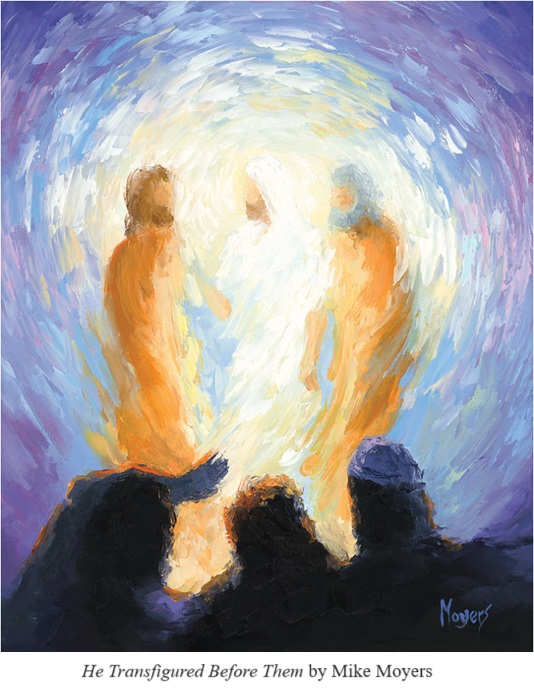
In this week’s Gospel, we read about the Transfiguration of Jesus (Mark 9:2-10), the ultimate image of embracing one’s identity and becoming one with it for the greater good.
Jesus took Peter, James, and John and led them up a high mountain apart by themselves. And he was transfigured before them, and his clothes became dazzling white, such as no fuller on earth could bleach them. Then Elijah appeared to them along with Moses, and they were conversing with Jesus. Then Peter said to Jesus in reply, “Rabbi, it is good that we are here! Let us make three tents: one for you, one for Moses, and one for Elijah.” He hardly knew what to say, they were so terrified. Then a cloud came, casting a shadow over them; from the cloud came a voice, “This is my beloved Son. Listen to him.” Suddenly, looking around, they no longer saw anyone but Jesus alone with them.
As they were coming down from the mountain, he charged them not to relate what they had seen to anyone, except when the Son of Man had risen from the dead. So they kept the matter to themselves, questioning what rising from the dead meant. – Mark 9:2-10
Recall a time where you felt affirmed or reaffirmed and had a sense of confidence in who you are as God’s beloved, leading to spiritual growth or renewal. Ask the Lord for the grace of that experience to extend to today, offering you wisdom, insight, and openness to whatever you may need.
The readings for the Fifth Sunday in Ordinary Time begin with a passage from the Book of Job where the subject, Job, continues to express dissatisfaction as he tries to come to terms with, and understand the reason for, the trials and tribulations he is and has been experiencing.
Job spoke, saying: Is not man’s life on earth a drudgery? Are not his days those of hirelings? He is a slave who longs for the shade, a hireling who waits for his wages. So I have been assigned months of misery, and troubled nights have been allotted to me. If in bed I say, “When shall I arise?” then the night drags on; I am filled with restlessness until the dawn. My days are swifter than a weaver’s shuttle; they come to an end without hope. Remember that my life is like the wind; I shall not see happiness again. – Job 7: 1-4, 6-7
Thinking about this passage, what resonates with you most? How do you feel about Job’s plight and about God’s role in it?
Recall a time when you felt challenged, and your faith tested. In what ways was God present to you, even if you were not aware or able to name God’s presence as such at that time? What would you say it was about that experience that affected your faith or trust in God? Take some time to share with God what’s on your mind and in your heart at this moment.
The response for the Responsorial Psalm this Sunday is, “Praise the Lord, who heals the brokenhearted.” (Psalm 147 cf. 3a). We all experience heartache and heartbreak as we journey through life. What situation in your life is outright disturbing your heart or creating a sense of unrest or uneasiness? What do you desire from God regarding this situation? What might God want you to know or to consider? In what ways can you envision this situation as an opportunity to deepen your faith and relationship with God?
In the First Letter of St. Paul to the Corinthians, verse 22 of chapter 9, we read, “To the weak I became weak, to win over the weak. I have become all things to all, to save at least some.” What’s it like to consider this, in light of today’s world, as an invitation to getting along in service to God and for the sake of being a living testament to the Gospel? Sticking with this, what would you want to ask St. Paul about this passage and the challenges he faced? What do you need from God as you strive to be a disciple of Jesus in today’s world? Pray for God’s desire for you, in terms of how you navigate the division and issues in today’s world, to be placed in your heart, imparting wisdom throughout each day.
Next, as we move to the Gospel passage for the Fifth Sunday in Ordinary Time (Mark 1:29-39), we have Jesus’ healing Simon’s mother-in-law as well as a multitude of people. Upon being healed, Simon’s mother-in-law gets back to the business of serving others. We also learn that Jesus separates from the crowd to go pray. Once he is found, Jesus gets back to the business of preaching and healing people as he moves on to the neighboring villages. Take time to contemplate this passage in terms of the necessity of prayer and downtime or time away. What happens when there is an interruption in your routine? In what ways are you open to change? How do you experience the dynamic nature of God through interruptions and changes around you?
“In Christianity, God is not a static thing—not even a person—but a dynamic, pulsating activity, a life, almost a kind of drama. Almost, if you will not think me irreverent, a kind of dance.” – C.S. Lewis
Traveling through time, Year after year, tick upon tock, Broken down into moments, One leading into the next, Some greener than the others, But all steady in their passing. Once gone, they are away, As if lost, forever missing. Yet, amid the shades of darkness, Light lives, cradled deep within, Both ready and most willing, Shining ever, and for all. Walking with great care, Thoughtful hearts take notice, Finding Whom they seek, Steady in their passing.
“We saw his star at its rising and have come to do him homage.” – Matthew 2:2
From one thing to another A shade, or some truth survives. Perhaps hidden from plain view, But nonetheless existing, If only to be seen, picked, From underneath the rubble, Intertwined and wrapped around, Trying to conceal or blur, The hard lines and soft edges, Leading one to discovery. Aiming, always aiming high, To the place where feelings go To wash away thoughts unkind. Resting in the heart of One, Meeting up, then stepping out, Similar but not the same. Grateful for Your peace and love, Amazing, so amazing, What can happen thru Your eyes. Though the winds may shift and change, The soul carries on its way, Steady in One who remains.
The Lord is my shepherd; I shall not want. – Psalm 23:1












 HopeThatFloats
You must be logged in to post a comment.