Celtic Healing Cross

You, have redeemed the world…

“The Holy Scriptures were not given to us that we should enclose them in books, but that we should engrave them upon our hearts.” ― St. John Chrysostom

Praying with the scripture readings for the Feast of the Exaltation of the Holy Cross (Numbers 21:4b-9; Psalm 78:1b-2, 34-38; Philippians 2:6-11; and John 3:3-17), contemplate what it means to engrave them upon your heart.

In the First Reading, we hear of the Israelites, at wit’s end, upset by their situation in the desert, and making it known to Moses. We also learn of the punishing arrival of saraph serpents, leading to the surmise of many, and the subsequent realization of sin and prayer for relief. Following this, Moses prays for the people to be spared from the serpents, and the Lord replies, “Make a saraph and mount it on a pole, and if any who have been bitten look at it, they will live.” (Numbers 21:8).

What do you make of the notion that to be cured, or to overcome the serpent’s bite, requires looking at the bronze serpent mounted on the pole?

Take some time to consider a situation or area in which your patience is worn thin, or where you have been bitten. What has your reaction or response been? And how might you ask for, and receive, God’s grace to move toward peace and healing—a better way?

The response for the Psalm (Psalm 78:1b-2, 34-38) is, “Do not forget the works of the Lord!” (Ps 78:7b). Like it was in the desert for the Israelites and Moses, it can be tempting for anyone to react or respond out of feelings of discontent or anger, when it feels like needs are not being met or answers are nowhere to be found. This psalm invites us to recall what is true. None of us are without mistakes and missteps along the way. Still though, God is merciful and forgiving. This psalm encourages us to recall and remember the ways that God has been, and is, steadfast toward us.

Think about your experience of God turning something bad into something good?

Throughout the week, in moments with or without concern or upset, pause to acknowledge and give praise to God for God’s faithfulness to you. Allow yourself the space and invite God into it, to help you to see the entire picture, and to remember what is true.

In the Letter of St. Paul to the Philippians (Philippians 2:6-11), it is written:

Christ Jesus, though he was in the form of God,
did not regard equality with God something to be grasped.
Rather, he emptied himself,
taking the form of a slave,
coming in human likeness;
and found human in appearance,
he humbled himself,
becoming obedient to death,
even death on a cross.
Because of this, God greatly exalted him
and bestowed on him the name
that is above every name,
that at the name of Jesus
every knee should bend,
of those in heaven and on earth and under the earth,
and every tongue confess that
Jesus Christ is Lord,
to the glory of God the Father.

Continuing to pray with the thoughts, feelings, and situations that have come to mind and heart thus far, where might the words emptied, humbled, exalted, and bestowed—the past tense verbs used by St. Paul to describe actions of Jesus and God—be applicable or come into play? Ask the Lord to help you to identify ways that these words operate in your life, and what purpose they might be serving.

Turning to the Gospel passage (John 3:13-17), Jesus is mid-conversation with Nicodemus, a Pharisee who has come to see Jesus in the darkness of night. Nicodemus is trying to understand what Jesus means by, “no one can see the kingdom of God without being born from above.” (Jn 3:3).

What does being born from above mean to you?

For the Feast of the Exaltation of the Holy Cross, we are reminded of where, and who, we currently are—our place as well as our call—eternal life through Jesus.

In the Gospel passage, Jesus refers to Moses lifting up the bronze serpent in the desert and says, “so must the Son of Man be lifted up, so that everyone who believes in him may have eternal life.” (Jn 3:14-15). He knows that Nicodemus will be familiar with and understand what has been written in Scripture. However, an earmark of Jesus is to elevate and help us along toward living Scripture. This is what he is trying to do, when he follows up with:

“For God so loved the world that he gave his only Son, so that everyone who believes in him might not perish but might have eternal life. For God did not send his Son into the world to condemn the world, but that the world might be saved through him.” (Jn 3:16-17).

Enter into conversation with Jesus about these two verses, inviting him to elevate and help you along in your journey toward living Scripture, or living it more fully. When your prayer time comes to a close, add the following:

We adore you, O Christ, and we bless you,
because by your Cross you have redeemed the world. – St. Francis of Assisi


Celtic Healing Cross

At the Banquet…

Dependent on one’s point of view,
and from one end of the spectrum,
to the long, far away other,
the distance between here and there,
holds no relevance to the Heart.

For everyone who exalts himself will be humbled,
but the one who humbles himself will be exalted. – Luke 14:11

The Better Part…

From day to day, the better part
lives and breathes, beckoning to all.
Caught in between concerns and cares,
weighed down with worries and/or fears,
but always there for the finding.

From day to day, the better part
waits us out, and begs our pardon.
Patience looks for the gate to lift
and the willful to be open;
the Timeless, ready on a dime.

From day to day, the better part
flows from the heart of one’s choosing.
But what underlies the surface?
Influencers? Influences?
Aware or not, we all have them.

Jesus entered a village
where a woman whose name was Martha welcomed him.
She had a sister named Mary
who sat beside the Lord at his feet listening to him speak.
Martha, burdened with much serving, came to him and said,
“Lord, do you not care
that my sister has left me by myself to do the serving?
Tell her to help me.”
The Lord said to her in reply,
“Martha, Martha, you are anxious and worried about many things.
There is need of only one thing.
Mary has chosen the better part
and it will not be taken from her.” – Luke 10:38-42

More Than a Wish…

The magi, or three wise men, are first drawn to Jerusalem by the star signifying the birth of a newborn king. Once there, they encounter Herod, who acting on fear, deceptively seeks to have them locate this king so that he may bring about his demise; not pay homage as he has claimed.

For the wise men, this journey began with the beckon of a bright, new star. Then, from Jerusalem and their exchange with Herod, that same star leads them further onward, guiding them to Bethlehem, and Jesus Christ. And after paying homage and offering gifts to the newborn king, it is a dream that directs them back home, rather than returning to Jerusalem to reveal the location of the newborn king to Herod.

Along the way, and at each stop, the wise men, like us, undoubtedly had choices to make. What, do you imagine, inspired them to keep following the star from its rising all the way to Jerusalem? And then onward to Bethlehem?

What led them to listen to the dream and go home a different way rather than returning by way of Jerusalem, stopping to give Herod the information he wanted from them?

After taking some time to contemplate the Gospel passage for the Epiphany of the Lord (Matthew 2:1-12), reflect on the choices that you may be facing at this time and how you go about making decisions.

What influences your decisions and from where do you take direction or draw inspiration? What are the factors that motivate you? How do they reflect a posture of paying homage to the Lord? (Perhaps they are born out of, or hold at their roots, love, patience, or something similar.)

Take what you notice into prayer, inviting Jesus to share Light and Wisdom with you. Pray with any feelings or desires that arise in you. And when this prayer time comes a close, ask Jesus to reveal one parting word, phrase, or image that will help to draw and lead you, like that star, to where you ought to be.

We saw his star at its rising and have come to do him homage. – Matthew 2:2

Then, Look Around…

First, listen, and then, look around. Allowing one’s senses to take in and sincerely contemplate the happenings of a day can be challenging, never mind those of the times. Yet, it is these happenings that impact not just our own personal space, but also extend beyond what we might imagine. They are like sound waves rippling outward and amplified, stirring the air all around us.

The readings for the 3rd Sunday in Ordinary Time begin with a passage from the Book of Jonah (Jon 3:1-5, 10) where the initially resistant prophet Jonah warns the people of Nineveh of their impending doom. However, just like Jonah who was previously swallowed up and in darkness (in the gut of a whale), the people of Nineveh see it fit to change their course, let go of their way, and open their hearts and minds more fully to God.

In Psalm 25, the psalmist expresses a desire to understand and to live by the ways of the Lord. The psalmist prays for God, who is faithful, compassionate, merciful, good, and upright, to teach them how to embody and live by the same ways. For this to happen though, like Jonah and the people of Nineveh, the psalmist realizes they must let go of the old (acknowledge and turn over their trespasses to God) to be more fully open to God. And thus, to live more fully as one created in the image of God, abiding by, and living in God’s ways.

In chapter 7 of St. Paul’s first letter to the Corinthians, the people of Corinth are urged to pay attention as time is of the essence. The passage (verses 29-31) begins with, “I tell you, brothers and sisters, the time is running out.” and ends with, “For the world in its present form is passing away.“.  In between, St. Paul writes:

“From now on, let those having wives act as not having them,
those weeping as not weeping,
those rejoicing as not rejoicing,
those buying as not owning,
those using the world as not using it fully.”

Perhaps what St. Paul is warning the Corinthians, and us, about, is being consumed by anything or anyone. He is calling us to be careful about what holds our attention, not to become self-consumed or fixated on anyone or anything earthly, as all of it is bound by time, is imperfect, and therefore passes away. Focus instead on that which is timeless—God and God’s ways.

This leads to the Gospel passage, Jesus’ announcement of the Kingdom of God as being at hand, and the call of the disciples Simon, Andrew, James, and John (Mark 1: 14-20). The disciples are busy, at work, mending their nets. This is useful work, but God had other work in mind for them at that time. Jesus reaffirms them in that yes, they are fishermen. However, he redirects them to being “fishers of men,” but again as we saw in the other readings for the 3rd Sunday in Ordinary Time, only if they will it as well. With Jesus, as with God, no one is ever forced to choose God and God’s ways. And although the time is now, the essence of God is that Time is not rushed or pressured (there is no act swiftly or lose out), and perhaps most importantly, Time is faithful, compassionate, merciful, good and upright, patient, and always open to change.

Make known to me your ways, Lord;
teach me your paths.
Guide me by your fidelity and teach me,
for you are God my savior,
for you I wait all the day long.
Remember your compassion and your mercy, O Lord,
for they are ages old.
Remember no more the sins of my youth;
remember me according to your mercy,
because of your goodness, Lord.

Good and upright is the Lord,
therefore he shows sinners the way,
He guides the humble in righteousness,
and teaches the humble his way. – Psalm 25:4-9

The Bread of Life…

Breaking free of all that is clutter,
To step away can be a struggle.
More than noise and expectations,
Theories and persuasion.
Competing, always competing,
Ever disguising might as right.
What is it with this clutter,
Going round both day and night?

It can be hard and very trying,
To move beyond its reach,
Or to strive to rise above it.

Yet, sometimes a willing heart,
Into the wide and open air,
Is all it really takes.

Then, leaning back, to catch a glimpse,
And take a breath so deep,
It carries inner strength and peace.
Filled with hope and gentle wisdom,
It’s time to return to what was left behind.
Somehow, it’s all the same,
But also, very different.

Because the loaf of bread is one, we, though many, are one body, for we all partake of the one loaf. – 1 Cor 10:17

Upon First Sight…

Upon first sight a threat,
A battle to be had,
A thing to put to rest.
Yet, drawing closer
A picture to behold.
Golden, like the rule,
If only it were practiced.
So many points to reflect upon,
Held together at the center
And spreading out,
As if to say,
I have so many ways,
I am full of life,
But still have room to grow.
Here for now, as if forever, as I am,
But please know better,
All is ever changing.
Working toward the air,
Poetry in motion,
To be blown about,
And all around,
Making waves,
Albeit gentle,
From one life to another.
Eternal presence,
Dwelling for the masses,
Extending hope
And willing for your freedom.
Not to be distorted,
Or held hostage for your needs,
But rather carried with great mercy,
And my love,
The example of compassion.

The Lord is my shepherd; there is nothing I shall want. – Psalm 23:1

Humility: Against the Grain or With It…

It’s said that only 10% of the energy received from the sun by a plant or tree (a.k.a. a producer) is transferred to the consumer of that plant or tree, and as one moves up the chain, although 10% keeps getting passed along to the next level, the amount of energy becomes less. This means that the further away from the original source one is, more consumption or effort is necessary to achieve or capture the same amount of energy that the plant or tree receives as a producer. As for the 90% of the energy that is retained by producers, it is used for growth and reproduction as well as some of it simply escaping as heat into the atmosphere.

It’s intriguing to think about only 1/10th of the energy received from the original source, the sun, as being passed along from the 1st level to the next, and only 1/10th of that lesser amount going to the next level, and so on. Yet, despite this comparatively small portion shrinking at each level, life not only goes on, but also evolves. It calls to mind last Sunday’s Gospel when in response to the disciples asking for an increase in faith Jesus said, “If you have faith the size of a mustard seed, you would say to [this] mulberry tree, ‘Be uprooted and planted in the sea,’ and it would obey you.” (Lk 17:5-6). It also leads to this Sunday’s readings and a key component of faith.

Although the way of the world might urge one and all to seek what is big, bold, or grand, and to make it known, the readings for the Twenty-eighth Sunday in Ordinary Time (shown below) offer an opportunity to contemplate humility. In the first reading (2 Kgs 5:14-17), Naaman, a successful and celebrated commander of King Aram’s army, is cured of leprosy by submerging himself in the Jordan seven times at the direction of the prophet Elisha. Yet, it is only by taking time to go back and look behind the scenes at the prior verses of this passage, that one can see or be reminded that it was at the urging of servants that Naaman made his way to Elisha, eventually overcame his notions and resistance to listening to the prophet, entered the waters of the Jordan, and was healed. Had Naaman dismissed his servants’ perspectives without consideration and continued to be bound up by his judgments, preferences, and ideas about the unexpected and less than grand actions Elisha instructed him to take, the healing would not have been possible. It’s important to consider humility as requiring an openness to considerations that originate and/or extend beyond oneself.

Turning to the second reading (2 Tim 2:8-13), St. Paul continues to exhort and encourage Timothy, to draw strength from the truth, keeping and carrying on the faith. While St. Paul is recognized for the tendency to be long on words, his point is always focused on the glory of God and eternal life. In this passage he writes, “Remember Jesus Christ, raised from the dead, a descendant of David: such is my gospel, for which I am suffering, even to the point of chains, like a criminal. But the word of God is not chained.” (v. 8-9). What’s it like to reflect on this vision or belief that, even though forces that seek to hold back, limit, or impose restraints on God-given freedom exist, the word of God, and therefore God, remains unchained and is not held back. How do you invite or allow the ever-unchained God into your times of challenge to comfort, sustain, and empower you? What’s it like to embrace or re-embrace, “I can’t, but God can,” and experience humility in this way?

Now, moving on to the Gospel According to Luke (Lk 17:11-19), we come back to a passage involving not 1, but 10 lepers. Jesus meets them as he is making his way to Jerusalem. They all call out to Jesus, asking for pity and they all listen when he tells them, “Go show yourselves to the priests.” (v. 14). However, only one of them becomes aware that he has been healed and goes back to Jesus to express gratitude. Jesus asks where the other 9 who were cleansed are, and goes on to tell the leper who returned, and whom he identifies as a foreigner, that his faith has saved him.” As you think about this passage, what is your first thought or feeling? What strikes you most?

It can be effortless to jump to a place of judgment either toward the one who returned or the 9 who did not. What happens though when you look again and shift your attention in this passage solely to Jesus? As you continue to reflect on this week’s readings, notice where you tend to look for or to celebrate examples of humility in your life? Share your observations with Jesus?

Humility beckons us away from focusing too much on thinking about who or where we are and draws us toward truth and unity. We are called not to shrink, but to open our hearts to all, to seek God (the Source) in all things, remembering to strive to embrace what is eternal while living within the limited reality of this world. Humility is not only letting God be God, but also asking for the grace to relinquish what we can, trust that we are more than what’s measurable, and that what’s left is and will be enough.

First Reading:
Naaman went down and plunged into the Jordan seven times
at the word of Elisha, the man of God.
His flesh became again like the flesh of a little child,
and he was clean of his leprosy.

Naaman returned with his whole retinue to the man of God.
On his arrival he stood before Elisha and said,
“Now I know that there is no God in all the earth,
except in Israel.
Please accept a gift from your servant.”

Elisha replied, “As the Lord lives whom I serve, I will not take it;”
and despite Naaman’s urging, he still refused.
Naaman said: “If you will not accept,
please let me, your servant, have two mule-loads of earth,
for I will no longer offer holocaust or sacrifice
to any other god except to the Lord.” – 2 Kgs 5:14-17

Second Reading:
Beloved:
Remember Jesus Christ, raised from the dead, a descendant of David:
such is my gospel, for which I am suffering,
even to the point of chains, like a criminal.
But the word of God is not chained.
Therefore, I bear with everything for the sake of those who are chosen,
so that they too may obtain the salvation that is in Christ Jesus,
together with eternal glory.
This saying is trustworthy:
If we have died with him
we shall also live with him;
if we persevere
we shall also reign with him.
But if we deny him
he will deny us.
If we are unfaithful
he remains faithful,
for he cannot deny himself. – 2 Tm 2:8-13

Gospel Reading:
As Jesus continued his journey to Jerusalem,
he traveled through Samaria and Galilee.
As he was entering a village, ten lepers met him.
They stood at a distance from him and raised their voices, saying,
“Jesus, Master! Have pity on us!”
And when he saw them, he said,
“Go show yourselves to the priests.”
As they were going they were cleansed.
And one of them, realizing he had been healed,
returned, glorifying God in a loud voice;
and he fell at the feet of Jesus and thanked him.
He was a Samaritan.
Jesus said in reply,
“Ten were cleansed, were they not?
Where are the other nine?
Has none but this foreigner returned to give thanks to God?”
Then he said to him, “Stand up and go;
your faith has saved you.” – Lk 17:11-19

In Every Season…

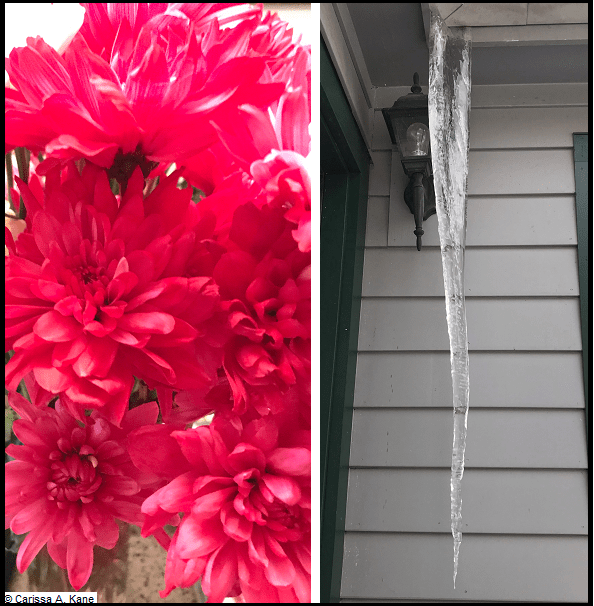
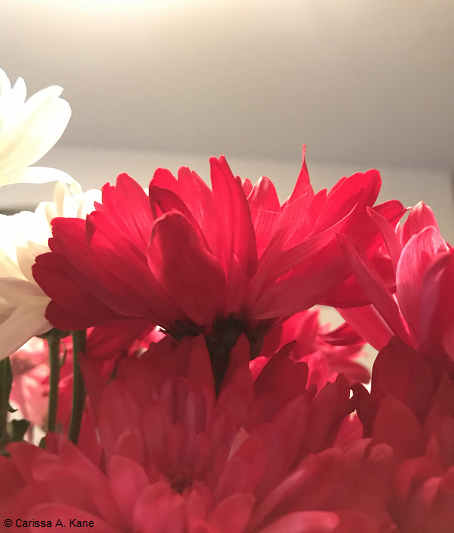
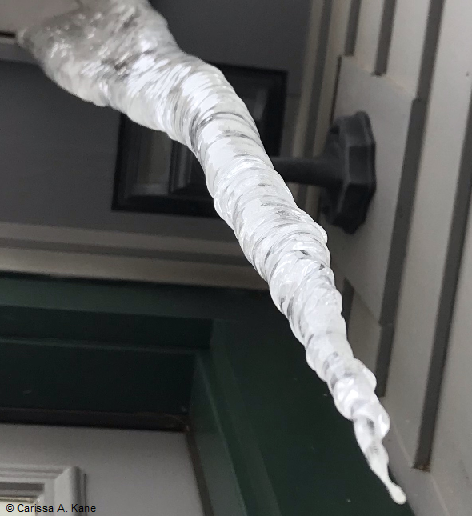
Flowers and an icicle do not seem to fit together, and yet, they do, or they did yesterday.  From a distance, each called attention in its own manner, a splash and depth of color and a long, glass-like spear.

Up close, and from numerous angles, with the light, and contrasted against the background, the delicate nature of each made prominent. There were so many petals, all the same composition, with similar shapes, and tips with greater variation, but coming together as one in each flower.

Then, the icicle, seemingly one big, smooth flow of water, many molecules, frozen… stuck in time. Yet, stepping nearer, not so plain and clear, layers, twists, and turns coming together to create it.

The beauty of nature in all its various forms comes into presence, like life… like love… like God, in both the expected and unexpected ways.

Embracing the moment, quietly, silently, gratefully, and allowing it to saturate one’s being, is the beginning of knowing, exercising, and extending Love. It is true that Love is timeless, and for the times, but in order to carry on toward fruition, Love must be experienced and embodied. For one can only put forth that which resides within. This is why time, and the way in which it is used, or not, is of the essence.

In the midst of whatever season one might find oneself, the benefit of using, spending, making, or taking time to rest in the love of God, wherever and however it suits one best, is never wasted.

Love takes off the masks we fear we cannot live without and know we cannot live within. — James Baldwin

What Night Reveals…

Heading steadily toward the longest night (or the shortest day) in the Northern Hemisphere, I am struck by the way this time of year brings with it not only a greater period of darkness in the sky, but also greater opportunities to see and experience things that might otherwise seem minuscule or entirely escape our attention.  Every year when the light of day starts to take its leave at times earlier and earlier in the day, and we move closer toward the Winter Solstice, there is a period of adjustment, and perhaps, even a decrease in the amount of time spent venturing out and operating at “day time” speed.

When day light and the business that accompanies it begin to fade away, it can seem like time is running out. In the midst of the challenges that may come with that, the darkness also tends to bring with it the perfect backdrop. It can seem like there is less time to accomplish the things we need to do. However, these days of darkness can actually help to create more time for things of greater importance… for that which is truly beneficial to us, and the world around us.

“If a man wishes to be sure of the road he’s traveling on, then he must close his eyes and travel in the dark.” – St. John of the Cross

Night and darkness, in a sense, slow time down, providing space and calling us into the quiet. Deep within this space, there awaits a gift to be seen or sensed.  Grace waits to show us the way. It is of no coincidence that it seems the stars shine their brightest during the shortest days of the year.  Gently, they remind us, that even in the darkest hours, “The Lord will be your light forever” (Isaiah 60).

Moon