His Warmth…

Although the colder air that accompanies this time of year in the Northeast can be quite refreshing, after some time, it can leave one wanting for the warmth of shelter, a soft blanket, or hot beverage to offset the chill.

In the Gospel passage for the Fourth Sunday of Advent (Matthew 1:18-24), we learn about the warmth of St. Joseph’s response to his betrothed, with whom he had not yet lived or had relations with, being pregnant. Imagine the response, gossip, or chill in the air, created by those around Mary and Joseph. Yet, even before his dream in which the Lord appeared, reassuring him of Mary’s faithfulness, Joseph had decided to respond in a way that was filled with warmth, gentleness, and mercy:

This is how the birth of Jesus Christ came about.
When his mother Mary was betrothed to Joseph,
but before they lived together,
she was found with child through the Holy Spirit.
Joseph her husband, since he was a righteous man,
yet unwilling to expose her to shame,
decided to divorce her quietly. –
v. 18-19

Envision yourself in Joseph’s shoes. He is described here as being righteous. What do you make of his initial decision to quietly divorce?

Reflecting on situations that are on your mind and in your heart, how do you seek righteousness? What does it look like? And what qualities does it manifest?

As the Gospel passage continues, Joseph has a dream in which the Lord visits him.

“Joseph, son of David,
do not be afraid to take Mary your wife into your home.
For it is through the Holy Spirit
that this child has been conceived in her.
She will bear a son and you are to name him Jesus,
because he will save his people from their sins.” –
v. 20-21

Recall a time when you had made a decision and then something occurred that reaffirmed your decision or created a new sense of the situation. What happened? What were you praying for, and how did things turn out? How were you saved or blessed? What was the warmth of God like?

Invite the Lord to revisit this with you. What grace from this experience awaits you today?

Spend some time contemplating the verses below and noticing what word, phrase, or image speaks to your heart most:

All this took place to fulfill what the Lord had said through the prophet:
Behold, the virgin shall conceive and bear a son,
and they shall name him Emmanuel,
which means “God is with us.” –
v. 22-23

Continuing to pray with what caught your attention, ask the Lord to grant you insight so that you may see, or have a greater sense of, “God is with us.”

Before ending this prayer time, return to the image of St. Joseph.

When Joseph awoke,
he did as the angel of the Lord had commanded him
and took his wife into his home. –
v. 24

As you strive to be faithful to God, what inspires you? What do you need from the Lord to draw comfort and strength from Him, as you journey through your days, while also reflecting the warmth of His presence.

Let the Lord enter; he is king of glory. – Psalm 24:7c,10b

A heart with a white center

What are you looking for…

With the news of yet another mass shooting in the United States along with violence and conflict around the world, on top of any personal challenges, from which no one is spared, a sense of doom or a feeling of imprisonment can hang in the air and weigh on one’s heart and mind. Yet, as we enter the Third Week of Advent, Gaudete (Rejoice) Sunday, our faith encourages us to remain a people of hope, holding firm to the Lord, and continuing to strive to be living testaments to the Way, knowing that there is something greater, and that God is with us.

In today’s Gospel (Matthew 11:2-11), it is written:

“Are you the one who is to come, or should we look for another?” – v. 3

This is the question that an imprisoned John the Baptist, having heard about “the works of the Christ,” (v.2) had his disciples ask Jesus.

With the events occurring around you, and in the world today, what are you looking for?

Taking a step back, in the First Reading (Isaiah 35:1-6a, 10), it is written:

Strengthen the hands that are feeble,
make firm the knees that are weak,
say to those whose hearts are frightened:
Be strong, fear not!
Here is your God,
he comes with vindication;
with divine recompense
he comes to save you.
– Isaiah 35:3-4

Spend some time recalling some of the ways that you have been strengthened by the Lord. What happens as you allow yourself to remember?

Read aloud today’s Psalm (146:6-10):

The Lord God keeps faith forever,
secures justice for the oppressed,
gives food to the hungry.
The Lord sets captives free.
The Lord gives sight to the blind;
the Lord raises up those who were bowed down.
The Lord loves the just;
the Lord protects strangers.
The fatherless and the widow he sustains,
but the way of the wicked he thwarts.
The Lord shall reign forever;
your God, O Zion, through all generations.

Reflecting on the qualities of God expressed in the Psalm, bring forth your own petitions, praying for the cares and concerns that are pulling at your heart at this time. Following each one, say the response, “Lord, come and save us.”

In the Letter of Saint James, from today’s Second Reading, it is written:

Be patient, brothers and sisters,
until the coming of the Lord.
See how the farmer waits for the precious fruit of the earth,
being patient with it
until it receives the early and the late rains.
You too must be patient.
Make your hearts firm,
because the coming of the Lord is at hand.
Do not complain, brothers and sisters, about one another,
that you may not be judged.
Behold, the Judge is standing before the gates.
Take as an example of hardship and patience, brothers and sisters,
the prophets who spoke in the name of the Lord.
– James 5:7-10

Share with Jesus, the ways or situations in which you are feeling challenged when it comes to patience, complaining/criticizing, and/or a heart firm in the Lord. Allow Jesus to impart his wisdom regarding this.

When you are ready for this prayer period to come to a close, offer an expression of gratitude, and ask the Lord to help you to draw inspiration from the experiences recalled and the insights gained during your prayer.

A heart with a white center

Lord, help me to discern what’s important as I face the moments before me today, and in the days to come. Help my choices to reflect your goodness, and my prayers to reflect your heart.

The sun with rays stretching out

Mustard Seeds and Mulberry Trees…

Thoughts and their deeds, running astray,
Turning hearts and minds inside out,
Reigning down waves of great mayhem.

No match, no matter, no chatter,
Can hold down the light shining through,
In lives that live and breathe true Truth.

Mustard seeds are in one and all,
Moving things like mulberry trees.
The mighty things that faith will do.

The sun with rays stretching out

If today you hear God’s voice, harden not your hearts. – Psalm 95:8

A view of the ocean from a stone arch

Overarching…

The readings for the Fifteenth Sunday in Ordinary Time present food for thought and prayer about what’s written, how it’s read, and what is brought to life from it. In the first reading (Deuteronomy 30:10-14), Moses urges the people to heed God’s voice and the commandments and statutes passed on to them and written in “this book of law”. He points out that God’s voice and words are not out of reach, but instead, he says, “No, it is something very near to you, already in your mouths and in your hearts; you have only to carry it out.” (v. 14).

Spend a few minutes with this verse. Then, think about this past week, an ongoing situation that is before you, or something that you have coming up. Invite the Lord to help you parse through all the thoughts and feelings of which you become aware as you ponder.

For the responsorial psalm, there are two from which to choose (Psalm 69:14, 17, 30-31, 33-34, 36, 37 or Psalm 19:8, 9, 10, 11). Read each of the responses listed below in silence.

Turn to the Lord in your need, and you will live. (cf. Ps 69:33)

Your words, Lord, are Spirit and life. (Ps 19:9a)

Next, read each response aloud. Notice if one response draws you in, or catches your attention, more than the other.

Bring into your prayer a Psalm response(s) and ask the Lord to guide you and lead you to greater awareness as you continue your contemplation from above. [Allow yourself to go with whichever response you land on first or feel more drawn to. It might be both, or even another verse that comes to mind.]

In the second reading (Colossians 1:15-20), St. Paul writes:

Christ Jesus is the image of the invisible God,
the firstborn of all creation.
For in him were created all things in heaven and on earth,
the visible and the invisible,
whether thrones or dominions or principalities or powers;
all things were created through him and for him.
He is before all things,
and in him all things hold together.
He is the head of the body, the church.
He is the beginning, the firstborn from the dead,
that in all things he himself might be preeminent.
For in him all the fullness was pleased to dwell,
and through him to reconcile all things for him,
making peace by the blood of his cross
through him, whether those on earth or those in heaven.

Sometimes it can be tricky, and trying, to face big and small choices every day among relationships, dilemmas, situations, etc. Think about how you have been managing. What brings you comfort? And, from where do you draw strength?

Pause to hold the words St. Paul writes of Jesus and remember that “Christ Jesus is the image of the invisible God”, and that you are created in the image of the invisible, and indivisible, God. What happens when you let that reality saturate your heart? Bring to prayer the thoughts and feelings that arise.

Turning to the Gospel passage (Luke 10:25-37), it begins:

There was a scholar of the law who stood up to test Jesus and said,
“Teacher, what must I do to inherit eternal life?”
Jesus said to him, “What is written in the law?
How do you read it?”
He said in reply,
“You shall love the Lord, your God,
with all your heart,
with all your being,
with all your strength,
and with all your mind,
and your neighbor as yourself.”
He replied to him, “You have answered correctly;
do this and you will live.”

Notice how Jesus points the scholar, and us, to the Word of God (“What is written in the law”), how it is processed internally (“How do you read it?”), and how it is lived out (“do this and you will live.”).

Like the scholar, we can know what is written in the law, but if we skip over considering how we are reading it—heart, mind, and soul, how can we possibly live it out authentically, united with God in both Word and Spirit, as intended?

But because he wished to justify himself, he said to Jesus,
“And who is my neighbor?”
Jesus replied,
“A man fell victim to robbers
as he went down from Jerusalem to Jericho.
They stripped and beat him and went off leaving him half-dead.
A priest happened to be going down that road,
but when he saw him, he passed by on the opposite side.
Likewise a Levite came to the place,
and when he saw him, he passed by on the opposite side.
But a Samaritan traveler who came upon him
was moved with compassion at the sight.
He approached the victim,
poured oil and wine over his wounds and bandaged them.
Then he lifted him up on his own animal,
took him to an inn, and cared for him.
The next day he took out two silver coins
and gave them to the innkeeper with the instruction,
‘Take care of him.
If you spend more than what I have given you,
I shall repay you on my way back.’
Which of these three, in your opinion,
was neighbor to the robbers’ victim?”
He answered, “The one who treated him with mercy.”
Jesus said to him, “Go and do likewise.”
– Luke 10:29-37

Thinking about this passage and the Scripture in the readings and psalm before it, what is most on your mind and in heart at this moment?

Continuing to pray. Ask the Lord to reveal to you whatever God wills, and to help you to bring together what is written, how to read it, and what “Go and do likewise” looks like or means for you today.

A view of the ocean from a stone arch

Our Father, who art in heaven,
hallowed be thy name;
thy kingdom come,
thy will be done
on earth as it is in heaven.
Give us this day our daily bread,
and forgive us our trespasses,
as we forgive those who trespass against us;
and lead us not into temptation,
but deliver us from evil.
Amen.

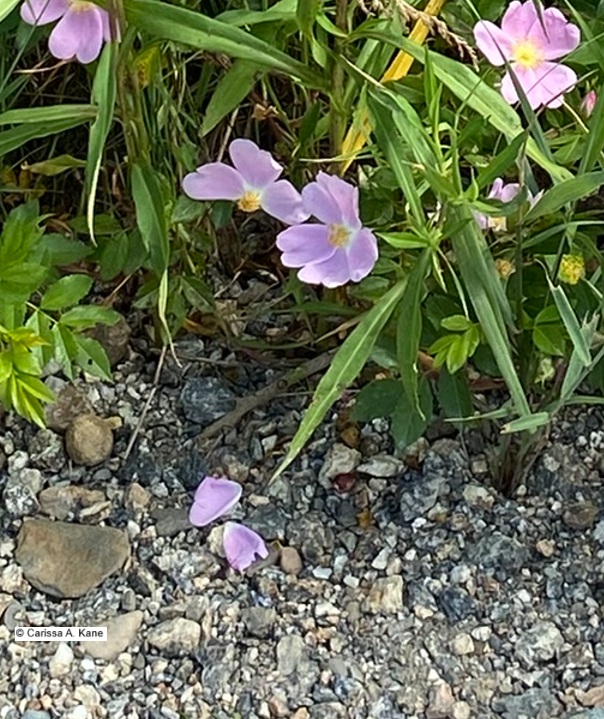
Purple flowers among weeds

Let Peace…

Walking along the path, flowers sprinkled among the greenery on either side bring both brightness and variation to the scene. In the middle, one flower leans toward another as if reaching out to the one looking down at petals lost. Holding on, seeking comfort, seeking peace; providing both to those walking through or passing by.

Stories, so many stories, in the present and in the past. Living, breathing stories, held by many hearts. And then there’s Peace, held within those many stories, seeking hearts to hold them well, souls to glean their wisdom, and bodies with the mind to march peace forward.

Purple flowers among weeds

Let the peace of Christ control your hearts; let the word of Christ dwell in you richly. – Colossians 3:15a, 16a

All We Have—More Than Enough…

In the Gospel passage for the Solemnity of the Most Holy Body and Blood of Christ (Luke 9:11b-17), it is written that as the end of the day is drawing near, Jesus’s disciples go to him with their plan on how to proceed with regards to the crowds who have followed Jesus and his disciples to Bethsaida, a town near the Sea of Galilee, and have witnessed Jesus’s preaching and healing. The disciples say, “Dismiss the crowd so that they can go to the surrounding villages and farms and find lodging and provisions; for we are in a deserted place here.” However, Jesus seems to have other ideas. He responds, “Give them some food yourselves.”

Take a moment to consider how you might receive Jesus’s words in this situation. How might your response vary based on whether you are in a deserted place? What’s it like to consider yourself as part of the solution, no matter where you are?

Next, the disciples focus on what they might do, but recognize it’s not possible for them to do much with what they have:

“Five loaves and two fish are all we have, unless we ourselves go and buy food for all these people.”

Think of a situation where you feel that all you have is not enough to address it. Now, envision Jesus coming into the situation and inviting you to tell him more about it. Start with the words, “All I have is …” Notice what you include (things, people, thoughts, feelings, etc.).

What happens within you as you name what you bring to the situation? How does Jesus receive you and respond?

Now imagine Jesus instructing his disciples, and you, “Have them sit down in groups…”. Then Jesus, with abundant love and patience, turns to you, and tells you more. Pray and converse with Jesus about what this might mean for you and your situation. Share any, and all, thoughts and feelings that arise within you.

In the Gospel passage, after the disciples listened to Jesus and did as he asked, it is written:

“Then taking the five loaves and the two fish,
and looking up to heaven,
he said the blessing over them, broke them,
and gave them to the disciples to set before the crowd.
They all ate and were satisfied.
And when the leftover fragments were picked up,
they filled twelve wicker baskets.”

What’s it like to contemplate the fact that with Jesus, all you have is enough, and can even be more than enough?

Take time today, and throughout the week, to set down whatever is on your plate or is occupying your mind. Then pause and invite Jesus to say the blessing over you and your concerns. Next, allow the peace and wisdom of Jesus, the Bread of Life, to wash over you, and reveal how what you have can meet this moment and the moments ahead, and be more than enough.

I am the living bread that came down from heaven, says the Lord;
whoever eats this bread will live forever. – John 6:51

Love equals Goodness

But for Goodness…

Raise a glass and tip your hat to Goodness.
Don’t be fooled or led astray,
Goodness is in all places;
No corner can escape it.

Even in the most common
Or the tiniest of things,
Goodness is awaiting us
To turn, and let Goodness in.

What of clouds, and darkness then?
What of violent, hateful things?
Big and bad, though they may be,
They are no match for Goodness.

Do not fear, do not distress,
But grab a hold of Goodness.
Better yet, say a prayer;
let Goodness, grab a hold of you.

Love equals Goodness

Taste and see that the Lord is good;
blessed is the stalwart one who takes refuge in him. – Psalm 34:9

The moon shining bright and full through the trees

The Light of One…

The second reading for the Second Sunday of Lent (Philippians 3:17-4:1) closes with the phrase, “stand firm in the Lord” (Phil 4:1). These words follow verses in which St. Paul encourages the Philippians, and us, “be imitators of me,” and reminds all, “our citizenship is in heaven, and from it we also await a savior, the Lord Jesus Christ. He will change our lowly body to conform with his glorified body by the power that enables him also to bring all things into subjection to himself.” (Phil 3:20-21).

Take a few moments to contemplate the characteristics of the Lord based on Scripture and your experience through prayer and faith. Visualize yourself standing firm in the Lord. What comes to mind or stirs in your heart?

This Sunday’s Gospel passage (Luke 9:28b-36) is about the Transfiguration of Jesus. Just prior to its verses, as part of his teaching on what it means to be a disciple, Jesus says, “What profit is there for one to gain the whole world yet lose or forfeit himself?” (Luke 9:25).

In seeking to respond to the call to conversion and deepening one’s faith, envision yourself with Jesus, Peter, John, and James, going up the mountain to pray. As you walk, consider an area in which you desire to increase trust in the Lord. Bring the things you notice to prayer. Ask Jesus for the grace to receive his insights, and the wisdom to parse the various facets that are involved.

Reaching the top of the mountain, there is a pause for greater solitude—a change or shift in appearance, dazzling white, Moses and Elijah joining Jesus. It is as if time has stopped. You watch and notice, becoming more fully aware of everything around you.

Then, as Moses and Elijah depart and Peter is saying something to Jesus, you hear, “This is my chosen Son; listen to him.” (Luke 9:35). You turn to Jesus, your light and salvation, and he tells you what you need to know. You receive his wisdom as the loving guidance that it is.

Preparing to rejoin Peter, James, and John for your journey back down the mountain, you express a sentiment to Jesus, and he to you, as this intimate moment winds down.

Walking down the mountain, you continue to hold onto and savor what has transpired. When you arrive at the base of the mountain, you look back up to the top, remembering this Scripture verse:

The Lord God took Abram outside and said,
“Look up at the sky and count the stars, if you can.
Just so,” he added, “shall your descendants be.”
Abram put his faith in the Lord,
who credited it to him as an act of righteousness.–
Genesis 15:5-6

The moon shining bright and full through the trees

The Lord is my light and my salvation; whom should I fear? – Psalm 27:1

Flowers

Rooted in Love…

As the days passed by,
the flowers, still bright,
holding onto life,
begin to show the
length of days and nights,
separate, away
from the source of life.

Leaves dropping from stems,
petals shriveling,
on the outside first.
Time ticks, closing in.
Hold on as they may,
away from their roots,
they limp as they linger.

In the First Reading for the Seventh Sunday in Ordinary Time (1 Samuel 26:2, 7-9, 12-13, 22-23), David and Abishai find themselves in a position of advantage, having the opportunity to kill Saul, who, along with his soldiers are in a deep sleep. However, despite Saul having grown distant from who he was at the beginning of his rule, and having become David’s enemy, David restrains himself and shows mercy. He says to Abishai, “Do not harm him, for who can lay a hand on the Lord’s anointed and remain innocent?” (v. 9).

Spend some time with the first reading and consider that as beings created in God’s image, in a sense, we are all anointed.

The response for the Psalm is, “The Lord is kind and merciful.” (Psalm 103:8). Reflect on the ways that the Lord has been kind and merciful to you. How does your experience inspire you in terms of the way you view situations and people? In what ways do you feel compelled to be kind and merciful to others? Are there areas where the Lord might want to work with you on expanding upon or reassessing this?

Turning to the Second Reading (1 Corinthians 15:45-49), St. Paul writes of Adam and Jesus, but he is also writing about the call to conversion and discipleship.

As was the earthly one, so also are the earthly,
and as is the heavenly one, so also are the heavenly.
Just as we have borne the image of the earthly one,
we shall also bear the image of the heavenly one. – verses 48-49

Envisioning your life as one line and the events/happenings during your life as another line on a continuum, think about the major events/happenings that have had a direct impact on you. What’s the difference between the times when you have maintained a sense of inner strength (or know-how) and peace, and the times you haven’t?

In the Gospel Reading (Luke 6:27-38), Jesus reminds us that Love is what sustains us. Not embracing cynicism, seeking or plotting revenge, settling or keeping scores. Rather, those are the things that tear us away from Love and the root of goodness and life—God.

How might you draw closer to Love in the challenges you face today? And how might the Lord desire to join you in an area of challenge?

The Lord is kind and merciful, slow to anger, abounding in mercy. – Psalm 103:8

Then, Look Around…

First, listen, and then, look around. Allowing one’s senses to take in and sincerely contemplate the happenings of a day can be challenging, never mind those of the times. Yet, it is these happenings that impact not just our own personal space, but also extend beyond what we might imagine. They are like sound waves rippling outward and amplified, stirring the air all around us.

The readings for the 3rd Sunday in Ordinary Time begin with a passage from the Book of Jonah (Jon 3:1-5, 10) where the initially resistant prophet Jonah warns the people of Nineveh of their impending doom. However, just like Jonah who was previously swallowed up and in darkness (in the gut of a whale), the people of Nineveh see it fit to change their course, let go of their way, and open their hearts and minds more fully to God.

In Psalm 25, the psalmist expresses a desire to understand and to live by the ways of the Lord. The psalmist prays for God, who is faithful, compassionate, merciful, good, and upright, to teach them how to embody and live by the same ways. For this to happen though, like Jonah and the people of Nineveh, the psalmist realizes they must let go of the old (acknowledge and turn over their trespasses to God) to be more fully open to God. And thus, to live more fully as one created in the image of God, abiding by, and living in God’s ways.

In chapter 7 of St. Paul’s first letter to the Corinthians, the people of Corinth are urged to pay attention as time is of the essence. The passage (verses 29-31) begins with, “I tell you, brothers and sisters, the time is running out.” and ends with, “For the world in its present form is passing away.“.  In between, St. Paul writes:

“From now on, let those having wives act as not having them,
those weeping as not weeping,
those rejoicing as not rejoicing,
those buying as not owning,
those using the world as not using it fully.”

Perhaps what St. Paul is warning the Corinthians, and us, about, is being consumed by anything or anyone. He is calling us to be careful about what holds our attention, not to become self-consumed or fixated on anyone or anything earthly, as all of it is bound by time, is imperfect, and therefore passes away. Focus instead on that which is timeless—God and God’s ways.

This leads to the Gospel passage, Jesus’ announcement of the Kingdom of God as being at hand, and the call of the disciples Simon, Andrew, James, and John (Mark 1: 14-20). The disciples are busy, at work, mending their nets. This is useful work, but God had other work in mind for them at that time. Jesus reaffirms them in that yes, they are fishermen. However, he redirects them to being “fishers of men,” but again as we saw in the other readings for the 3rd Sunday in Ordinary Time, only if they will it as well. With Jesus, as with God, no one is ever forced to choose God and God’s ways. And although the time is now, the essence of God is that Time is not rushed or pressured (there is no act swiftly or lose out), and perhaps most importantly, Time is faithful, compassionate, merciful, good and upright, patient, and always open to change.

Make known to me your ways, Lord;
teach me your paths.
Guide me by your fidelity and teach me,
for you are God my savior,
for you I wait all the day long.
Remember your compassion and your mercy, O Lord,
for they are ages old.
Remember no more the sins of my youth;
remember me according to your mercy,
because of your goodness, Lord.

Good and upright is the Lord,
therefore he shows sinners the way,
He guides the humble in righteousness,
and teaches the humble his way. – Psalm 25:4-9