Flowers

Rooted in Love…

As the days passed by,
the flowers, still bright,
holding onto life,
begin to show the
length of days and nights,
separate, away
from the source of life.

Leaves dropping from stems,
petals shriveling,
on the outside first.
Time ticks, closing in.
Hold on as they may,
away from their roots,
they limp as they linger.

In the First Reading for the Seventh Sunday in Ordinary Time (1 Samuel 26:2, 7-9, 12-13, 22-23), David and Abishai find themselves in a position of advantage, having the opportunity to kill Saul, who, along with his soldiers are in a deep sleep. However, despite Saul having grown distant from who he was at the beginning of his rule, and having become David’s enemy, David restrains himself and shows mercy. He says to Abishai, “Do not harm him, for who can lay a hand on the Lord’s anointed and remain innocent?” (v. 9).

Spend some time with the first reading and consider that as beings created in God’s image, in a sense, we are all anointed.

The response for the Psalm is, “The Lord is kind and merciful.” (Psalm 103:8). Reflect on the ways that the Lord has been kind and merciful to you. How does your experience inspire you in terms of the way you view situations and people? In what ways do you feel compelled to be kind and merciful to others? Are there areas where the Lord might want to work with you on expanding upon or reassessing this?

Turning to the Second Reading (1 Corinthians 15:45-49), St. Paul writes of Adam and Jesus, but he is also writing about the call to conversion and discipleship.

As was the earthly one, so also are the earthly,
and as is the heavenly one, so also are the heavenly.
Just as we have borne the image of the earthly one,
we shall also bear the image of the heavenly one. – verses 48-49

Envisioning your life as one line and the events/happenings during your life as another line on a continuum, think about the major events/happenings that have had a direct impact on you. What’s the difference between the times when you have maintained a sense of inner strength (or know-how) and peace, and the times you haven’t?

In the Gospel Reading (Luke 6:27-38), Jesus reminds us that Love is what sustains us. Not embracing cynicism, seeking or plotting revenge, settling or keeping scores. Rather, those are the things that tear us away from Love and the root of goodness and life—God.

How might you draw closer to Love in the challenges you face today? And how might the Lord desire to join you in an area of challenge?

The Lord is kind and merciful, slow to anger, abounding in mercy. – Psalm 103:8

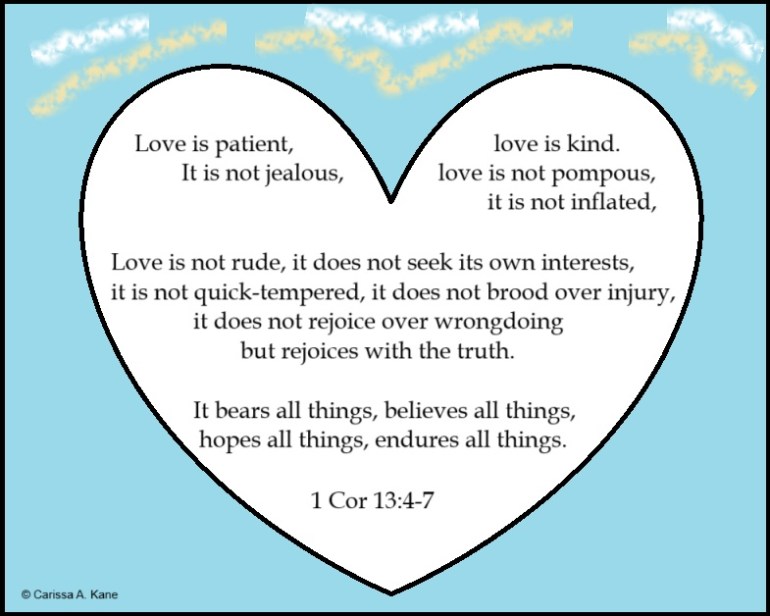
Heart with Love is patient, Love is Kind scripture verse.

On the Plain…

Blessed are we, created in the image of the Lord,
Who comes down from the mountain,
To stand with us on level ground.
Bestower of grace on all,
Willing spirits will receive Him.
Words of Wisdom and Hope He speaks,
Bringing Light and Life to the soul.

Care for the poor,
Feed the hungry,
Comfort those in need.
Way of ways, it is not easy.

Hold fast to only One—the Lord.
Falling not for hollow banter,
Careful of the ruse; it’s not True.
Look not to glorify others,
Rather, seek Wisdom from the Source.
Big and bold isn’t always best, and
Stay awake is what the Lord commanded.

Heart with Love is patient, Love is Kind scripture verse.
Winter sun shining down on lake

Go in Faith…

After ministering to many people in Capernaum, Jesus sets out for a deserted place, yet the crowds search for, and find him. They don’t want him to leave. However, he explains that he must go because his ministry and proclamation of the Kingdom of God must extend to other villages and towns. After witnessing and hearing his preaching, and all the healings, how do you imagine the people of Capernaum took this news? Do you think they were skeptical or upset at the idea of other people, from a different village or town, and who perhaps they considered as outsiders, being the recipients of Jesus’s preaching and healing, too?

What’s it like when you consider Jesus’s mission as one that extends to all people, regardless of who they are or from where they come?

The Gospel for the Fifth Sunday in Ordinary Time (Luke 5:1-11), begins with Jesus having moved on to Judea and then Lake Gennesaret. It is written:

“While the crowd was pressing in on Jesus and listening to the word of God, he was standing by the Lake of Gennesaret.” – Luke 5:1.

Take some time to put yourself in the crowd. As you draw in toward Jesus and listen to the word of God, what comes into your mind, and how is your heart stirred? What prayer arises within you?

As the Gospel passage continues, Jesus gets into Simon’s boat and asks him to push away from the shore. This is not so that he can leave the crowd that has been closing in on him. Rather, it is so that he can continue to minister, teaching them from the boat.

Envision yourself on the shore with Jesus and then in the boat a short distance from the shore. What’s different when you’re in the crowd versus when you’re in the boat? What might Jesus want you to learn from his actions in this situation? What words does Jesus have for you and the crowd?

When Jesus’s preaching to the crowd ends, it is written:

“…he said to Simon,
‘Put out into deep water and lower your nets for a catch.’
Simon said in reply,
‘Master, we have worked hard all night and have caught nothing,
but at your command I will lower the nets.’
When they had done this, they caught a great number of fish
and their nets were tearing.
They signaled to their partners in the other boat
to come to help them.
They came and filled both boats
so that the boats were in danger of sinking.
When Simon Peter saw this, he fell at the knees of Jesus and said,
‘Depart from me, Lord, for I am a sinful man.’
For astonishment at the catch of fish they had made seized him
and all those with him,
and likewise James and John, the sons of Zebedee,
who were partners of Simon.
Jesus said to Simon, ‘Do not be afraid;
from now on you will be catching men.’
When they brought their boats to the shore,
they left everything and followed him.” – Luke 5:4-11

After working hard all night to no avail, Peter does as Jesus asks. He goes back out into the deep part of the sea, and with Jesus by his side, where there was nothing, now there is an abundance, so much so that his nets and the boats can hardly hold it. However, for this to be possible, Peter had to first leave behind and let go of what he had already come to know—he was out all night and there were no fish to be caught—and rather than holding onto defeat or being discouraged, he had to put his hope, faith, and trust in Jesus.

Recall a time when you experienced a challenge, difficulty, or drought of some kind and how faith and Jesus’s presence helped you? What were your prayers like during that time? In what ways did you avail yourself, or help yourself, to be open to listening to and being present to Jesus? Thinking of that time, how can you relate to Peter in this Gospel passage?

Turning to today, think about a situation you’re currently facing. How are you inspired as you continue to seek and draw nearer to Jesus?

Winter sun shining down on lake

“On the day I cried out, you answered; you strengthened my spirit.” – Psalm 138:3

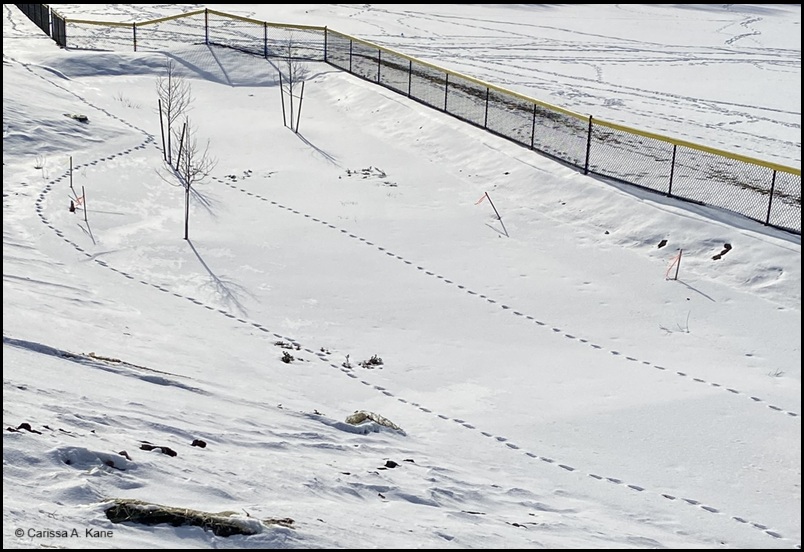
Various tracks in the snow

Presentation…

Your entrance, O Lord, glorious more than grand,
Humble, intimate, and so graceful too.

Your presence, O Lord, not pervasive, but kind,
merciful, compassionate… most fair too.

Your path, O Lord, filled with guidance and Love,
gentle and strong, for the good of all too.

Your way, O Lord, considering all things,
small and big, taking all into Your heart.

Your Wisdom, O Lord, makes clear how to be:
Inspired by Love to seek Peace and Good Will.

Various tracks in the snow

Because he himself was tested through what he suffered, he is able to help those who are being tested. – Hebrews 2:18

Receive Each Moment…

Driving on the highway on a clear but overcast winter morning one moment. Aimlessly sliding across lanes in the next. But through the grace of God, control was regained and the trip continued. In an instant, never mind a day or more, all sorts of things such as situations, environments, etc. can change drastically.

We can know that something is coming and do our best to prepare for it. For example, cold weather can bring icy conditions. Yet even being aware and extra careful, one can’t make any, and all, ice on a road or highway visible to the naked eye. And sometimes, like it or not, there is ice that’s both invisible and inescapable, extending across a road.

So, what’s one to do in these kinds of unavoidable situations? Shrink away from them? Or face them?

The fact of the matter is that there isn’t any one way or one answer for most things. However, there is always a best way to meet the moment. And oftentimes, arriving at it requires relinquishing the notion of control. Whether sliding across the highway in the cold, or steering the wheel on a warm, sunny day, it is the grace and love of God that sustains us.

We all have experiences that can shake us, literally and in other ways. Ones that can create anxiety, fear, uncertainty, and more. Yet, in all of them, we may not be in control, but we always have a choice(s). We can always strive to focus on what is best, what is possible, and most especially the spirit in which we proceed.

Last week’s Gospel was about the Wedding feast at Cana (John 2:1-11). When Mary tells Jesus that the wine has run out, he responds in part, “My hour has not yet come.” Yet, Mary still tells the waiters to do as Jesus tells them. Jesus instructs the waiters. They follow his instructions—essentially becoming part of the miracle—and through the grace of God, the problem is resolved. It wasn’t time… but it was. The time for the goodness of God—love, mercy, compassion, etc.—is always.

In the Gospel for the Third Sunday in Ordinary Time (Luke 1:1-4; 4:14-21), we start by going back to the beginning of Luke’s Gospel. We are reminded of Luke’s motivation. In his own words, he is striving to preserve an accurate account of Jesus life and ministry. And part of that account follows as we read about Jesus in the time after his baptism and temptation in the desert.

Jesus returned to Galilee in the power of the Spirit,
and news of him spread throughout the whole region.
He taught in their synagogues and was praised by all. – Luke 4:14-15

What do you imagine Jesus, “in the power of the Spirit,” was like? What characteristics would you use to describe someone in the power of the Holy Spirit?

As the Gospel continues, Jesus enters the temple in Nazareth and proceeds to read from the scroll handed to him—the scroll of the prophet Isaiah.

He unrolled the scroll and found the passage where it was written:
The Spirit of the Lord is upon me,
because he has anointed me
to bring glad tidings to the poor.
He has sent me to proclaim liberty to captives
and recovery of sight to the blind,
to let the oppressed go free,
and to proclaim a year acceptable to the Lord.
Rolling up the scroll, he handed it back to the attendant and sat down,
and the eyes of all in the synagogue looked intently at him.
He said to them,
“Today this Scripture passage is fulfilled in your hearing.” – Luke 4:17-21

Take some time to think about what you have learned and come to know about Jesus’s life and ministry. In what ways did Jesus’s words and actions fulfill this passage? How have you experienced these and other qualities of Jesus?

Whether it was at the wedding feast in Cana, in the temple in Nazareth, or elsewhere, and no matter what time it was, the Spirit in which Jesus lived and ministered was consistent and unwavering. And at the same time, he was fluid in meeting the moment with love and mercy, lifting all up as the glory of God, rather than making it his own.

Jesus’s life and teachings show us that the moment is always upon us, and the times is always right, to reflect the goodness of God. And more than that, our time is ours only thru the grace of God, and as such, it is always ripe with opportunity to be an expression of love and mercy in the world.

Take, Lord, and receive all my liberty,
my memory, my understanding,
and my entire will,
All I have and call my own.

You have given all to me.
To you, Lord, I return it.

Everything is yours; do with it what you will.
Give me only your love and your grace,
that is enough for me. – St. Ignatius, Suscipe

More Than a Wish…

The magi, or three wise men, are first drawn to Jerusalem by the star signifying the birth of a newborn king. Once there, they encounter Herod, who acting on fear, deceptively seeks to have them locate this king so that he may bring about his demise; not pay homage as he has claimed.

For the wise men, this journey began with the beckon of a bright, new star. Then, from Jerusalem and their exchange with Herod, that same star leads them further onward, guiding them to Bethlehem, and Jesus Christ. And after paying homage and offering gifts to the newborn king, it is a dream that directs them back home, rather than returning to Jerusalem to reveal the location of the newborn king to Herod.

Along the way, and at each stop, the wise men, like us, undoubtedly had choices to make. What, do you imagine, inspired them to keep following the star from its rising all the way to Jerusalem? And then onward to Bethlehem?

What led them to listen to the dream and go home a different way rather than returning by way of Jerusalem, stopping to give Herod the information he wanted from them?

After taking some time to contemplate the Gospel passage for the Epiphany of the Lord (Matthew 2:1-12), reflect on the choices that you may be facing at this time and how you go about making decisions.

What influences your decisions and from where do you take direction or draw inspiration? What are the factors that motivate you? How do they reflect a posture of paying homage to the Lord? (Perhaps they are born out of, or hold at their roots, love, patience, or something similar.)

Take what you notice into prayer, inviting Jesus to share Light and Wisdom with you. Pray with any feelings or desires that arise in you. And when this prayer time comes a close, ask Jesus to reveal one parting word, phrase, or image that will help to draw and lead you, like that star, to where you ought to be.

We saw his star at its rising and have come to do him homage. – Matthew 2:2

More than Believing…

In the First Reading for the Feast of the Holy Innocents (1John 1:5-2:2), it is written:

“Now this is the message that we have heard from him [Jesus] and proclaim to you: God is light, and in him there is no darkness at all.” (verse 5)

In the past week(s), how have you experienced God’s light? In what ways do you desire for the light of God to shine through you, inspiring and leading you?

A few days ago, the celebration of Christmas, the birth of Jesus Christ, began. The days leading up to Christmas can often be filled with anticipation and perhaps a rush, or a last-minute push, as if trying to cross the finish line in first place. Even in less busy years, this time of year can be as if there is something in the air, leading to reaching and stretching or a feeling of pressure and tension.

Similarly, some of the Scripture readings in the days after Christmas can change the feeling in the air as we read about stoning of St. Stephen and the Holy Innocents.

However, when and where there is darkness, there is also Light to be found.

In the Gospel for the Feast of the Holy Innocents, we are told of the Holy Family’s Flight to Egypt:

“When the magi had departed, behold,
the angel of the Lord appeared to Joseph in a dream and said,
“Rise, take the child and his mother, flee to Egypt,
and stay there until I tell you.
Herod is going to search for the child to destroy him.”
Joseph rose and took the child and his mother by night
and departed for Egypt.
He stayed there until the death of Herod,
that what the Lord had said through the prophet might be fulfilled,
‘Out of Egypt I called my son.’

When Herod realized that he had been deceived by the magi,
he became furious.
He ordered the massacre of all the boys in Bethlehem and its vicinity
two years old and under,
in accordance with the time he had ascertained from the magi.
Then was fulfilled what had been said through Jeremiah the prophet:
‘A voice was heard in Ramah,
sobbing and loud lamentation;
Rachel weeping for her children,
and she would not be consoled,
since they were no more.’” – Matthew 2:13-18

What do you imagine the experiences mentioned in this passage were like for Rachel, Herod, and Joseph? As you contemplate this along with your own experiences, what captures your attention most?

In the Gospel passage for the Feast of the Holy Family (Luke 2:41-52), Jesus at 12 years old is separated from his parents. After celebrating the Feast of Passover, Mary and Joseph are traveling as part of a caravan of relatives and others they know, heading back home from Jerusalem. They are more than a little way into the journey when they realize that Jesus is not with the group.

We read:

“After three days they found him in the temple,
sitting in the midst of the teachers,
listening to them and asking them questions,
and all who heard him were astounded
at his understanding and his answers.
When his parents saw him,
they were astonished,
and his mother said to him,
“Son, why have you done this to us?
Your father and I have been looking for you with great anxiety.”
And he said to them,
“Why were you looking for me?
Did you not know that I must be in my Father’s house?”
But they did not understand what he said to them.
He went down with them and came to Nazareth,
and was obedient to them;
and his mother kept all these things in her heart.
And Jesus advanced in wisdom and age and favor
before God and man.” – Luke 2:46-52

Picture what it was like for Mary and Joseph as they retraced their steps back to Jerusalem trying to find their son. What do you think the experience was like for the others in their caravan? Who, if any, searched with and returned to Jerusalem with Mary and Joseph? And, how about what it might have been like for Jesus and the teachers in the temple?

Sometimes, when going through an experience, it can be easy for the scope of consideration to shrink, becoming narrower and leading one to consider fewer perspectives. However, faith calls us to be both focused (on God, Jesus, and the Way) and broad (open to different perspectives and willing to be guided and led by the Holy Spirit) in our approach and our endeavors.

What do you notice about God’s light and Divine intervention through the Flight into Egypt and the Finding of Jesus in the Temple? Pray with whatever insights you have. Talk with and listen to Jesus, as you share what you notice and any needs and desires that arise from within you as you continue to contemplate these passages and your own encounters and experiences.

Put on, as God’s chosen ones, holy and beloved, heartfelt compassion, kindness, humility, gentleness, and patience, bearing with one another and forgiving one another, if one has a grievance against another; as the Lord has forgiven you, so must you also do. And over all these put on love, that is, the bond of perfection. And let the peace of Christ control your hearts, the peace into which you were also called in one body. And be thankful. – Colossians 3:12-15

There’s Always Room for Grace…

Upon reaching the Fourth Sunday of Advent, tempted to jump ahead or enticed toward being caught up in the final material touches that accompany Christmas and holiday celebrations is not an uncommon place to find oneself. Between day-in-day-day-out responsibilities and all that comes with the holidays, it can be hard to juggle all the things that call or try to call one’s attention at this time of year. However, taking some time to consider and pray with your desire for experiencing the peace and joy of this holy season as well as God’s desire for you, and then taking even just a few moments here and there throughout the coming week(s) can make a big difference.

At this time of year, it may seem like things, whether gifts, gestures, or responses, need to big, or bigger, or not at all. Yet, looking the readings for today (Micah 5:1-4a; Psalm 80:2-3, 15-16, 18-19; Hebrews 10:5-10; and Luke 1:39-45), they are a reminder of the most important part of all—the Source of peace and joy. And perhaps they can also be seen as an invitation to take notice of the source of one’s motivation and the state of one’s heart.

From the Book of Micah, we read:

“But you, Bethlehem-Ephrathah least among the clans of Judah, from you shall come forth for me one who is to be ruler in Israel; whose origin is from of old, from ancient times.” – Micah 5:1

When thinking of a ruler or a king, it’s natural to think in terms of grandeur. And in general, it seems human nature to be attracted to that which is, in some way, big, bright, or shiny. It’s easier to notice or pay attention to things that are “in your face” so to speak. Yet, the Prince of Peace is to come from the least among Judah’s clans.

In what ways are you open to the unexpected throughout the holidays? How do you desire to receive them as well as to recognize beauty and grandeur in both the big and the smaller moments?

The response for the Psalm is:

“Lord, make us turn to you; let us see your face and we shall be saved.” – Psalm 80:4

Take some time to reflect on, and pray with, the ways that the Lord restores, renews, and refreshes you. As you think about the coming week and the continuing holiday season, what are the places or situations where you might feel hesitant, anxious, or less inclined toward? Invite Jesus into these spaces and allow your heart and mind to be open to the direction toward which the Lord wishes to inspire you.

In the Letter to the Hebrews, St. Paul writes:

When Christ came into the world, he said: “Sacrifice and offering you did not desire, but a body you prepared for me; in holocausts and sin offerings you took no delight. Then I said, ‘As is written of me in the scroll, behold, I come to do your will, O God.’” – Hebrews 10:5-7

And in the Gospel according to Luke, Elizabeth is described as being “filled with the Holy Spirit” as she cries out:

“Blessed are you among women, and blessed is the fruit of your womb. And how does this happen to me, that the mother of my Lord should come to me? For at the moment the sound of your greeting reached my ears, the infant in my womb leaped for joy. Blessed are you who believed that what was spoken to you by the Lord would be fulfilled.” – Luke 1:42-45

What are some of the ways that the Holy Spirit has guided or enlightened you along the way this year?

Remembering that Mary has come to see Elizabeth after being visited by the Angel, Gabriel, and having responded yes to God’s will, what’s it like when you contemplate how the way that Mary responds—her will embracing God’s will and the two becoming One—extends beyond her and impacts others?

How are you affected or inspired by the notion that God’s will for Mary, is also God’s will for humanity?

Behold, I am the handmaid of the Lord. May it be done to me according to your word. – Luke 1:38

The Thing To Do…

The Gospel passage for the Third Sunday of Advent (Luke 3:10-18) begins with the question, “What then should we do?” What to do is a question that is asked of John the Baptist three times in this passage. And through his replies, John essentially instructs those who have what we might call an upper hand or an edge over others—a crowd, the tax collectors, and the soldiers who are seemingly among the first to make their way to the desert to be baptized—to share with those who are without, to refrain from over taxing others, and to stop abusing their position by using it to take advantage of others.

How do John’s instructions strike you?

It’s interesting that just prior to this passage, John had said to the first group of people mentioned (the crowd),

“You brood of vipers! Who warned you to flee from the coming wrath? Produce good fruits as evidence of your repentance; and do not begin to say to yourselves, ‘We have Abraham as our father,’ for I tell you, God can raise up children to Abraham from these stones. Even now the ax lies at the root of the trees. Therefore every tree that does not produce good fruit will be cut down and thrown into the fire.” – Luke 3:8-9.

What do you think caused the crowd to respond with, “What then should we do?”

Envisioning yourself in this crowd, and labeled by John the Baptist as “a brood of vipers,” are you surprised or shocked? What would you do at these words? What response or question would you have?

When presented with a situation that is unexpected, how do you decide what to do? What does your prayer process look like in terms of manner, taking time and a step back, desire and/or openness to new or different ways forward? How about when it comes to situations that are expected? How does your prayer process stay the same or fluctuate?

Spend some time in prayer, sharing with Jesus that which arises into your awareness, and seeking wisdom, guidance, and whatever else you feel you need at this moment. As your prayer comes to a close, express your desire as you go forward, and ask for the grace to receive, whole-heartedly, God’s love for you, and the desire Jesus has for you at this moment.

Then, on this Gaudete Sunday, rejoice in the Lord!

You do not need to know precisely what is happening, or exactly where it is all going. What you need is to recognize the possibilities and challenges offered by the present moment, and to embrace them with courage, faith and hope. – Thomas Merton

Stairs on a nature trial

Advent(ure)…

The Season of Advent and its related Scripture remind us of the twists and turns that life can take for anyone. They also provide an opportunity to see the faithfulness and goodness of God. In addition, they exemplify how being faithful to God involves being open to ways or paths that may differ, sometimes greatly, from the ones we may have planned or imagined for ourselves.

Take some time to think about what it has been like in the past for you to accept or make changes to the plans, ideas, and/or notions you have envisioned. What is it like in the present?

We all have things we would like to accomplish and look for ways, or paths, to do so. However, in proceeding in earnest and with good intentions as we strive, we can become mixed up when we don’t leave room for, can’t see, or are not open to the possibility of change(s) as being needed and for the better good. So when the twists and turns come, we can become even more attached to our own intentions and the ways we planned to accomplish them, instead of allowing the grace of God to help us to be open to making an adjustment or being open to a different way.

Sometimes, interference and the unexpected can push our buttons in ways that can make us behave as less than what we are… what we were created to be—beings in the image of God. When this happens, we can lose sight of the wideness of God, and the depth of God’s love, compassion, and mercy.

What are some memories you have of times when you met change, unexpected challenges, and/or uncertainty with a quiet calmness? How do those times compare to ones where, perhaps, quiet calmness and peace gave way to unrest?

Stand with the Lord at the threshold between the times of peace and the times of unrest that you’ve recalled. Ask Jesus to unveil the place(s) where maybe you couldn’t sense his presence or take direction, as well as the place(s) where you could. Express to the Lord your gratitude and your desire to remember whatever he wants you to hold onto from these instances as you enter the Advent Season and look to prepare for Christmas.

Make known to me your ways, Lord; teach me your paths. – Psalm 25:4