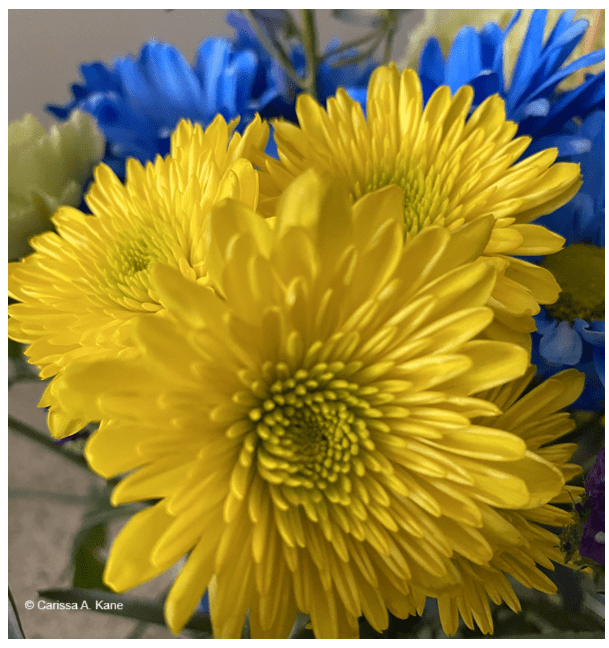
Yellow flowers representing hope

Rooted in What?

The Gospel for the Fifth Sunday of Lent (John 8:1-11) can be seen as providing an opportunity to consider what’s at the root of one’s reactions and the ensuing responses or decisions to the situations or news that arises from day to day.

Read the passage below to familiarize yourself with the situation described.

Jesus went to the Mount of Olives.
But early in the morning he arrived again in the temple area,
and all the people started coming to him,
and he sat down and taught them.
Then the scribes and the Pharisees brought a woman
who had been caught in adultery
and made her stand in the middle.
They said to him,
“Teacher, this woman was caught
in the very act of committing adultery.
Now in the law, Moses commanded us to stone such women.
So what do you say?”
They said this to test him,
so that they could have some charge to bring against him.
Jesus bent down and began to write on the ground with his finger.
But when they continued asking him,
he straightened up and said to them,
“Let the one among you who is without sin
be the first to throw a stone at her.”
Again he bent down and wrote on the ground.
And in response, they went away one by one,
beginning with the elders.
So he was left alone with the woman before him.
Then Jesus straightened up and said to her,
“Woman, where are they?
Has no one condemned you?”
She replied, “No one, sir.”
Then Jesus said, “Neither do I condemn you.
Go, and from now on do not sin any more.”
– John 8:1-11

Next, take some time to revisit this reading from different perspectives.

First, put yourself in the shoes of the crowd. You’ve come to see and listen to this new teacher. What has drawn you to him?

Envision yourself listening to Jesus preach when suddenly, there’s an interruption. A group of men push there way through the crowd, pulling along and forcibly putting a woman into the middle of the gathering. Then they publicly call her out and ask the new teacher what he has to say about the impending doom called for by the law. What’s your first thought or feeling? What do you imagine the expression on Jesus’s face is as this is happening?

Allow yourself time to process and discuss with Jesus what it’s like to be in the crowd, witnessing this occurrence.

Next, put yourself in the shoes of the scribes and Pharisees. What do you imagine led them to essentially drag the woman, not only to where Jesus was, but also to where there was a crowd around him? The passage tells us they wanted to test Jesus. What about consideration of the woman?

Invite Jesus into the thoughts and feelings that come up as you contemplate this perspective. Ask Jesus to show you if there are areas where you might be prioritizing something to the extent that it causes a blind eye toward side effects, such as disregard for the circumstances and/or well-being of others.

Now, put yourself in the shoes of the woman caught in adultery. What’s it like to envision being forcibly taken from one place to another, put in the middle of a crowd, having your transgressions publicized, and being used as a pawn, as you await your fate, which doesn’t look good according to Mosaic law, and may or may not be determined by this new teacher?

Again, share your thoughts and feelings with Jesus. Ask him to impart wisdom and grace to you in whatever challenges you face. Also ask him to reveal anything that might be detracting from your ability to be at your best and/or to choose what is best in His eyes.

Finally, put yourself in Jesus’s shoes. You’re preaching to a crowd that has gathered around you. You see and sense the need in each person’s face. Your heart, full of peace, love, and purpose, is moved with compassion. As you’re speaking, the scribes and Pharisees arrive with the woman in tow. What do you notice most as this interruption is occurring? What’s happening internally, and from where does your response come?

Allow yourself time to pray and reflect on this experience with Jesus. What insight does Jesus want you to prioritize at this moment in your life? In what ways, and toward what, is your heart, full of peace, love, and purpose, moved with compassion?

Where can Divinity meet, and raise, your humanity for the greater glory of God?
Yellow flowers representing hope

Hope rooted in the Lord, is well placed; with the Lord, nothing is impossible.

The Pilot…

To get somewhere, one needs to know where they are in relation to where they want to be and then to come up with a travel plan. However, oftentimes the path or trajectory shifts or ends up being different due to changing circumstances such as weather, terrain, and/or other unexpected issues. And while there are rules of navigation, the ability to adapt and adjust is crucial just as much as precision is.

One way to consider the readings for the Fifth Sunday of Lent is not only as tools, but precision tools for navigation. In the first reading (Jeremiah 31:31-34), the prophet reveals that God is making some adjustments. This is not a change in commitment level or objective, but rather a change in approach.

I will place my law within them, and write it upon their hearts; I will be their God, and they shall be my people. They will no longer teach their friends and relatives, “Know the Lord!” Everyone, from least to greatest, shall know me—oracle of the Lord—for I will forgive their iniquity and no longer remember their sin.” (verses 33-34)

God’s communication is going to be directed straight to God’s people (not requiring a “go-between” or a 3rd person account), making it more personal and approachable as well as accepting and forgiving—all hallmarks of a healthy relationship.

In the responsorial psalm (Psalm 51:3-4, 12-13, 14-15), the psalmist expresses a desire for God to wash away their wrongdoing and states:

“A clean heart create for me, O God, and a steadfast spirit renew within me. Cast me not out from your presence, and your Holy Spirit take not from me.” (verses 12-13)

Since a heart cannot be clean or pure when it’s holding onto transgressions, resentments, or cold feelings toward oneself or others, the psalmist first asks for God’s mercy (for these things holding them back to be lifted from them). Once the obstacle(s) is removed, the way toward a heart that is unwavering in faithfulness to God is opened because the heart is better able to receive the wisdom and guidance of the Holy Spirit.   

In the Letter to the Hebrews, St. Paul uses two words, in the passage for the second reading (Hebrews 5:7-9), that are sometimes received less enthusiastically than words like mercy and compassion. They are “reverence” and “obedience.” St. Paul writes of Jesus: “…he was heard because of his reverence” and “…he learned obedience from what he suffered”. Jesus’s relationship with God was open and honest; it was sacred. Jesus walked this earth, rooted in a desire to do God’s will and always seeking God as his source of strength and wisdom to face what he needed to face. When taken in the light of Jesus’ example, these words, “reverence” and “obedience”, when chosen with one’s free will express an attitude of humility and faithfulness to God, and of God to us.

Coming to the Gospel (John 12:20-33), Jesus’s words here strike at the heart of navigating. That is, holding onto or maintaining focus on the end goal despite the challenges that arise along the way.

It is written:

“Jesus answered them, “The hour has come for the Son of Man to be glorified. Amen, amen, I say to you, unless a grain of wheat falls to the ground and dies, it remains just a grain of wheat; but if it dies, it produces much fruit.” (verse 23-24).

If one is going to get to their destination, they can’t stay in one place or state of being. A change, shift or movement toward what one desires is necessary.

“I am troubled now. Yet what should I say? ‘Father, save me from this hour’? But it was for this purpose that I came to this hour.” (verse 27)

Jesus knows his purpose or mission through his relationship with God. What are you and God aiming for as you navigate? (If unsure, consider what is fulfilling or rings true with the soul, bringing a sense of peace.)

“Father, glorify your name.” Then a voice came from heaven, “I have glorified it and will glorify it again.” (verse 28)

When two wills move together, there is resonance in words and actions. However, there can only be one pilot.

“Now is the time of judgment on this world; now the ruler of this world will be driven out.” (verse 31)

Jesus knows who’s leading the way and encourages us toward awareness as well.

May the strength of God pilot us,
may the wisdom of God instruct us,
may the hand of God protect us,
may the word of God direct us.
Be always ours this day and for evermore. – St. Patrick

What Are Words For…

According to the Oxford English Dictionary there are around 170,000 words currently used in the English language. In addition, there are around 47,000 words that are now considered outdated or obsolete. In preparing for, and during Lent, there is often a great focus on actions and what one will do or perhaps not do over the course of these forty days. However, Lent is also a great time to consider the importance and weight or impact of words, and how they are used.

The Gospel Acclamation for the First Sunday of Lent is “One does not live on bread alone, but on every word that comes forth from the mouth of God.” (Matthew 4:4b).

Consider things you have heard over the past week or so. How did you receive them? What words impacted you most? Now consider things you have said over the past week or so. What effects do you imagine your words have had? Invite the Lord into this process of remembering and discerning.

Whether in words heard or spoken over the past week, how did you experience God or characteristics of God’s word through the exchanges you had, words involved. and/or information received or given out?

In the Gospel for the First Sunday of Lent, it is written:

The Spirit drove Jesus out into the desert,
and he remained in the desert for forty days,
tempted by Satan.
He was among wild beasts,
and the angels ministered to him.

After John had been arrested,
Jesus came to Galilee proclaiming the gospel of God:
“This is the time of fulfillment.
The kingdom of God is at hand.
Repent, and believe in the gospel.”
– Mark 1:12-15

In what ways would you like the Lord to help you when it comes to the word of God as you go about each day?

Your ways, O Lord, are love and truth to those who keep your covenant. – cf. Psalm 25:10

Growth mindset

Thursday after Ash Wednesday…

In the Book of Deuteronomy, chapter 30, verses 15-20, after having presented God’s commandments to the people, Moses exhorts them to choose life over death by embracing and living by God’s “commandments, statutes and decrees”. This brings up an interesting question. Outside of obvious situations where the distinction is clear between a choice that is life giving and one that is not, how does one determine what they are really choosing, and perhaps more importantly, why?

There are few things in life that are clear cut and without the possibility for change. Yet, the human tendency leans toward wanting things to be one way or the other, to fit comfortably into categories or boxes, and to be “known for all time”. However, this leaves little to no room for new information or consideration of different circumstances.

Sometimes it can be helpful to flip things around, contemplating them from another angle or two and considering different points of view. Oftentimes, what is thought to be wrong, so different, or out of line, underneath the surface or layers upon first look, can be not so wrong, different, or out of line, at all.

During Lent, we try to renew or refresh our spirit and growth mindset. We open our hearts and minds to seeing and being anew and strengthening our faith and discipleship ways. We are reminded of what it is we profess to believe and why, as well as the desire to choose what is life giving so that even in death, we experience Life.

Take some time to contemplate Moses’ words about choosing life or death alongside the following poem from the Persian poet Rumi.

“I died as mineral and became a plant,
I died as plant and rose to animal,
I died as animal and I was human,
Why should I fear? When was I less by dying?
Yet once more I shall die human,
To soar with angels blessed above.
And when I sacrifice my angel soul
I shall become what no mind ever conceived.
As a human, I will die once more,
Reborn, I will with the angels soar.
And when I let my angel body go,
I shall be more than mortal mind can know.”
– Rumi

What influences your choices? How do you draw inspiration from the example of Jesus in making them? What grace(s) do you desire in this area? Invite Jesus into this conversation, taking time to listen and asking to be open to and to notice whatever insights might be revealed.

Blessed are those who trust in the Lord; the Lord will be their trust. – Jeremiah 17:7

Ready, Set, Lent…

The mark is made,
The season begins,
From one to forty,
Days, one at a time,
As if turning pages
We make our way,
From start to end,
Through these Lenten days.

Giving up, giving in, letting go,
Yet not one thing for another,
As if a game of swapping.
No. Not at all.
Some thing, or things, for One.
The point remains on focus,
In the here and now,
Not here and there
Or scattered about,
But brought together.

Body and soul,
Front and center,
Sorted out or broken down,
But always built back up,
From one desire to another,
According to Thine will,
Heart and mind become one,
Drawn closer, e’er closer,
To the image of One.

A clean heart create for me, O God, and a steadfast spirit renew within me. – Psalm 51:12