Under The Influence…

It seems that human nature tends toward comparison and judgment along with practices that help one to “find their place” and obtain some level of comfort. However, although these skills might be helpful in deciphering and navigating the world around us, they can also lead to complacency, and a sedentary or fixed way of seeing and being. The readings for the Solemnity of Christ the King offer an opportunity to reflect upon choices, judgments, and viewpoints, and to consider by what or whom they are influenced. Or, in other words, to contemplate who is leading you.     

In the First Reading (Ezekiel 34:11-12, 15-17), the deep level of care and protective nature of God is expressed.

“Thus says the Lord God: I myself will look after and tend my sheep.” (v. 11).

The passage continues to describe God’s desire to rescue, find, and heal as well as God’s promise to make judgments and course correct those who are wrong or have gone astray.

How do you feel about this notion? What’s it like to leave the judgment and course correction to God? Are there areas in which it is more of a challenge than others? Spend some time in prayer asking for guidance around replacing judgments that veer away from God’s desire for you and for a clearer vision of what role God desires for you.

In the Responsorial Psalm (Psalm 23:1-3,5-6), we stay with the image of the Shepherd who takes care of and provides for his sheep. The psalmist writes of the Lord as refreshing their soul, guiding them in right paths, and blessing them so that “goodness and kindness follow” them. The psalmist then says, “I shall dwell in the house of the Lord for years to come” (v. 6).

What do you think they mean? What do you imagine that would be like? How would it feel? In what places or situations have you experienced similar feelings?  

“The Lord is my shepherd; there is nothing I shall want.” (v. 1).

In what ways do you feel inspired when you imagine God’s loving presence permeating all experiences and capable of extending beyond all that might otherwise be a barrier?

Looking to the Second Reading (1 Corinthians 15:20-26, 28), St. Paul writes about Christ the King who helps us to life by helping us to overcome death, in its various forms, while at the same time leaving the ultimate judgment to God.  

“then comes the end, when he hands over the kingdom to his God and Father, when he has destroyed every sovereignty and every authority and power. For he must reign until he has put all his enemies under his feet. The last enemy to be destroyed is death. When everything is subjected to him, then the Son himself will also be subjected to the one who subjected everything to him, so that God may be all in all.” (v. 24-26, 28).   

What happens when you think about Jesus, to whom God subjected all things, handing the kingdom back to God (v. 24) and subjecting Himself to God? What’s it like for you to let go of something that you have obtained or been given? Where is God in that decision or process?

Now turning to the Gospel (Matthew 25:31-46), Jesus talks to his disciples about the final judgment and separation between sheep (the righteous) and goats. Notice how the criteria that Jesus describes are all things that can be done to take care of and protect others.

“For I was hungry and you gave me food, I was thirsty and you gave me drink, a stranger and you welcomed me, naked and you clothed me, ill and you cared for me, in prison and you visited me.” (v. 35-36).

There is always more than just “I,” “me,” and “mine,” and part of striving for the Kingdom of God is not only to know this, but also to live in a way that shows respect, dignity, appreciation, and care for others. Also, it’s not about being perfect or being able to amass a long list of service to others, but rather about focusing efforts on being in service of God by surrendering one’s heart and mind to being under the influence, united with, and led by God.
The Lord is my shepherd; there is nothing I shall want. – Ps 23:1
Familiarity…

What is it that turns the less familiar or unknown into something to be wary of? What is it that stirs up friction, creates angst, and seeks to build fortresses around what is “known” and against what is new or different? While familiarity can be a good thing, it can also get in the way of better things.

At times, what is known can pull at strings, hoping to stretch nerves thin, to direct hearts and minds to narrow ends, and to fill wide, open space with falsehoods. Yes, what’s familiar and comfortable can and will, at times, masquerade around as one beneficial thing or another, while really playing on deep seated or hidden worries, and selling deception as truth.

In the Gospel passage for the 12th Sunday in Ordinary Time (Matthew 10:26-33), Jesus says, “Fear no one…,” “Do not be afraid…,” “Do not be afraid…” As you think about your day-to-day life, envision yourself looking around and listening. Take notice. What do you see and hear? What thoughts and feelings are evoked? And, more importantly, where, or to whom, does it lead you?

“God made Truth with many doors to welcome every believer who knocks on them.” – Khalil Gibran

This is why it’s so important to take time to pause for prayer and to reflect on not only the direction in which one is travelling, but also to notice who or what is prompting or leading one’s movement.

Throughout Scripture we see God engaging with creation in a way that shows flexibility, mercy, forgiveness, and a give and take that always leaves room for growth of heart and mind, and thus, greater understanding that includes reason, but also often extends beyond it. We also see free will, and the twists and turns and outcomes, often unexpected by the human mind, that flow from it. We see many examples of people acting, reacting, and responding out of fear that sells itself as die-hard commitment to tradition, or presents itself as self-preservation, pride, greed, jealousy, and more. There are also many examples of people rising above the circumstances, in ways alternative to the times in which they lived. And through it all, we see, time and again, God’s flexibility through unwavering love, patience, compassion, forgiveness, integrity, and understanding.

What’s an image from Scripture that comes to mind when you think about interactions between God and a person or group of people? Go to a passage that includes one of the interactions, read it, and then spend some time reflecting on it. What are you most drawn to in the passage? What qualities of God touch your heart most deeply? What is God revealing to you and wanting you to know at this moment?

What’s it like to think that maybe everything you’ve ever known is just a fraction of every good thing that awaits you on the other side of resistance to the unfamiliar?

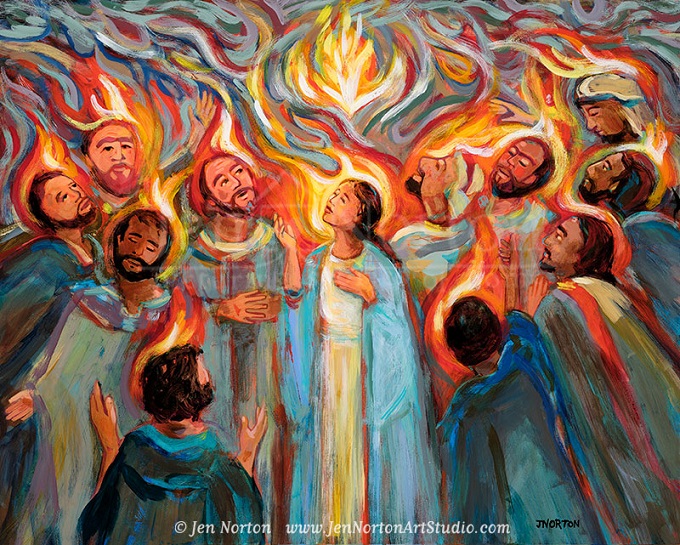
Ignited by the Spirit…

Do you recall being in a group of people, partaking in an experience, whatever it might have been, and having anything that might normally serve to create a wedge or cause a disturbance, fade away? What was that like?

Oftentimes, when such experiences occur, it’s because there is a shared focus and desire that outweighs all the things that might otherwise interfere and distract individuals away from being influenced by the Spirit that moves them toward embracing what is mutually beneficial to all. In other words, it happens when one lets go and detaches from being driven by what is more immediately self-serving or earthly. This then leaves room to be led by the Spirit.

In chapter 2 of the Acts of the Apostle’s, it is written,

And they were all filled with the Holy Spirit
and began to speak in different tongues,
as the Spirit enabled them to proclaim.

Now there were devout Jews from every nation under heaven staying in Jerusalem.
At this sound, they gathered in a large crowd,
but they were confused
because each one heard them speaking in his own language.
They were astounded, and in amazement they asked,
“Are not all these people who are speaking Galileans?
Then how does each of us hear them in his native language?” – Acts 2:4-8

This is an example of the Spirit breaking down barriers that would seek to prevent the Good News from being shared, lived, and spread across the face of the earth. Reading on, we learn more about the many different places from which the crowd came. Undoubtedly, they also had different ideas on how to live and how to go about doing things.

We are Parthians, Medes, and Elamites,
inhabitants of Mesopotamia, Judea and Cappadocia,
Pontus and Asia, Phrygia and Pamphylia,
Egypt and the districts of Libya near Cyrene,
as well as travelers from Rome,
both Jews and converts to Judaism, Cretans and Arabs,
yet we hear them speaking in our own tongues
of the mighty acts of God.” – Acts 2:9-11

What’s it like to contemplate the way that the Spirit enabled the disciples of Jesus, who were, for all intents and purposes, more alike than not, to communicate with those who spoke different languages and were foreign to them?

Notice how the Spirit enabled the disciples, and further defined the notion of discipleship, to become more diverse while at the same time bringing about greater unity. Also consider the posture of the disciples. In chapter 1 of the Acts of the Apostles, we read that they, “devoted themselves with one accord to prayer” and we see that play out in the choice of Matthias to join them (v. 15-26) as well as in their choices going forward. Again, they are united in prayer with hearts that desire to be led to “do the right thing” (what is good and just) more so than choosing based on personal preference or bias. This is what happens when there is a genuine striving to do what is best.

On this Pentecost, in a world that continues to face such great division and strife, the words of Thomas Merton seem so appropriate, “My dear brothers and sisters, we are already one. But we imagine we are not. And what we have to recover is our original unity. What we have to be, is what we are.”

Take some time to meditate on these words. Pray with what comes to mind and how your heart is moved. What does the Spirit want to show you?

When you send forth your spirit, they are created, and you renew the face of the earth. – Ps 104:30

Ascending…

In the perpetual quest
So quietly pursued,
Rising up and reaching out.
Catching to the eye,
Inviting to the soul,
A symbol and a sign,
Whether seen by one or not.

Aspiring to something greater.
Ascending from the earth,
Leaving worms to worm it out.
So simple, yet so not.

Seeking to be found,
Finding what is sought,
Staying true, ever knowing,
Not so much is all that deep.
Not so much is lasting.

The earth is crying,
Tearing everywhere,
Calling out for something real.
Not just some trick or worse,
Not a passing trend or racket.

And authenticity, if it’s true,
Can’t be bought.

May the eyes of your hearts be enlightened, that you may know what is the hope that belongs to God’s call. (Ephesians 1:18)

Be Thou My Vision…

Sitting in the audience as the story continues to unfold, there is a scene where one character calls out, asking, will you love me either way? Do you care if I win, or if I lose? Then comes the response, something along the lines of, to be honest, I don’t really care about those kinds of things.

Thinking about this exchange, it’s interesting how importance is assigned and judgments are made that are often based upon our (society’s) lack of understanding. And, in the process, these “ideals” often stir up false notions of what is good, righteous, and true, and even worse, they often fuel fear, in the competition to keep or attain the imaginary security living up to them brings.

The scripture readings for the Fourth Sunday of Lent show how these false ideals can lead to fear and judgment and get in the way of actual goodness, righteousness, and truth.

In the first reading (1 Samuel 16:1-13), we learn how David, the youngest of Jesse’s sons, was chosen by God to be anointed by Samuel. Upon encountering Jesse and his sons, Samuel’s assumption is that the one to be anointed will have certain characteristics that could be judged at first sight. However, it is written, “God does not see as a mortal, who sees the appearance. The Lord looks into the heart.” (v. 7b). It turns out that the last, and least likely to be judged as the chosen one, is in fact, chosen, and for qualities that cannot be readily seen.

As we go through life, we are constantly subject to judgment based on external values (clothing, education, mode of transportation, location of and type of housing, etc.). We are constantly being marketed to and pulled toward someone else’s notion of how to be and someone else’s definition of success. We also hear so much about first impressions.
None of these things, however, really inform anyone of the most important feature of humankind—the heart, or the most important voice—that of the Creator. They are almost always based upon the external, and often look past qualities that convey deeper meaning, value, and purpose.

In Psalm 23, verses 1-6, it is written, “The Lord guides me along the way of righteousness.” (v. 3b). These words encourage us to trust, like David, that the path of righteousness is made known to us through God. If we were to look solely at man-made ideas about what’s important and how to live, depending on where we were and who we were surrounded by, we might be okay, but even if we were, the person or people leading us, would still be susceptible to falling away from what is good, just, and true. So, it’s important to have a relationship with God and to entrust oneself to the One who really knows the way that is best, and whose focus is the well-being of all hearts and souls.

St. Paul expands on this notion in the Letter to the Ephesians (Ephesians 5:8-14), when he writes, “For you were once darkness, but now you are light in the Lord. Live as children of light, for light produces every kind of goodness and righteousness and truth.” (v. 8-9).

When we look to the Gospel According to John (chapter 9, verses 1-41), we see the Pharisees, on the surface, defending the faith. However, what they are really defending is a way of operating that breeds fear and judgment and seeks to confine, control, and conform God’s ways to their ways. How do we know this?

Looking at the actions and responses of the Pharisees, we can see how they treat the blind man who was healed, his parents, and Jesus. Their hearts are closed. At one point, they say to the blind man who can now see (because of Jesus), “You were born totally in sin, and are you trying to teach us?” (v. 34). After saying this, they removed the man from their presence. All for answering them truthfully, when he was interrogated for a second time and said, “This is what is so amazing, that you do not know where he is from, yet he opened my eyes. We know that God does not listen to sinners, but if one is devout and does his will, he listens to him. It is unheard of that anyone ever opened the eyes of a person born blind. If this man were not from God, he would not be able to do anything.” (v. 30-33).

During this Season of Lent, it’s a great time to reflect on our words and actions, and with this Sunday’s Scripture passages, an even better time to consider how fear and judgment come into play in what we see and how we respond.

Be Thou My Vision, performed by Audrey Assad

In the Light…

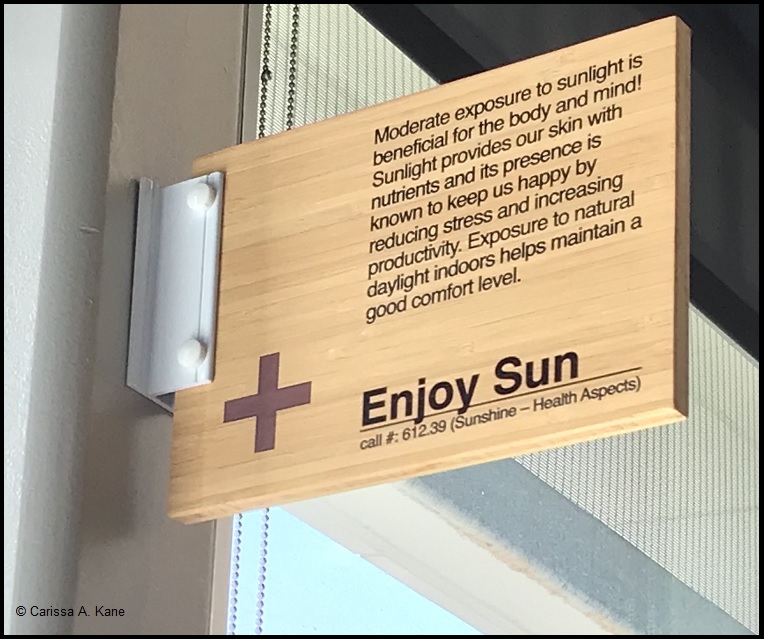
Standing up to take a break, stretch a little, and take a few steps around before returning to work in a temporary workspace for the day, the sign pictured below came into view. I read it and looked around some more. Taking in the environment and noticing more fully the ambience created by the natural light, gratitude and appreciation arose for the light and the souls who not only thought to share these interesting facts about sunlight and its benefits, but who also acted to shed the light, both in word and experience.

Oftentimes in the course of a day or week, we can be quick to move from task to task, and perhaps we miss the sign, put off the call, or rush through or past it, on the way to something else. Yet, much of the time, that thing, whatever it may be, that has a greater hold on our attention, robs us, “like a thief in the night,” of being present in a moment or for an opportunity to experience that which enlivens the soul, helps us to look beyond our own, often limited, schedules, scopes, or agendas, and reminds us of what’s really important—our connectedness, how we respect and appreciate each other—differences and all—and how we share our time and what we have, as blessings from Above.

The Lord is kind and merciful. – Psalm 103:8a

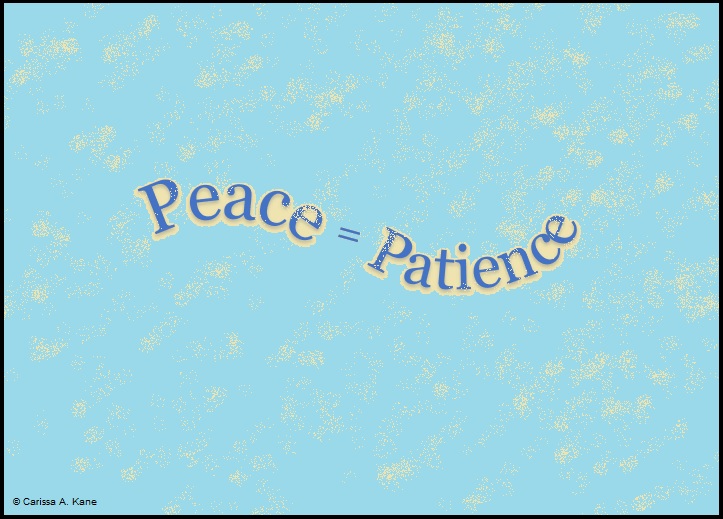
Time to Stop and Time to Go… Time for Peace?

Literally, the second the light turns green, horns are honking. Sometimes, it is from cars two or three deep in line! Imagine if instead of cars on the roads, it was just people, single file, moving on foot. Stop or go to the rhythm of the traffic lights. Perhaps it would be more like the game musical chairs than the one named “Simon Says,” but in today’s world, likely more dangerous, and certainly far more intense.

While in situations like driving, signs of impatience can be much easier to spot, at other times it can be harder to see when patience is absent or slipping away. The second reading for the Third Sunday of Advent (Jas 5:7-10), begins with, “Be patient, brothers and sisters.” It seems so fitting that during one of the busiest times of the year for many people, these verses in the Letter of James contain a form of the word, and urges patience four times, once each in three out of the four verses. And, as for the one verse that doesn’t use the word, it calls us to ponder one of the ways that human beings tend to handle displeasure with one another (“Do not complain, brothers, about one another, that you may not be judged.” – v.9).

Think of a recent experience where you were on the receiving end of your own or someone else’s impatience or displeasure. What happened? And what judgments were involved?

Now, think of a recent experience where you were the one responding with impatience or displeasure. What was going on? And what opinions or beliefs were involved?

In each situation, how might an increase of your own patience have improved the situation or the aftermath of it?

When pausing to think of recent experiences where patience was lacking or displeasure arose, on someone else’s part or on your part, which experience was easier to recall? Which experience came to mind more quickly?

It can be tempting to see patience in terms of something someone has or does not have. However, like any other attribute, it’s possible for it to exist in some situations and not in others. This is important because oftentimes it can be easy to think, “I’m patient,” or “I’m…” this or that based on a small sampling of situations that one’s ego might readily serve up to “pass the test” and move us along from further introspection and possibly attaining additional growth and greater freedom; things that are impossible without honestly looking across and considering the spectrum of one’s life experiences.

An Advent Prayer: Lord, help me to allow you to direct the pace of each day. Through my stopping and going, and all that may occur between, may my actions and responses reflect grace and genuine patience and understanding that flows from you, regardless of what I may or may not receive in return. And help me to continue to look to you, that you may grant me the grace to notice and appreciate the beauty and goodness of all creation, and the heart and soul of those I encounter each day.

Be patient, brothers and sisters,
until the coming of the Lord.
See how the farmer waits for the precious fruit of the earth,
being patient with it
until it receives the early and the late rains.
You too must be patient.
Make your hearts firm,
because the coming of the Lord is at hand.
Do not complain, brothers and sisters, about one another,
that you may not be judged.
Behold, the Judge is standing before the gates.
Take as an example of hardship and patience, brothers and sisters,
the prophets who spoke in the name of the Lord. – James 5:7-10

To Build or Coming Together…

Walking along the pace is brisk in some places
and much slower and methodical at others.
The path so concrete,
laid out as clear as day,
but then seemingly disappearing,
leaving those travelling it to take stock…
to figure the way forward that safely,
or maybe wisely, fits them best.
Yet, sometimes the “where I am” and “where I want to be”
do not meet, or maybe just not yet.

A process that makes time, and the taking of it,
not only a good thing,
but also a necessary thing.
Overall, a journey building upon itself
before coming to the end of the trek,
or this one, on this plane, at least,
and landing on stable ground,
or rather learning to be steady
on whatever the ground may be.

While some building may call for a single column
as if marking the way,
some calls are for branching out,
and lending support.
Still rising, tall and strong,
a new look on a familiar way,
always moving, continuing the journey,
sometimes quick, slower at others,
maybe even coming to a pause,
but ultimately, always moving toward,
if not with, greater depth.

Make straight paths for your feet, that what is lame may not be dislocated but healed. – Heb 12:13

In the Fabric…

It’s challenging, to say the least, to live in a world where tangible assets not only overwhelmingly drive motivation, but also speculation and modes of operation. And even more than that, status and materialism push humankind toward pursuits that are often so far removed from the stirrings and movements of grace that seek to connect and strengthen hearts.

St. Ignatius of Loyola wrote, “For it is not knowing much, but realizing and relishing things interiorly, that contents and satisfies the soul.” Yet, as suggested in Ecclesiastes, the human condition is such that we continue to toil under the sun to know more, do more, win more, and so on. But for what kind of gain? and at what cost?

Here is one who has labored with wisdom and knowledge and skill,
and yet to another who has not labored over it,
he must leave property.
This also is vanity and a great misfortune.
For what profit comes to man from all the toil and anxiety of heart
with which he has labored under the sun?
All his days sorrow and grief are his occupation;
even at night his mind is not at rest.
This also is vanity. – Ecc 2:21-23

Looking around, or tuning in to the pulse of society, one can only wonder, with that beat, what kind of “more” will ever be enough? And in the process, what happens to the hearts involved? There’s ebb and flow of course, but in what ways and to what degree do they drift? And at what point does the unfamiliar become all too familiar?

Turning to Psalm 95, the psalmist writes, “If today you hear God’s voice, harden not your hearts.” Before that, a call to turn back to the One who knows.

Teach us to number our days aright,
that we may gain wisdom of heart. – Ps 90:12

Remember, ask and you shall receive. However, as always, there’s choice in how one responds.

St. Paul urges us forward, let go of that which binds one to the earth and drags one down. Instead, be grounded to, as well as through, that which is elevated and fulfilling in a far greater way.

If then you were raised with Christ, seek what is above, where Christ is seated at the right hand of God.
Think of what is above, not of what is on earth. – Col 3:1-2

Be true… be not only baptized into Christ, but also put on Christ. Think about it. How does the heart and mind of Christ infuse your soul? How does it influence choices as you face challenges and navigate this world?

In the Gospel according to Luke (chapter 12:13-21), Jesus tells the parable of the rich man who had such a surplus at harvest that he replaced his barns with even bigger ones so he could essentially rest on his laurels and live off all that he had store up. While this parable can lead one to reflect on possessions and sharing or helping others from what one has, it can also be a catalyst to considering more closely how one’s pursuits affect the fabric of one’s being. Aside from the tangible, from what has one’s heart moved away? To what has one’s heart moved toward? And most importantly, where is God in all of that?

Peace Dwells Within…

That which was spoken long ago,

Holds true still, even in this day and age.

Peace, it dwells within,

And cannot come from that which is external.

Listen to Paul, who once was murderous Saul,

Filled with conviction,

Really hate, disguised as a passion he thought was right.

The Lord opened his heart,

Corrected his vision,

And led him to turn from his ways.

His conviction remained.

His passion transformed,

From one that was steal.

Redeemed one might say,

By the Way that is true,

By the One who is always waiting,

For the other to come around.

Peace is about embracing possibilities,

Seeking Grace and gratitude,

Being open to ways that differ,

And accepting differences,

Without surrendering to them.

Peace comes in discovery

As well as in re-discovery,

In going out into the world,

Remembering in whose image all are created,

Holding true to oneself,

And allowing others to do the same.

Peace, it dwells within,

But its effects go well beyond.

And let the peace of Christ control your hearts, the peace into which you were also called in one body. And be thankful. – Col 3:15