Violet Hydrangeas

More Than Just Another Day…

In the Gospel for the Fourteenth Sunday in Ordinary Time (Mark 6:1-6), as Jesus is teaching in the synagogue in Nazareth (his hometown), the people there are rather cynical due to their preconceived notions about what someone teaching with authority needs to be or look like, or where they need to come from. This is nothing new though. A common misstep of humankind throughout history has often been allowing for the appearance of strength, status, or other superficial measures to supersede the things that really matter, such as substance.

In this Gospel passage, we learn that Jesus couldn’t do much in Nazareth. It is written of Jesus, “He was amazed by their lack of faith.” What do you think is meant by that? What do you think made the people so closed off to Jesus, his approach, and what he was trying to teach them?

Whatever it was, there was a lack of openness to the Spirit of God exuding from Jesus. Perhaps the people couldn’t accept his words as truth or take to heart and ponder them, because they challenged them to consider things differently. However, with God, relationships are all about being mutual. And so, Jesus works with those in Nazareth who are open to the Spirit, and then moves on to places where the people are more open to him and the Way. Nothing is forced upon the Nazoreans, or those who disagree, and as always, Jesus models an example of respecting free will and trusting his Father to be the ultimate judge and decider of their fate. Anything else would lead to Jesus putting himself over God and would lead to further division and chaos.

Jesus can see this, but most of the people in the synagogue are too caught up in their own ideas and ideologies to notice the substance of Jesus’s teaching. Perhaps they recognize that it’s more than just another day in the synagogue, but their faith has shifted into a fixed version of the way things ought to be based on what they can wrap their minds around, rather than remaining fixed on God and, therefore, flexible to receive the Spirit’s guidance toward what may be new and different but is still of God.

When one comes to expect, or demands, the same of every day or has become self-centered and self-preserving above all else, faith becomes stagnant and fixed, for with God, Jesus, and the Holy Spirit, there’s always something happening for the good of all, there is breadth and depth, there is newness and life… there is acceptance, and it is always more than just another day.
Violet Hydrangeas

Therefore, I am content with weaknesses, insults, hardships, persecutions, and constraints, for the sake of Christ; for when I am weak, then I am strong. – 2 Corinthians 12:10

Pentecost

Amazing…

The goodness of your breath O God,
filled me up, heart and soul and body,
and got me started.
The faithfulness of your presence
Carries me along, and your spirit,
Moves me to what is best.

How much? How many? What rank?
It does not matter; not a single bit.
Besides, who am I to measure?

You lead me through both highs and lows.
You teach me how to be, and what to cherish.
I am lifted up and over by your love and care.
Amazing how you do it. Amazing!
The glory is forever yours, and yours alone,
Yet, you always share it.

Pentecost

When you send forth your spirit, they are created, and you renew the face of the earth. – Psalm 104:30

Deference to Love…

Circumstances come and go,
Like trains arriving and departing.
Slowing down to a standstill,
Then picking up, increasing speed.
Paying homage on one hand,
Indifference on the other.
Sometimes creeping in,
Showing up unannounced,
All at once, or not at all,
And everywhere in between.
They slip in, they slip out,
They disappear, or they don’t.

Circumstances show themselves,
Morning, noon, and night,
But so do signs, big and small,
They come and go as well.
Some noticed, some not, but…
Always on time, in time,
If not a step ahead.
They are all around us.
Then, there is Love,
Binding all together
In this coming and this going.
Love serves us well…
If we allow it.

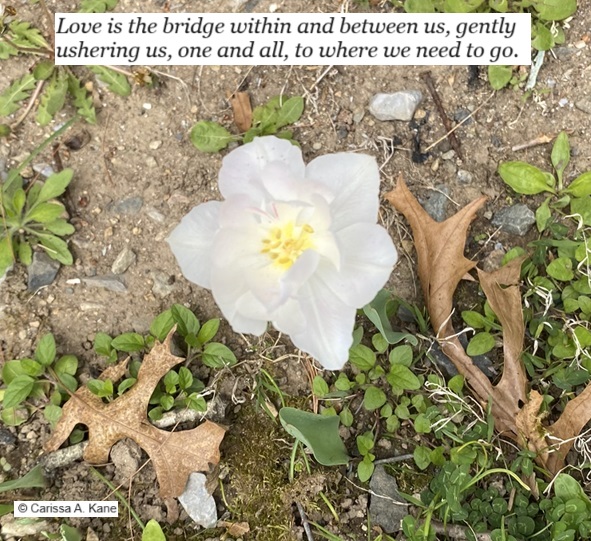
White flower with dirt to one side and vegetation to the other side.

“It was not you who chose me, but I who chose you and appointed you to go and bear fruit that will remain, so that whatever you ask the Father in my name he may give you. This I command you: love one another.” – John 15:16-17


The Sun Rising

Relating to and thru One…

The readings for the Third Sunday of Lent can be seen as a call to pay attention to the nature of relationships and what they lead or point to. In the First Reading (Exodus 20:1-17), God delivers the commandments, which are seemingly clear instructions, and by adhering to them, the people will prosper. Notice how God’s mercy far outweighs any punishment.

For I, the Lord, your God, am a jealous God, inflicting punishment for their ancestors’ wickedness on the children of those who hate me, down to the third and fourth generation; but showing love down to the thousandth generation of those who love me and keep my commandments. (Ex 20:5-6)

Also, notice that punishment is reserved for “those who hate me,” and their children. Hate is a pretty strong word and one can imagine some sort of pattern or learned behavior to reach that point or designation. In that light, perhaps this passage can be viewed as a Lenten invitation to be mindful of one’s actions, the sentiments from which they come, and what they might teach.

Looking at the Responsorial Psalm (Psalm 19:8-11), the response is “Lord, you have the words of everlasting life.” (Jn 6:68c). Again, drawing us to God’s words as priceless and wrapping up by trying to convey just how valuable they are: They are more precious than gold, than a heap of purest gold; sweeter also than syrup or honey from the comb. (Ps 19:11).

As for verses 8-10 of the Psalm, the first part of each line refers to the Lord’s “rules”—laws, decrees, precepts, commands, reverence, and ordinances. The second part of each phrase or sentence provides guidance by giving indicators that one can use to try to determine if they are obeying and honoring the Lord. How? By evaluating the situation and answering the question: Do I experience or have a sense of a refreshed soul/peace, wisdom, a rejoicing heart, enlightenment, endurance/inner strength, truth, or justice?

The law of the Lord is perfect,
    refreshing the soul;
The decree of the Lord is trustworthy,
    giving wisdom to the simple.

The precepts of the Lord are right,
    rejoicing the heart;
the command of the Lord is clear,
    enlightening the eye.

The fear of the Lord is pure,
    enduring forever;
the ordinances of the Lord are true,
    all of them just.

In the Second Reading (1 Corinthians 1:22-25), St. Paul is encouraging the Corinthians, and us, to be careful about the way we go about seeking signs and wisdom. God certainly uses people, situations, and things to accomplish tasks and impart wisdom, however, as St. Paul says, “we proclaim Christ crucified.”  That means, there is no substituting human thoughts, ideas, goals, etc. for God’s will and wisdom as the source or root that one allows to resonate with and guide their soul. Ultimately, things come down to what happens between each person and God, and one is not to blindly follow others thus giving what belongs to or originates with God (one’s soul and will) to another human being and/or their agenda.

In what ways do you take each situation to prayer with an openness to the fact that what is right and just in one situation may not be right and just or the best way in another situation? What’s it like to consider that the “rules” and their application are shaped by God’s love and mercy, and that this is by God’s design? In what ways do you leave room for love and mercy in situations and decisions?

Turning to the Gospel passage referred to as the Cleansing of the Temple (John 2:13-25), we can see Jesus’ disavowal of the perversion of the Temple and the rules and practices around and within it. The focus has become all about transactions and status. Jesus drives everyone out, saying to those profiting at the expense of the poor—those selling doves, “Take these out of here, and stop making my Father’s house a marketplace.” (Jn 2:16). In the verses that follow, Jesus refers to his body as the temple and foreshadows his crucifixion and resurrection. The passage ends with:

But Jesus would not trust himself to them because he knew them all,
and did not need anyone to testify about human nature.
He himself understood it well.
(Jn 2:24-25)

Envision Jesus, who is the source of salvation and redemption, entering the temple area of your life—your heart. Imagine yourself receiving the peace, inner strength, and wisdom of Jesus as you sit together. What would you share? And, what would He who understands human nature well, impart to you in terms of what to drive out and what to keep?

What Are Words For…

According to the Oxford English Dictionary there are around 170,000 words currently used in the English language. In addition, there are around 47,000 words that are now considered outdated or obsolete. In preparing for, and during Lent, there is often a great focus on actions and what one will do or perhaps not do over the course of these forty days. However, Lent is also a great time to consider the importance and weight or impact of words, and how they are used.

The Gospel Acclamation for the First Sunday of Lent is “One does not live on bread alone, but on every word that comes forth from the mouth of God.” (Matthew 4:4b).

Consider things you have heard over the past week or so. How did you receive them? What words impacted you most? Now consider things you have said over the past week or so. What effects do you imagine your words have had? Invite the Lord into this process of remembering and discerning.

Whether in words heard or spoken over the past week, how did you experience God or characteristics of God’s word through the exchanges you had, words involved. and/or information received or given out?

In the Gospel for the First Sunday of Lent, it is written:

The Spirit drove Jesus out into the desert,
and he remained in the desert for forty days,
tempted by Satan.
He was among wild beasts,
and the angels ministered to him.

After John had been arrested,
Jesus came to Galilee proclaiming the gospel of God:
“This is the time of fulfillment.
The kingdom of God is at hand.
Repent, and believe in the gospel.”
– Mark 1:12-15

In what ways would you like the Lord to help you when it comes to the word of God as you go about each day?

Your ways, O Lord, are love and truth to those who keep your covenant. – cf. Psalm 25:10

Saturday after Ash Wednesday…

Sometimes due to the weather or one’s location, for example in the snow, on the sand at a beach, or stepping out of a pool, the impact of where one has traveled can be clearly seen. Most often though, we tread without leaving any physical indications at all.

The response for today’s Psalm is derived from Psalm 86, verse 11ab: Teach me your way, O Lord, that I may walk in your truth.

The text for the complete verse is as follows:

Teach me, Lord, your way
that I may walk in your truth,
single-hearted and revering your name.
– Psalm 86:11

Reflect on the places to which you have traveled and/or spent time over the past few days, or the past week. As you remember where you have been, what comes to mind?

In what ways would you say that you experienced walking in God’s truth, single-hearted and revering God’s name? Were there places or situations where you were more grounded and fully present to the moment?

As you allow yourself to imagine revisiting these places, take time to notice or re-notice things.

Next, have a conversation with the Lord and share whatever thoughts and feelings arise within you. Ask to be shown what the Lord sees in these experiences and wants you to see as you continue striving in discipleship.

When your conversation is completed, pray:

Teach me, Lord, your way that I may walk in your truth, single-hearted and revering your name. – Ps 86:11  

Ready, Set, Lent…

The mark is made,
The season begins,
From one to forty,
Days, one at a time,
As if turning pages
We make our way,
From start to end,
Through these Lenten days.

Giving up, giving in, letting go,
Yet not one thing for another,
As if a game of swapping.
No. Not at all.
Some thing, or things, for One.
The point remains on focus,
In the here and now,
Not here and there
Or scattered about,
But brought together.

Body and soul,
Front and center,
Sorted out or broken down,
But always built back up,
From one desire to another,
According to Thine will,
Heart and mind become one,
Drawn closer, e’er closer,
To the image of One.

A clean heart create for me, O God, and a steadfast spirit renew within me. – Psalm 51:12

Ever Evolving…

The readings for the Fifth Sunday in Ordinary Time begin with a passage from the Book of Job where the subject, Job, continues to express dissatisfaction as he tries to come to terms with, and understand the reason for, the trials and tribulations he is and has been experiencing.

Job spoke, saying:
Is not man’s life on earth a drudgery?
Are not his days those of hirelings?
He is a slave who longs for the shade,
a hireling who waits for his wages.
So I have been assigned months of misery,
and troubled nights have been allotted to me.
If in bed I say, “When shall I arise?”
then the night drags on;
I am filled with restlessness until the dawn.
My days are swifter than a weaver’s shuttle;
they come to an end without hope.
Remember that my life is like the wind;
I shall not see happiness again. – Job 7: 1-4, 6-7  

Thinking about this passage, what resonates with you most? How do you feel about Job’s plight and about God’s role in it?

Recall a time when you felt challenged, and your faith tested. In what ways was God present to you, even if you were not aware or able to name God’s presence as such at that time? What would you say it was about that experience that affected your faith or trust in God? Take some time to share with God what’s on your mind and in your heart at this moment.

The response for the Responsorial Psalm this Sunday is, “Praise the Lord, who heals the brokenhearted.” (Psalm 147 cf. 3a). We all experience heartache and heartbreak as we journey through life. What situation in your life is outright disturbing your heart or creating a sense of unrest or uneasiness? What do you desire from God regarding this situation? What might God want you to know or to consider? In what ways can you envision this situation as an opportunity to deepen your faith and relationship with God?

In the First Letter of St. Paul to the Corinthians, verse 22 of chapter 9, we read, “To the weak I became weak, to win over the weak. I have become all things to all, to save at least some.” What’s it like to consider this, in light of today’s world, as an invitation to getting along in service to God and for the sake of being a living testament to the Gospel? Sticking with this, what would you want to ask St. Paul about this passage and the challenges he faced? What do you need from God as you strive to be a disciple of Jesus in today’s world? Pray for God’s desire for you, in terms of how you navigate the division and issues in today’s world, to be placed in your heart, imparting wisdom throughout each day.  

Next, as we move to the Gospel passage for the Fifth Sunday in Ordinary Time (Mark 1:29-39), we have Jesus’ healing Simon’s mother-in-law as well as a multitude of people. Upon being healed, Simon’s mother-in-law gets back to the business of serving others. We also learn that Jesus separates from the crowd to go pray. Once he is found, Jesus gets back to the business of preaching and healing people as he moves on to the neighboring villages. Take time to contemplate this passage in terms of the necessity of prayer and downtime or time away. What happens when there is an interruption in your routine? In what ways are you open to change? How do you experience the dynamic nature of God through interruptions and changes around you?

“In Christianity, God is not a static thing—not even a person—but a dynamic, pulsating activity, a life, almost a kind of drama. Almost, if you will not think me irreverent, a kind of dance.” – C.S. Lewis

The Village of Comfort…

The Gospel reading for the Fourth Sunday in Ordinary Time follows Jesus and the first disciples (Simon, Andrew, James and John called away from mending their fishing nets) as they enter into Capernaum, the place whose name means “village of comfort”. In this passage from the Gospel According to Mark (chapter 1, verses 21-28), Jesus’ way of being and his teaching capture the attention of the people. What he offers is new and different and comes with signs, as Jesus and the disciples enter a synagogue where he teaches with authenticity and frees a man who is under the hold of an unclean spirit.

Then they came to Capernaum,
and on the sabbath Jesus entered the synagogue and taught.
The people were astonished at his teaching,
for he taught them as one having authority and not as the scribes.
In their synagogue was a man with an unclean spirit;
he cried out, “What have you to do with us, Jesus of Nazareth?
Have you come to destroy us?
I know who you are—the Holy One of God!”
Jesus rebuked him and said,
“Quiet! Come out of him!”
The unclean spirit convulsed him and with a loud cry came out of him.
All were amazed and asked one another,
“What is this?
A new teaching with authority.
He commands even the unclean spirits and they obey him.”
His fame spread everywhere throughout the whole region of Galilee. – Mk 1:21-28   

It’s interesting to consider this passage in terms of human nature. Presumably the people in Capernaum (village of comfort), know one another. What do you imagine it was like when Jesus and his disciples, strangers, entered their space in general, but more specifically, their sacred space—the synagogue? How do you respond when someone new or unknown enters your space? What kinds of things determine your response?

Returning to the Gospel, in this passage one can infer that the people in the synagogue were drawn to Jesus and his message because despite being in the village of comfort, beyond the surface, their real needs were not being met.

“The people were astonished at his teaching, for he taught them as one having authority and not as the scribes.” 

What Jesus was saying, as he taught, spoke to the people of Capernaum. His words and his way touch their hearts, and they recognize him as being authentic. Reflecting on this past week, what kinds of words and things, and who, has touched your heart? What tends to strike a chord with you?

Coming back to the Gospel and the synagogue, next there is a man with an unclean spirit. Notice how the man and the spirit influencing him are intertwined. The man cries out, but the pronoun is “us”.

“he cried out, “What have you to do with us, Jesus of Nazareth? Have you come to destroy us?”

Yet, drawn into the presence of Jesus, the two become distinguishable. And, of everyone who is present (outside of the disciples), it is only the unclean spirit who recognizes and names what’s really happening. The unclean spirit knows who Jesus is, and perhaps, senses its doom.

I know who you are—the Holy One of God!     

In what ways do you invite Jesus to help you discern and recognize situations where good and evil may have become intertwined?

Jesus expels the unclean spirit, setting the man free. The people are in awe and try to make sense of what they have witnessed. Word of Jesus spreads as they recognize Jesus’ way as being both new and powerful, or authoritative. Are they caught up in Jesus’ way, in the way the unclean spirit obeyed him, in Jesus being the Holy One of God?… What is it that is moving them and leads to Jesus becoming famous? What are they celebrating?

Revisit the things that tend to strike a chord with you and ask Jesus to reveal the places of comfort that may be creating a cloud of disguise and interfering with what is best. Express your desire to be led by the Light of God. Ask Jesus to help you to know what is influencing you.   

The people who sit in darkness have seen a great light; on those dwelling in a land overshadowed by death, light has arisen. – Matthew 4:16

At First, Listen…

First there was one deer, nibbling on a nearby plant. Then surveying the yard, another on the other side. Finally, there appeared two more, subtly joining in from the woods behind. Gently they made their way around the yard, pausing at the slightest of noises to look around and assess their surroundings, their sense of being too. Discerning between the sights and sounds their eyes and ears receive, responding in ways both wise and worthy. Standing still in the face of sounds both soft and firm, but kind, while retreating from those loud and harsh, and well, unbridled. Their awareness so keen, their dignity unwavering, and their presence so peaceful. Life listening and living Life at its fullest—Spirit meeting spirit, Spirit leading spirit.

How do you receive and listen to the noises around you and across the world? How or by what are your reactions and responses inspired?

Samuel was sleeping in the temple of the Lord
where the ark of God was.
The Lord called to Samuel, who answered, “Here I am.”
Samuel ran to Eli and said, “Here I am. You called me.”
“I did not call you,” Eli said. “Go back to sleep.”
So he went back to sleep.
Again the Lord called Samuel, who rose and went to Eli.
“Here I am,” he said. “You called me.”
But Eli answered, “I did not call you, my son. Go back to sleep.”

At that time Samuel was not familiar with the Lord,
because the Lord had not revealed anything to him as yet.
The Lord called Samuel again, for the third time.
Getting up and going to Eli, he said, “Here I am. You called me.”
Then Eli understood that the Lord was calling the youth.
So he said to Samuel, “Go to sleep, and if you are called, reply,
Speak, Lord, for your servant is listening.”
When Samuel went to sleep in his place,
the Lord came and revealed his presence,
calling out as before, “Samuel, Samuel!”
Samuel answered, “Speak, for your servant is listening.”

Samuel grew up, and the Lord was with him,
not permitting any word of his to be without effect. –
1 Samuel 3:3b-10, 19