First there was one deer, nibbling on a nearby plant. Then surveying the yard, another on the other side. Finally, there appeared two more, subtly joining in from the woods behind. Gently they made their way around the yard, pausing at the slightest of noises to look around and assess their surroundings, their sense of being too. Discerning between the sights and sounds their eyes and ears receive, responding in ways both wise and worthy. Standing still in the face of sounds both soft and firm, but kind, while retreating from those loud and harsh, and well, unbridled. Their awareness so keen, their dignity unwavering, and their presence so peaceful. Life listening and living Life at its fullest—Spirit meeting spirit, Spirit leading spirit.
How do you receive and listen to the noises around you and across the world? How or by what are your reactions and responses inspired?
Samuel was sleeping in the temple of the Lord where the ark of God was. The Lord called to Samuel, who answered, “Here I am.” Samuel ran to Eli and said, “Here I am. You called me.” “I did not call you,” Eli said. “Go back to sleep.” So he went back to sleep. Again the Lord called Samuel, who rose and went to Eli. “Here I am,” he said. “You called me.” But Eli answered, “I did not call you, my son. Go back to sleep.”
At that time Samuel was not familiar with the Lord, because the Lord had not revealed anything to him as yet. The Lord called Samuel again, for the third time. Getting up and going to Eli, he said, “Here I am. You called me.” Then Eli understood that the Lord was calling the youth. So he said to Samuel, “Go to sleep, and if you are called, reply, Speak, Lord, for your servant is listening.” When Samuel went to sleep in his place, the Lord came and revealed his presence, calling out as before, “Samuel, Samuel!” Samuel answered, “Speak, for your servant is listening.”
Samuel grew up, and the Lord was with him, not permitting any word of his to be without effect. – 1 Samuel 3:3b-10, 19
Traveling through time, Year after year, tick upon tock, Broken down into moments, One leading into the next, Some greener than the others, But all steady in their passing. Once gone, they are away, As if lost, forever missing. Yet, amid the shades of darkness, Light lives, cradled deep within, Both ready and most willing, Shining ever, and for all. Walking with great care, Thoughtful hearts take notice, Finding Whom they seek, Steady in their passing.
“We saw his star at its rising and have come to do him homage.” – Matthew 2:2
Let the peace of Christ control your hearts; Let the word of Christ dwell in you richly. – Col 3:15a, 16a
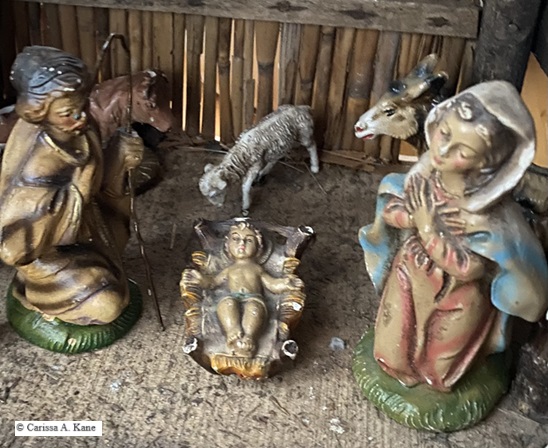
The verses above are used for the Gospel acclamation for the Feast of the Holy Family (usually celebrated the Sunday after Christmas). Oftentimes, the nativity of Jesus and the spirit of Christmas can be accompanied by thoughts of serenity and peace as well as images of idyllic creches and decorations. In such a setting, it can be rather easy to allow the peace of Christ and the word of Christ to flourish within when riding the joy of Christmas or any other anticipated or celebratory day or event. Yet, reality is such that life is a mixed bag and the unexpected, sometimes the dreaded, can come along at any moment, making it more challenging to be open to or inspired by the peace and word of Christ.
Imagine the joy and astonishment of Mary and Joseph at the birth of Jesus and what they initially encountered in the aftermath of his birth as people paid homage. Are there times in your life that come to mind and to which you can relate this experience? Times that have given rise to great joy, overwhelming peace, and/or the feeling of being so amazed.
Now, here we are, a week later, and in our liturgical celebration, we hear about Simeon and Anna paying homage to Christ and at the same time foretelling what’s to come (Lk 2:2-40).
“and Simeon blessed them and said to Mary his mother, ‘Behold, this child is destined for the fall and rise of many in Israel, and to be a sign that will be contradicted (and you yourself a sword will pierce) so that the thoughts of many hearts may be revealed’.” (v.34-35)
And coming forward at that very time, she gave thanks to God and spoke about the child to all who were awaiting the redemption of Jerusalem. (v. 38)
What’s it like to reflect on the fact that even though Jesus is the Christ, the reality is that it’s not going to be all roses and sunshine for Jesus, Mary, and Joseph either? It can be tempting to forget or to overlook reality, and to see the Holy Family as not only holy, but also as untouched. Take some time now to invite the Holy Family into whatever is happening at this time in your life. In what ways can you draw strength and inspiration from Jesus, Mary, and Joseph? What’s it like to consider that your experiences, your life, your family, and that of all those around you, are holy too?
Envision the peace and the word of Christ entering into the conversation and dwelling with, within, and all around you, drawing you, and all, closer to God.
Put on, as God’s chosen ones, holy and beloved, heartfelt compassion, kindness, humility, gentleness, and patience, bearing with one another and forgiving one another, if one has a grievance against another; as the Lord has forgiven you, so must you also do. And over all these put on love, that is, the bond of perfection. And let the peace of Christ control your hearts, the peace into which you were also called in one body. And be thankful. Let the word of Christ dwell in you richly, as in all wisdom you teach and admonish one another, singing psalms, hymns, and spiritual songs with gratitude in your hearts to God. And whatever you do, in word or in deed, do everything in the name of the Lord Jesus, giving thanks to God the Father through him. – Col 3:12-17
In a year where the Fourth Sunday of Advent falls on the same day as Christmas Eve (with the Christmas Vigil Mass), and in a world where it seems that there is a constant push toward an absolute one way or the other, but rarely a celebration of a little here, a little there, or somewhere in between, there lies a reminder of a better way.
Each year the Season of Advent is thought of as a period of waiting and Christmas as a period of celebrating the arrival of Jesus Christ, our Savior. And while we remember and participate in rituals each year, it can be easy to overlook the essence of these practices and to get lost in the ways in which we have come to proceed through them. With this, the opportunity to fully receive what is Divinely offered can become less.
Oftentimes, the greatest desire that many of us hold is the desire for peace (inner peace, peace within families/communities, world peace, etc.). And it is not uncommon to move, knowingly or not, toward external things or activities and attach a sense of peace to them, rather than to the joy they might bring to us as well as the real source of that joy and the peace that accompanies it—the Spirit of God.
Keeping in mind that peace is not possible without an openness to coexistence and unity, in what ways is your heart and mind open to peace? What strengths/challenges do you experience with regards to coexistence and unity in various situations? Where does this come up in your prayer life, and how is your sense of peace affected?
In a few days, when the Fourth Sunday of Advent and Christmas Eve (with the celebration of the Christmas Vigil Mass) share the day, envision it as an invitation to unity and, through it, peace. Take some time to reflect on the notion that what you desire is what you need, and what you are waiting for is already, in a sense, here. Then take some time to celebrate the goodness of the Lord.
Forever I will sing the goodness of the Lord. – Psalm 89:2A
The 3rd Sunday of Advent is referred to as Gaudete Sunday, as we move closer to Christmas, anticipating the joy and celebration of the birth of Jesus, the new Adam. The readings for this Sunday (Isaiah 61:1-2A, 6-7; Responsorial Psalm – Luke 1:46-50, 53-54, 1 Thessalonians 5:16-24, and John 1:6-8, 19-28) call upon us to embrace and rejoice in the Spirit of the Lord. What does that look like? How do you know when you’re embracing and rejoicing in the Spirit of the Lord?
In the Gospel, John the Baptist is asked by priests and Levites, “Who are you?” (John 1:22). Part of John’s response is, “I am the voice of one crying out in the desert, ‘make straight the way of the Lord,’” (John 1:23). Reflecting on John’s response, what do you imagine it was like for him? How would you respond to the question, “Who are you?” In what ways would your response be the same or different depending on who asks the question?
What’s it like to ponder that the same God who created John and inspired his words and actions, desires to do the same for all of us?
Continuing to consider this, in what places or situations do you desire your words and actions to be influenced more by God? What are the places or situations where you experience peace, joy, and a sense that your desire and God’s are united?
Prayer: Gracious and merciful Lord, over the course of the next few weeks, with all the busyness of the Advent and Christmas Season, help us to be open to your inspiration and to cooperate with the glue that is your Grace, so that we might discover that there is joy in each moment.
“Man is born broken; he lives by mending. The grace of God is the glue.” – Eugene O’Neill
A star found residing where it was placed. Holding still and quiet.
Its edges beveled, dimensions on display, highlighting different shades, color throughout the various times of day.
Sometimes crystal clear, what’s behind showing through. And other times, transforming as a show of what’s reflected on it.
A voice of one crying out in the desert: ‘Prepare the way of the Lord, make straight his paths.’” – Mark 1:3
In what situations do you sense facets of your faith more strongly? In what areas do you desire to deepen or to be more in touch with your faith? In what ways is your faith multidimensional?
As the fire kicks in, it dances about. And the smoke? It fades away. All attention now To the brilliance Of its flames.
No ear has ever heard, no eye ever seen, any God but you working such deeds for those who wait for him. – Isaiah 64:3
The readings for the First Sunday of Advent call upon one and all to watch and wait… to pay attention. However, it can be very challenging to take heed to this message, especially at a time of year when everything is busier and there is pressure to fit more and more into whatever time one has. So, what are some ways that one can wade through the sea of distractions that float their way this Advent?
O God, restore us; light up your face and we shall be saved. – Psalm 80:4
First, get in touch with your desire for this Advent Season. Make time for some solitude and prayer so that you can get a better sense of your heart’s deepest wishes. What are your priorities? What are ways you can continue to pray and draw inspiration through each day of Advent?
God is faithful, and by him you were called to fellowship with his Son, Jesus Christ our Lord. – 1 Corinthians 1:9
Second, consider how you can be more intentional in moving through the season with your desires and an openness to God’s presence. What are you willing to invest with regards to time and space? Remember, more is not necessarily better. Also, the attitude with which one approaches a commitment, or a task, will affect the experience. So, try to take your coat off and put your bags down at the door, so to speak, as you enter. Take some time to unload and put aside whatever you’re coming from or holding onto so that you can receive whatever may be awaiting you.
Show us Lord, your love; and grant us your salvation. – Psalm 85:8 (Gospel Acclamation)
Before moving on, spend some time reflecting on the goodness of God. Recount your experience of God’s love (through prayer, nature, art, a meaningful exchange, etc.) over the past weeks and months. Allow yourself some time to bask in the grandeur of God.
What I say to you, I say to all: ‘Watch!’” – Mark 13:37
Third and last, Jesus instructed his disciples to keep watch and to be ready. It can be easy to take this as a directive and make it our own, but no matter how determined one might be, the risk becomes leaving God at the direction, and therefore missing the intent. This is not a solo endeavor! There is no way to effectively watch and be ready, without the grace of God.
This brings us back to desire! Scripture tells us that it is God who has chosen us (John 15:16). The season of Advent is an opportunity to remember and pay homage to this. It is an invitation to keep striving to avail oneself to the grace of God, not only to keep the faith, but to also to proceed with a willingness and openness to God’s ways and to grow in faith.
May we all use this Advent to choose, and keep choosing, God.
It seems that human nature tends toward comparison and judgment along with practices that help one to “find their place” and obtain some level of comfort. However, although these skills might be helpful in deciphering and navigating the world around us, they can also lead to complacency, and a sedentary or fixed way of seeing and being. The readings for the Solemnity of Christ the King offer an opportunity to reflect upon choices, judgments, and viewpoints, and to consider by what or whom they are influenced. Or, in other words, to contemplate who is leading you.
In the First Reading (Ezekiel 34:11-12, 15-17), the deep level of care and protective nature of God is expressed.
“Thus says the Lord God: I myself will look after and tend my sheep.” (v. 11).
The passage continues to describe God’s desire to rescue, find, and heal as well as God’s promise to make judgments and course correct those who are wrong or have gone astray.
How do you feel about this notion? What’s it like to leave the judgment and course correction to God? Are there areas in which it is more of a challenge than others? Spend some time in prayer asking for guidance around replacing judgments that veer away from God’s desire for you and for a clearer vision of what role God desires for you.
In the Responsorial Psalm (Psalm 23:1-3,5-6), we stay with the image of the Shepherd who takes care of and provides for his sheep. The psalmist writes of the Lord as refreshing their soul, guiding them in right paths, and blessing them so that “goodness and kindness follow” them. The psalmist then says, “I shall dwell in the house of the Lord for years to come” (v. 6).
What do you think they mean? What do you imagine that would be like? How would it feel? In what places or situations have you experienced similar feelings?
“The Lord is my shepherd; there is nothing I shall want.” (v. 1).
In what ways do you feel inspired when you imagine God’s loving presence permeating all experiences and capable of extending beyond all that might otherwise be a barrier?
Looking to the Second Reading (1 Corinthians 15:20-26, 28), St. Paul writes about Christ the King who helps us to life by helping us to overcome death, in its various forms, while at the same time leaving the ultimate judgment to God.
“then comes the end, when he hands over the kingdom to his God and Father, when he has destroyed every sovereignty and every authority and power. For he must reign until he has put all his enemies under his feet. The last enemy to be destroyed is death. When everything is subjected to him, then the Son himself will also be subjected to the one who subjected everything to him, so that God may be all in all.” (v. 24-26, 28).
What happens when you think about Jesus, to whom God subjected all things, handing the kingdom back to God (v. 24) and subjecting Himself to God? What’s it like for you to let go of something that you have obtained or been given? Where is God in that decision or process?
Now turning to the Gospel (Matthew 25:31-46), Jesus talks to his disciples about the final judgment and separation between sheep (the righteous) and goats. Notice how the criteria that Jesus describes are all things that can be done to take care of and protect others.
“For I was hungry and you gave me food, I was thirsty and you gave me drink, a stranger and you welcomed me, naked and you clothed me, ill and you cared for me, in prison and you visited me.” (v. 35-36).
There is always more than just “I,” “me,” and “mine,” and part of striving for the Kingdom of God is not only to know this, but also to live in a way that shows respect, dignity, appreciation, and care for others. Also, it’s not about being perfect or being able to amass a long list of service to others, but rather about focusing efforts on being in service of God by surrendering one’s heart and mind to being under the influence, united with, and led by God.
The Lord is my shepherd; there is nothing I shall want. – Ps 23:1
There’s the saying that attitude is everything, and there is no denying the importance and impact of attitude on behavior. The Gospel for the Thirty-third Sunday in Ordinary Time (Mt 25:14-30 shown below), provides an example of how attitude can affect choices. In this passage, referred to as the Parable of the Talents, Jesus tells the story of three servants and how they handled the possessions their master entrusted to them while he was away.
To start, we learn that the master gave each servant a different amount based upon their ability. This suggests that he had a sense of what they were capable of and perhaps a desire not to give them more than what they might be able to handle. But also, more importantly, the master gave something of value to each of them, allowing them room for growth. He would not have done that if he did not see potential in each of them.
Looking at how each servant responded, we can see that the ones who were entrusted with more (five and two talents respectively) produced more and the one entrusted with the least (one talent), produced the least. It can be tempting to look at this situation, and the master’s response upon his return, as a simple matter and to judge the servant who buried the talent instead of growing it as weak for allowing his actions to be driven by fear. However, there is more to this story than what is on the surface.
Think about the characteristics of Jesus and the way that he responds to people. He listens, he notices, he allows people to be who they are, and where they are in their journey, while at the same time loving or valuing them, and encouraging them toward growth and living in the light. There is always a path toward shedding whatever it is that is holding someone back from becoming more and more authentic as one created in the image of God.
When considering this passage in the light of attitudes, we can easily jump to a conclusion that two of the servants had what might be thought of as a healthier attitude and did something productive with what was entrusted to them. While on the other hand, the third servant focused on the unjust ways of his master, resulting in a poor attitude and therefore a lackluster performance. What about the master though?
What was the master’s attitude in this parable? At the beginning, it is implied that he saw less potential or expected less from the third servant. Also, upon his return, how did he receive the third servant’s choice and the reasons behind it?
The third servant says, “Master, I knew you were a demanding person, harvesting where you did not plant and gathering where you did not scatter; so out of fear I went off and buried your talent in the ground. Here it is back.” All the master seems to take in is the fact that the servant did not multiply what was entrusted to him. And his reaction to that is to assign the servant even less value (“You wicked, lazy servant!”) and to condemn him to darkness. How might his response have been different if he was able to consider the impact of his ways, and the fear it created in the servant?
Although the servant didn’t, at the time, possess the wherewithal to multiply what was given to him, he at least recognized its importance and preserved it. His fear held him back, but he did do something. It seems the master couldn’t appreciate that. If you think about Jesus and his interactions with people, in what ways does the master’s words and actions reflect the attitude and behavior of Jesus?
While the Parable of the Talents might be considered in terms of “what one does with what is given to them is important,” it can also serve as an invitation to consider roles and the attitudes that can accompany them. As you consider your own life, in what situations might you be one of the servants who multiplied the talents? the servant who was given one talent? the master? Reflect upon your demeanor in these roles. How, if at all, does your attitude shift in these different situations? Where is the light of God and in what ways is Jesus present to, and in, you?
Jesus told his disciples this parable: “A man going on a journey called in his servants and entrusted his possessions to them. To one he gave five talents; to another, two; to a third, one– to each according to his ability. Then he went away. Immediately the one who received five talents went and traded with them, and made another five. Likewise, the one who received two made another two. But the man who received one went off and dug a hole in the ground and buried his master’s money.
“After a long time the master of those servants came back and settled accounts with them. The one who had received five talents came forward bringing the additional five. He said, ‘Master, you gave me five talents. See, I have made five more.’ His master said to him, ‘Well done, my good and faithful servant. Since you were faithful in small matters, I will give you great responsibilities. Come, share your master’s joy.’ Then the one who had received two talents also came forward and said, ‘Master, you gave me two talents. See, I have made two more.’ His master said to him, ‘Well done, my good and faithful servant. Since you were faithful in small matters, I will give you great responsibilities. Come, share your master’s joy.’ Then the one who had received the one talent came forward and said, ‘Master, I knew you were a demanding person, harvesting where you did not plant and gathering where you did not scatter; so out of fear I went off and buried your talent in the ground. Here it is back.’ His master said to him in reply, ‘You wicked, lazy servant! So you knew that I harvest where I did not plant and gather where I did not scatter? Should you not then have put my money in the bank so that I could have got it back with interest on my return? Now then! Take the talent from him and give it to the one with ten. For to everyone who has, more will be given and he will grow rich; but from the one who has not, even what he has will be taken away. And throw this useless servant into the darkness outside, where there will be wailing and grinding of teeth.'” – Matthew 25:14-30
Reading Scripture it’s not too hard to envision the Pharisees and scribes as having a persona of lofty authoritarians who are learned, serious, and on the surface appearing to be so proper. Yet, Jesus points out that their actions do not align with their words. In the Gospel for the Thirty-first Sunday in Ordinary Time, Jesus tells the crowd and the disciples to observe and do as the Pharisees and scribes say, but do not act as they do. Do not hold down or seek to elevate yourself above others. Jesus then goes on to say, “you have but one teacher, and you are all brothers.” You have but one Father, but one master, Christ, and that the greater glory is not in being served or glorifying yourself, but rather in being of service to others, and therefore of service to God.
Reflecting on this Gospel and considering other Scripture passages as well, it may seem obvious that the Pharisees and scribes were not about what they proclaimed. Perhaps they fell victim to the notion that they had already arrived, were afraid of losing what they had attained, or some other thing that shrunk their hearts and made them sterner with others, and lax in their own prayer and practices, making them less likely to be inspired by God and more likely to be misguided and led astray.
Despite this, the actions of the Pharisees and scribes don’t make them worthless or deserving of being canceled. We can hold them accountable but must remember they are still part of God’s creation. They also need love, mercy, and prayers.
Jesus says to observe and listen to what they say. Maybe he’s reminding us that God can still work through them. Their transgressions are not bigger than God.
Praying with this passage brought to mind an instance from grade school, in my 2nd grade classroom, where being orderly was of the utmost importance to the teacher, most especially when it came to the inside of a student’s desk. All the students knew what was expected, and it seemed that all of us really tried to meet this expectation. However, there were a couple of students who had a very hard time with being organized. So, one day, the teacher was walking around the classroom, teaching a lesson, and without warning, flipped and dumped out the contents of this student’s desk, startling everyone, to say the least, and sending books, paper, pencils, and so on, all over the place. The student was then yelled at for being so disorganized, the teacher turned the desk back upright, and told the student to pick everything up, and put it back in the desk, neatly. The student, who was normally quiet, shrunk even more, their cheeks turned red, and tears were coming down their face as they began doing as they were told. The rest of us 7- and 8-year-olds, just sat there horrified. None of us dared to try to help the student for fear of what would happen if we did. It’s interesting how fear can interfere. It’s also interesting how judgment can be too.
When I think about this instance, in the light of this Gospel, I wonder, what was the point, or the lesson being taught that day? What made it so important that the inside of our desks be orderly, to the extent that a student who was trying their best and just being themself, be demeaned like that, and the room be made so disorderly, in efforts to obtain order? However, faith also calls me to hold and look at the entire picture, including before and beyond that instance and to recall that I also had what one would call a lot of positive experiences in that classroom.
Looking at the Pharisees and scribes, Jesus points out a disconnect not only between their words and their actions, but also in their hearts. He cautions the crowd, and us, to not be fooled or distracted toward self-serving ways. To not rely on external things, such as possessions or positions of authority, to gain good graces or a particular outcome, but rather to rely on the grace and guidance of God. Jesus is saying, if we’re going to be led by anybody or anything, or if we’re going to follow anybody or anything, first and foremost, let it be God.
But there’s more… humility.
When we think about this Gospel passage, it can be tempting to cast stones at the Pharisees and the scribes, thinking of ourselves as perhaps being far removed from them, especially in the “us” and “them”, divided times I which we live. Yet, in our certainty and in our knowing, we too can become susceptible to an attitude or posture that interferes and creates static, making us less receptive to being led by God, more likely for other things to come before, or in place of God, and making us less loving, compassionate, and forgiving.
It’s unlikely that the Pharisees and scribes set out to fall into a haze, becoming less aware, open, or able to continue learning through experiences, and blocked, at least at that time, from continually drawing closer to God. However, in certainties and in knowing about what ought to be, it can be easy to become closed off to what is, and the open, honest dialogue that helps us to know when we are moving toward a will that is not in alignment with God, and that is of disservice, rather than what is best.
“Humility is an attitude of honesty with God, oneself, and of all reality. It enables us to be at peace in the presence of our powerlessness and to rest in the forgetfulness of self.” – Thomas Keating
Jesus spoke to the crowds and to his disciples, saying, “The scribes and the Pharisees have taken their seat on the chair of Moses. Therefore, do and observe all things whatsoever they tell you, but do not follow their example. For they preach but they do not practice. They tie up heavy burdens hard to carry and lay them on people’s shoulders, but they will not lift a finger to move them. All their works are performed to be seen. They widen their phylacteries and lengthen their tassels. They love places of honor at banquets, seats of honor in synagogues, greetings in marketplaces, and the salutation ‘Rabbi.’ As for you, do not be called ‘Rabbi.’ You have but one teacher, and you are all brothers. Call no one on earth your father; you have but one Father in heaven. Do not be called ‘Master’; you have but one master, the Christ. The greatest among you must be your servant. Whoever exalts himself will be humbled; but whoever humbles himself will be exalted.” – Matthew 23:1-12













 HopeThatFloats
You must be logged in to post a comment.