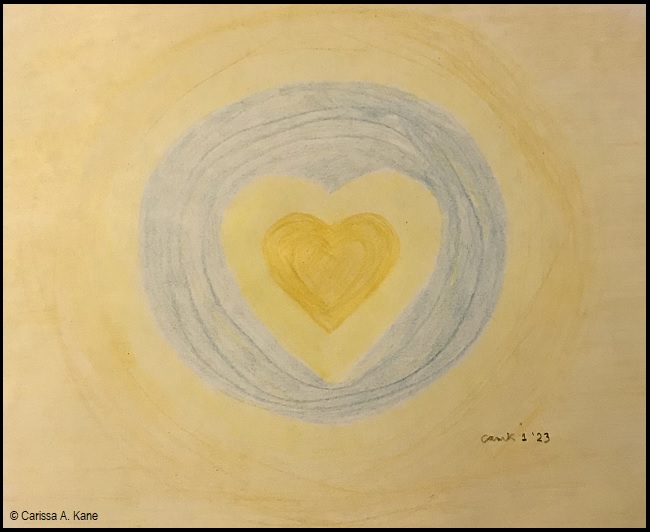
Gold circle representing the world filled with sky blue color and a white heart with a white cross in the center.

In the Wrapping…

The first reading for the Fifth Sunday in Ordinary Time speaks of helping those in need as the way to overcome darkness. The Lord says through the prophet Isaiah, “If you remove from your midst oppression, false accusation and malicious speech; if you bestow your bread on the hungry and satisfy the afflicted; then light shall rise for you in the darkness, and the gloom shall become for you like midday.” (Is 58:9b-10). Perhaps this can be seen as an invitation to greater unity through the exercise of mercy and compassion. Think about a time when you were shown mercy and compassion. What was that experience like? How did it impact you? Oftentimes, in showing mercy and compassion, a greater sense of unity is born and the light within each of us shines brighter with Life, making the darkness in the world, what it really is, “less than.”

In the First Letter to the Corinthians, St. Paul writes, “…my message and my proclamation were not with persuasive words of wisdom, but with a demonstration of Spirit and power, so that your faith might rest not on human wisdom but on the power of God.” (1 Cor 2:4-5). It’s human nature to want to understand and to make logical conclusions. It’s just the way we are. However, when the determination to meet this need to know or to make sense of happenings becomes more driven by human motivation, the results tend to run narrow, and create vision like that of being in a tunnel. It is then, that our understanding becomes warped and more of an obstacle than an aid to seeing the “greater than” that exists in each situation. Instead, it leads to a hardening of both one’s mind and heart, and an approach that pulls one away from living with authenticity and integrity and making choices in the light of truth and justice.

In the Book of the Prophet Jeremiah, we read, “… I will place my law within them, and write it upon their hearts; I will be their God, and they shall be my people.” (Jer 31:33).

In striving to make choices that are truly beneficial—ones that embrace love, peace, and justice for oneself as well as others—balance is necessary, and the starting place for that is in one’s heart. It is only in our hearts that we can begin to understand in a way that will lead us to what is best. It is only in our hearts that Jesus, the light of the world, shows us the way that is truly just. And it is only through our hearts that our motivation becomes purer, our minds move toward a broader way of being, and we can genuinely shine before others, giving glory to God (Mt 5:16).

So, when I can’t understand, show indifference or disdain, begin to make assumptions, can’t give the benefit of the doubt, and can’t wrap my head around something, perhaps it’s because, first, I need to be wrapping my heart around it.
Light shines through the darkness for the upright;
they are gracious and merciful and just.
Well for them who are gracious and lend,
who conduct their affairs with justice. – Psalm 112:4-5

An Unconquered Heart…

From a young age, one is often taught to pay attention to the weather. When you hear thunder, go inside as rain, wind, and lightning may be near or approaching, if not already there. If there are heavy winds and/or lightning, stay inside and away from the windows, and so on. When there’s snow or sleet, beware of the road conditions—stay home. Most of what is taught about stormy weather is about actively retreating or staying put for one’s own well-being. Yet, sometimes, these efforts can instill fear and anxiety as the motivators for one’s actions.

Considering the state of, or conditions in the world today, the feeling or thought that we are in stormy times, both literally and figuratively, is palpable for so many. At times, it can lead one to retreat or stay put, shrinking, or turning away from active participation in the larger world. And while a certain amount of self-preservation can be good, withdrawal serves one and all best, not only when it is temporary, but also when one is intentional in how that time away is spent, and the choices and actions that result from it.

So, while the times may be stormy, perhaps the storm is perfect. Perfect for taking a step back and noticing for what one’s heart beats. Perfect for contemplating where one is, and where one is moved to be. Perfect for retreating to prayer and reflecting on what the world needs, one’s openness to the invitations of Grace that await, whether amid the storm, on its edges, or in an entirely different relation, and one’s desire to become more aware of what active participation in this stormy world might mean on a personal level, as well as how these storms can be overcome by being held as a meeting place for Jesus.

We often think or speak of the calm after the storm, and it often seems easier to appreciate the beauty of the sun after a rainstorm, or the snow-covered trees when removed from the threat and possible dangers of the driving winds and snow. However, Jesus tells us that he is with us always. Thus, the calm never ceases. It’s up to us though, to nurture our deepest, truest desires, to strive to invite peace into each situation, and to choose to not only look for, but to also navigate in, with, and through Grace. In doing so, we stay connected, our retreating or staying put remains temporary, and brings forth fruit that is lasting. Fruit that is ordained by God, bringing us back into the fold, with greater life, and as unconquered hearts whose actions flow from, and glorify God, and all creation.    

Give me, O Lord, a steadfast heart, which no unworthy affection may drag downwards; give me an unconquered heart, which no tribulation can wear out; give me an upright heart, which no unworthy purpose may tempt aside. Bestow on me also, O Lord my God, understanding to know you, diligence to seek you, wisdom to find you, and faithfulness that may finally embrace you, through Jesus Christ our Lord. Amen. – St. Thomas Aquinas

When Jesus saw the crowds, he went up the mountain,
and after he had sat down, his disciples came to him.
He began to teach them, saying:
“Blessed are the poor in spirit,
for theirs is the kingdom of heaven.
Blessed are they who mourn,
for they will be comforted.
Blessed are the meek,
for they will inherit the land.
Blessed are they who hunger and thirst for righteousness,
for they will be satisfied.
Blessed are the merciful,
for they will be shown mercy.
Blessed are the clean of heart,
for they will see God.
Blessed are the peacemakers,
for they will be called children of God.
Blessed are they who are persecuted for the sake of righteousness,
for theirs is the kingdom of heaven.
Blessed are you when they insult you and persecute you
and utter every kind of evil against you falsely because of me.
Rejoice and be glad,
for your reward will be great in heaven. Thus they persecuted
the prophets who were before you.” – Mt 5:1-12

Company…

In the process of growing up, a sense of right and wrong forms within. It’s based upon lessons learned, whether explicitly taught to one or gleaned from experiences. This sense is accompanied by the development of principles as well as the assignment of value to people, places, and things. Oftentimes this process is impacted not only by one’s immediate environment, but also by one’s community, the broader society, and perhaps, the happenings throughout the world as well. It’s human nature, after all, to derive meaning and to be affected by one’s surroundings and the people, places, and things, to which one is exposed. Hence the saying that one is known by one’s companions.

In chapter one of the First Letter of Saint Paul to the Corinthians, Paul is imploring the Corinthians to be united in the Lord rather than torn apart by their differences. How poignant for the times we live in today. The wisdom of this Bible passage speaks to us today just as the letter of St. Paul did to the Corinthians. Warning them, and us, that continuing on a path with such great division, serves only to unravel us, and that it is only through unity that we can overcome such a fate. So how do we move toward greater unity?

Most importantly, as St. Paul suggests, we need to return to the truth. Underneath all that divides us, and at the core of all that we are, and all that we can be, is the fact that our meaning and purpose comes from something far greater than any one person or group could ever encompass. We need to recognize when we are being pulled away and distracted from this truth, and to remove ourselves from partaking in any movements that seek to undermine honesty and integrity, in any way. The “win at all costs” mentality that seems so pervasive and accepted in society, needs to be challenged.

This is what St. Paul is talking about when he writes about there being rivalries and urges the people to stop thinking of themselves as belonging solely to one identity over another. This is what causes the great divide, and serves to scatter us, undoing the power and potential of unity.

When we move through the influence of our Oneness, see our differences as being ordained by God, and use them as the bond of perfection that they can be, we are able to come together in ways that value, serve, and work to benefit all of creation, and that give glory to God. When we trust the longings of true love and follow the example of Jesus, pride, prejudice, status, and exclusivity fall away and the unity that results brings greater—lasting—meaning and purpose to our lives than we could ever achieve on our own or within any segment of society seeking its own good over the good of all.

Paul writes, “For Christ did not send me to baptize but to preach the gospel, and not with the wisdom of human eloquence, so that the cross of Christ might not be emptied of its meaning.”

“The wisdom of human eloquence” would encourage one to find and stay with those around whom one feels most comfortable and identifies most closely. St. Paul is saying, don’t be fooled. He is saying, seek to be in the company of the Lord. Identify, first and foremost, with the Lord, so that you may experience redemption and your life may have direction and meaning that extend beyond the narrow confines of human understanding.         

Reflect and pray:

When you contemplate the company you keep, what are some of the values or meaning you derive from your relationship with God and others? Where, and in what ways, do you experience unity?

As you go about your day or your week, what kind of companion are you?

How do expectations come into play with regards to your ability for companionship? And in what ways do you see the Lord as companioning you and vice versa?

When you reflect on the notion of an invitation to be a companion of the Lord awaiting you in all circumstances, what is your reaction or response?

I urge you, brothers and sisters, in the name of our Lord Jesus Christ,
that all of you agree in what you say,
and that there be no divisions among you,
but that you be united in the same mind and in the same purpose.
For it has been reported to me about you, my brothers and sisters,
by Chloe’s people, that there are rivalries among you.
I mean that each of you is saying,
“I belong to Paul,” or “I belong to Apollos,”
or “I belong to Cephas,” or “I belong to Christ.”
Is Christ divided?
Was Paul crucified for you?
Or were you baptized in the name of Paul?
For Christ did not send me to baptize but to preach the gospel,
and not with the wisdom of human eloquence,
so that the cross of Christ might not be emptied of its meaning. – 1 Cor 1:10-13, 17

Enabled by Grace

To be

Radically, yet gently,

Influenced by, and

Utterly, without doubt,

Moved to, and in, the light of

Peace, love, and

Healing

“…I will make you a light to the nations, that my salvation may reach to the ends of the earth.” – Is 49:6

The Essence of Holidays and More…

Into the night and all day too,
The glow of lights sprinkled here and there,
but really, almost everywhere.
This peace, this joy, ever present,
Sometimes noticed more than others,
Sometimes not at all,
Nevertheless, a presence always there.
The heart, holding all together,
Ups and downs, yeas and nays,
Judgments, and lessons learned.
Steady in the flow of life,
Brave but never brazen.
Standard bearer, but more,
Usher of truth and light.
There through it all,
From year to year,
And age to age.

Holy Spirit, help us turn the page,
As the bells ring,
And a new year begins,
Renew our listening,
Renew our resolve.
Show us love,
Show us kindness.
Bring us peace,
Bring us newness.
Help us to work with Grace,
To change what we need to change,
And to carry hope, wherever we go.
Help us, bit by bit, to turn our world around.


May God be gracious to us and bless us; may God’s face shine upon us. – Psalm 67:2

Signs and Wonder…

Approaching the intersection of two busy streets, cones and temporary stop signs come into view, and then fallen lines disrupting service to the traffic lights that normally direct cars safely from one side to the other. It’s interesting how in driving or using other forms of transportation, one not only learns to look for signs, but also to be guided by them in reaching destinations safely.

Similarly, as one journeys through life, guidance comes, and prayers are often answered through signs, coming in various forms of interaction with God and others. Sometimes, in both times of light and times of darkness, whether personal or societal, it can be easy to miss signs, lose sight of, or take for granted, experiences of grace. The scripture readings throughout Advent and Christmas, remind us of God’s faithfulness and guiding presence, especially to Mary and Joseph, leading up to and beyond the birth of Jesus.

Through allowing or inviting God to be the source of their path and the sustenance of their hope, Mary and Joseph were not only drawn into their God-given purpose, but they were also led all the way through to its fulfillment… teaching us that the path can be difficult, the road uncertain, but that there can also be great joy when we embrace the spirit of Christmas—a heart full of light, and hope in the Lord.

All the ends of the earth have seen the saving power of God. – Psalm 98:3c

A Christmas Prayer: Lord, help me to remember your faithfulness, and to be open to the signs and guidance you place along my path. Turn my gaze always toward you, Emmanuel, as the source of all hope, that my heart may faithfully embrace the spirit of Christmas all year long, leading me to notice and appreciate the beauty and goodness of all creation, and the heart and soul of those I encounter each day.

More Than Pieces…

Pieces, everything comes in pieces.
Our coming and our going,
Who we are and what we do,
Hours, minutes, seconds of each day.
Sometimes, taken as a whole,
Might we miss or gloss over gold,
The little things as not worth the time of day?
Though precious is each moment,
Taken alone and on its own,
Might we miss or gloss over gold,
The broader view as just another day?
Pieces, broken down and shared,
Everything is pieces,
Of a picture big and small,
Glossy gold and full of glimpses,
Captured best holding one another,
Drawing strength and beauty altogether,
Being grateful for it all.

“Everything that is in the heavens, on earth, and under the earth is penetrated with connectedness, penetrated with relatedness.” – Hildegard Von Bingen

An Advent Prayer: Lord, help me to hold the pieces of my life together, big and small, easy and challenging and all that falls between, with great love and care, trusting that it is really You, the King of Glory (Ps 24:10b), who holds them all… who holds us all. And help me to continue to look to you, that you may grant me the grace to notice and appreciate the beauty and goodness of all creation, and the heart and soul of those I encounter each day.

From All Appearances…

At the beginning of the Gospel reading for the Second Sunday of Advent (Matthew 3:1-12) there is a description of the “voice crying out in the desert, prepare the way of the Lord, make straight his paths” (verse 3). We read that John the Baptist is outfitted in camel hair clothing and has a “wild” diet of grasshoppers (a.k.a. locusts) and honey. Based solely on this physical description and his location in the desert, it’s easy to envision John as having a gruff or primitive appearance. Yet, there were many people who traveled to be baptized by him. So, what was it that drew them to him?

Imagine someone dressed in clothing made from material that was typically used for making cloaks, tents, and carpets and eating bugs and wild honey telling you to get ready… to straighten up and make a proper path for the Lord. What would you notice first? What would you think? How would you respond?

What obstacles are there to looking at the appearance of John the Baptist, and seeing the heart of a faithful servant of God, or a guardian angel pointing out the way?

Oftentimes, we can become conditioned by our surroundings, social circles, and society in general as to how people or things should look, act, or speak. However, these expectations not only make it easier to miss the spirit and the heart of those we encounter along the way, but also make it easier to be misled or go astray. When thinking about preparing, an ideal image or notion of what should be may come to mind, and although it may be helpful to have a sense or an idea about things, it’s important to always leave a little space to prayerfully ponder that which is different, unknown, or unfamiliar.

An Advent Prayer: Lord, in a world that seeks to glorify based on appearances and all that fades, help me to go with Your grain, instead of society’s. Help me to overcome any obstacles that may prevent me from seeing beyond appearances. Help me to look to You and grant me the grace to notice and appreciate the beauty and goodness of all creation, and the heart and soul of those I encounter each day.

John the Baptist appeared, preaching in the desert of Judea
and saying, “Repent, for the kingdom of heaven is at hand!”
It was of him that the prophet Isaiah had spoken when he said:
A voice of one crying out in the desert,
Prepare the way of the Lord,
make straight his paths.
John wore clothing made of camel’s hair
and had a leather belt around his waist.
His food was locusts and wild honey.
At that time Jerusalem, all Judea,
and the whole region around the Jordan
were going out to him
and were being baptized by him in the Jordan River
as they acknowledged their sins.

When he saw many of the Pharisees and Sadducees
coming to his baptism, he said to them, “You brood of vipers!
Who warned you to flee from the coming wrath?
Produce good fruit as evidence of your repentance.
And do not presume to say to yourselves,
‘We have Abraham as our father.’
For I tell you,
God can raise up children to Abraham from these stones.
Even now the ax lies at the root of the trees.
Therefore every tree that does not bear good fruit
will be cut down and thrown into the fire.
I am baptizing you with water, for repentance,
but the one who is coming after me is mightier than I.
I am not worthy to carry his sandals.
He will baptize you with the Holy Spirit and fire.
His winnowing fan is in his hand.
He will clear his threshing floor
and gather his wheat into his barn,
but the chaff he will burn with unquenchable fire.” – Matthew 3:1-12

Facing All Sides…

Today, November 20th, is also the Solemnity of Our Lord Jesus Christ, King of the Universe. Although the date of this occasion is not the same every year, this year is one where it coincides with the anniversary of the official release of Windows 1.0 (November 20, 1985) which included a game, Reversi, based on another game named Othello.

Regardless of the name though, the two-player game like the push and pull of life on earth is all about strategy. It involves a green board and round pieces that are black on one side and white on the other, and players take turns trying to “book-end” their opponent’s pieces either horizontally or vertically. When successful, a player can then convert pieces from the other player’s color to one’s own, and when all the pieces are used, the player who has more of their color pieces on the board wins.

Essentially, this game is another that is all about paying attention, thinking ahead, maneuvering, and navigating to benefit from both one’s own plays as well as the missteps of one’s opponent. Typical of pretty much any kind of competition. Or, on the other hand, it can just be a simple, engaging game while spending time with a loved one. The pieces like coins or chips, creating an interesting rhythm as they shake back and forth in a loosely closed fist, and a pattern that slowly emerges as each piece is placed on the board of green amid moments of speaking and ones of silence. Ultimately, like many things, it depends on the eye with which one views it.

Sitting with chapter 23, verses 35-43, of the Gospel according to Luke (below), one can see two sides of the piece. There were those, the rulers, soldiers, and one of the criminals, who saw the situation solely in terms of themselves and in the world (winning, losing, us against them). They taunt Jesus and browbeat him about not fighting back and overcoming them, which they assume he would do if he was really a king.

And then, there was the other criminal, who saw the situation as it truly was. He could see and acknowledge the truth, that both criminals had done wrong, and Jesus had not. He also pushed back against the misconceptions and aggressive behavior toward Jesus. It seems that the eye through which he viewed what was happening was more flexible, able to take in a broader view—the full picture including beyond himself, and less hardened than the others who were there. As a result, he was more open, and this allowed him to see through the noise and mentality of the crowd. It led him to the truth and a desire that drew him closer to Jesus, Savior, in the moment he was facing… in the moment they were facing together.

In this month of Thanksgiving and remembrance, with which eye are you viewing situations? And in what ways do you desire to face each moment together with Jesus?

The rulers sneered at Jesus and said,
“He saved others, let him save himself
if he is the chosen one, the Christ of God.”
Even the soldiers jeered at him.
As they approached to offer him wine they called out,
“If you are King of the Jews, save yourself.”
Above him there was an inscription that read,
“This is the King of the Jews.”

Now one of the criminals hanging there reviled Jesus, saying,
“Are you not the Christ?
Save yourself and us.”
The other, however, rebuking him, said in reply,
“Have you no fear of God,
for you are subject to the same condemnation?
And indeed, we have been condemned justly,
for the sentence we received corresponds to our crimes,
but this man has done nothing criminal.”
Then he said,
“Jesus, remember me when you come into your kingdom.”
He replied to him,
“Amen, I say to you,
today you will be with me in Paradise.” – Lk 23:35-43

At Our Best…

The readings for the Thirty-third Sunday in Ordinary Time extend an opportunity to think about one’s relationship with Jesus and reflect on how justice and perseverance come into play. In the first reading (Mal 3:19-20a), we read the phrase, “the sun of justice with its healing rays.” How have you experienced the healing rays of justice? In what ways do you impart the fruits of that healing in your daily life?

In the responsorial psalm (Ps 98:5-6, 7-8, 9), we read:

Let the rivers clap their hands,
the mountains shout with them for joy,
Before the Lord who comes,
who comes to govern the earth,
To govern the world with justice
and the peoples with fairness. – Psalm 98:8-9

Envision something that recently brought you joy and excitement. How did it impact the people and the environment around you? Was everyone happy? Was anyone affected in a way that was not beneficial? Where do sense Jesus was in this situation?

Now, let’s take a step back. Consider this: What is your understanding and experience of justice and fairness? Can you think of some examples of the two? Do they include situations where there may be no personal benefit involved? How is your understanding and application of justice and fairness influenced by the example of Jesus’s life, death, and resurrection, and the many parables he told?

In the second reading (2Thes 3:7-12), St. Paul reminds the Thessalonians of how he, Silvanus, and Timothy have behaved and urges them to do likewise.

Brothers and sisters:
You know how one must imitate us.
For we did not act in a disorderly way among you,
nor did we eat food received free from anyone.
On the contrary, in toil and drudgery, night and day
we worked, so as not to burden any of you.
Not that we do not have the right.
Rather, we wanted to present ourselves as a model for you,
so that you might imitate us.
In fact, when we were with you,
we instructed you that if anyone was unwilling to work,
neither should that one eat.
We hear that some are conducting themselves among you in a
disorderly way,
by not keeping busy but minding the business of others.
Such people we instruct and urge in the Lord Jesus Christ to work quietly
and to eat their own food. – 2Thes 3:7-12

As you contemplate St. Paul’s words to the Thessalonians calling on them to focus on their work and to persevere in faith so as not to become idle and then “disorderly,” by getting caught up or interfering in the business of others, what strikes you most? With the current state of many things in the world, what insight(s) can you draw from this passage? In what ways do you experience Jesus in the places that have been capturing your focus these days?

Looking to the Gospel passage (Lk 21:5-19 included below), Jesus speaks of what’s to come, understood as the end of days. He essentially tells those who are listening, do not fall prey to being distracted by the signs and chaos around you, and do not be worried about how to respond or react, but rather, stay focused on me, and I will help you to know what to say… what to do. The passage closes with Jesus saying, “By your perseverance you will secure your lives.” How do you know the difference between being driven by the perseverance of faith in Jesus and being driven by your own sheer will masked as perseverance of faith in Jesus?

The Gospel verses taken together, tell us that the answers are not predetermined or black and white, but are all encompassing, pure, and speak to the uniqueness of each moment that can often escape the human mind and heart. Jesus, through his abundant love and wisdom, knows the importance, and all the implications of each moment, far better than anyone else could ever know. So, when we stay focused on Jesus with a desire to follow him, we can overcome any obstacles in ways that imitate the example of Jesus and honor the glory of God. And in doing so, we receive the grace we need to meet each moment.

What’s it like to envision justice and perseverance of faith in Jesus as a call of discipleship to surrender to Jesus in each moment, remembering his example, no matter what the moment holds, with a willingness to evolve, allowing room for movement? How might this influence the things you celebrate, and the things you don’t?

“Power at its best is love implementing the demands of justice, and justice at its best is power correcting everything that stands against love.” – Martin Luther King, Jr.

While some people were speaking about
how the temple was adorned with costly stones and votive offerings,
Jesus said, “All that you see here–
the days will come when there will not be left
a stone upon another stone that will not be thrown down.”

Then they asked him,
“Teacher, when will this happen?
And what sign will there be when all these things are about to happen?”
He answered,
“See that you not be deceived,
for many will come in my name, saying,
‘I am he,’ and ‘The time has come.’
Do not follow them!
When you hear of wars and insurrections,
do not be terrified; for such things must happen first,
but it will not immediately be the end.”
Then he said to them,
“Nation will rise against nation, and kingdom against kingdom.
There will be powerful earthquakes, famines, and plagues
from place to place;
and awesome sights and mighty signs will come from the sky.

“Before all this happens, however,
they will seize and persecute you,
they will hand you over to the synagogues and to prisons,
and they will have you led before kings and governors
because of my name.
It will lead to your giving testimony.
Remember, you are not to prepare your defense beforehand,
for I myself shall give you a wisdom in speaking
that all your adversaries will be powerless to resist or refute.
You will even be handed over by parents, brothers, relatives, and friends,
and they will put some of you to death.
You will be hated by all because of my name,
but not a hair on your head will be destroyed.
By your perseverance you will secure your lives.” – Lk 21:5-19