If this, then that permeates across all spaces, Creating fear, stirring up all kinds of notions, Extracting excuses, and some hare-brained ideas, Running roughshod, shredding norms, raging all about. That mirror on the wall? It’s turning, twisting, And swiftly rotting away from the inside out. Say, who’s the Lear-est?, “What can you do for me-man”?
Stop running every which way, but right side up. Pause. Take a minute and step away. Make a change. Seek Grace. Take it in. Soak it up. Receive the gift. In a world traditionally conditional, Only unconditional love, honest and true, Steadies steps, bridges gaps, raises strength for the day, making whole whatever’s fractured, broken, or faux.
It is written: “The Lord, your God, shall you worship and him alone shall you serve.” – Matthew 4:10
The Gospel for The Solemnity of Our Lord Jesus Christ, King of the Universe (Luke 23:35-43) gives witness to how honesty, and owning up to the truth, leads to the path of healing and salvation. And, as the days in the week ahead lead to the First Sunday of Advent, it can also be seen as an invitation for personal reflection and contemplation on areas of growth as well as places or spots that could benefit from greater attention through prayer and other practices throughout the journey toward Christmas. While the Gospel for this week has us at the crucifixion, as always, the focus is ultimately on salvation—Resurrection.
Turning to the Gospel for this Sunday, of the men on either side of Jesus at the crucifixion, one cast shade at him, while the other set the record straight, and then said, “Jesus, remember me when you come into your kingdom.” The first man seems unable to look beyond himself, and only lashes out at Jesus, and doubts him. It is written:
“Now one of the criminals hanging there reviled Jesus, saying, “Are you not the Christ? Save yourself and us.”
The man on the opposite side of Jesus, responds differently. He seems better able to look at the situation he is in with greater clarity. He recognizes and accepts (or owns up to) the truth. Not only that, but he also speaks it. Furthermore, he expresses to Jesus, his desire to be remembered by Him. The second man’s response is, in effect, an act of repentance. It is written:
The other, however, rebuking him, said in reply, “Have you no fear of God, for you are subject to the same condemnation? And indeed, we have been condemned justly, for the sentence we received corresponds to our crimes, but this man has done nothing criminal.” Then he said, “Jesus, remember me when you come into your kingdom.”
Take some time to re-read and consider this Gospel passage more deeply.
What do you imagine is at the heart of each man’s response? How does your heart respond to them? Given your experience of Jesus, how do imagine his heart responds to each man?
During our lifetimes, there are various challenges of varying degrees that we all face. We all have ups and downs, and days that are better than others in terms of how we respond and react. However, our faith tells us we are not alone and encourages us to do our best, and to remember Jesus, and His example.
Think about honesty, healing, and salvation and what your experience has been. Bring whatever comes to mind and heart into conversation with Jesus, trusting that it will be received with sincerity, love, compassion, and mercy.
Acknowledge areas of improvement and growth and how that came about. How are your practices (words, actions, prayer, etc.) an example of honesty, healing, and salvation?
Invite Jesus to share insight on areas where you know you can do better and to reveal ones in which perhaps, you may not be aware.
When your prayer time is coming to its completion, envision yourself asking Jesus for whatever you feel you need at this moment, and then saying to Jesus, “Jesus, remember me when you come into your kingdom.” Close your eyes, take comfort, and trust that Jesus, who said to the criminal asking to be remembered, “Amen, I say to you, today you will be with me in Paradise.”, remembers you always.
He is before all things, and in him all things hold together. – Corinthians 1:17
September 21 is the feast day of St. Matthew, the tax collector turned disciple. It is Matthew’s home at which Jesus and his disciples are having dinner, among, “many tax collectors and sinners” (Mt 9:10), when the following exchange occurs:
The Pharisees saw this and said to his disciples, “Why does your teacher eat with tax collectors and sinners?” He heard this and said, “Those who are well do not need a physician, but the sick do. Go and learn the meaning of the words, ‘I desire mercy, not sacrifice.’ I did not come to call the righteous but sinners.” – Matthew 9:11-13
If you were Matthew or a dinner guest at his house and witnessed this exchange between Jesus and the Pharisees, how would you feel, and what would you make of Jesus’s words? How about if you were a Pharisee? A disciple? Envision yourself in the shoes of the different people present or groups represented.
While there can be a wide range of perspectives and experiences in earthly regards, looking beyond that, what do you see or sense as a common bond or thread between them all?
Next, take some time to remember and pray with some of your experiences of compassion, forgiveness, and kindness. What’s it like to reflect on instances in which you received mercy, as well as the ones where you exhibited mercy toward another, as originating from the heart of God, for whom nothing is impossible? Not only that, but also to consider that these instances involved your cooperation with God, through whom anything is possible?
Share with the Lord what’s on your mind and in your heart as you contemplate his words.
In the Gospel for the Twenty-fifth Sunday in Ordinary Time, St. Luke writes:
Jesus said to his disciples: “The person who is trustworthy in very small matters is also trustworthy in great ones; and the person who is dishonest in very small matters is also dishonest in great ones. If, therefore, you are not trustworthy with dishonest wealth, who will trust you with true wealth? If you are not trustworthy with what belongs to another, who will give you what is yours? No servant can serve two masters. He will either hate one and love the other, or be devoted to one and despise the other. You cannot serve both God and mammon.” – Luke 16:10-13
Continuing to pray with your experiences of mercy, reflect on God’s grace and the extent to which honesty, trust, and trustworthiness, have helped or aided you toward receiving and extending compassion, kindness, and the benefit of the doubt to yourself and others. Ask the Lord to help you to see clearly your areas of growth, and to gently acknowledge, and commit to cooperation with Grace in, areas in need of conversion.
What wisdom is waiting on you today?
Closing prayer: Hallelujah! Praise, you servants of the Lord, praise the name of the Lord. Blessed be the name of the Lord both now and forever. From the rising of the sun to its setting let the name of the Lord be praised. High above all nations is the Lord; above the heavens his glory. Who is like the Lord our God, enthroned on high, looking down on heaven and earth? He raises the needy from the dust, lifts the poor from the ash heap, Seats them with princes, the princes of the people, Gives the childless wife a home, the joyful mother of children. Hallelujah! – Psalm 113:1-9
At times it can be very tempting to want to come to an understanding and then to make that understanding into something, or to hold it, as fixed or set in stone. Yet, time and again, Scripture repeatedly points to change. In Isaiah 43, it is written:
“See, I am doing something new! Now it springs forth, do you not perceive it? In the wilderness I make a way, in the wasteland, rivers.” (v. 19).
In other words, in places where the human tendency is to see something as set or stagnant, or to write it off, in, through and with the Father, the Son, and the Holy Spirit, there is movement and possibility in everything, even that which appears to be static. In fact, the only true constant, as faith teaches, is the unwavering presence of the Holy Trinity.
Take a few moments to consider this further. Notice what comes to mind, and to what your heart is drawn as you contemplate this notion, and your personal experience.
In the Gospel passage for the Solemnity of the Most Holy Trinity it is written:
Jesus said to his disciples: “I have much more to tell you, but you cannot bear it now. But when he comes, the Spirit of truth, he will guide you to all truth. He will not speak on his own, but he will speak what he hears, and will declare to you the things that are coming. He will glorify me, because he will take from what is mine and declare it to you. Everything that the Father has is mine; for this reason I told you that he will take from what is mine and declare it to you.” – John 16:12-15
Notice that Jesus uses the present tense when he says the Spirit of truth “will speak what he hears.” Jesus did not say, “will speak what he has heard.” What do you make of that?
Coming back to the notion of the Holy Trinity embracing and aiding movement and possibility, in what ways are you open to hearing more as you go about each day? In what areas might you be thoroughly convinced that there is no need to hear more, or to hear differently? How much room is being left for the Holy Spirit?
How does your level or sense of hope come into play and in whom or what is it placed? What is your overall stance, and how is the glory of God being honored or manifested in or through it?
Invite Jesus into conversation. Share with him what you’re noticing. Tell him about what it’s like for you when presented with something new or more, whether it relates to something you have already heard about, or something entirely different or novel. Allow Jesus to hear you out. Then ask Jesus for the grace to hear him out, and to be open to what he wants to reveal to you.
Glory be to the Father, and to the Son, and to the Holy Spirit, as it was in the beginning, is now, and ever shall be, world without end. Amen.
“Christ is risen from the dead, and by His death He has trampled upon death, and has given live to those, who are in the tombs.” – the Troparion of Pascha
Taking it on the level, as only You, Lord, can do. Giving what humanity, can only aspire to grasp.
Falling down, then getting up, pushed time upon time again. Light of Life into darkness, You brought life—heart, mind, and soul.
Impostors come, and they go, but Your Spirit, Lord, remains. Waiting our reception, Lord, not for one, but for the many.
Upon first sight a threat, A battle to be had, A thing to put to rest. Yet, drawing closer A picture to behold. Golden, like the rule, If only it were practiced. So many points to reflect upon, Held together at the center And spreading out, As if to say, I have so many ways, I am full of life, But still have room to grow. Here for now, as if forever, as I am, But please know better, All is ever changing. Working toward the air, Poetry in motion, To be blown about, And all around, Making waves, Albeit gentle, From one life to another. Eternal presence, Dwelling for the masses, Extending hope And willing for your freedom. Not to be distorted, Or held hostage for your needs, But rather carried with great mercy, And my love, The example of compassion.
The Lord is my shepherd; there is nothing I shall want. – Psalm 23:1
Meet me at the Intersection. You know the place. The one where our wills meet, And where differences are laid aside. The one where hearts meld for all.
Meet me at the Intersection. You know the place. The one where face to face, Our guards recline and fears subside, As we recall the beauty of our Oneness.
Meet me at the Intersection. You know the place. The one, and only One, Where we help each other, And the choices made, Regardless of their ilk, Shine with greater Glory.
Meet me at the Intersection. You know the place. The one where we walk, hand in hand, And there is no wedge between us. Where we recall, together is our destiny.
Meet me at the Intersection, You know the place. For there is no other way, But the Way—open, just, and free, As life, in all its Glory, rises to its fullness.
When Jesus and the disciples drew near Jerusalem and came to Bethphage on the Mount of Olives, Jesus sent two disciples, saying to them, “Go into the village opposite you, and immediately you will find an ass tethered, and a colt with her. Untie them and bring them here to me. And if anyone should say anything to you, reply, ‘The master has need of them.’ Then he will send them at once.” This happened so that what had been spoken through the prophet might be fulfilled: Say to daughter Zion, “Behold, your king comes to you, meek and riding on an ass, and on a colt, the foal of a beast of burden.” The disciples went and did as Jesus had ordered them. They brought the ass and the colt and laid their cloaks over them, and he sat upon them. The very large crowd spread their cloaks on the road, while others cut branches from the trees and strewed them on the road. The crowds preceding him and those following kept crying out and saying: “Hosanna to the Son of David; blessed is he who comes in the name of the Lord; hosanna in the highest.” And when he entered Jerusalem the whole city was shaken and asked, “Who is this?” And the crowds replied, “This is Jesus the prophet, from Nazareth in Galilee.” – Matthew 21:1-11
Literally, the second the light turns green, horns are honking. Sometimes, it is from cars two or three deep in line! Imagine if instead of cars on the roads, it was just people, single file, moving on foot. Stop or go to the rhythm of the traffic lights. Perhaps it would be more like the game musical chairs than the one named “Simon Says,” but in today’s world, likely more dangerous, and certainly far more intense.
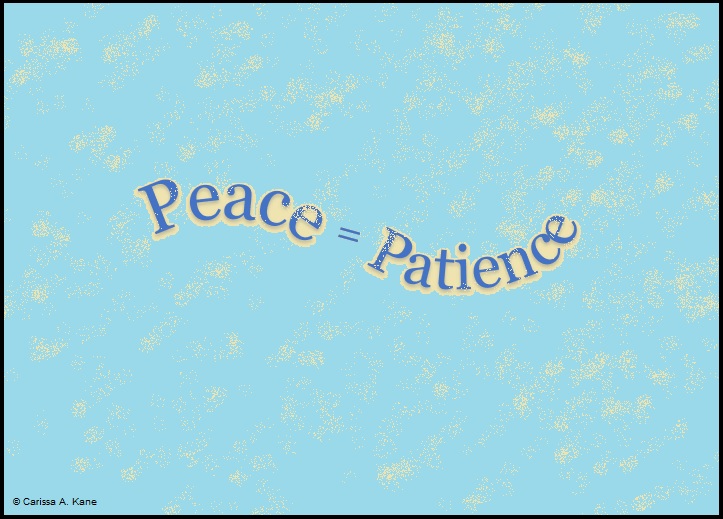
While in situations like driving, signs of impatience can be much easier to spot, at other times it can be harder to see when patience is absent or slipping away. The second reading for the Third Sunday of Advent (Jas 5:7-10), begins with, “Be patient, brothers and sisters.” It seems so fitting that during one of the busiest times of the year for many people, these verses in the Letter of James contain a form of the word, and urges patience four times, once each in three out of the four verses. And, as for the one verse that doesn’t use the word, it calls us to ponder one of the ways that human beings tend to handle displeasure with one another (“Do not complain, brothers, about one another, that you may not be judged.” – v.9).
Think of a recent experience where you were on the receiving end of your own or someone else’s impatience or displeasure. What happened? And what judgments were involved?
Now, think of a recent experience where you were the one responding with impatience or displeasure. What was going on? And what opinions or beliefs were involved?
In each situation, how might an increase of your own patience have improved the situation or the aftermath of it?
When pausing to think of recent experiences where patience was lacking or displeasure arose, on someone else’s part or on your part, which experience was easier to recall? Which experience came to mind more quickly?
It can be tempting to see patience in terms of something someone has or does not have. However, like any other attribute, it’s possible for it to exist in some situations and not in others. This is important because oftentimes it can be easy to think, “I’m patient,” or “I’m…” this or that based on a small sampling of situations that one’s ego might readily serve up to “pass the test” and move us along from further introspection and possibly attaining additional growth and greater freedom; things that are impossible without honestly looking across and considering the spectrum of one’s life experiences.
An Advent Prayer: Lord, help me to allow you to direct the pace of each day. Through my stopping and going, and all that may occur between, may my actions and responses reflect grace and genuine patience and understanding that flows from you, regardless of what I may or may not receive in return. And help me to continue to look to you, that you may grant me the grace to notice and appreciate the beauty and goodness of all creation, and the heart and soul of those I encounter each day.
Be patient, brothers and sisters, until the coming of the Lord. See how the farmer waits for the precious fruit of the earth, being patient with it until it receives the early and the late rains. You too must be patient. Make your hearts firm, because the coming of the Lord is at hand. Do not complain, brothers and sisters, about one another, that you may not be judged. Behold, the Judge is standing before the gates. Take as an example of hardship and patience, brothers and sisters, the prophets who spoke in the name of the Lord. – James 5:7-10
With the pitter patter of rain and dense mist earlier in the week, it became more and more challenging to see clearly. However, once the rain slowed, visibility improved ever so slightly. Then, as we continued, we exited an area that was overcome with fog. Once more our vision was restored more fully, until that is, we came across the next pocket of thick mist and its partnering wave of rain. Overall, in slowing down, the weather, although an obstacle, did not pull us off course or lead us astray. Remaining focused on the road, we found our way, and eventually, arrived safely.
In the Gospel reading for the Thirty-first Sunday in Ordinary Time (Luke 19:1-10 below), we read that Zacchaeus was searching for Jesus, “but he could not see him because of the crowd.” The crowd, perhaps like waves of rain and dense like fog, was an obstacle, yet Zacchaeus remained focused on his desire “to see who Jesus was.” Allowing himself to be led by the longing of his heart, Zacchaeus does not get lost in the crowd or become discouraged. Nor does he push through the crowd or use whatever means he may have had as a wealthy tax collector. Rather, Zacchaeus seems to abandon any such notions and instead, he lets go of his status as he looks to overcome the limitations of his physical stature and climbs a tree to get a glimpse of Jesus.
Next, comes perhaps the most important part of this passage. What does Zacchaeus do in response to his encounter with Jesus? He owns his previous actions and changes his ways. He vows to repair any damage he has done and to adjust how he operates. He promises to extend not only his pocketbook, but also his heart to others, especially those in need. He does not deny the truth, but instead rightfully embraces it.
The Lord is near to all who call upon him, to all who call upon him in truth. – Psalm 145:18
Zacchaeus truly wanted to know who Jesus was and was willing to let go of all he had to find out. Not only that, but once he experienced Jesus for himself, he was also willing to let go of all he had known. In joining the way of Jesus, he was not going for something that would lead him to become less tolerant or accepting or disparage and drag him and others down. The changes Zacchaeus makes are ones aligned with honesty, integrity, respect, and dignity. These are all hallmarks of life-giving choices; ones that honor and praise the beauty of God and all God’s creation.
So, while the rain falls where it may, and the fog may seem endless as if extending well beyond the horizon, as for the Way, it remains clear as can be, if only one is open to it.
At that time, Jesus came to Jericho and intended to pass through the town. Now a man there named Zacchaeus, who was a chief tax collector and also a wealthy man, was seeking to see who Jesus was; but he could not see him because of the crowd, for he was short in stature. So he ran ahead and climbed a sycamore tree in order to see Jesus, who was about to pass that way. When he reached the place, Jesus looked up and said, “Zacchaeus, come down quickly, for today I must stay at your house.” And he came down quickly and received him with joy. When they all saw this, they began to grumble, saying, “He has gone to stay at the house of a sinner.” But Zacchaeus stood there and said to the Lord, “Behold, half of my possessions, Lord, I shall give to the poor, and if I have extorted anything from anyone I shall repay it four times over.” And Jesus said to him, “Today salvation has come to this house because this man too is a descendant of Abraham. For the Son of Man has come to seek and to save what was lost.” – Luke 19:1-10
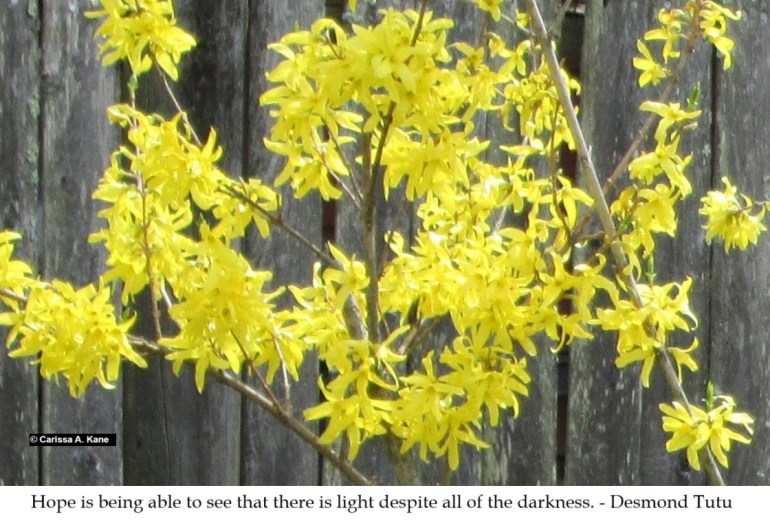
Kahlil Gibran wrote, “The optimist sees the rose and not its thorns; the pessimist stares at the thorns, oblivious of the rose.” Looking at the circumstances occurring around the world today, one might wonder how on earth it is possible to not see thorns and weeds run amok. However, also happening around the world at the same time as all these daunting occurrences are ones that inspire and give cause to celebrate.
Perhaps within these days, too, there is opportunity to hold a broader view and to seek the hope that is awaiting in each moment, in each act of love, kindness, mercy, and compassion. But first, a pause. Maybe there is a letting go or taking up that needs some space to allow it to unfold. These kinds of times are also often great for working through unrest and moving closer, if not to the side of peace.
Imagine a rose without thorns. Is it perfect? Is it incomplete? Either way, honesty urges taking in the entire picture, whether of something familiar or something unknown. For that is when truth comes into view, and with it, a return to what is real. Yet, all along the way, Wisdom softly calls, although we may evolve, sometimes resist, or dig in, there is always something greater happening here. In fact, there is always something greater happening everywhere. Yes, and it is worthwhile to behold.
Lord, you have been our refuge through all generations. – Psalm 90:1











 HopeThatFloats
You must be logged in to post a comment.