Saving Power…

Taking the plunge, one by one,
each day breaks through, something new;
Your wisdom and grace abound.

You come to us, work through us,
dignify our worth, our place.
How great when we allow it!

Kindness, compassion, mercy,
Your word, all within our reach,
to embrace, not turn around.

Brute force is never Your way.
Choice upon choice, you give us,
filled with hope, to seek what’s best.

Guiding light softly spoken,
gentle nudging, Love of loves,
Always with us, through and through,
Saving Power seeking heart.

Heart with a cross in the center

The Lord has revealed to the nations his saving power. – (cf. Psalm 98: 2b)

A view of the ocean from a stone arch

Overarching…

The readings for the Fifteenth Sunday in Ordinary Time present food for thought and prayer about what’s written, how it’s read, and what is brought to life from it. In the first reading (Deuteronomy 30:10-14), Moses urges the people to heed God’s voice and the commandments and statutes passed on to them and written in “this book of law”. He points out that God’s voice and words are not out of reach, but instead, he says, “No, it is something very near to you, already in your mouths and in your hearts; you have only to carry it out.” (v. 14).

Spend a few minutes with this verse. Then, think about this past week, an ongoing situation that is before you, or something that you have coming up. Invite the Lord to help you parse through all the thoughts and feelings of which you become aware as you ponder.

For the responsorial psalm, there are two from which to choose (Psalm 69:14, 17, 30-31, 33-34, 36, 37 or Psalm 19:8, 9, 10, 11). Read each of the responses listed below in silence.

Turn to the Lord in your need, and you will live. (cf. Ps 69:33)

Your words, Lord, are Spirit and life. (Ps 19:9a)

Next, read each response aloud. Notice if one response draws you in, or catches your attention, more than the other.

Bring into your prayer a Psalm response(s) and ask the Lord to guide you and lead you to greater awareness as you continue your contemplation from above. [Allow yourself to go with whichever response you land on first or feel more drawn to. It might be both, or even another verse that comes to mind.]

In the second reading (Colossians 1:15-20), St. Paul writes:

Christ Jesus is the image of the invisible God,
the firstborn of all creation.
For in him were created all things in heaven and on earth,
the visible and the invisible,
whether thrones or dominions or principalities or powers;
all things were created through him and for him.
He is before all things,
and in him all things hold together.
He is the head of the body, the church.
He is the beginning, the firstborn from the dead,
that in all things he himself might be preeminent.
For in him all the fullness was pleased to dwell,
and through him to reconcile all things for him,
making peace by the blood of his cross
through him, whether those on earth or those in heaven.

Sometimes it can be tricky, and trying, to face big and small choices every day among relationships, dilemmas, situations, etc. Think about how you have been managing. What brings you comfort? And, from where do you draw strength?

Pause to hold the words St. Paul writes of Jesus and remember that “Christ Jesus is the image of the invisible God”, and that you are created in the image of the invisible, and indivisible, God. What happens when you let that reality saturate your heart? Bring to prayer the thoughts and feelings that arise.

Turning to the Gospel passage (Luke 10:25-37), it begins:

There was a scholar of the law who stood up to test Jesus and said,
“Teacher, what must I do to inherit eternal life?”
Jesus said to him, “What is written in the law?
How do you read it?”
He said in reply,
“You shall love the Lord, your God,
with all your heart,
with all your being,
with all your strength,
and with all your mind,
and your neighbor as yourself.”
He replied to him, “You have answered correctly;
do this and you will live.”

Notice how Jesus points the scholar, and us, to the Word of God (“What is written in the law”), how it is processed internally (“How do you read it?”), and how it is lived out (“do this and you will live.”).

Like the scholar, we can know what is written in the law, but if we skip over considering how we are reading it—heart, mind, and soul, how can we possibly live it out authentically, united with God in both Word and Spirit, as intended?

But because he wished to justify himself, he said to Jesus,
“And who is my neighbor?”
Jesus replied,
“A man fell victim to robbers
as he went down from Jerusalem to Jericho.
They stripped and beat him and went off leaving him half-dead.
A priest happened to be going down that road,
but when he saw him, he passed by on the opposite side.
Likewise a Levite came to the place,
and when he saw him, he passed by on the opposite side.
But a Samaritan traveler who came upon him
was moved with compassion at the sight.
He approached the victim,
poured oil and wine over his wounds and bandaged them.
Then he lifted him up on his own animal,
took him to an inn, and cared for him.
The next day he took out two silver coins
and gave them to the innkeeper with the instruction,
‘Take care of him.
If you spend more than what I have given you,
I shall repay you on my way back.’
Which of these three, in your opinion,
was neighbor to the robbers’ victim?”
He answered, “The one who treated him with mercy.”
Jesus said to him, “Go and do likewise.”
– Luke 10:29-37

Thinking about this passage and the Scripture in the readings and psalm before it, what is most on your mind and in heart at this moment?

Continuing to pray. Ask the Lord to reveal to you whatever God wills, and to help you to bring together what is written, how to read it, and what “Go and do likewise” looks like or means for you today.

A view of the ocean from a stone arch

Our Father, who art in heaven,
hallowed be thy name;
thy kingdom come,
thy will be done
on earth as it is in heaven.
Give us this day our daily bread,
and forgive us our trespasses,
as we forgive those who trespass against us;
and lead us not into temptation,
but deliver us from evil.
Amen.

Sunrise at sea

Eastertide…

Eastertide through days and nights,
forty… fifty… ever more.
It is truly right and just,
here, above, and all around.
Presence of mind, truthful heart;
the soul of goodness triumphs.

Genuine faith, obeying,
not tyrant, nor king—Savior.
Wanting good for goodness sake,
bearing with things, not grasping,
nor pulling apart, as if
at odds, and fighting within.

In a boat fishing around,
who’s there? What sides are you on?
Is it right, or something else?
Casting nets, or casting stones?
From where does your wisdom come?
What sentiments control you?

Sunrise at sea

When they had finished breakfast, Jesus said to Simon Peter,
“Simon, son of John, do you love me more than these?”
Simon Peter answered him, “Yes, Lord, you know that I love you.”
Jesus said to him, “Feed my lambs.”

He then said to Simon Peter a second time,
“Simon, son of John, do you love me?”
Simon Peter answered him, “Yes, Lord, you know that I love you.”
Jesus said to him, “Tend my sheep.”

Jesus said to him the third time,
“Simon, son of John, do you love me?”
Peter was distressed that Jesus had said to him a third time,
“Do you love me?” and he said to him,
“Lord, you know everything; you know that I love you.”
Jesus said to him, “Feed my sheep. – John 21:15-17

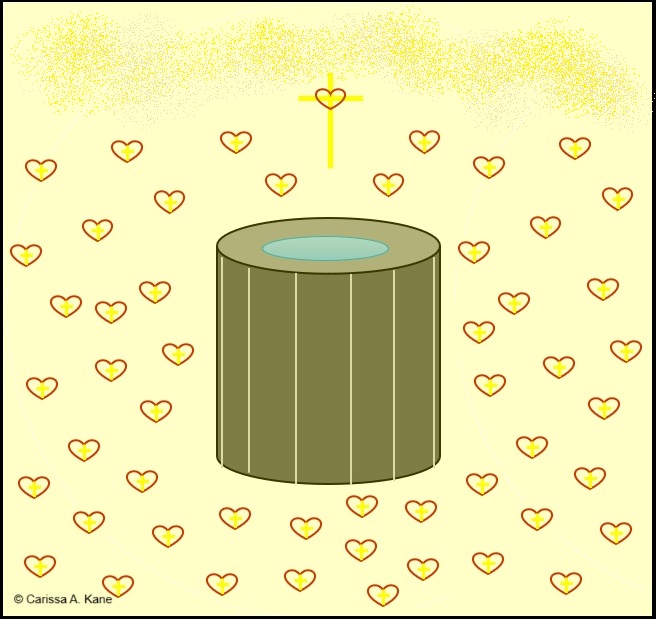
Hearts at the well; Jesus

When Hearts Are Best…

The response to the Psalm for the Third Sunday of Lent is, “If today you hear his voice, harden not your hearts.” (Psalm 95:8). In last Sunday’s second reading (Philippian’s 3:17-4:1), St. Paul encourages discipleship with a focus on the Lord and the goal of citizenship in heaven, and instructs us to “Stand firm in the Lord.” (Phil 4:1). What happens when you reflect on the Lord’s nature as being both firm and kindhearted at the same time?

Continuing to think about the Lord’s characteristics, Let’s turn to the Gospel passage, the Samaritan Woman (John 4:5-42 – included below). Through the ebb and flow of their conversation, what touches your heart most about Jesus, the Samaritan woman, and their interaction? In what places do you sense firmness? And kindness? How do the two characteristics work together, and what do they bring about?

Next, take some time to consider a situation(s) you are currently facing. In what ways are your faith experience and your beliefs working? Do they expand your heart, or constrict it? How do they fit with “stand firm in the Lord” and “harden not your heart,” coming together for what is best. Invite Jesus to join you in prayer and to share His insights and guidance as you ponder this further.

Hearts at the well; Jesus

Jesus came to a town of Samaria called Sychar,
near the plot of land that Jacob had given to his son Joseph.
Jacob’s well was there.
Jesus, tired from his journey, sat down there at the well.
It was about noon.

A woman of Samaria came to draw water.
Jesus said to her,
“Give me a drink.”
His disciples had gone into the town to buy food.
The Samaritan woman said to him,
“How can you, a Jew, ask me, a Samaritan woman, for a drink?”
—For Jews use nothing in common with Samaritans.—
Jesus answered and said to her,
“If you knew the gift of God
and who is saying to you, ‘Give me a drink, ‘
you would have asked him
and he would have given you living water.”
The woman said to him,
“Sir, you do not even have a bucket and the cistern is deep;
where then can you get this living water?
Are you greater than our father Jacob,
who gave us this cistern and drank from it himself
with his children and his flocks?”
Jesus answered and said to her,
“Everyone who drinks this water will be thirsty again;
but whoever drinks the water I shall give will never thirst;
the water I shall give will become in him
a spring of water welling up to eternal life.”
The woman said to him,
“Sir, give me this water, so that I may not be thirsty
or have to keep coming here to draw water.”

Jesus said to her,
“Go call your husband and come back.”
The woman answered and said to him,
“I do not have a husband.”
Jesus answered her,
“You are right in saying, ‘I do not have a husband.’
For you have had five husbands,
and the one you have now is not your husband.
What you have said is true.”
The woman said to him,
“Sir, I can see that you are a prophet.
Our ancestors worshiped on this mountain;
but you people say that the place to worship is in Jerusalem.”
Jesus said to her,
“Believe me, woman, the hour is coming
when you will worship the Father
neither on this mountain nor in Jerusalem.
You people worship what you do not understand;
we worship what we understand,
because salvation is from the Jews.
But the hour is coming, and is now here,
when true worshipers will worship the Father in Spirit and truth;
and indeed the Father seeks such people to worship him.
God is Spirit, and those who worship him
must worship in Spirit and truth.”
The woman said to him,
“I know that the Messiah is coming, the one called the Christ;
when he comes, he will tell us everything.”
Jesus said to her,
“I am he, the one speaking with you.”

At that moment his disciples returned,
and were amazed that he was talking with a woman,
but still no one said, “What are you looking for?”
or “Why are you talking with her?”
The woman left her water jar
and went into the town and said to the people,
“Come see a man who told me everything I have done.
Could he possibly be the Christ?”
They went out of the town and came to him.
Meanwhile, the disciples urged him, “Rabbi, eat.”
But he said to them,
“I have food to eat of which you do not know.”
So the disciples said to one another,
“Could someone have brought him something to eat?”
Jesus said to them,
“My food is to do the will of the one who sent me
and to finish his work.
Do you not say, ‘In four months the harvest will be here’?
I tell you, look up and see the fields ripe for the harvest.
The reaper is already receiving payment
and gathering crops for eternal life,
so that the sower and reaper can rejoice together.
For here the saying is verified that ‘One sows and another reaps.’
I sent you to reap what you have not worked for;
others have done the work,
and you are sharing the fruits of their work.”
Many of the Samaritans of that town began to believe in him
because of the word of the woman who testified,
“He told me everything I have done.”
When the Samaritans came to him,
they invited him to stay with them;
and he stayed there two days.
Many more began to believe in him because of his word,
and they said to the woman,
“We no longer believe because of your word;
for we have heard for ourselves,
and we know that this is truly the savior of the world.” – John 4:5-42

Be Opened…

In the Gospel passage for the Twenty-third Sunday in Ordinary Time (Mk 7:31-37), the people of a village bring a man who is deaf and has a speech impediment to Jesus and plead with him to lay his hand on him. What do you think made the people of the village do this? The deaf man could see, after all, and he could have found his own way to Jesus and asked for himself. What do imagine caused the people to get involved on the deaf man’s behalf? What are some things that lead you to get involved on the behalf of others?

We also read in this passage that Jesus “took him [the deaf man] off by himself away from the crowd.” (v. 33). Perhaps to remove the noise and distractions? Perhaps to engage in a more personal way with the man? Or maybe it was something else.

In the Scripture passage prior to this one, Jesus is trying to step away from the crowds when he is approached by the Syrophoenician woman asking for her daughter to be healed (Mk 7:24-30). This occurs after he has responded to the Pharisees questioning his disciples’ behavior; where Jesus replied in part, “Nothing that enters one from outside can defile that person; but the things that come out from within are what defile.” (Mk 7:15). Considering this teaching and carrying it forward into Jesus’s interactions with the Syrophoenician woman and the deaf man, reflect on the way he receives and responds to people, situations, and what’s going on around him.

How do you receive people, situations, and what’s going on around you? What inner attitudes or dispositions do you carry into interactions? What’s going on in your heart, and how does it affect your response?

Coming back to today’s Gospel Jesus says, “Ephphatha!” (“Be opened!”), and as a result, the deaf man can hear, and his speech impediment is gone. He is healed from his affliction through Jesus’s command, or call, to openness. So why then, does Jesus tell the man not to tell anyone? And how might this fit in with the idea of evangelization?

Maybe Jesus is calling us to be open to what’s going on around us and what God is trying to tell us as individuals, to further open and transform one’s own heart toward greater understanding and compassion. And with that, reminding us that evangelization comes through the grace of God and at times is aided, or complemented, by kind and loving hearts that are both fluid with and fixated on God.

Say to those whose hearts are frightened:
Be strong, fear not!
Here is your God,
he comes with vindication;
with divine recompense
he comes to save you. – Isaiah 35:4

Ready, Set, Lent…

The mark is made,
The season begins,
From one to forty,
Days, one at a time,
As if turning pages
We make our way,
From start to end,
Through these Lenten days.

Giving up, giving in, letting go,
Yet not one thing for another,
As if a game of swapping.
No. Not at all.
Some thing, or things, for One.
The point remains on focus,
In the here and now,
Not here and there
Or scattered about,
But brought together.

Body and soul,
Front and center,
Sorted out or broken down,
But always built back up,
From one desire to another,
According to Thine will,
Heart and mind become one,
Drawn closer, e’er closer,
To the image of One.

A clean heart create for me, O God, and a steadfast spirit renew within me. – Psalm 51:12

From Kindness to Love…

In a few days, it will be Valentine’s Day, the holiday synonymous with hearts and love. It will also be Ash Wednesday, the start of the Lenten season, known by its call for prayer, almsgiving and fasting, all aimed at drawing closer to Jesus, growing in awareness of falsities that hold one back, and trying to shed them. Both occasions, despite the differences in how they are celebrated, come down to love, whose source is God, and the ways in which it is expressed, received, nurtured within, and responded to.

While one might associate Valentine’s Day more with romantic love, there’s no denying that it, as true love in any variation, often extends and ripples outward in positive ways, affecting those beyond the initial recipient. With Ash Wednesday and during Lent, a more concerted effort is made to strive to recognize and overcome, through God’s grace, whatever may be interfering or holding back the love one has received from flowing more fully and freely so as to make them more Christlike in their way of being.

The Gospel passage for the Sixth Sunday in Ordinary Time provides an opportunity to reflect on what might be referred to as the beginning of love—kindness. If love is an open door to the heart, kindness is the door cracked open, just enough to check it out and consider the other, allowing the heart and soul to be moved into action that shows care.   

In the following Gospel passage, we read about Jesus curing a leper. Again, as in other passages where he heals and cures people, we see the kindness of Jesus, who is “moved with pity”.

A leper came to Jesus and kneeling down begged him and said,
“If you wish, you can make me clean.”
Moved with pity, he stretched out his hand,
touched him, and said to him,
“I do will it. Be made clean.”
The leprosy left him immediately, and he was made clean.
Then, warning him sternly, he dismissed him at once.

He said to him, “See that you tell no one anything,
but go, show yourself to the priest
and offer for your cleansing what Moses prescribed;
that will be proof for them.”

The man went away and began to publicize the whole matter.
He spread the report abroad
so that it was impossible for Jesus to enter a town openly.
He remained outside in deserted places,
and people kept coming to him from everywhere. – Mark 1:40-45  

Keep in mind that the man with leprosy would have been living away from others, perhaps as part of a leper colony. It seems he would have felt like and been treated as an outcast. What else do you think a leper or outcast might experience?

Upon being healed, the leper could once again join the fold. Imagine his thoughts and feelings over now being allowed to be part of and engage with a broader community. What would that be like? How would you feel and react, given a similar experience?

Spend some time reflecting on the kindness of Jesus. What would Jesus remember most about the leper, his condition, and the way He was approached by him? What do you imagine Jesus’ response or reaction would be to the leper telling everyone and anyone about Jesus healing him, leading to Jesus having to remain “outside in deserted places”?

As the days of Lent draw closer, are there areas in your life where you feel challenged when it comes to receiving or giving with a heart full of kindness rather than a sense of obligation, duty, etc.? When it comes to this, in what ways do you desire to experience the kindness of Jesus? How might your kindness, or inclination toward it, remain balanced while also continuing to evolve more fully into love?

First Things First…

The readings for the Seventeenth Sunday in Ordinary Time offer an opportunity to consider priorities and the values that elevate some over others.

In the first reading (1 Kgs 3:5, 7-12), we can see that Solomon acknowledges that although he is king, he needs God’s grace if his desire to rule wisely is going to be fulfilled. He knows that to do right requires more than his own knowledge, perception, and opinions. He understands that he needs to be able to have a sense of more than what he can surmise, and this is why he asks God for a discerning heart (and mind) when he could’ve asked for anything else at all. His top priority is not solely for himself, but for the benefit of all whom he serves as king.

In the psalm, we read the response, “Lord, I love your commands.” (Ps 119:97a). Again, we see reliance on God, as well as value and priority placed on God’s words as providing what is necessary. The psalmist tells of how God’s words are precious, carrying kindness and compassion, and expresses a desire to honor God’s words by living them (“For in all your precepts I go forward; every false way I hate” – Ps 119:128). Then the psalmist says, “The revelation of your words sheds light, gives understanding to the simple.” (Ps 119:130). Again, we see evidence of fulfillment of a desire for truth and understanding as well as a continued desire to be led by God. It’s important to remember that the psalmist has experienced the grace of God directly, just like Solomon. It is in the words of God through intimate, personal exchanges that Solomon and the psalmist come to know in a particular moment what is good and right and wise in God’s eyes.

When we read further, in the second reading, St. Paul stresses relationship with God. In essence, he is saying that when priorities and values are centered in and through God, we become like the Love who created us.

“We know that all things work for good for those who love God,
who are called according to his purpose.
For those he foreknew he also predestined
to be conformed to the image of his Son,
so that he might be the firstborn
among many brothers and sisters.
And those he predestined he also called;
and those he called he also justified;
and those he justified he also glorified.” – Rom 8:28-30

This brings us to the Gospel reading (Mt 13:44-52) and an invitation to prayer and reflection on priorities and values.

Jesus said to his disciples:
“The kingdom of heaven is like a treasure buried in a field,
which a person finds and hides again,
and out of joy goes and sells all that he has and buys that field.
Again, the kingdom of heaven is like a merchant
searching for fine pearls.
When he finds a pearl of great price,
he goes and sells all that he has and buys it.
Again, the kingdom of heaven is like a net thrown into the sea,
which collects fish of every kind.
When it is full they haul it ashore
and sit down to put what is good into buckets.
What is bad they throw away.
Thus it will be at the end of the age.
The angels will go out and separate the wicked from the righteous
and throw them into the fiery furnace,
where there will be wailing and grinding of teeth.

“Do you understand all these things?”
They answered, “Yes.”
And he replied,
“Then every scribe who has been instructed in the kingdom of heaven
is like the head of a household
who brings from his storeroom both the new and the old.” – Mt 13:44-52

The word of God is the revelation of God, and through our graced experiences, we participate in the living word of God. Take some time to pray and reflect on your life through the lens of being a participant in the word of God? What comes to mind? What feelings arise from within? And in what ways do you feel inspired by the word of God, yesterday… today… as you think about the future?

What’s Inside…

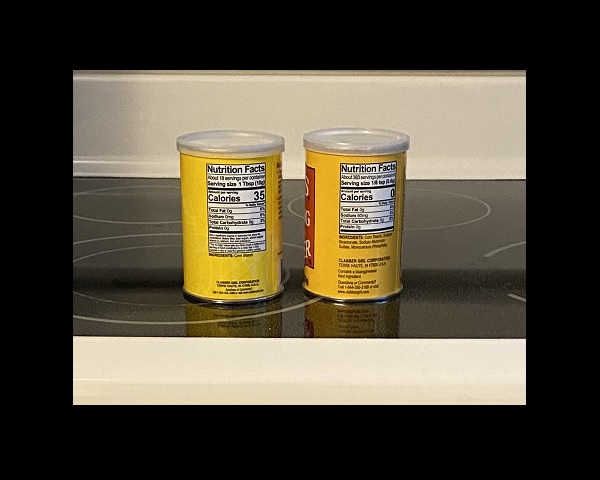
Opening the oven door as the kitchen timer worked its way toward zero seconds, an unanticipated outcome awaited. The bread inside, although cooked through, was not quite what was expected. Shocked at its stature and the rather dense outcome, and wondering what happened, I revisited all that went into its making. First, I envisioned all the steps, and then opened cabinet doors to look again at some of the baking ingredients, but nothing stood out.

Upon thinking some more, and feeling certain that baking powder was added, I thought perhaps it was expired and had lost its potency. Then, there it was. In the process of re-examining, the problem was revealed. It wasn’t baking powder after all that was used. The canister had the same shape, height, color, and text, but rather than containing baking powder, it held cornstarch. And although the bread tasted almost the same as any other banana bread that was made, its consistency and body was not at all the same.

Contemplating the Gospel passage for the Sixteenth Sunday in Ordinary Time (Matthew 13:24-43) and reflecting on Jesus’ words as he tells the parables of weeds among wheat, the mustard seed, and the yeast, one is reminded of the importance of what goes into things. Or, in other words, what makes them up or influences them. Are there hidden ingredients? What’s the intent, the source, or motivation, and what, ultimately, is being sought?

So how does one really know what’s what with so much that is conflicting and competing in the midst of what can be confusing and misleading times? How does one distinguish between what things look like and what they really are, and decipher what’s happening around them and how it might be influencing them?

Prior to the Gospel, in this week’s readings, we read:

“The Spirit comes to the aid of our weakness;
for we do not know how to pray as we ought,
but the Spirit himself intercedes with inexpressible groanings.
And the one who searches hearts
knows what is the intention of the Spirit,
because he intercedes for the holy ones
according to God’s will.”—Romans 8:26-27

To discover what’s real, or what’s true, one must not only be willing to take a good look inside and out, but also be willing to look again, and then some more, searching with a heart that is sincere and an openness to the possibility that what looked like baking powder might not have ever been baking powder at all.

From All Appearances…

At the beginning of the Gospel reading for the Second Sunday of Advent (Matthew 3:1-12) there is a description of the “voice crying out in the desert, prepare the way of the Lord, make straight his paths” (verse 3). We read that John the Baptist is outfitted in camel hair clothing and has a “wild” diet of grasshoppers (a.k.a. locusts) and honey. Based solely on this physical description and his location in the desert, it’s easy to envision John as having a gruff or primitive appearance. Yet, there were many people who traveled to be baptized by him. So, what was it that drew them to him?

Imagine someone dressed in clothing made from material that was typically used for making cloaks, tents, and carpets and eating bugs and wild honey telling you to get ready… to straighten up and make a proper path for the Lord. What would you notice first? What would you think? How would you respond?

What obstacles are there to looking at the appearance of John the Baptist, and seeing the heart of a faithful servant of God, or a guardian angel pointing out the way?

Oftentimes, we can become conditioned by our surroundings, social circles, and society in general as to how people or things should look, act, or speak. However, these expectations not only make it easier to miss the spirit and the heart of those we encounter along the way, but also make it easier to be misled or go astray. When thinking about preparing, an ideal image or notion of what should be may come to mind, and although it may be helpful to have a sense or an idea about things, it’s important to always leave a little space to prayerfully ponder that which is different, unknown, or unfamiliar.

An Advent Prayer: Lord, in a world that seeks to glorify based on appearances and all that fades, help me to go with Your grain, instead of society’s. Help me to overcome any obstacles that may prevent me from seeing beyond appearances. Help me to look to You and grant me the grace to notice and appreciate the beauty and goodness of all creation, and the heart and soul of those I encounter each day.

John the Baptist appeared, preaching in the desert of Judea
and saying, “Repent, for the kingdom of heaven is at hand!”
It was of him that the prophet Isaiah had spoken when he said:
A voice of one crying out in the desert,
Prepare the way of the Lord,
make straight his paths.
John wore clothing made of camel’s hair
and had a leather belt around his waist.
His food was locusts and wild honey.
At that time Jerusalem, all Judea,
and the whole region around the Jordan
were going out to him
and were being baptized by him in the Jordan River
as they acknowledged their sins.

When he saw many of the Pharisees and Sadducees
coming to his baptism, he said to them, “You brood of vipers!
Who warned you to flee from the coming wrath?
Produce good fruit as evidence of your repentance.
And do not presume to say to yourselves,
‘We have Abraham as our father.’
For I tell you,
God can raise up children to Abraham from these stones.
Even now the ax lies at the root of the trees.
Therefore every tree that does not bear good fruit
will be cut down and thrown into the fire.
I am baptizing you with water, for repentance,
but the one who is coming after me is mightier than I.
I am not worthy to carry his sandals.
He will baptize you with the Holy Spirit and fire.
His winnowing fan is in his hand.
He will clear his threshing floor
and gather his wheat into his barn,
but the chaff he will burn with unquenchable fire.” – Matthew 3:1-12