The Touch of Grace…

Recall an experience of bumping into someone that you know, in a place and at a time that you normally wouldn’t expect to see them? Initially, you might be surprised for good or less, or perhaps it might take a few moments to fully recognize the person. Maybe some memories of them come to mind.

Next, imagine that you kept encountering that same person over the course of several weeks. What would you think? What would you feel?

Now envision being one of Jesus’ disciples and having the experience of Jesus’ appearing to you, here and there, in the time between his Resurrection and Ascension. How would you react or respond after the profound experience of his crucifixion, his Resurrection, and being in the environment of belief and disbelief created by it all?

Would you be devoted to trying to see a pattern to Jesus’ appearances to try to predict when you might see him next? Would you commit yourself to trying to figure out the reasons why he was appearing? How hard would you work to come to some sort of knowledge about these occurrences? In what ways would you characterize your approach?

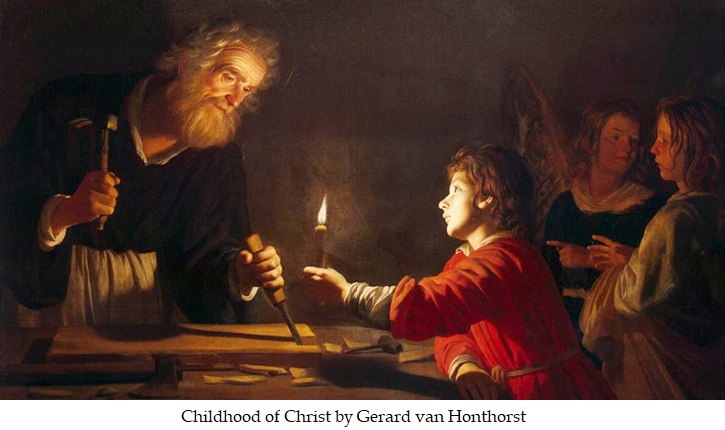
Focusing more closely on Jesus and his third appearance at the Sea of Tiberias (John 21), how determined would your mind be, and how open would your heart be, to the presence of Jesus who is in the form of the person on the shore, unknown and at a distance? How about to yourself or the person on the shore, thought of as being known? Would you cast the net again? What would you discover?

Simon Peter said to them, “I am going fishing.”
They said to him, “We also will come with you.”
So they went out and got into the boat,
but that night they caught nothing.
When it was already dawn, Jesus was standing on the shore;
but the disciples did not realize that it was Jesus.
Jesus said to them, “Children, have you caught anything to eat?”
They answered him, “No.”
So he said to them, “Cast the net over the right side of the boat
and you will find something.”
So they cast it, and were not able to pull it in
because of the number of fish.
So the disciple whom Jesus loved said to Peter, “It is the Lord.”
When Simon Peter heard that it was the Lord,
he tucked in his garment, for he was lightly clad,
and jumped into the sea. – Jn 21:3-7

In what ways do you allow Jesus to be present to you in the unexpected? In what ways do you invite Jesus to help you to be present, to hold situations up to the light, to receive God’s wisdom so that you can embody the thoughts and feelings needed not only to embrace the moment, but also to receive and recognize the grace it holds, and how to share it?

Sometimes, there are so many questions, and it can seem like so much work. Yet, as April turns to May and the Feast of St. Joseph The Worker arrives, so also does the opportunity to experience not only the light of longer days, but also renewal through the touch of Grace—peace, light, hope, and inspiration—that continues to blossom with the Easter season, and beyond.

How does grace touch and move your heart? And how is it reflected in your work?


Golden…

As daylight breaks,
The Sun gently makes its way across the room.
A brightness calling out,
But without sound,
That which is truly out of sight.

A beacon as it beckons,
Come closer,
Look to see.
Rising up and drawing near,
A clearer view awaits.

Darker shades turn to blue,
Then lighter still,
Altogether moving up,
Orange, yellow, gold,
So bold, so pure, so true.

It echoes all around,
A promise made as well as kept,
From One heart to another,
Meet me here, meet me there,
No matter what, you can meet me anywhere.

Give thanks to the Lord for he is good, his love is everlasting. – Psalm 118:1

It Travels and Echoes…

Waking up to the sounds of birds singing to each other,
Calling back and forth,
Noise bouncing here and there—echoes,
Do they realize how far their voices reach?
What is their intention?
What’s that now?
What do they say?
Something familiar, something new,
They whistle in possibilities,
And the newness of the day.
What is my intention?
How does it travel?
What do I say?
Do I realize the blessing that comes with this new day?

The Lord has done great things for us; we are filled with joy. – Psalm 126:3

In Any Case…

In Greek mythology, keeping the gods and goddesses happy was central to life. So, temples were built, activities were held, sacrifices were made, all to please the gods and goddesses so that the people in turn might be helped along or rewarded rather than punished. Having recently seen a show that involved Greek mythology and the challenge of relationships, reading “…be reconciled to God,” in chapter 5, verse 20 of the Second Letter to the Corinthians, strikes a chord. And then there is the Gospel reading for the Fourth Sunday of Lent which includes the parable of the Prodigal Son (Luke 15:11-32), which really leads one to think about relationships. Combining the two, it can be intriguing to look more closely at the differences and similarities between one’s relationship with God and one’s relationships with others (family, friends, acquaintances, etc.). And perhaps consider further, the impact of both the things we can see and those we think we can see but cannot.

Looking to St. Paul and to the Prodigal Son, it’s all about stripping away the extraneous, drawing closer to what lies within, and trusting one’s experience. However, not one’s experience of self or others, but looking for, remembering and trusting one’s experience of God within the interactions and dealings we have with one another.

Imagine riding along from start to finish with Saul of Tarsus, soldier… warrior, active persecutor of early Christians who was literally knocked off his horse, called to conversion, and way down the road, became St. Paul.

Envision travelling with the Prodigal Son. The son who took his inheritance while his father was still living and turned his back on everyone and everything that he had previously known. He had to take his own path and have his own way; it was just something he needed to do. However, on that path, he lost everything, but then gained so much more than he could have ever dreamed of, by owning the truth and returning home, where he was immediately welcomed and embraced.

For St. Paul and the Prodigal Son, it turned out that the things that drove them… the things that sucked them in as being so important or so necessary, weren’t. And while it may have seemed to them as though they lost everything in the process of their falling, they did not. Both experienced the kindness and love of God both directly and through others—the grace that led them to pivot—and it is through that, that they came to know their true worth as God’s beloved, and that what really matters can never be taken away, only shared and magnified.

On Balance…

Tomorrow, March 20, 2022, is the vernal equinox, giving those of us in the Northern Hemisphere an even split between day and night and marking the beginning of spring. It’s not often we experience such balance in a day. In fact, it only happens twice a year on the vernal and autumnal equinoxes, and given the pace of life, the light of these days likely slips by without much notice.

The thing that’s interesting though, is as with many happenings in the natural world around us, there’s a message or lesson they hold. The vernal equinox can serve as a concrete example to not only bring equity and balance to heart and mind, but also perhaps to provide an experience we can all relate to, no matter where we are, and in doing so, on some level, restore a sense of harmony.

Take some time to absorb what is often the background as we go about each day—nature. Bring it to the forefront. Next, as you look around, consider your life. Where do you find balance and harmony? In what ways do you experience the Lord as kind and merciful in the hours of both the day and night? How are you inspired?

Bless the Lord, my soul;
all my being, bless his holy name!
Bless the Lord, my soul;
and do not forget all his gifts,
Who pardons all your sins,
and heals all your ills,
Who redeems your life from the pit,
and crowns you with mercy and compassion,
Who fills your days with good things,
so your youth is renewed like the eagle’s.
The Lord does righteous deeds,
brings justice to all the oppressed.
He made known his ways to Moses,
to the Israelites his deeds.
Merciful and gracious is the Lord,
slow to anger, abounding in mercy.
He will not always accuse,
and nurses no lasting anger;
He has not dealt with us as our sins merit,
nor requited us as our wrongs deserve. – Psalm 103: 1-10

Trust in Remembering…

Sitting with the readings for the second Sunday of Lent, like an old friend, the word “Trust” enters the room with a warm smile and as if to say, “Remember me… remember when…” So much of life is about trust and so often, it seems to come down to whom or what one trusts, to what degree, how that trust is received, and the impact or consequences of its handling.

As human beings, we share in a perfectly, imperfect nature, as we navigate life in, and surrounded by, a competitive, material world. It can be tempting to think or feel, even if subconsciously, that there is something we can do about anything happening around us at any time; that a level of control is always within our grasp. We may even look to capture the things that we, as human beings, think will help us to have that control. Yet, the only control we ever really have, and the only victory ever really won, is in choices that we make to trust in God’s ways and to let go, or shed the impulse or notion that any one interest outranks everyone’s interest.

In the ninth chapter of the Gospel according to Luke, Peter, John, and James ascend the mountain with Jesus and share in the experience of his transfiguration. In the passage prior to this one, while explaining what it means to be a disciple, Jesus says, “What profit is there for one to gain the whole world yet lose or forfeit himself?” (Lk 9:25). Looking at the circumstances in the world today, one can clearly see that there is no profit in profiteering, only loss for everyone.

Think about what it must have been like for Peter, John, and James to hear Jesus’ words about discipleship and then to witness his transfiguration seeing him stand alongside the prophets, Moses and Elijah.

Looking to today’s world, when it seems there is nothing to do, or there is no good way to stop what is already in motion, perhaps the best place to start is to forget control, then pause to go back and remember the beginning. Jesus took Peter, James, and John up the mountain to pray. One can only wonder, what was in their hearts as they placed their trust in Jesus and followed him up that mountain. One can only wonder how they received what happened and what they carried in their hearts on the way down, and thereafter.

How does your trust in Jesus shape your choices, create unity, express love, and spread goodwill? Connecting with Jesus as an old friend greeting you with a warm smile, how would you proceed from the phrase, “Remember me… remember when…?”

Share with Jesus what you carry in your heart as you reflect on the world we live in, and the journey you are on within it.

Jesus took Peter, John, and James
and went up the mountain to pray.
While he was praying his face changed in appearance
and his clothing became dazzling white.
And behold, two men were conversing with him, Moses and Elijah,
who appeared in glory and spoke of his exodus
that he was going to accomplish in Jerusalem.
Peter and his companions had been overcome by sleep,
but becoming fully awake,
they saw his glory and the two men standing with him.
As they were about to part from him, Peter said to Jesus,
“Master, it is good that we are here;
let us make three tents,
one for you, one for Moses, and one for Elijah.”
But he did not know what he was saying.
While he was still speaking,
a cloud came and cast a shadow over them,
and they became frightened when they entered the cloud.
Then from the cloud came a voice that said,
“This is my chosen Son; listen to him.”
After the voice had spoken, Jesus was found alone.
They fell silent and did not at that time
tell anyone what they had seen. – Lk 9:28b-36

Victory

Looking out the window,
branches all around.
Open arms holding up the snow,
or the snow resting on open arms?
Both clinging to each other,
or one melting into the other?
Does it really matter?
Still, looking out the window.
Still, branches upon branches.
Some sturdier than others,
some swaying more than others.
Does it really matter?
More looking out the window,
at those branches and that snow.
Through it all, they just keep gently staying.
Perhaps, that’s all that really matters.

Shine like lights in the world as you hold on to the word of life. – Phil 2:15d,16a

Heart Set…

Mind over matter,
What difference does it make?
The set of one’s mind,
May toggle or break,
Or yet even worse,
Get stuck in one place.

Heart in the matter,
What difference does it make?
The set of one’s heart,
When inspired by God,
Finds purpose, builds faith,
Sings praises, gives faith.

One cried out to the other: “Holy, holy, holy is the Lord of hosts!
All the earth is filled with God’s glory!” – Isaiah 6:3

Truth in the Midst…

According to the ancient Greek philosopher Plato, “No one is more hated than he who speaks the truth.” This certainly seems the case for Jesus in chapter 4, verses 21-30 of the Gospel according to Luke. In fact, Jesus expands upon this observation. Not only does the truth and those who speak it, tend to garner disdain or be less than popular, but this is kicked up a notch, often occurring with greater intensity and less receptivity, the closer to home one is.

In this passage, Jesus gives two examples for his fellow Nazoreans to ponder. First, there is the widow in Sidon. What is it that led Elijah to her and her son, saving them from a sure death during the great famine? Second, there is Naaman the Syrian, who was cleansed of leprosy. How is it that Elisha was sent to Naaman rather than one of his own people suffering from leprosy?

After taking great offense at Jesus’ words (“No prophet is accepted in his native place”) and examples, the crowd seeks to extinguish him. One can only wonder if anyone in the crowd was able to step back and further consider the situation and what had transpired. Were they able to remove themselves from the sting of the truth long enough to recognize that their anger was misdirected, and to move toward healing and greater peace?

In today’s volatile and often chaotic world, it can be easy to choose a side or make a judgment and cling to it. However, oftentimes, in doing so, it can also be easy to become rigid, and to lose sight and insight into what really matters. Not only that, but also to possibly overlook Grace, which is always revealing itself in ever-changing and evolving ways.

In chapter 4 of the Gospel according to Luke, Jesus was inviting the people of Nazareth toward greater faith and into a new way of being. He is calling us in the same way today, reminding us that we cannot receive God, who made the earth and all that inhabits it, if we are not willing to change and receive the grace of a still greater way.

For true life does not occur where the air is stale and stagnant, and where all cannot breathe, but rather where it is new, fresh, and flowing free.

Jesus began speaking in the synagogue, saying:
“Today this Scripture passage is fulfilled in your hearing.”
And all spoke highly of him
and were amazed at the gracious words that came from his mouth.
They also asked, “Isn’t this the son of Joseph?”
He said to them, “Surely you will quote me this proverb,
‘Physician, cure yourself,’ and say,
‘Do here in your native place
the things that we heard were done in Capernaum.’”
And he said, “Amen, I say to you,
no prophet is accepted in his own native place.
Indeed, I tell you,
there were many widows in Israel in the days of Elijah
when the sky was closed for three and a half years
and a severe famine spread over the entire land.
It was to none of these that Elijah was sent,
but only to a widow in Zarephath in the land of Sidon.
Again, there were many lepers in Israel
during the time of Elisha the prophet;
yet not one of them was cleansed, but only Naaman the Syrian.”
When the people in the synagogue heard this,
they were all filled with fury.
They rose up, drove him out of the town,
and led him to the brow of the hill
on which their town had been built,
to hurl him down headlong.
But Jesus passed through the midst of them and went away. – Luke 4:21-30

Where Do You Dwell?

While the outside world has so much to offer, sometimes it can feel like too much, making the idea of hiding away in the seclusion of a hermitage or something similar of greater appeal than it might be otherwise. Today, January 15th, is the feast of St. Paul the Hermit who was born and lived in Egypt until he died around the age of 112. Referred to as the “First Hermit,” little information is known of him.

However, what seems of most importance is known. That is, how St. Paul the Hermit became a hermit and how humankind came to know about him. Originally, at the age of 15 and an orphan, he went into a cave seeking refuge during the persecution of Christians, in the year 250 A.D., by Roman Emperor Decius. His intention was to come out of hiding and return home once the persecutions ended.

But, over the course of his time away from humankind, St. Paul found peace as well as a calling to remain in the desert living a solitary life of prayer as a hermit. So how did this information about St. Paul the Hermit come to be known? St. Anthony of Egypt is said to have come across St. Paul along his own journey toward Truth and self-discovery.

It’s interesting how St. Paul the Hermit was called to a life of seclusion, yet still, God called another, St. Anthony, to give witness to his life and death as holy. It’s also intriguing that St. Anthony was led to St. Paul the Hermit in the process of entertaining thoughts of himself as the most enduring hermit in existence… until he met St. Paul.

In the First Letter of St. Paul to the Corinthians, chapter 12, verses 4-11, St. Paul the Apostle writes about different kinds of spiritual gifts, different forms of service, and different workings that are dispersed to all, individually, but by the same God who creates them, and the same Spirit who brings them to fruition. With God, no one gift, or creation, is above the other, differentiation is by design, all are loved into existence, all are created for unity, and all are equally important.

So, while St. Paul the Hermit and St. Anthony of Egypt had similar callings and different paths, like us, humility is what leads them to a better place.

In everything, it is only through the grace of God that we can lay down human notions; truly understand, appreciate, take care of, and celebrate one another; and thus, partake in the unity—the heart of God– that is Creation.