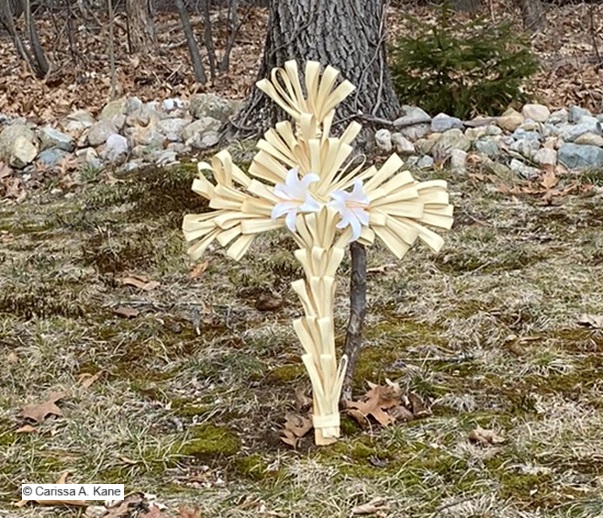
Neither grave, nor the gravity, Could hold Him down. That cross, though heavy, Not heavy enough, Nor could it ever be. A temporary thing, A passage, passing with time, The Begotten not gone.
That stone, though big, Not big enough, Nor could it ever be. A temporary thing, A passage, passing with time. The Begotten hidden, Not seen, not heard, But certainly not gone.
Then, Easter. Arriving between the quiet, Entering amid the stillness, And everything changes. Everything becomes new again, In the remembering of what is. Nothing ever stronger than What was, What is, and What shall ever be.
Just as Light cannot be kept from shining, And Truth, refusing to remain hidden, There is no greater shield or power than that created by Creator. We are more than passengers on borrowed time. More than temporary things or passages, passing with time. And in Him, with Him, and thru Him, Neither grave, nor the gravity, Can hold us down.
Breaking, broke, broken, Rescued, healed, awoken, Ever taken with your Way. For the sake of all, It’s all the same. No one more than the other, Each onto its own, But gathered in Your name.
Your grace O Lord, The longing of our hearts. Eloi, Eloi, lema sabachthani. At times, perhaps, We think we know, Yet thinking doesn’t make it so.
Your grace O Lord, The longing of our hearts. We feel one way or another, Sometimes many ways at once, Yet feeling doesn’t make it so.
Your grace O Lord, The longing of our hearts. With us, within us, Always within reach.
Your grace O Lord, Makes known your Way, The desire in our hearts, Yours and ours together, Rising up, makes it so.
To get somewhere, one needs to know where they are in relation to where they want to be and then to come up with a travel plan. However, oftentimes the path or trajectory shifts or ends up being different due to changing circumstances such as weather, terrain, and/or other unexpected issues. And while there are rules of navigation, the ability to adapt and adjust is crucial just as much as precision is.
One way to consider the readings for the Fifth Sunday of Lent is not only as tools, but precision tools for navigation. In the first reading (Jeremiah 31:31-34), the prophet reveals that God is making some adjustments. This is not a change in commitment level or objective, but rather a change in approach.
“I will place my law within them, and write it upon their hearts; I will be their God, and they shall be my people. They will no longer teach their friends and relatives, “Know the Lord!” Everyone, from least to greatest, shall know me—oracle of the Lord—for I will forgive their iniquity and no longer remember their sin.” (verses 33-34)
God’s communication is going to be directed straight to God’s people (not requiring a “go-between” or a 3rd person account), making it more personal and approachable as well as accepting and forgiving—all hallmarks of a healthy relationship.
In the responsorial psalm (Psalm 51:3-4, 12-13, 14-15), the psalmist expresses a desire for God to wash away their wrongdoing and states:
“A clean heart create for me, O God, and a steadfast spirit renew within me. Cast me not out from your presence, and your Holy Spirit take not from me.” (verses 12-13)
Since a heart cannot be clean or pure when it’s holding onto transgressions, resentments, or cold feelings toward oneself or others, the psalmist first asks for God’s mercy (for these things holding them back to be lifted from them). Once the obstacle(s) is removed, the way toward a heart that is unwavering in faithfulness to God is opened because the heart is better able to receive the wisdom and guidance of the Holy Spirit.
In the Letter to the Hebrews, St. Paul uses two words, in the passage for the second reading (Hebrews 5:7-9), that are sometimes received less enthusiastically than words like mercy and compassion. They are “reverence” and “obedience.” St. Paul writes of Jesus: “…he was heard because of his reverence” and “…he learned obedience from what he suffered”. Jesus’s relationship with God was open and honest; it was sacred. Jesus walked this earth, rooted in a desire to do God’s will and always seeking God as his source of strength and wisdom to face what he needed to face. When taken in the light of Jesus’ example, these words, “reverence” and “obedience”, when chosen with one’s free will express an attitude of humility and faithfulness to God, and of God to us.
Coming to the Gospel (John 12:20-33), Jesus’s words here strike at the heart of navigating. That is, holding onto or maintaining focus on the end goal despite the challenges that arise along the way.
It is written:
“Jesus answered them, “The hour has come for the Son of Man to be glorified. Amen, amen, I say to you, unless a grain of wheat falls to the ground and dies, it remains just a grain of wheat; but if it dies, it produces much fruit.” (verse 23-24).
If one is going to get to their destination, they can’t stay in one place or state of being. A change, shift or movement toward what one desires is necessary.
“I am troubled now. Yet what should I say? ‘Father, save me from this hour’? But it was for this purpose that I came to this hour.” (verse 27)
Jesus knows his purpose or mission through his relationship with God. What are you and God aiming for as you navigate? (If unsure, consider what is fulfilling or rings true with the soul, bringing a sense of peace.)
“Father, glorify your name.” Then a voice came from heaven, “I have glorified it and will glorify it again.” (verse 28)
When two wills move together, there is resonance in words and actions. However, there can only be one pilot.
“Now is the time of judgment on this world; now the ruler of this world will be driven out.” (verse 31)
Jesus knows who’s leading the way and encourages us toward awareness as well.
May the strength of God pilot us, may the wisdom of God instruct us, may the hand of God protect us, may the word of God direct us. Be always ours this day and for evermore. – St. Patrick
On this 4th Sunday of Lent, Laetare Sunday, the readings invite us to consider the depth of God’s steadfastness and love. Focusing on the second reading, take some time to reflect on the qualities of God (rich in mercy, great love, etc.).
Brothers and sisters: God, who is rich in mercy, because of the great love he had for us, even when we were dead in our transgressions, brought us to life with Christ — by grace you have been saved —, raised us up with him, and seated us with him in the heavens in Christ Jesus, that in the ages to come He might show the immeasurable riches of his grace in his kindness to us in Christ Jesus. For by grace you have been saved through faith, and this is not from you; it is the gift of God; it is not from works, so no one may boast. For we are his handiwork, created in Christ Jesus for the good works that God has prepared in advance, that we should live in them. – Ephesians 2:4-10
How do you experience these qualities in your life? In your relationship with God and others, where do you give? and where do you withhold? Take some time to ponder being God’s handiwork.
“You often say, “I would give, but only to the deserving.” The trees in your orchard say not so, nor the flocks in your pasture. They give that they may live, for to withhold is to perish.” – Kahlil Gibran
Sometimes due to the weather or one’s location, for example in the snow, on the sand at a beach, or stepping out of a pool, the impact of where one has traveled can be clearly seen. Most often though, we tread without leaving any physical indications at all.
The response for today’s Psalm is derived from Psalm 86, verse 11ab: Teach me your way, O Lord, that I may walk in your truth.
The text for the complete verse is as follows:
Teach me, Lord, your way that I may walk in your truth, single-hearted and revering your name. – Psalm 86:11
Reflect on the places to which you have traveled and/or spent time over the past few days, or the past week. As you remember where you have been, what comes to mind?
In what ways would you say that you experienced walking in God’s truth, single-hearted and revering God’s name? Were there places or situations where you were more grounded and fully present to the moment?
As you allow yourself to imagine revisiting these places, take time to notice or re-notice things.
Next, have a conversation with the Lord and share whatever thoughts and feelings arise within you. Ask to be shown what the Lord sees in these experiences and wants you to see as you continue striving in discipleship.
When your conversation is completed, pray:
Teach me, Lord, your way that I may walk in your truth, single-hearted and revering your name. – Ps 86:11
The readings for the Fifth Sunday in Ordinary Time begin with a passage from the Book of Job where the subject, Job, continues to express dissatisfaction as he tries to come to terms with, and understand the reason for, the trials and tribulations he is and has been experiencing.
Job spoke, saying: Is not man’s life on earth a drudgery? Are not his days those of hirelings? He is a slave who longs for the shade, a hireling who waits for his wages. So I have been assigned months of misery, and troubled nights have been allotted to me. If in bed I say, “When shall I arise?” then the night drags on; I am filled with restlessness until the dawn. My days are swifter than a weaver’s shuttle; they come to an end without hope. Remember that my life is like the wind; I shall not see happiness again. – Job 7: 1-4, 6-7
Thinking about this passage, what resonates with you most? How do you feel about Job’s plight and about God’s role in it?
Recall a time when you felt challenged, and your faith tested. In what ways was God present to you, even if you were not aware or able to name God’s presence as such at that time? What would you say it was about that experience that affected your faith or trust in God? Take some time to share with God what’s on your mind and in your heart at this moment.
The response for the Responsorial Psalm this Sunday is, “Praise the Lord, who heals the brokenhearted.” (Psalm 147 cf. 3a). We all experience heartache and heartbreak as we journey through life. What situation in your life is outright disturbing your heart or creating a sense of unrest or uneasiness? What do you desire from God regarding this situation? What might God want you to know or to consider? In what ways can you envision this situation as an opportunity to deepen your faith and relationship with God?
In the First Letter of St. Paul to the Corinthians, verse 22 of chapter 9, we read, “To the weak I became weak, to win over the weak. I have become all things to all, to save at least some.” What’s it like to consider this, in light of today’s world, as an invitation to getting along in service to God and for the sake of being a living testament to the Gospel? Sticking with this, what would you want to ask St. Paul about this passage and the challenges he faced? What do you need from God as you strive to be a disciple of Jesus in today’s world? Pray for God’s desire for you, in terms of how you navigate the division and issues in today’s world, to be placed in your heart, imparting wisdom throughout each day.
Next, as we move to the Gospel passage for the Fifth Sunday in Ordinary Time (Mark 1:29-39), we have Jesus’ healing Simon’s mother-in-law as well as a multitude of people. Upon being healed, Simon’s mother-in-law gets back to the business of serving others. We also learn that Jesus separates from the crowd to go pray. Once he is found, Jesus gets back to the business of preaching and healing people as he moves on to the neighboring villages. Take time to contemplate this passage in terms of the necessity of prayer and downtime or time away. What happens when there is an interruption in your routine? In what ways are you open to change? How do you experience the dynamic nature of God through interruptions and changes around you?
“In Christianity, God is not a static thing—not even a person—but a dynamic, pulsating activity, a life, almost a kind of drama. Almost, if you will not think me irreverent, a kind of dance.” – C.S. Lewis
It seems that human nature tends toward comparison and judgment along with practices that help one to “find their place” and obtain some level of comfort. However, although these skills might be helpful in deciphering and navigating the world around us, they can also lead to complacency, and a sedentary or fixed way of seeing and being. The readings for the Solemnity of Christ the King offer an opportunity to reflect upon choices, judgments, and viewpoints, and to consider by what or whom they are influenced. Or, in other words, to contemplate who is leading you.
In the First Reading (Ezekiel 34:11-12, 15-17), the deep level of care and protective nature of God is expressed.
“Thus says the Lord God: I myself will look after and tend my sheep.” (v. 11).
The passage continues to describe God’s desire to rescue, find, and heal as well as God’s promise to make judgments and course correct those who are wrong or have gone astray.
How do you feel about this notion? What’s it like to leave the judgment and course correction to God? Are there areas in which it is more of a challenge than others? Spend some time in prayer asking for guidance around replacing judgments that veer away from God’s desire for you and for a clearer vision of what role God desires for you.
In the Responsorial Psalm (Psalm 23:1-3,5-6), we stay with the image of the Shepherd who takes care of and provides for his sheep. The psalmist writes of the Lord as refreshing their soul, guiding them in right paths, and blessing them so that “goodness and kindness follow” them. The psalmist then says, “I shall dwell in the house of the Lord for years to come” (v. 6).
What do you think they mean? What do you imagine that would be like? How would it feel? In what places or situations have you experienced similar feelings?
“The Lord is my shepherd; there is nothing I shall want.” (v. 1).
In what ways do you feel inspired when you imagine God’s loving presence permeating all experiences and capable of extending beyond all that might otherwise be a barrier?
Looking to the Second Reading (1 Corinthians 15:20-26, 28), St. Paul writes about Christ the King who helps us to life by helping us to overcome death, in its various forms, while at the same time leaving the ultimate judgment to God.
“then comes the end, when he hands over the kingdom to his God and Father, when he has destroyed every sovereignty and every authority and power. For he must reign until he has put all his enemies under his feet. The last enemy to be destroyed is death. When everything is subjected to him, then the Son himself will also be subjected to the one who subjected everything to him, so that God may be all in all.” (v. 24-26, 28).
What happens when you think about Jesus, to whom God subjected all things, handing the kingdom back to God (v. 24) and subjecting Himself to God? What’s it like for you to let go of something that you have obtained or been given? Where is God in that decision or process?
Now turning to the Gospel (Matthew 25:31-46), Jesus talks to his disciples about the final judgment and separation between sheep (the righteous) and goats. Notice how the criteria that Jesus describes are all things that can be done to take care of and protect others.
“For I was hungry and you gave me food, I was thirsty and you gave me drink, a stranger and you welcomed me, naked and you clothed me, ill and you cared for me, in prison and you visited me.” (v. 35-36).
There is always more than just “I,” “me,” and “mine,” and part of striving for the Kingdom of God is not only to know this, but also to live in a way that shows respect, dignity, appreciation, and care for others. Also, it’s not about being perfect or being able to amass a long list of service to others, but rather about focusing efforts on being in service of God by surrendering one’s heart and mind to being under the influence, united with, and led by God.
The Lord is my shepherd; there is nothing I shall want. – Ps 23:1
Taken by the contrasting colors of the leaves against the soothing blue backdrop of the sky, it’s interesting how well they get along.
In the Gospel passage for the Thirtieth Sunday in Ordinary Time, the heart of Jesus’ response can be seen as an invitation to consider love, and how it is revealed through, and in, relationships. Jesus reminds us that being faithful to God is more than striving to love and serve God. It also involves striving to love or to take care of oneself as well as one’s neighbor.
When the Pharisees heard that Jesus had silenced the Sadducees, they gathered together, and one of them, a scholar of the law tested him by asking, “Teacher, which commandment in the law is the greatest?” He said to him, “You shall love the Lord, your God, with all your heart, with all your soul, and with all your mind. This is the greatest and the first commandment. The second is like it: You shall love your neighbor as yourself. The whole law and the prophets depend on these two commandments.” – Mt 22:34-40
Reflecting upon the past week, in what ways did you strive to love and serve God? What thoughts and feelings surface as you recall the situations where the love of God was most present to you? Allow yourself to envision God’s response to a heart, your heart, operating in love and service.
Continuing to stay with the moments of the past week, are there ways you took care of yourself through them? Take some time to consider more fully how each experience came about. What might God want you to know about them? How might you pray in response?
What moments come to mind as ones where the love you have received extended beyond yourself whether in thought or deed?
Still reviewing the past week, who or what would you include as your neighbors (family, community members, any fellow human being, animals, nature, etc.)? What did you appreciate in them? For each way that you might have struggled to appreciate them or that you felt more than a little challenged by them, try to return to naming something you appreciated.
How do you feel inspired by the things that you have contemplated during this time? And what do you desire to carry forward?
Leaning into Fall, the trees embrace the Essence of their nature. Season after season, year after year, who’s to say on time, or in time? Either way, waiting without edge, trusting in the beauty of Your time as you gently reveal the colors, so many colors, of Your way.
Beacon calling out to one and all alike, remember: life is but a spectrum, at its fullest and shining bright, when casting out the shadows, fears, and doubts. Your light so much stronger than the decay, rising up and out from far below.
It’s time to recognize again who we really are. So much alike, created to be different, but not with indifference or carrying any shades of hate. Loved into existence, the vision of Your eye. Side by side, each and every one of us are vessels of Your grace, and we all have a place.
Holy God, Most High Creator, hold us all together, unite us in Your heart… in our hearts.
Shine like lights in the world as you hold on to the word of life. – Phil 2:15d, 16a
There’s something about climbing a mountain, of any kind, that lends itself to leaning in. Stepping ahead, slowing down, gaining traction, sometimes even resting. Hints here and there—leading, reaching, stretching—all progress in this journey.
There’s something about climbing a mountain, of any kind, that lends itself to letting go. Noticing moments filled with movement; movement filled with moments. Some are silent and others not. Some are focused more than others. A mix of sorts, obstacles slowly falling away, leaving room for air as well as airing.
There’s something about climbing a mountain, of any kind, that lends itself to learning. Exploring ups and downs, reflecting on what’s over, up ahead, or coming around. Changing ever changing, discovering what’s important and tossing what is not.
Jesus took Peter, James, and his brother, John, and led them up a high mountain by themselves. And he was transfigured before them; his face shone like the sun and his clothes became white as light. And behold, Moses and Elijah appeared to them, conversing with him. Then Peter said to Jesus in reply, “Lord, it is good that we are here. If you wish, I will make three tents here, one for you, one for Moses, and one for Elijah.” While he was still speaking, behold, a bright cloud cast a shadow over them, then from the cloud came a voice that said, “This is my beloved Son, with whom I am well pleased; listen to him.” When the disciples heard this, they fell prostrate and were very much afraid. But Jesus came and touched them, saying, “Rise, and do not be afraid.” And when the disciples raised their eyes, they saw no one else but Jesus alone.
As they were coming down from the mountain, Jesus charged them, “Do not tell the vision to anyone until the Son of Man has been raised from the dead.” – Mt 17:1-9
You must be logged in to post a comment.