Be Dazzled…

The readings for the Second Sunday of Lent take us on a journey from sacrifice or letting go to service, embracing identity, and finally becoming one with it. In the first reading, Abraham shows a willingness to sacrifice or let go of whatever his ideas or plans might have been to listen to God and do as God asks (Genesis 22:1-18). Remember, Sarah and Abraham, in their more senior years and against all odds, had their son Isaac after having been barren. Imagine what it must have been like for Abraham to then be asked to sacrifice or let go of his and Sarah’s long-awaited arrival. Yet, Abraham exemplifies a faith that places trust in God (and God alone) above all. He proceeds to take steps toward what God has asked of him. As they left the servants behind and walked along, Isaac asks his father where the sheep is for their offering. Abraham replies, “God will provide the sheep for the burnt offering.” Once they finish building an altar and placing the wood, Abraham moves toward sacrificing his and Sarah’s only child. However, the angel stops him as Isaac’s demise is not what God wills. As Abraham said, God does provide the sheep for sacrifice: “Abraham looked up and saw a single ram caught by its horns in the thicket. So Abraham went and took the ram and offered it up as a burnt offering in place of his son.” And the wisdom of his response to God’s requests and promptings shows that being faithful is to nurture a will that is open to and guided by God. For it is this kind of will that does not lead to demise or destruction.

Continuing to look to what it is to be faithful to God, the response for the Psalm is “I will walk before the Lord, in the land of the living” (Psalm 116:9). How do you feel motivated by Abraham’s example of striving to serve God with a united heart and mind? Try to envision or embody the spirit of walking before God in all that you say and do this week.

Turning to the second reading (Romans 8:31b-34), St. Paul encourages us to remember and embrace our identity when he writes: “If God is for us, who can be against us?” When one is operating with a desire to do God’s will and in the scope of being part of creation in God’s image, there is a sense of inner strength, awareness, and reverence for what is good and just while at the same time a sense of lightness and freedom or free will. It is important to pause every so often to examine what’s going on internally and from where one’s words and actions are flowing. Invite Jesus to the conversation and ask the Lord for the grace to be aligned compatibly with God in each situation you face.

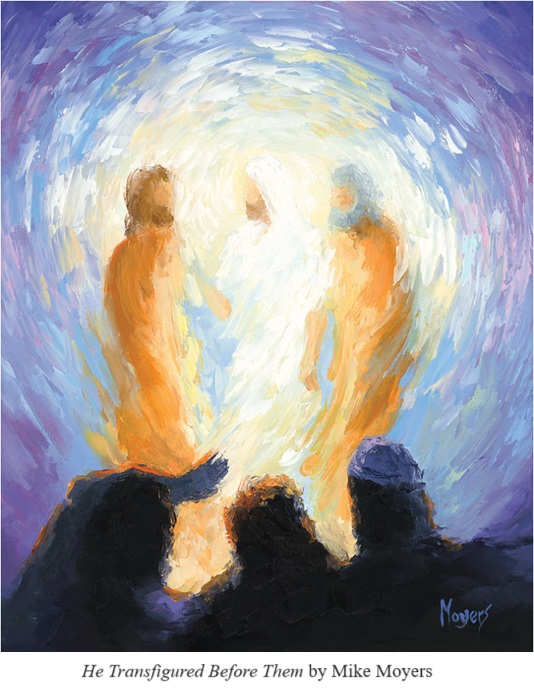
In this week’s Gospel, we read about the Transfiguration of Jesus (Mark 9:2-10), the ultimate image of embracing one’s identity and becoming one with it for the greater good.

Jesus took Peter, James, and John
and led them up a high mountain apart by themselves.
And he was transfigured before them,
and his clothes became dazzling white,
such as no fuller on earth could bleach them.
Then Elijah appeared to them along with Moses,
and they were conversing with Jesus.
Then Peter said to Jesus in reply,
“Rabbi, it is good that we are here!
Let us make three tents:
one for you, one for Moses, and one for Elijah.”
He hardly knew what to say, they were so terrified.
Then a cloud came, casting a shadow over them;
from the cloud came a voice,
“This is my beloved Son. Listen to him.”
Suddenly, looking around, they no longer saw anyone
but Jesus alone with them.

As they were coming down from the mountain,
he charged them not to relate what they had seen to anyone,
except when the Son of Man had risen from the dead.
So they kept the matter to themselves,
questioning what rising from the dead meant.
– Mark 9:2-10

Recall a time where you felt affirmed or reaffirmed and had a sense of confidence in who you are as God’s beloved, leading to spiritual growth or renewal. Ask the Lord for the grace of that experience to extend to today, offering you wisdom, insight, and openness to whatever you may need.

Bearing Fruit…

Questions upon questions.
Sitting still, or idly sitting?
With, or at, each other?
Whether picking, picked, or chosen,
The answer is the same.
Apples of God’s eye.
Desire of desires.

Fruit bearing fruit,
Fruit bearing with fruit.
A breath of fresh air,
A dose of patience,
Perseverance too.
From the heart of One
To another, then another.

All searching for some peace,
While time is fast escaping.
All in One, One in all,
History that is shared,
Spirits called together.
Even when far apart,
Destiny is waiting.

It was not you who chose me, but I who chose you and appointed you to go and bear fruit that will remain, so that whatever you ask the Father in my name he may give you. This I command you: love one another. – John 15:16-17

On Schedule…

On a recent trip into the city, memories of daily travel into the office by commuter rail came to mind. In particular, the schedules and the frequency of trains, or lack thereof, depending on what the workday had to offer and when it ended up being time to go home. During that time, there were a number of trains between 4:45pm and around 6:30pm on the line that I needed to take, so if I missed one, I could just hop on the next without much of a wait. However, if I was delayed at work past 6:15, and not able to run fast enough to make it to the platform and onto the 6:30 train before it started pulling out, the wait for the next train was substantial.

Thinking back on those times, I remember running for that last rush hour train and seeing other people do the same, sometimes making it, and sometimes times not. Then there were those occasional times of choosing not to make a mad dash for it, but rather to slow down, letting go of any notion of getting onto the train in those last moments before it pulled away. On those days, it was interesting how the station gradually transformed from being so crowded and noisy to a quieter, more spacious, easy-going place as it moved past the hours known for their rush. It was also easier to appreciate, once foregoing the push to move quickly, hop on, grab a seat, and get outbound.

It seems like a lot of life can be focused on being outbound and moving on to the next thing. Society just keeps pushing for more and more, and with greater speed, seemingly unaware of what is being lost or left behind. This constant hustle often leads to losing sight of what’s personal and meaningful, diminishing the time and patience that allows for potential to be seen and nurtured, and forgetting that “best” is most often brought out in one another by that which is rooted in a higher purpose—that which is mutually beneficial.         

In the First Reading of the Twenty-fifth Sunday in Ordinary Time it is written,

“Seek the Lord while he may be found, call upon him while he is near.” – Isaiah 55:6

In this busy, challenging world in which we live, what’s it like to turn this verse around and to contemplate the Lord seeking you, and calling your name with a desire to draw near to you? Where are the places that you invite or allow the Lord to find you and to be close to you? Where are the places where perhaps you don’t?

In verse 18 of Psalm 145, we read, “The Lord is near to all who call upon him, to all who call upon him in truth.” And in the Second Reading, we read part of St. Paul’s letter to the Philippians, where he relates his desire to be Christ-centered (“Christ will be magnified in my body, whether by life or by death.” – Phil 1:20c). For it is in the Lord, and in living out the ways of the Lord, that he not only finds purpose and meaning, but also becomes an extension of God’s grace to others, encouraging them to also strive toward that which is greater than.    

How are you inspired in relationships? Where do you find purpose, meaning, and mutual, generative benefit? In what ways do you desire to deepen your relationship with God, and others?

In the Gospel reading, Jesus shares the parable of the workers in the vineyard (Matthew 20:1-16) where the focus is on the desire and willingness to join in and work in the vineyard, rather than who got there first, who worked the longest, or any other credentials. This passage is a great reminder that with God, it’s never too late, nor too early, patience is abundant, potential is appreciated, and there’s always room for those who desire a place in the vineyard and come willing to do the work. With God, you can’t miss, not just because the time is always right, but also because the schedule is flexible, as well as forgiving.

Jesus told his disciples this parable:
“The kingdom of heaven is like a landowner
who went out at dawn to hire laborers for his vineyard.
After agreeing with them for the usual daily wage,
he sent them into his vineyard.
Going out about nine o’clock,
the landowner saw others standing idle in the marketplace,
and he said to them, ‘You too go into my vineyard,
and I will give you what is just.’
So they went off.
And he went out again around noon,
and around three o’clock, and did likewise.
Going out about five o’clock,
the landowner found others standing around, and said to them,
‘Why do you stand here idle all day?’
They answered, ‘Because no one has hired us.’
He said to them, ‘You too go into my vineyard.’
When it was evening the owner of the vineyard said to his foreman,
‘Summon the laborers and give them their pay,
beginning with the last and ending with the first.’
When those who had started about five o’clock came,
each received the usual daily wage.
So when the first came, they thought that they would receive more,
but each of them also got the usual wage.
And on receiving it they grumbled against the landowner, saying,
‘These last ones worked only one hour,
and you have made them equal to us,
who bore the day’s burden and the heat.’
He said to one of them in reply,
‘My friend, I am not cheating you.
Did you not agree with me for the usual daily wage?
Take what is yours and go.
What if I wish to give this last one the same as you?
Or am I not free to do as I wish with my own money?
Are you envious because I am generous?’
Thus, the last will be first, and the first will be last.” – Matthew 20:1-16

Out of Bounds…

In the Letter to the Romans, St. Paul writes, “Do not conform yourselves to this age but be transformed by the renewal of your mind, that you may discern what is the will of God, what is good and pleasing and perfect.” (Romans 12:2). Although he was writing to people of a different time than us, how appropriate this instruction or advice is for any age. After all, looking around and considering all of creation, there’s not only a broad spectrum of living things, but also cycles or seasons of change that occur across each category, and all created in the image of the Creator. With all of this, it’s not too hard to imagine God as being far more dynamic than any one generation, society, or age might deem.

Still though, it can be easy to move through a task, a day, or more with “a place for everything and everything in its place” mindset, whether as an individual or within a group or an organization. Perhaps St. Paul is reminding us not to get hung up on making things fit into our existing notions, to the extent that we leave no room to perceive the new things that God is doing or trying to teach us (Is 43:19). After all, how can God reveal to us, even a portion of insight to God’s will or a shimmer of the expanse and depth of God’s love, if one has already made up their mind and is so fixed and unwilling to consider something other?

This is not to say that one should never hold fast to a value or notion, but rather to be cautious of excluding possibilities outside of the ones already recognized or held.

In the Gospel for the Twenty-second Sunday in Ordinary Time, Jesus says to Peter, “Get behind me, Satan! You are an obstacle to me. You are thinking not as God does, but as human beings do.” (Matthew 16:23). He says this because Peter’s response comes out of his own understanding and is not based on listening to and considering what was said or communicating with Jesus.

When Jesus reveals that he will be killed, it does not fit the narrative of Peter’s notion of what’s to come of the Anointed One. The influence of Peter’s response is not of God. It is rigid, does not consider what the Anointed One has said, and leaves no room for possibilities outside of what Peter “knows”.

Again, looking around and considering all of creation, there is change, there is fluidity. God is not rigid. And, having been created in God’s image, humankind is not meant to be rigid either. To hold fast? Yes, but first and foremost to God. This is so that everything else not only falls into place in a way that is most fitting, but also in a way that is blessed and does not serve to block the flow of God’s grace from extending in ways beyond our own understanding.

Jesus began to show his disciples
that he must go to Jerusalem and suffer greatly
from the elders, the chief priests, and the scribes,
and be killed and on the third day be raised.
Then Peter took Jesus aside and began to rebuke him,
“God forbid, Lord! No such thing shall ever happen to you.”
He turned and said to Peter,
“Get behind me, Satan! You are an obstacle to me.
You are thinking not as God does, but as human beings do.”


Then Jesus said to his disciples,
“Whoever wishes to come after me must deny himself,
take up his cross, and follow me.
For whoever wishes to save his life will lose it,
but whoever loses his life for my sake will find it.
What profit would there be for one to gain the whole world
and forfeit his life?
Or what can one give in exchange for his life?
For the Son of Man will come with his angels in his Father’s glory,
and then he will repay all according to his conduct.” – Matthew 16:21-27

Risen…

The light, rising in the east,

Breaks over the water’s edge,

Reaching out to all.

Its glow carries warmth,

Its sharpness, an invitation.

Zooming in to look and listen,

It shimmers and it shines.

What does it mean?

What does it say?

The journey of day,

Darkness ever attempting

To be in life’s way.

Yet, some things are impossible.

Light, like life, is never ending.

Up and over,

Again, and again.

With this Light,

Nothing is impossible.

Alleluia! Alleluia! Christ is risen! Alleluia!

Cross Roads…

Meet me at the Intersection.
You know the place.
The one where our wills meet,
And where differences are laid aside.
The one where hearts meld for all.

Meet me at the Intersection.
You know the place.
The one where face to face,
Our guards recline and fears subside,
As we recall the beauty of our Oneness.

Meet me at the Intersection.
You know the place.
The one, and only One,
Where we help each other,
And the choices made,
Regardless of their ilk,
Shine with greater Glory.

Meet me at the Intersection.
You know the place.
The one where we walk, hand in hand,
And there is no wedge between us.
Where we recall, together is our destiny.

Meet me at the Intersection,
You know the place.
For there is no other way,
But the Way—open, just, and free,
As life, in all its Glory, rises to its fullness.

When Jesus and the disciples drew near Jerusalem
and came to Bethphage on the Mount of Olives,
Jesus sent two disciples, saying to them,
“Go into the village opposite you,
and immediately you will find an ass tethered,
and a colt with her.
Untie them and bring them here to me.
And if anyone should say anything to you, reply,
‘The master has need of them.’
Then he will send them at once.”
This happened so that what had been spoken through the prophet
might be fulfilled:
Say to daughter Zion,
“Behold, your king comes to you,
meek and riding on an ass,
and on a colt, the foal of a beast of burden.”
The disciples went and did as Jesus had ordered them.
They brought the ass and the colt and laid their cloaks over them,
and he sat upon them.
The very large crowd spread their cloaks on the road,
while others cut branches from the trees
and strewed them on the road.
The crowds preceding him and those following
kept crying out and saying:
“Hosanna to the Son of David;
blessed is he who comes in the name of the Lord;
hosanna in the highest.”
And when he entered Jerusalem
the whole city was shaken and asked, “Who is this?”
And the crowds replied,
“This is Jesus the prophet, from Nazareth in Galilee.” – Matthew 21:1-11

Which Way…

With the pitter patter of rain and dense mist earlier in the week, it became more and more challenging to see clearly. However, once the rain slowed, visibility improved ever so slightly. Then, as we continued, we exited an area that was overcome with fog. Once more our vision was restored more fully, until that is, we came across the next pocket of thick mist and its partnering wave of rain. Overall, in slowing down, the weather, although an obstacle, did not pull us off course or lead us astray. Remaining focused on the road, we found our way, and eventually, arrived safely.    

In the Gospel reading for the Thirty-first Sunday in Ordinary Time (Luke 19:1-10 below), we read that Zacchaeus was searching for Jesus, “but he could not see him because of the crowd.” The crowd, perhaps like waves of rain and dense like fog, was an obstacle, yet Zacchaeus remained focused on his desire “to see who Jesus was.” Allowing himself to be led by the longing of his heart, Zacchaeus does not get lost in the crowd or become discouraged. Nor does he push through the crowd or use whatever means he may have had as a wealthy tax collector. Rather, Zacchaeus seems to abandon any such notions and instead, he lets go of his status as he looks to overcome the limitations of his physical stature and climbs a tree to get a glimpse of Jesus.

Next, comes perhaps the most important part of this passage. What does Zacchaeus do in response to his encounter with Jesus? He owns his previous actions and changes his ways. He vows to repair any damage he has done and to adjust how he operates. He promises to extend not only his pocketbook, but also his heart to others, especially those in need. He does not deny the truth, but instead rightfully embraces it.

The Lord is near to all who call upon him, to all who call upon him in truth. – Psalm 145:18

Zacchaeus truly wanted to know who Jesus was and was willing to let go of all he had to find out. Not only that, but once he experienced Jesus for himself, he was also willing to let go of all he had known. In joining the way of Jesus, he was not going for something that would lead him to become less tolerant or accepting or disparage and drag him and others down. The changes Zacchaeus makes are ones aligned with honesty, integrity, respect, and dignity. These are all hallmarks of life-giving choices; ones that honor and praise the beauty of God and all God’s creation.

So, while the rain falls where it may, and the fog may seem endless as if extending well beyond the horizon, as for the Way, it remains clear as can be, if only one is open to it.        

At that time, Jesus came to Jericho and intended to pass through the town.
Now a man there named Zacchaeus,
who was a chief tax collector and also a wealthy man,
was seeking to see who Jesus was;
but he could not see him because of the crowd,
for he was short in stature.
So he ran ahead and climbed a sycamore tree in order to see Jesus,
who was about to pass that way.
When he reached the place, Jesus looked up and said,
“Zacchaeus, come down quickly,
for today I must stay at your house.”
And he came down quickly and received him with joy.
When they all saw this, they began to grumble, saying,
“He has gone to stay at the house of a sinner.”
But Zacchaeus stood there and said to the Lord,
“Behold, half of my possessions, Lord, I shall give to the poor,
and if I have extorted anything from anyone
I shall repay it four times over.”
And Jesus said to him,
“Today salvation has come to this house
because this man too is a descendant of Abraham.
For the Son of Man has come to seek
and to save what was lost.” – Luke 19:1-10

In the Fabric…

It’s challenging, to say the least, to live in a world where tangible assets not only overwhelmingly drive motivation, but also speculation and modes of operation. And even more than that, status and materialism push humankind toward pursuits that are often so far removed from the stirrings and movements of grace that seek to connect and strengthen hearts.

St. Ignatius of Loyola wrote, “For it is not knowing much, but realizing and relishing things interiorly, that contents and satisfies the soul.” Yet, as suggested in Ecclesiastes, the human condition is such that we continue to toil under the sun to know more, do more, win more, and so on. But for what kind of gain? and at what cost?

Here is one who has labored with wisdom and knowledge and skill,
and yet to another who has not labored over it,
he must leave property.
This also is vanity and a great misfortune.
For what profit comes to man from all the toil and anxiety of heart
with which he has labored under the sun?
All his days sorrow and grief are his occupation;
even at night his mind is not at rest.
This also is vanity. – Ecc 2:21-23

Looking around, or tuning in to the pulse of society, one can only wonder, with that beat, what kind of “more” will ever be enough? And in the process, what happens to the hearts involved? There’s ebb and flow of course, but in what ways and to what degree do they drift? And at what point does the unfamiliar become all too familiar?

Turning to Psalm 95, the psalmist writes, “If today you hear God’s voice, harden not your hearts.” Before that, a call to turn back to the One who knows.

Teach us to number our days aright,
that we may gain wisdom of heart. – Ps 90:12

Remember, ask and you shall receive. However, as always, there’s choice in how one responds.

St. Paul urges us forward, let go of that which binds one to the earth and drags one down. Instead, be grounded to, as well as through, that which is elevated and fulfilling in a far greater way.

If then you were raised with Christ, seek what is above, where Christ is seated at the right hand of God.
Think of what is above, not of what is on earth. – Col 3:1-2

Be true… be not only baptized into Christ, but also put on Christ. Think about it. How does the heart and mind of Christ infuse your soul? How does it influence choices as you face challenges and navigate this world?

In the Gospel according to Luke (chapter 12:13-21), Jesus tells the parable of the rich man who had such a surplus at harvest that he replaced his barns with even bigger ones so he could essentially rest on his laurels and live off all that he had store up. While this parable can lead one to reflect on possessions and sharing or helping others from what one has, it can also be a catalyst to considering more closely how one’s pursuits affect the fabric of one’s being. Aside from the tangible, from what has one’s heart moved away? To what has one’s heart moved toward? And most importantly, where is God in all of that?

Trust in Remembering…

Sitting with the readings for the second Sunday of Lent, like an old friend, the word “Trust” enters the room with a warm smile and as if to say, “Remember me… remember when…” So much of life is about trust and so often, it seems to come down to whom or what one trusts, to what degree, how that trust is received, and the impact or consequences of its handling.

As human beings, we share in a perfectly, imperfect nature, as we navigate life in, and surrounded by, a competitive, material world. It can be tempting to think or feel, even if subconsciously, that there is something we can do about anything happening around us at any time; that a level of control is always within our grasp. We may even look to capture the things that we, as human beings, think will help us to have that control. Yet, the only control we ever really have, and the only victory ever really won, is in choices that we make to trust in God’s ways and to let go, or shed the impulse or notion that any one interest outranks everyone’s interest.

In the ninth chapter of the Gospel according to Luke, Peter, John, and James ascend the mountain with Jesus and share in the experience of his transfiguration. In the passage prior to this one, while explaining what it means to be a disciple, Jesus says, “What profit is there for one to gain the whole world yet lose or forfeit himself?” (Lk 9:25). Looking at the circumstances in the world today, one can clearly see that there is no profit in profiteering, only loss for everyone.

Think about what it must have been like for Peter, John, and James to hear Jesus’ words about discipleship and then to witness his transfiguration seeing him stand alongside the prophets, Moses and Elijah.

Looking to today’s world, when it seems there is nothing to do, or there is no good way to stop what is already in motion, perhaps the best place to start is to forget control, then pause to go back and remember the beginning. Jesus took Peter, James, and John up the mountain to pray. One can only wonder, what was in their hearts as they placed their trust in Jesus and followed him up that mountain. One can only wonder how they received what happened and what they carried in their hearts on the way down, and thereafter.

How does your trust in Jesus shape your choices, create unity, express love, and spread goodwill? Connecting with Jesus as an old friend greeting you with a warm smile, how would you proceed from the phrase, “Remember me… remember when…?”

Share with Jesus what you carry in your heart as you reflect on the world we live in, and the journey you are on within it.

Jesus took Peter, John, and James
and went up the mountain to pray.
While he was praying his face changed in appearance
and his clothing became dazzling white.
And behold, two men were conversing with him, Moses and Elijah,
who appeared in glory and spoke of his exodus
that he was going to accomplish in Jerusalem.
Peter and his companions had been overcome by sleep,
but becoming fully awake,
they saw his glory and the two men standing with him.
As they were about to part from him, Peter said to Jesus,
“Master, it is good that we are here;
let us make three tents,
one for you, one for Moses, and one for Elijah.”
But he did not know what he was saying.
While he was still speaking,
a cloud came and cast a shadow over them,
and they became frightened when they entered the cloud.
Then from the cloud came a voice that said,
“This is my chosen Son; listen to him.”
After the voice had spoken, Jesus was found alone.
They fell silent and did not at that time
tell anyone what they had seen. – Lk 9:28b-36

With Whom…

Pulling into an open lot along a scenic road, initially it seemed as though there was no place from which to view the water. Bushes and trees were all around, as if a fortress blocking the way to the water gently waving behind it. However, stepping out into the fresh air, with each movement closer, possibilities arose, until at last, nearer still and despite any preconceived notions, a path, narrow as could be, but still present, a way through appeared.

Oftentimes, there is much more than one might see or think there to be, yet it can be tempting to refrain from asking, disregard the invitation, and instead turn back, embrace presumptions from afar, and choose a side, rather than trusting that call, choosing to discover (ask and receive), allowing paths to appear and Truth to become known.

In the passage below, what resonates most with you at this moment? Which person(s) do you identify with and in what ways? How do you desire to be, and to live? Where is God in that desire?

The whole Israelite community grumbled against Moses and Aaron.
The Israelites said to them,
“Would that we had died at the Lord’s hand in the land of Egypt,
as we sat by our fleshpots and ate our fill of bread!
But you had to lead us into this desert
to make the whole community die of famine!”

Then the Lord said to Moses,
“I will now rain down bread from heaven for you.
Each day the people are to go out and gather their daily portion;
thus will I test them,
to see whether they follow my instructions or not.

On the sixth day, however, when they prepare what they bring in,
let it be twice as much as they gather on the other days.
So Moses and Aaron told all the Israelites,
“At evening you will know that it was the Lord
who brought you out of the land of Egypt;
and in the morning you will see the glory of the Lord,
when he hears your grumbling against him.
But who are we that you should grumble against us?”

And Moses said, “When the Lord gives you meat to eat in the evening
and in the morning your fill of bread,
and hears the grumbling you utter against him,
who then are we?
Your grumbling is not against us, but against the Lord.”

Then Moses said to Aaron, “Tell the whole Israelite community:
Approach the Lord, for he has heard your grumbling.”
But while Aaron was speaking to the whole Israelite community,
they turned in the direction of the wilderness,
and there the glory of the Lord appeared in the cloud!

The Lord said to Moses:
“I have heard the grumbling of the Israelites.
Tell them: In the evening twilight you shall eat flesh,
and in the morning you shall have your fill of bread,
so that you may know that I, the Lord, am your God.”

In the evening quail came up and covered the camp.
In the morning a dew lay all about the camp,
and when the dew evaporated, there on the surface of the desert
were fine flakes like hoarfrost on the ground.
On seeing it, the Israelites asked one another, “What is this?”
for they did not know what it was.
But Moses told them,
“This is the bread that the Lord has given you to eat.” – Exodus 16:2-15