The Gospel reading for the Fourth Sunday in Ordinary Time follows Jesus and the first disciples (Simon, Andrew, James and John called away from mending their fishing nets) as they enter into Capernaum, the place whose name means “village of comfort”. In this passage from the Gospel According to Mark (chapter 1, verses 21-28), Jesus’ way of being and his teaching capture the attention of the people. What he offers is new and different and comes with signs, as Jesus and the disciples enter a synagogue where he teaches with authenticity and frees a man who is under the hold of an unclean spirit.
Then they came to Capernaum, and on the sabbath Jesus entered the synagogue and taught. The people were astonished at his teaching, for he taught them as one having authority and not as the scribes. In their synagogue was a man with an unclean spirit; he cried out, “What have you to do with us, Jesus of Nazareth? Have you come to destroy us? I know who you are—the Holy One of God!” Jesus rebuked him and said, “Quiet! Come out of him!” The unclean spirit convulsed him and with a loud cry came out of him. All were amazed and asked one another, “What is this? A new teaching with authority. He commands even the unclean spirits and they obey him.” His fame spread everywhere throughout the whole region of Galilee. – Mk 1:21-28
It’s interesting to consider this passage in terms of human nature. Presumably the people in Capernaum (village of comfort), know one another. What do you imagine it was like when Jesus and his disciples, strangers, entered their space in general, but more specifically, their sacred space—the synagogue? How do you respond when someone new or unknown enters your space? What kinds of things determine your response?
Returning to the Gospel, in this passage one can infer that the people in the synagogue were drawn to Jesus and his message because despite being in the village of comfort, beyond the surface, their real needs were not being met.
“The people were astonished at his teaching, for he taught them as one having authority and not as the scribes.”
What Jesus was saying, as he taught, spoke to the people of Capernaum. His words and his way touch their hearts, and they recognize him as being authentic. Reflecting on this past week, what kinds of words and things, and who, has touched your heart? What tends to strike a chord with you?
Coming back to the Gospel and the synagogue, next there is a man with an unclean spirit. Notice how the man and the spirit influencing him are intertwined. The man cries out, but the pronoun is “us”.
“he cried out, “What have you to do with us, Jesus of Nazareth? Have you come to destroy us?”
Yet, drawn into the presence of Jesus, the two become distinguishable. And, of everyone who is present (outside of the disciples), it is only the unclean spirit who recognizes and names what’s really happening. The unclean spirit knows who Jesus is, and perhaps, senses its doom.
I know who you are—the Holy One of God!
In what ways do you invite Jesus to help you discern and recognize situations where good and evil may have become intertwined?
Jesus expels the unclean spirit, setting the man free. The people are in awe and try to make sense of what they have witnessed. Word of Jesus spreads as they recognize Jesus’ way as being both new and powerful, or authoritative. Are they caught up in Jesus’ way, in the way the unclean spirit obeyed him, in Jesus being the Holy One of God?… What is it that is moving them and leads to Jesus becoming famous? What are they celebrating?
Revisit the things that tend to strike a chord with you and ask Jesus to reveal the places of comfort that may be creating a cloud of disguise and interfering with what is best. Express your desire to be led by the Light of God. Ask Jesus to help you to know what is influencing you.
The people who sit in darkness have seen a great light; on those dwelling in a land overshadowed by death, light has arisen. – Matthew 4:16
The 3rd Sunday of Advent is referred to as Gaudete Sunday, as we move closer to Christmas, anticipating the joy and celebration of the birth of Jesus, the new Adam. The readings for this Sunday (Isaiah 61:1-2A, 6-7; Responsorial Psalm – Luke 1:46-50, 53-54, 1 Thessalonians 5:16-24, and John 1:6-8, 19-28) call upon us to embrace and rejoice in the Spirit of the Lord. What does that look like? How do you know when you’re embracing and rejoicing in the Spirit of the Lord?
In the Gospel, John the Baptist is asked by priests and Levites, “Who are you?” (John 1:22). Part of John’s response is, “I am the voice of one crying out in the desert, ‘make straight the way of the Lord,’” (John 1:23). Reflecting on John’s response, what do you imagine it was like for him? How would you respond to the question, “Who are you?” In what ways would your response be the same or different depending on who asks the question?
What’s it like to ponder that the same God who created John and inspired his words and actions, desires to do the same for all of us?
Continuing to consider this, in what places or situations do you desire your words and actions to be influenced more by God? What are the places or situations where you experience peace, joy, and a sense that your desire and God’s are united?
Prayer: Gracious and merciful Lord, over the course of the next few weeks, with all the busyness of the Advent and Christmas Season, help us to be open to your inspiration and to cooperate with the glue that is your Grace, so that we might discover that there is joy in each moment.
“Man is born broken; he lives by mending. The grace of God is the glue.” – Eugene O’Neill
Reading Scripture it’s not too hard to envision the Pharisees and scribes as having a persona of lofty authoritarians who are learned, serious, and on the surface appearing to be so proper. Yet, Jesus points out that their actions do not align with their words. In the Gospel for the Thirty-first Sunday in Ordinary Time, Jesus tells the crowd and the disciples to observe and do as the Pharisees and scribes say, but do not act as they do. Do not hold down or seek to elevate yourself above others. Jesus then goes on to say, “you have but one teacher, and you are all brothers.” You have but one Father, but one master, Christ, and that the greater glory is not in being served or glorifying yourself, but rather in being of service to others, and therefore of service to God.
Reflecting on this Gospel and considering other Scripture passages as well, it may seem obvious that the Pharisees and scribes were not about what they proclaimed. Perhaps they fell victim to the notion that they had already arrived, were afraid of losing what they had attained, or some other thing that shrunk their hearts and made them sterner with others, and lax in their own prayer and practices, making them less likely to be inspired by God and more likely to be misguided and led astray.
Despite this, the actions of the Pharisees and scribes don’t make them worthless or deserving of being canceled. We can hold them accountable but must remember they are still part of God’s creation. They also need love, mercy, and prayers.
Jesus says to observe and listen to what they say. Maybe he’s reminding us that God can still work through them. Their transgressions are not bigger than God.
Praying with this passage brought to mind an instance from grade school, in my 2nd grade classroom, where being orderly was of the utmost importance to the teacher, most especially when it came to the inside of a student’s desk. All the students knew what was expected, and it seemed that all of us really tried to meet this expectation. However, there were a couple of students who had a very hard time with being organized. So, one day, the teacher was walking around the classroom, teaching a lesson, and without warning, flipped and dumped out the contents of this student’s desk, startling everyone, to say the least, and sending books, paper, pencils, and so on, all over the place. The student was then yelled at for being so disorganized, the teacher turned the desk back upright, and told the student to pick everything up, and put it back in the desk, neatly. The student, who was normally quiet, shrunk even more, their cheeks turned red, and tears were coming down their face as they began doing as they were told. The rest of us 7- and 8-year-olds, just sat there horrified. None of us dared to try to help the student for fear of what would happen if we did. It’s interesting how fear can interfere. It’s also interesting how judgment can be too.
When I think about this instance, in the light of this Gospel, I wonder, what was the point, or the lesson being taught that day? What made it so important that the inside of our desks be orderly, to the extent that a student who was trying their best and just being themself, be demeaned like that, and the room be made so disorderly, in efforts to obtain order? However, faith also calls me to hold and look at the entire picture, including before and beyond that instance and to recall that I also had what one would call a lot of positive experiences in that classroom.
Looking at the Pharisees and scribes, Jesus points out a disconnect not only between their words and their actions, but also in their hearts. He cautions the crowd, and us, to not be fooled or distracted toward self-serving ways. To not rely on external things, such as possessions or positions of authority, to gain good graces or a particular outcome, but rather to rely on the grace and guidance of God. Jesus is saying, if we’re going to be led by anybody or anything, or if we’re going to follow anybody or anything, first and foremost, let it be God.
But there’s more… humility.
When we think about this Gospel passage, it can be tempting to cast stones at the Pharisees and the scribes, thinking of ourselves as perhaps being far removed from them, especially in the “us” and “them”, divided times I which we live. Yet, in our certainty and in our knowing, we too can become susceptible to an attitude or posture that interferes and creates static, making us less receptive to being led by God, more likely for other things to come before, or in place of God, and making us less loving, compassionate, and forgiving.
It’s unlikely that the Pharisees and scribes set out to fall into a haze, becoming less aware, open, or able to continue learning through experiences, and blocked, at least at that time, from continually drawing closer to God. However, in certainties and in knowing about what ought to be, it can be easy to become closed off to what is, and the open, honest dialogue that helps us to know when we are moving toward a will that is not in alignment with God, and that is of disservice, rather than what is best.
“Humility is an attitude of honesty with God, oneself, and of all reality. It enables us to be at peace in the presence of our powerlessness and to rest in the forgetfulness of self.” – Thomas Keating
Jesus spoke to the crowds and to his disciples, saying, “The scribes and the Pharisees have taken their seat on the chair of Moses. Therefore, do and observe all things whatsoever they tell you, but do not follow their example. For they preach but they do not practice. They tie up heavy burdens hard to carry and lay them on people’s shoulders, but they will not lift a finger to move them. All their works are performed to be seen. They widen their phylacteries and lengthen their tassels. They love places of honor at banquets, seats of honor in synagogues, greetings in marketplaces, and the salutation ‘Rabbi.’ As for you, do not be called ‘Rabbi.’ You have but one teacher, and you are all brothers. Call no one on earth your father; you have but one Father in heaven. Do not be called ‘Master’; you have but one master, the Christ. The greatest among you must be your servant. Whoever exalts himself will be humbled; but whoever humbles himself will be exalted.” – Matthew 23:1-12
Out of place, But right at home, Very much at ease. More than content To simply be, Like flowers will And often do. Accepting grace, Blooming faith. Paying homage, Chosen, yes, chosen, And gently put in place.
Glory be to the Father, and to the Son, and to the Holy Spirit. As it was in the beginning, is now, and ever shall be, world without end. Amen.
In the perpetual quest So quietly pursued, Rising up and reaching out. Catching to the eye, Inviting to the soul, A symbol and a sign, Whether seen by one or not.
Aspiring to something greater. Ascending from the earth, Leaving worms to worm it out. So simple, yet so not.
Seeking to be found, Finding what is sought, Staying true, ever knowing, Not so much is all that deep. Not so much is lasting.
The earth is crying, Tearing everywhere, Calling out for something real. Not just some trick or worse, Not a passing trend or racket.
And authenticity, if it’s true, Can’t be bought.
May the eyes of your hearts be enlightened, that you may know what is the hope that belongs to God’s call. (Ephesians 1:18)
Meet me at the Intersection. You know the place. The one where our wills meet, And where differences are laid aside. The one where hearts meld for all.
Meet me at the Intersection. You know the place. The one where face to face, Our guards recline and fears subside, As we recall the beauty of our Oneness.
Meet me at the Intersection. You know the place. The one, and only One, Where we help each other, And the choices made, Regardless of their ilk, Shine with greater Glory.
Meet me at the Intersection. You know the place. The one where we walk, hand in hand, And there is no wedge between us. Where we recall, together is our destiny.
Meet me at the Intersection, You know the place. For there is no other way, But the Way—open, just, and free, As life, in all its Glory, rises to its fullness.
When Jesus and the disciples drew near Jerusalem and came to Bethphage on the Mount of Olives, Jesus sent two disciples, saying to them, “Go into the village opposite you, and immediately you will find an ass tethered, and a colt with her. Untie them and bring them here to me. And if anyone should say anything to you, reply, ‘The master has need of them.’ Then he will send them at once.” This happened so that what had been spoken through the prophet might be fulfilled: Say to daughter Zion, “Behold, your king comes to you, meek and riding on an ass, and on a colt, the foal of a beast of burden.” The disciples went and did as Jesus had ordered them. They brought the ass and the colt and laid their cloaks over them, and he sat upon them. The very large crowd spread their cloaks on the road, while others cut branches from the trees and strewed them on the road. The crowds preceding him and those following kept crying out and saying: “Hosanna to the Son of David; blessed is he who comes in the name of the Lord; hosanna in the highest.” And when he entered Jerusalem the whole city was shaken and asked, “Who is this?” And the crowds replied, “This is Jesus the prophet, from Nazareth in Galilee.” – Matthew 21:1-11
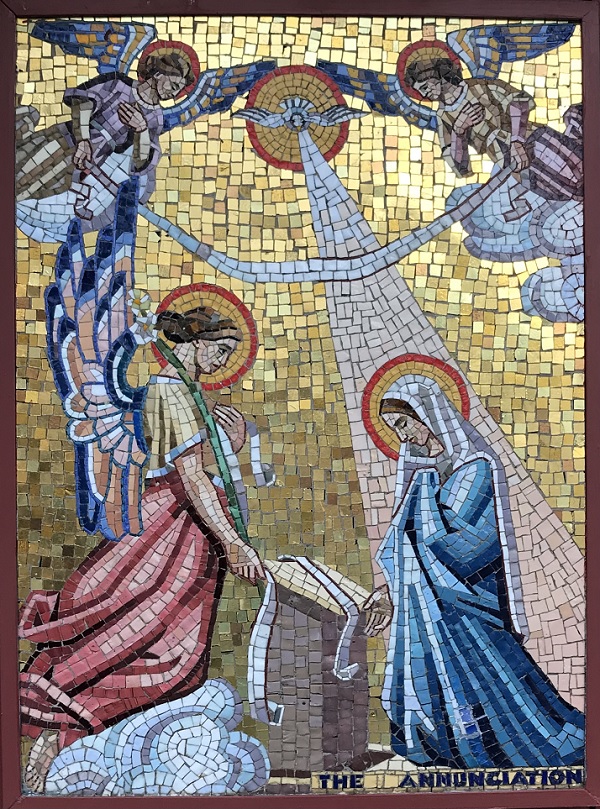
Today, March 25th, is the Solemnity of the Annunciation of the Lord. The readings for this day, are a reminder, “God is with us” (Isaiah 8:10), “for nothing will be impossible for God.” (Luke 1:37), and guidance to contemplate relationship with God. An opportunity to consider how one responds to the call of the ever present God of love, mercy, and redemption. What happens at the thought of “I come to do your will.” (Psalm 40:8a, 9a; Hebrews 10:7b, 9a), or Mary’s response of “Behold, I am the handmaid of the Lord.” (Luke 1:38)?
Spending time with the road traveled by the Prophet Isaiah, the Psalmist, Mary, and St. Paul, one can draw inspiration, perhaps more easily, because we know, or we can read about the ways in which God was with them and enabled them to fulfill the path that was theirs, in the face of trials and tribulations.
In the first reading for the Fifth Sunday of Lent, it is written, “I will put my spirit in you that you may live, and I will settle you upon your land; thus you shall know that I am the Lord. I have promised, and I will do it, says the Lord.” (Ezekiel 37:14).
The verses that follow this passage, are referred to as the joining of the two sticks. That is, God’s intention or call… God’s will for the tribes of Juda and Joseph to come together and for the people to be united.
“Thus says the Lord God: I will soon take the Israelites from among the nations to which they have gone and gather them from all around to bring them back to their land. I will make them one nation in the land, upon the mountains of Israel, and there shall be one king for them all. They shall never again be two nations, never again be divided into two kingdoms.” – Ezekiel 37:21-22
Thinking about this in terms of the division in families, communities, and the world at large today, in what ways do you see the Spirit of God shining through in your life, your community, and the world?
With the Lord there is mercy and fullness of redemption. – Psalm 130:7
Where do you experience love, mercy, and unity? And how do you desire to be an agent or a partner in not only carrying, but also sharing the essence of these attributes of God?
Looking around and sitting with personal challenges and the state of the world today can be daunting at times. There is much that is awry and issues that can seem insurmountable. With these realities it can be tempting to not look around or to not focus much attention or thought on the problems that exist. However, not ignoring what’s going on, is part of what it means to carry the cross—to live in reality, whatever it may be, praying and proceeding with hope that is eternal, and that resides in and seeks to be guided by God, for whom nothing is impossible.
As St. Paul writes, “If the Spirit of the one who raised Jesus from the dead dwells in you, the one who raised Christ from the dead will give life to your mortal bodies also, through his Spirit dwelling in you.” (Romans 8:11). How do you desire the Spirit of the Lord to be present to you at this moment? In what areas do you desire greater light and life?
In lots of ways, the times we are experiencing lend themselves to the deception that we are dealing with the impossible and that throwing the towel in, or walking away is the answer. Yet, faith beckons one to pause and to notice. Who or what is deeming the situation a lost cause? What is the source? Is it a human summation? From what spirit does it come?
In chapter 11 of the Gospel According to John, verses 1-45, we read about the raising of Lazarus. In order to go to the home of his good friends, Mary, Martha, and the now deceased Lazarus, Jesus must return to the town where people have tried to stone him, more than once. In addition, by the time Jesus arrives there, it has been four days since Lazarus’ lifeless body was placed in the tomb. Many would deem this situation hopeless or impossible. Why does Jesus go back to the place where he is mocked, and people are seeking his demise? Why does Jesus even attempt to raise Lazarus who is clearly beyond resuscitation?
Because Jesus is Life! He is full of love and mercy, the embodiment of God, and death, in any of its forms, cannot and will not defeat Him, or those who belong to Him. For it is through Him, that all things are possible.
Now a man was ill, Lazarus from Bethany, the village of Mary and her sister Martha. Mary was the one who had anointed the Lord with perfumed oil and dried his feet with her hair; it was her brother Lazarus who was ill. So the sisters sent word to him saying, “Master, the one you love is ill.” When Jesus heard this he said, “This illness is not to end in death, but is for the glory of God, that the Son of God may be glorified through it.” Now Jesus loved Martha and her sister and Lazarus. So when he heard that he was ill, he remained for two days in the place where he was. Then after this he said to his disciples, “Let us go back to Judea.” The disciples said to him, “Rabbi, the Jews were just trying to stone you, and you want to go back there?” Jesus answered, “Are there not twelve hours in a day? If one walks during the day, he does not stumble, because he sees the light of this world. But if one walks at night, he stumbles, because the light is not in him.” He said this, and then told them, “Our friend Lazarus is asleep, but I am going to awaken him.” So the disciples said to him, “Master, if he is asleep, he will be saved.” But Jesus was talking about his death, while they thought that he meant ordinary sleep. So then Jesus said to them clearly, “Lazarus has died. And I am glad for you that I was not there, that you may believe. Let us go to him.” So Thomas, called Didymus, said to his fellow disciples, “Let us also go to die with him.” When Jesus arrived, he found that Lazarus had already been in the tomb for four days. Now Bethany was near Jerusalem, only about two miles away. And many of the Jews had come to Martha and Mary to comfort them about their brother. When Martha heard that Jesus was coming, she went to meet him; but Mary sat at home. Martha said to Jesus, “Lord, if you had been here, my brother would not have died. But even now I know that whatever you ask of God, God will give you.” Jesus said to her, “Your brother will rise.” Martha said to him, “I know he will rise, in the resurrection on the last day.” Jesus told her, “I am the resurrection and the life; whoever believes in me, even if he dies, will live, and everyone who lives and believes in me will never die. Do you believe this?” She said to him, “Yes, Lord. I have come to believe that you are the Christ, the Son of God, the one who is coming into the world.” When she had said this, she went and called her sister Mary secretly, saying, “The teacher is here and is asking for you.” As soon as she heard this, she rose quickly and went to him. For Jesus had not yet come into the village, but was still where Martha had met him. So when the Jews who were with her in the house comforting her saw Mary get up quickly and go out, they followed her, presuming that she was going to the tomb to weep there. When Mary came to where Jesus was and saw him, she fell at his feet and said to him, “Lord, if you had been here, my brother would not have died.” When Jesus saw her weeping and the Jews who had come with her weeping, he became perturbed and deeply troubled, and said, “Where have you laid him?” They said to him, “Sir, come and see.” And Jesus wept. So the Jews said, “See how he loved him.” But some of them said, “Could not the one who opened the eyes of the blind man have done something so that this man would not have died?” So Jesus, perturbed again, came to the tomb. It was a cave, and a stone lay across it. Jesus said, “Take away the stone.” Martha, the dead man’s sister, said to him, “Lord, by now there will be a stench; he has been dead for four days.” Jesus said to her, “Did I not tell you that if you believe you will see the glory of God?” So they took away the stone. And Jesus raised his eyes and said, “Father, I thank you for hearing me. I know that you always hear me; but because of the crowd here I have said this, that they may believe that you sent me.” And when he had said this, He cried out in a loud voice, “Lazarus, come out!” The dead man came out, tied hand and foot with burial bands, and his face was wrapped in a cloth. So Jesus said to them, “Untie him and let him go.” Now many of the Jews who had come to Mary and seen what he had done began to believe in him. – John 11:1-45
Stepping out on an overcast night, part of the sky is aglow. It’s as if the moon, in its fullest state, is straining to be seen through the clouds. When, in actuality, the moon, in its fullest state, authentic as can be, is not held back by the clouds. Neither are we.
In chapter 5 of the Gospel According to Matthew, it is written, “Jesus said to his disciples: ‘I tell you, unless your righteousness surpasses that of the scribes and Pharisees, you will not enter the kingdom of heaven.’” (v. 20).
While the scribes and Pharisees were learned and appeared to be fastidious in their commitment to God and practice of the laws, many of them were missing the most important piece of the law. That is, the need to serve with love, compassion, and mercy. Without these components, an oath becomes empty words, the law loses its integrity, and hearts become self-righteous rather than righteous.
Jesus brings fulfillment through his authenticity. He doesn’t just talk about the Way, but he also lives it, inviting us to join him, and enabling us to strive toward love, compassion, and mercy, in all we do, while also being accountable. And when we accept the invitation, at the end of the day, not even the clouds or darkness hold us back.
“Love makes your soul crawl out from its hiding place.” ― Zora Neale Hurston
Jesus said to his disciples: “Do not think that I have come to abolish the law or the prophets. I have come not to abolish but to fulfill. Amen, I say to you, until heaven and earth pass away, not the smallest letter or the smallest part of a letter will pass from the law, until all things have taken place. Therefore, whoever breaks one of the least of these commandments and teaches others to do so will be called least in the kingdom of heaven. But whoever obeys and teaches these commandments will be called greatest in the kingdom of heaven. I tell you, unless your righteousness surpasses that of the scribes and Pharisees, you will not enter the kingdom of heaven.
“You have heard that it was said to your ancestors, You shall not kill; and whoever kills will be liable to judgment. But I say to you, whoever is angry with his brother will be liable to judgment; and whoever says to his brother, ‘Raqa,’ will be answerable to the Sanhedrin; and whoever says, ‘You fool,’ will be liable to fiery Gehenna. Therefore, if you bring your gift to the altar, and there recall that your brother has anything against you, leave your gift there at the altar, go first and be reconciled with your brother, and then come and offer your gift. Settle with your opponent quickly while on the way to court. Otherwise your opponent will hand you over to the judge, and the judge will hand you over to the guard, and you will be thrown into prison. Amen, I say to you, you will not be released until you have paid the last penny.
“You have heard that it was said, You shall not commit adultery. But I say to you, everyone who looks at a woman with lust has already committed adultery with her in his heart. If your right eye causes you to sin, tear it out and throw it away. It is better for you to lose one of your members than to have your whole body thrown into Gehenna. And if your right hand causes you to sin, cut it off and throw it away. It is better for you to lose one of your members than to have your whole body go into Gehenna.
“It was also said, Whoever divorces his wife must give her a bill of divorce. But I say to you, whoever divorces his wife – unless the marriage is unlawful – causes her to commit adultery, and whoever marries a divorced woman commits adultery.
“Again you have heard that it was said to your ancestors, Do not take a false oath, but make good to the Lord all that you vow. But I say to you, do not swear at all; not by heaven, for it is God’s throne; nor by the earth, for it is his footstool; nor by Jerusalem, for it is the city of the great King. Do not swear by your head, for you cannot make a single hair white or black. Let your ‘Yes’ mean ‘Yes,’ and your ‘No’ mean ‘No.’ Anything more is from the evil one.”
Pieces, everything comes in pieces. Our coming and our going, Who we are and what we do, Hours, minutes, seconds of each day. Sometimes, taken as a whole, Might we miss or gloss over gold, The little things as not worth the time of day? Though precious is each moment, Taken alone and on its own, Might we miss or gloss over gold, The broader view as just another day? Pieces, broken down and shared, Everything is pieces, Of a picture big and small, Glossy gold and full of glimpses, Captured best holding one another, Drawing strength and beauty altogether, Being grateful for it all.
“Everything that is in the heavens, on earth, and under the earth is penetrated with connectedness, penetrated with relatedness.” – Hildegard Von Bingen
An Advent Prayer: Lord, help me to hold the pieces of my life together, big and small, easy and challenging and all that falls between, with great love and care, trusting that it is really You, the King of Glory (Ps 24:10b), who holds them all… who holds us all. And help me to continue to look to you, that you may grant me the grace to notice and appreciate the beauty and goodness of all creation, and the heart and soul of those I encounter each day.
At the beginning of the Gospel reading for the Second Sunday of Advent (Matthew 3:1-12) there is a description of the “voice crying out in the desert, prepare the way of the Lord, make straight his paths” (verse 3). We read that John the Baptist is outfitted in camel hair clothing and has a “wild” diet of grasshoppers (a.k.a. locusts) and honey. Based solely on this physical description and his location in the desert, it’s easy to envision John as having a gruff or primitive appearance. Yet, there were many people who traveled to be baptized by him. So, what was it that drew them to him?
Imagine someone dressed in clothing made from material that was typically used for making cloaks, tents, and carpets and eating bugs and wild honey telling you to get ready… to straighten up and make a proper path for the Lord. What would you notice first? What would you think? How would you respond?
What obstacles are there to looking at the appearance of John the Baptist, and seeing the heart of a faithful servant of God, or a guardian angel pointing out the way?
Oftentimes, we can become conditioned by our surroundings, social circles, and society in general as to how people or things should look, act, or speak. However, these expectations not only make it easier to miss the spirit and the heart of those we encounter along the way, but also make it easier to be misled or go astray. When thinking about preparing, an ideal image or notion of what should be may come to mind, and although it may be helpful to have a sense or an idea about things, it’s important to always leave a little space to prayerfully ponder that which is different, unknown, or unfamiliar.
An Advent Prayer: Lord, in a world that seeks to glorify based on appearances and all that fades, help me to go with Your grain, instead of society’s. Help me to overcome any obstacles that may prevent me from seeing beyond appearances. Help me to look to You and grant me the grace to notice and appreciate the beauty and goodness of all creation, and the heart and soul of those I encounter each day.
John the Baptist appeared, preaching in the desert of Judea and saying, “Repent, for the kingdom of heaven is at hand!” It was of him that the prophet Isaiah had spoken when he said: A voice of one crying out in the desert, Prepare the way of the Lord, make straight his paths. John wore clothing made of camel’s hair and had a leather belt around his waist. His food was locusts and wild honey. At that time Jerusalem, all Judea, and the whole region around the Jordan were going out to him and were being baptized by him in the Jordan River as they acknowledged their sins.
When he saw many of the Pharisees and Sadducees coming to his baptism, he said to them, “You brood of vipers! Who warned you to flee from the coming wrath? Produce good fruit as evidence of your repentance. And do not presume to say to yourselves, ‘We have Abraham as our father.’ For I tell you, God can raise up children to Abraham from these stones. Even now the ax lies at the root of the trees. Therefore every tree that does not bear good fruit will be cut down and thrown into the fire. I am baptizing you with water, for repentance, but the one who is coming after me is mightier than I. I am not worthy to carry his sandals. He will baptize you with the Holy Spirit and fire. His winnowing fan is in his hand. He will clear his threshing floor and gather his wheat into his barn, but the chaff he will burn with unquenchable fire.” – Matthew 3:1-12













 HopeThatFloats
You must be logged in to post a comment.