Working my way around, whether by chance or fate, again, once more, I hear, reverberations of, not stern warnings, but of wise voices of the past.
Just as justice for one, affects justice for all, mercy and compassion make the way to goodwill; offspring of love, made by, an even greater Love.
“From my point of view, God is the light that illuminates the darkness, even if it does not dissolve it, and a spark of divine light is within each of us.” – Pope Francis
“Christ is risen from the dead, and by His death He has trampled upon death, and has given live to those, who are in the tombs.” – the Troparion of Pascha
Taking it on the level, as only You, Lord, can do. Giving what humanity, can only aspire to grasp.
Falling down, then getting up, pushed time upon time again. Light of Life into darkness, You brought life—heart, mind, and soul.
Impostors come, and they go, but Your Spirit, Lord, remains. Waiting our reception, Lord, not for one, but for the many.
As the days passed by, the flowers, still bright, holding onto life, begin to show the length of days and nights, separate, away from the source of life.
Leaves dropping from stems, petals shriveling, on the outside first. Time ticks, closing in. Hold on as they may, away from their roots, they limp as they linger.
In the First Reading for the Seventh Sunday in Ordinary Time (1 Samuel 26:2, 7-9, 12-13, 22-23), David and Abishai find themselves in a position of advantage, having the opportunity to kill Saul, who, along with his soldiers are in a deep sleep. However, despite Saul having grown distant from who he was at the beginning of his rule, and having become David’s enemy, David restrains himself and shows mercy. He says to Abishai, “Do not harm him, for who can lay a hand on the Lord’s anointed and remain innocent?” (v. 9).
Spend some time with the first reading and consider that as beings created in God’s image, in a sense, we are all anointed.
The response for the Psalm is, “The Lord is kind and merciful.” (Psalm 103:8). Reflect on the ways that the Lord has been kind and merciful to you. How does your experience inspire you in terms of the way you view situations and people? In what ways do you feel compelled to be kind and merciful to others? Are there areas where the Lord might want to work with you on expanding upon or reassessing this?
Turning to the Second Reading (1 Corinthians 15:45-49), St. Paul writes of Adam and Jesus, but he is also writing about the call to conversion and discipleship.
As was the earthly one, so also are the earthly, and as is the heavenly one, so also are the heavenly. Just as we have borne the image of the earthly one, we shall also bear the image of the heavenly one. – verses 48-49
Envisioning your life as one line and the events/happenings during your life as another line on a continuum, think about the major events/happenings that have had a direct impact on you. What’s the difference between the times when you have maintained a sense of inner strength (or know-how) and peace, and the times you haven’t?
In the Gospel Reading (Luke 6:27-38), Jesus reminds us that Love is what sustains us. Not embracing cynicism, seeking or plotting revenge, settling or keeping scores. Rather, those are the things that tear us away from Love and the root of goodness and life—God.
How might you draw closer to Love in the challenges you face today? And how might the Lord desire to join you in an area of challenge?
The Lord is kind and merciful, slow to anger, abounding in mercy. – Psalm 103:8
Blessed are we, created in the image of the Lord, Who comes down from the mountain, To stand with us on level ground. Bestower of grace on all, Willing spirits will receive Him. Words of Wisdom and Hope He speaks, Bringing Light and Life to the soul.
Care for the poor, Feed the hungry, Comfort those in need. Way of ways, it is not easy.
Hold fast to only One—the Lord. Falling not for hollow banter, Careful of the ruse; it’s not True. Look not to glorify others, Rather, seek Wisdom from the Source. Big and bold isn’t always best, and Stay awake is what the Lord commanded.
From where chaos comes, Base passion and design, Stirring ill will, division, Seeds sowing lies. Looking, always looking, To seep and settle in.
From where chaos spreads, Human passions and designs, From what we, as masters, embrace, What we give into, And what we withstand.
From where peace comes, Divine passion and design. Love weaving in and out, Through time and space. Ushering good tidings, Encouraging good will.
From where peace spreads, Human passions and designs, From what we, as servants, embrace, What we give into, And what we withstand.
“Until he extends his circle of compassion to include all living things, man will not himself find peace.” – Albert Schweitzer
For where jealousy and selfish ambition exist, there is disorder and every foul practice. But the wisdom from above is first of all pure, then peaceable, gentle, compliant, full of mercy and good fruits, without inconstancy or insincerity. And the fruit of righteousness is sown in peace for those who cultivate peace. – James 3:16-18
It is written in the Book of Wisdom, “God did not make death, nor does he rejoice in the destruction of the living.” (Wisdom 1:13). As ones created in the image of God, we are to live and behave as such. And while an eye for an eye or “getting even” may be tempting at times, it can lead to the destruction of another of God’s creation and can create a false sense of satisfaction, neither of which are in line with the image of God, or life giving.
In the second reading for the Thirteenth Sunday in Ordinary Time, St. Paul reminds the Corinthians that there is much more to discipleship than what one believes, what one knows, says, and does, and one’s conviction. It is the spirit in which one lives, and that guides one.
St. Paul writes, “For you know the gracious act of our Lord Jesus Christ, that though he was rich, for your sake he became poor, so that by his poverty you might become rich. Not that others should have relief while you are burdened, but that as a matter of equality your abundance at the present time should supply their needs, so that their abundance may also supply your needs, that there may be equality.” (2 Corinthians 8:9, 13-14).
It is only fitting that those created in God’s image be mindful of disparity and strive to recognize and honor the image of God in others, and therefore work toward, encourage, and support equality. The mindset that St. Paul is encouraging is not new. In fact, he writes, “As it is written: ‘Whoever had much did not have more, and whoever had little did not have less.'” (2 Corinthians 8:15). He is referring to the Book of Exodus (Ex 16:18) and how the Manna (the nourishment that God provided for Moses and Israelites) was allotted. It did not matter how much or how little one person gathered, there was enough for everyone to have what they needed. Not only that, but also there was great awareness that it was all provided through the goodness—love and mercy—of God.
One could not think of what they collected as belonging to oneself, but rather as being provided by God, and as one created in the image of God, it was to be shared and for everyone to partake of. There was to be equality, or equity, in terms of everyone having what they needed to not only survive, but to keep moving along the journey.
Turning to the Gospel passage (Mark 5:21-43), again we can see that it’s all about equity. A synagogue official’s daughter is on her death bed, and he begs Jesus to heal her, “Please, come lay your hands on her that she may get well and live.” Jesus begins to follow Jairus. They are moving through the heavy crowd when a woman who also needs Jesus’s help touches his cloak saying, “If I but touch his clothes, I shall be cured.”
One can imagine, especially given that period of time in history, that as a man and a synagogue official, Jairus would be able to gain Jesus’s attention and position himself to have access to Jesus more easily than the woman. Both Jairus (or his daughter) and the woman need healing, but each needs to approach the situation differently because of their circumstances. To Jesus, it doesn’t matter who got to him first or last, or who has more or less (power, possessions, status, etc.). As with God’s grace, Jesus’s healing is equitable and those who approach in faith get what they need—the woman’s hemorrhaging comes to an end and Jairus’s daughter is raised by Jesus. How do you relate to Jairus and/or the woman with a hemorrhage in terms of approach and asking in prayer?
Oftentimes, when thinking about faith and asking for something, it can be can easy to only think in terms asking God or Jesus for what one needs or wants. However, being created in the image of God, we are called to also look at the other side of this. Take some time to pray and reflect on the spirit in which you respond when it comes the needs and wants of others. In what ways does Jesus’s sense of equality and equity increase your faith and inspire you?
Sing praise to the Lord, you faithful; give thanks to his holy memory. For his anger lasts but a moment; his favor a lifetime. At dusk weeping comes for the night; but at dawn there is rejoicing. – Psalm 30:5-6
The readings for the Third Sunday of Lent can be seen as a call to pay attention to the nature of relationships and what they lead or point to. In the First Reading (Exodus 20:1-17), God delivers the commandments, which are seemingly clear instructions, and by adhering to them, the people will prosper. Notice how God’s mercy far outweighs any punishment.
For I, the Lord, your God, am a jealous God, inflicting punishment for their ancestors’ wickedness on the children of those who hate me, down to the third and fourth generation; but showing love down to the thousandth generation of those who love me and keep my commandments. (Ex 20:5-6)
Also, notice that punishment is reserved for “those who hate me,” and their children. Hate is a pretty strong word and one can imagine some sort of pattern or learned behavior to reach that point or designation. In that light, perhaps this passage can be viewed as a Lenten invitation to be mindful of one’s actions, the sentiments from which they come, and what they might teach.
Looking at the Responsorial Psalm (Psalm 19:8-11), the response is “Lord, you have the words of everlasting life.” (Jn 6:68c). Again, drawing us to God’s words as priceless and wrapping up by trying to convey just how valuable they are: They are more precious than gold, than a heap of purest gold; sweeter also than syrup or honey from the comb. (Ps 19:11).
As for verses 8-10 of the Psalm, the first part of each line refers to the Lord’s “rules”—laws, decrees, precepts, commands, reverence, and ordinances. The second part of each phrase or sentence provides guidance by giving indicators that one can use to try to determine if they are obeying and honoring the Lord. How? By evaluating the situation and answering the question: Do I experience or have a sense of a refreshed soul/peace, wisdom, a rejoicing heart, enlightenment, endurance/inner strength, truth, or justice?
The law of the Lord is perfect, refreshing the soul; The decree of the Lord is trustworthy, giving wisdom to the simple.
The precepts of the Lord are right, rejoicing the heart; the command of the Lord is clear, enlightening the eye.
The fear of the Lord is pure, enduring forever; the ordinances of the Lord are true, all of them just.
In the Second Reading (1 Corinthians 1:22-25), St. Paul is encouraging the Corinthians, and us, to be careful about the way we go about seeking signs and wisdom. God certainly uses people, situations, and things to accomplish tasks and impart wisdom, however, as St. Paul says, “we proclaim Christ crucified.” That means, there is no substituting human thoughts, ideas, goals, etc. for God’s will and wisdom as the source or root that one allows to resonate with and guide their soul. Ultimately, things come down to what happens between each person and God, and one is not to blindly follow others thus giving what belongs to or originates with God (one’s soul and will) to another human being and/or their agenda.
In what ways do you take each situation to prayer with an openness to the fact that what is right and just in one situation may not be right and just or the best way in another situation? What’s it like to consider that the “rules” and their application are shaped by God’s love and mercy, and that this is by God’s design? In what ways do you leave room for love and mercy in situations and decisions?
Turning to the Gospel passage referred to as the Cleansing of the Temple (John 2:13-25), we can see Jesus’ disavowal of the perversion of the Temple and the rules and practices around and within it. The focus has become all about transactions and status. Jesus drives everyone out, saying to those profiting at the expense of the poor—those selling doves, “Take these out of here, and stop making my Father’s house a marketplace.” (Jn 2:16). In the verses that follow, Jesus refers to his body as the temple and foreshadows his crucifixion and resurrection. The passage ends with:
But Jesus would not trust himself to them because he knew them all, and did not need anyone to testify about human nature. He himself understood it well. (Jn 2:24-25)
Envision Jesus, who is the source of salvation and redemption, entering the temple area of your life—your heart. Imagine yourself receiving the peace, inner strength, and wisdom of Jesus as you sit together. What would you share? And, what would He who understands human nature well, impart to you in terms of what to drive out and what to keep?
The readings for the Second Sunday of Lent take us on a journey from sacrifice or letting go to service, embracing identity, and finally becoming one with it. In the first reading, Abraham shows a willingness to sacrifice or let go of whatever his ideas or plans might have been to listen to God and do as God asks (Genesis 22:1-18). Remember, Sarah and Abraham, in their more senior years and against all odds, had their son Isaac after having been barren. Imagine what it must have been like for Abraham to then be asked to sacrifice or let go of his and Sarah’s long-awaited arrival. Yet, Abraham exemplifies a faith that places trust in God (and God alone) above all. He proceeds to take steps toward what God has asked of him. As they left the servants behind and walked along, Isaac asks his father where the sheep is for their offering. Abraham replies, “God will provide the sheep for the burnt offering.” Once they finish building an altar and placing the wood, Abraham moves toward sacrificing his and Sarah’s only child. However, the angel stops him as Isaac’s demise is not what God wills. As Abraham said, God does provide the sheep for sacrifice: “Abraham looked up and saw a single ram caught by its horns in the thicket. So Abraham went and took the ram and offered it up as a burnt offering in place of his son.” And the wisdom of his response to God’s requests and promptings shows that being faithful is to nurture a will that is open to and guided by God. For it is this kind of will that does not lead to demise or destruction.
Continuing to look to what it is to be faithful to God, the response for the Psalm is “I will walk before the Lord, in the land of the living” (Psalm 116:9). How do you feel motivated by Abraham’s example of striving to serve God with a united heart and mind? Try to envision or embody the spirit of walking before God in all that you say and do this week.
Turning to the second reading (Romans 8:31b-34), St. Paul encourages us to remember and embrace our identity when he writes: “If God is for us, who can be against us?” When one is operating with a desire to do God’s will and in the scope of being part of creation in God’s image, there is a sense of inner strength, awareness, and reverence for what is good and just while at the same time a sense of lightness and freedom or free will. It is important to pause every so often to examine what’s going on internally and from where one’s words and actions are flowing. Invite Jesus to the conversation and ask the Lord for the grace to be aligned compatibly with God in each situation you face.
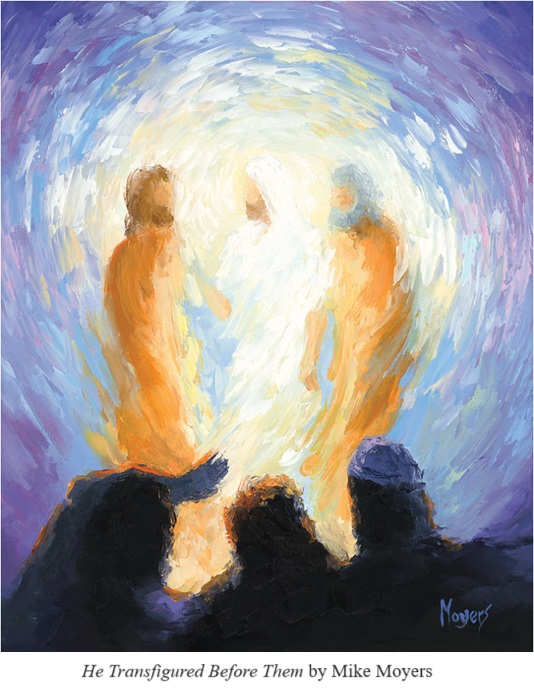
In this week’s Gospel, we read about the Transfiguration of Jesus (Mark 9:2-10), the ultimate image of embracing one’s identity and becoming one with it for the greater good.
Jesus took Peter, James, and John and led them up a high mountain apart by themselves. And he was transfigured before them, and his clothes became dazzling white, such as no fuller on earth could bleach them. Then Elijah appeared to them along with Moses, and they were conversing with Jesus. Then Peter said to Jesus in reply, “Rabbi, it is good that we are here! Let us make three tents: one for you, one for Moses, and one for Elijah.” He hardly knew what to say, they were so terrified. Then a cloud came, casting a shadow over them; from the cloud came a voice, “This is my beloved Son. Listen to him.” Suddenly, looking around, they no longer saw anyone but Jesus alone with them.
As they were coming down from the mountain, he charged them not to relate what they had seen to anyone, except when the Son of Man had risen from the dead. So they kept the matter to themselves, questioning what rising from the dead meant. – Mark 9:2-10
Recall a time where you felt affirmed or reaffirmed and had a sense of confidence in who you are as God’s beloved, leading to spiritual growth or renewal. Ask the Lord for the grace of that experience to extend to today, offering you wisdom, insight, and openness to whatever you may need.
The Gospel reading for the Fourth Sunday in Ordinary Time follows Jesus and the first disciples (Simon, Andrew, James and John called away from mending their fishing nets) as they enter into Capernaum, the place whose name means “village of comfort”. In this passage from the Gospel According to Mark (chapter 1, verses 21-28), Jesus’ way of being and his teaching capture the attention of the people. What he offers is new and different and comes with signs, as Jesus and the disciples enter a synagogue where he teaches with authenticity and frees a man who is under the hold of an unclean spirit.
Then they came to Capernaum, and on the sabbath Jesus entered the synagogue and taught. The people were astonished at his teaching, for he taught them as one having authority and not as the scribes. In their synagogue was a man with an unclean spirit; he cried out, “What have you to do with us, Jesus of Nazareth? Have you come to destroy us? I know who you are—the Holy One of God!” Jesus rebuked him and said, “Quiet! Come out of him!” The unclean spirit convulsed him and with a loud cry came out of him. All were amazed and asked one another, “What is this? A new teaching with authority. He commands even the unclean spirits and they obey him.” His fame spread everywhere throughout the whole region of Galilee. – Mk 1:21-28
It’s interesting to consider this passage in terms of human nature. Presumably the people in Capernaum (village of comfort), know one another. What do you imagine it was like when Jesus and his disciples, strangers, entered their space in general, but more specifically, their sacred space—the synagogue? How do you respond when someone new or unknown enters your space? What kinds of things determine your response?
Returning to the Gospel, in this passage one can infer that the people in the synagogue were drawn to Jesus and his message because despite being in the village of comfort, beyond the surface, their real needs were not being met.
“The people were astonished at his teaching, for he taught them as one having authority and not as the scribes.”
What Jesus was saying, as he taught, spoke to the people of Capernaum. His words and his way touch their hearts, and they recognize him as being authentic. Reflecting on this past week, what kinds of words and things, and who, has touched your heart? What tends to strike a chord with you?
Coming back to the Gospel and the synagogue, next there is a man with an unclean spirit. Notice how the man and the spirit influencing him are intertwined. The man cries out, but the pronoun is “us”.
“he cried out, “What have you to do with us, Jesus of Nazareth? Have you come to destroy us?”
Yet, drawn into the presence of Jesus, the two become distinguishable. And, of everyone who is present (outside of the disciples), it is only the unclean spirit who recognizes and names what’s really happening. The unclean spirit knows who Jesus is, and perhaps, senses its doom.
I know who you are—the Holy One of God!
In what ways do you invite Jesus to help you discern and recognize situations where good and evil may have become intertwined?
Jesus expels the unclean spirit, setting the man free. The people are in awe and try to make sense of what they have witnessed. Word of Jesus spreads as they recognize Jesus’ way as being both new and powerful, or authoritative. Are they caught up in Jesus’ way, in the way the unclean spirit obeyed him, in Jesus being the Holy One of God?… What is it that is moving them and leads to Jesus becoming famous? What are they celebrating?
Revisit the things that tend to strike a chord with you and ask Jesus to reveal the places of comfort that may be creating a cloud of disguise and interfering with what is best. Express your desire to be led by the Light of God. Ask Jesus to help you to know what is influencing you.
The people who sit in darkness have seen a great light; on those dwelling in a land overshadowed by death, light has arisen. – Matthew 4:16
The 3rd Sunday of Advent is referred to as Gaudete Sunday, as we move closer to Christmas, anticipating the joy and celebration of the birth of Jesus, the new Adam. The readings for this Sunday (Isaiah 61:1-2A, 6-7; Responsorial Psalm – Luke 1:46-50, 53-54, 1 Thessalonians 5:16-24, and John 1:6-8, 19-28) call upon us to embrace and rejoice in the Spirit of the Lord. What does that look like? How do you know when you’re embracing and rejoicing in the Spirit of the Lord?
In the Gospel, John the Baptist is asked by priests and Levites, “Who are you?” (John 1:22). Part of John’s response is, “I am the voice of one crying out in the desert, ‘make straight the way of the Lord,’” (John 1:23). Reflecting on John’s response, what do you imagine it was like for him? How would you respond to the question, “Who are you?” In what ways would your response be the same or different depending on who asks the question?
What’s it like to ponder that the same God who created John and inspired his words and actions, desires to do the same for all of us?
Continuing to consider this, in what places or situations do you desire your words and actions to be influenced more by God? What are the places or situations where you experience peace, joy, and a sense that your desire and God’s are united?
Prayer: Gracious and merciful Lord, over the course of the next few weeks, with all the busyness of the Advent and Christmas Season, help us to be open to your inspiration and to cooperate with the glue that is your Grace, so that we might discover that there is joy in each moment.
“Man is born broken; he lives by mending. The grace of God is the glue.” – Eugene O’Neill
You must be logged in to post a comment.