Trees straight ahead standing tall, Making way for what may come, What was, and what is beyond. So willing to share the scene With the bright and countless leaves.
Together in their welcome To fellow lives passing through, Trees and leaves hold each other, One another, as Love holds them too.
The Lord is a God of justice, who knows no favorites. – Sirach 35:12
What’s known, And what is not. Calculating possibilities.
Looking then leaping, A snapshot in time. Measuring risk, and seeking reward.
Guarantees, Warranties, Yet, nothing is certain.
The seeker being sought, The Sought, searching seekers. Meeting up, teeing up, And, finding what is lost.
“…to live in a manner worthy of the call you have received, with all humility and gentleness, with patience, bearing with one another through love, striving to preserve the unity of the spirit through the bond of peace…” – Ephesians 4:1-3
In the Gospel for the Fourteenth Sunday in Ordinary Time (Mark 6:1-6), as Jesus is teaching in the synagogue in Nazareth (his hometown), the people there are rather cynical due to their preconceived notions about what someone teaching with authority needs to be or look like, or where they need to come from. This is nothing new though. A common misstep of humankind throughout history has often been allowing for the appearance of strength, status, or other superficial measures to supersede the things that really matter, such as substance.
In this Gospel passage, we learn that Jesus couldn’t do much in Nazareth. It is written of Jesus, “He was amazed by their lack of faith.” What do you think is meant by that? What do you think made the people so closed off to Jesus, his approach, and what he was trying to teach them?
Whatever it was, there was a lack of openness to the Spirit of God exuding from Jesus. Perhaps the people couldn’t accept his words as truth or take to heart and ponder them, because they challenged them to consider things differently. However, with God, relationships are all about being mutual. And so, Jesus works with those in Nazareth who are open to the Spirit, and then moves on to places where the people are more open to him and the Way. Nothing is forced upon the Nazoreans, or those who disagree, and as always, Jesus models an example of respecting free will and trusting his Father to be the ultimate judge and decider of their fate. Anything else would lead to Jesus putting himself over God and would lead to further division and chaos.
Jesus can see this, but most of the people in the synagogue are too caught up in their own ideas and ideologies to notice the substance of Jesus’s teaching. Perhaps they recognize that it’s more than just another day in the synagogue, but their faith has shifted into a fixed version of the way things ought to be based on what they can wrap their minds around, rather than remaining fixed on God and, therefore, flexible to receive the Spirit’s guidance toward what may be new and different but is still of God.
When one comes to expect, or demands, the same of every day or has become self-centered and self-preserving above all else, faith becomes stagnant and fixed, for with God, Jesus, and the Holy Spirit, there’s always something happening for the good of all, there is breadth and depth, there is newness and life… there is acceptance, and it is always more than just another day.
Therefore, I am content with weaknesses, insults, hardships, persecutions, and constraints, for the sake of Christ; for when I am weak, then I am strong. – 2 Corinthians 12:10
A long time ago, in a place that’s near, but that seems so far away, an experience that left a lasting impression occurred. I was preparing to leave for college orientation and one of my aunts was at my family’s home visiting. She came into mine and my sister’s room as I was packing some clothes and we had a conversation. I don’t recall how long it lasted or even what we were talking about, but I do recall how it felt to have here there. She was so caring and genuinely interested in being present to me in those moments. I often think of that day with fondness and remember feeling so loved by her, both then, and every time it’s come to mind since then. There were pearls of wisdom, simply in her presence.
I’m not sure that I ever told her how much that time together meant to me, but I will always remember it, along with her hugs, as if embracing one with all her heart and soul—the very definition of Love.
In the second reading for the 7th Sunday of Easter (1 John 4:11-16), it is written:
“Beloved, if God so loved us, we also must love one another. No one has ever seen God. Yet, if we love one another, God remains in us, and his love is brought to perfection in us.”
Consider taking some time to reflect on the verses above and how they come into play in daily life including interactions with those who are known by you and those who are yet to be known by you (strangers). In what ways might you better cooperate with God in working to bring love to perfection in you as well as through you?
The readings for the Second Sunday of Lent take us on a journey from sacrifice or letting go to service, embracing identity, and finally becoming one with it. In the first reading, Abraham shows a willingness to sacrifice or let go of whatever his ideas or plans might have been to listen to God and do as God asks (Genesis 22:1-18). Remember, Sarah and Abraham, in their more senior years and against all odds, had their son Isaac after having been barren. Imagine what it must have been like for Abraham to then be asked to sacrifice or let go of his and Sarah’s long-awaited arrival. Yet, Abraham exemplifies a faith that places trust in God (and God alone) above all. He proceeds to take steps toward what God has asked of him. As they left the servants behind and walked along, Isaac asks his father where the sheep is for their offering. Abraham replies, “God will provide the sheep for the burnt offering.” Once they finish building an altar and placing the wood, Abraham moves toward sacrificing his and Sarah’s only child. However, the angel stops him as Isaac’s demise is not what God wills. As Abraham said, God does provide the sheep for sacrifice: “Abraham looked up and saw a single ram caught by its horns in the thicket. So Abraham went and took the ram and offered it up as a burnt offering in place of his son.” And the wisdom of his response to God’s requests and promptings shows that being faithful is to nurture a will that is open to and guided by God. For it is this kind of will that does not lead to demise or destruction.
Continuing to look to what it is to be faithful to God, the response for the Psalm is “I will walk before the Lord, in the land of the living” (Psalm 116:9). How do you feel motivated by Abraham’s example of striving to serve God with a united heart and mind? Try to envision or embody the spirit of walking before God in all that you say and do this week.
Turning to the second reading (Romans 8:31b-34), St. Paul encourages us to remember and embrace our identity when he writes: “If God is for us, who can be against us?” When one is operating with a desire to do God’s will and in the scope of being part of creation in God’s image, there is a sense of inner strength, awareness, and reverence for what is good and just while at the same time a sense of lightness and freedom or free will. It is important to pause every so often to examine what’s going on internally and from where one’s words and actions are flowing. Invite Jesus to the conversation and ask the Lord for the grace to be aligned compatibly with God in each situation you face.
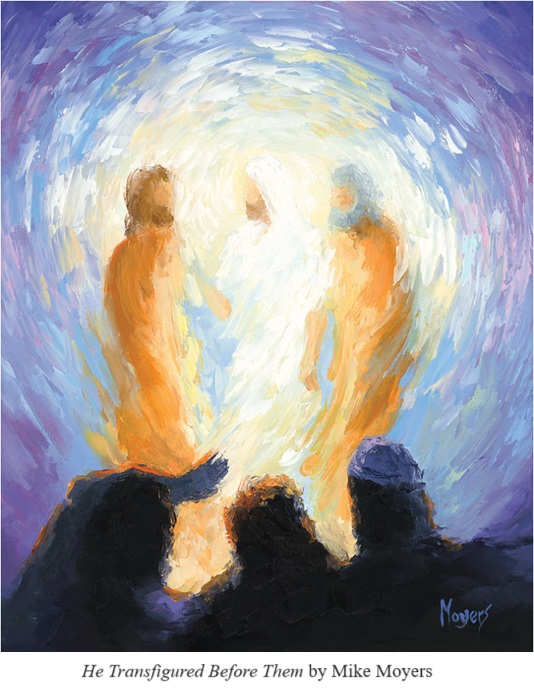
In this week’s Gospel, we read about the Transfiguration of Jesus (Mark 9:2-10), the ultimate image of embracing one’s identity and becoming one with it for the greater good.
Jesus took Peter, James, and John and led them up a high mountain apart by themselves. And he was transfigured before them, and his clothes became dazzling white, such as no fuller on earth could bleach them. Then Elijah appeared to them along with Moses, and they were conversing with Jesus. Then Peter said to Jesus in reply, “Rabbi, it is good that we are here! Let us make three tents: one for you, one for Moses, and one for Elijah.” He hardly knew what to say, they were so terrified. Then a cloud came, casting a shadow over them; from the cloud came a voice, “This is my beloved Son. Listen to him.” Suddenly, looking around, they no longer saw anyone but Jesus alone with them.
As they were coming down from the mountain, he charged them not to relate what they had seen to anyone, except when the Son of Man had risen from the dead. So they kept the matter to themselves, questioning what rising from the dead meant. – Mark 9:2-10
Recall a time where you felt affirmed or reaffirmed and had a sense of confidence in who you are as God’s beloved, leading to spiritual growth or renewal. Ask the Lord for the grace of that experience to extend to today, offering you wisdom, insight, and openness to whatever you may need.
In a few days, it will be Valentine’s Day, the holiday synonymous with hearts and love. It will also be Ash Wednesday, the start of the Lenten season, known by its call for prayer, almsgiving and fasting, all aimed at drawing closer to Jesus, growing in awareness of falsities that hold one back, and trying to shed them. Both occasions, despite the differences in how they are celebrated, come down to love, whose source is God, and the ways in which it is expressed, received, nurtured within, and responded to.
While one might associate Valentine’s Day more with romantic love, there’s no denying that it, as true love in any variation, often extends and ripples outward in positive ways, affecting those beyond the initial recipient. With Ash Wednesday and during Lent, a more concerted effort is made to strive to recognize and overcome, through God’s grace, whatever may be interfering or holding back the love one has received from flowing more fully and freely so as to make them more Christlike in their way of being.
The Gospel passage for the Sixth Sunday in Ordinary Time provides an opportunity to reflect on what might be referred to as the beginning of love—kindness. If love is an open door to the heart, kindness is the door cracked open, just enough to check it out and consider the other, allowing the heart and soul to be moved into action that shows care.
In the following Gospel passage, we read about Jesus curing a leper. Again, as in other passages where he heals and cures people, we see the kindness of Jesus, who is “moved with pity”.
A leper came to Jesus and kneeling down begged him and said, “If you wish, you can make me clean.” Moved with pity, he stretched out his hand, touched him, and said to him, “I do will it. Be made clean.” The leprosy left him immediately, and he was made clean. Then, warning him sternly, he dismissed him at once.
He said to him, “See that you tell no one anything, but go, show yourself to the priest and offer for your cleansing what Moses prescribed; that will be proof for them.”
The man went away and began to publicize the whole matter. He spread the report abroad so that it was impossible for Jesus to enter a town openly. He remained outside in deserted places, and people kept coming to him from everywhere. – Mark 1:40-45
Keep in mind that the man with leprosy would have been living away from others, perhaps as part of a leper colony. It seems he would have felt like and been treated as an outcast. What else do you think a leper or outcast might experience?
Upon being healed, the leper could once again join the fold. Imagine his thoughts and feelings over now being allowed to be part of and engage with a broader community. What would that be like? How would you feel and react, given a similar experience?
Spend some time reflecting on the kindness of Jesus. What would Jesus remember most about the leper, his condition, and the way He was approached by him? What do you imagine Jesus’ response or reaction would be to the leper telling everyone and anyone about Jesus healing him, leading to Jesus having to remain “outside in deserted places”?
As the days of Lent draw closer, are there areas in your life where you feel challenged when it comes to receiving or giving with a heart full of kindness rather than a sense of obligation, duty, etc.? When it comes to this, in what ways do you desire to experience the kindness of Jesus? How might your kindness, or inclination toward it, remain balanced while also continuing to evolve more fully into love?
At the beginning of the Gospel reading for the Second Sunday of Advent (Matthew 3:1-12) there is a description of the “voice crying out in the desert, prepare the way of the Lord, make straight his paths” (verse 3). We read that John the Baptist is outfitted in camel hair clothing and has a “wild” diet of grasshoppers (a.k.a. locusts) and honey. Based solely on this physical description and his location in the desert, it’s easy to envision John as having a gruff or primitive appearance. Yet, there were many people who traveled to be baptized by him. So, what was it that drew them to him?
Imagine someone dressed in clothing made from material that was typically used for making cloaks, tents, and carpets and eating bugs and wild honey telling you to get ready… to straighten up and make a proper path for the Lord. What would you notice first? What would you think? How would you respond?
What obstacles are there to looking at the appearance of John the Baptist, and seeing the heart of a faithful servant of God, or a guardian angel pointing out the way?
Oftentimes, we can become conditioned by our surroundings, social circles, and society in general as to how people or things should look, act, or speak. However, these expectations not only make it easier to miss the spirit and the heart of those we encounter along the way, but also make it easier to be misled or go astray. When thinking about preparing, an ideal image or notion of what should be may come to mind, and although it may be helpful to have a sense or an idea about things, it’s important to always leave a little space to prayerfully ponder that which is different, unknown, or unfamiliar.
An Advent Prayer: Lord, in a world that seeks to glorify based on appearances and all that fades, help me to go with Your grain, instead of society’s. Help me to overcome any obstacles that may prevent me from seeing beyond appearances. Help me to look to You and grant me the grace to notice and appreciate the beauty and goodness of all creation, and the heart and soul of those I encounter each day.
John the Baptist appeared, preaching in the desert of Judea and saying, “Repent, for the kingdom of heaven is at hand!” It was of him that the prophet Isaiah had spoken when he said: A voice of one crying out in the desert, Prepare the way of the Lord, make straight his paths. John wore clothing made of camel’s hair and had a leather belt around his waist. His food was locusts and wild honey. At that time Jerusalem, all Judea, and the whole region around the Jordan were going out to him and were being baptized by him in the Jordan River as they acknowledged their sins.
When he saw many of the Pharisees and Sadducees coming to his baptism, he said to them, “You brood of vipers! Who warned you to flee from the coming wrath? Produce good fruit as evidence of your repentance. And do not presume to say to yourselves, ‘We have Abraham as our father.’ For I tell you, God can raise up children to Abraham from these stones. Even now the ax lies at the root of the trees. Therefore every tree that does not bear good fruit will be cut down and thrown into the fire. I am baptizing you with water, for repentance, but the one who is coming after me is mightier than I. I am not worthy to carry his sandals. He will baptize you with the Holy Spirit and fire. His winnowing fan is in his hand. He will clear his threshing floor and gather his wheat into his barn, but the chaff he will burn with unquenchable fire.” – Matthew 3:1-12
Spending the better part of the week surrounded by a plethora of books and various other media, it’s interesting to think about the variety of characteristics held within, as well as characters passing through, a public library.
Looking at the rows upon rows of books that are all around, it’s hard not to be fascinated by the fact that there’s always more to learn. This is not as in a conquest, but rather as in an opportunity, if one is open to it. And even more than that, no matter how vast, neatly ordered, and organized the books and other media may be, the contents of them serve everyone best, only when contemplated and taken into consideration with the range of human experience and love, and the knowledge it imparts into one’s heart.
Frequently viewed as a destination for those searching knowledge, know-how, a place to work, or a group of one sort or another, the library is also a place for those seeking shelter from outside. However, regardless of the time of day or reason for entering, when the library is open, none are turned away. Instead, they are welcome to come in as they are, and become a unique part of the inviting, peaceful environment. Imagine that in a place full of books!
Sometimes we think we know, but until we seek to look beyond the distortions, we honestly cannot.
If you had to describe Easter in one word, what word would you use? While there is a plethora of words that could be chosen, what words speak more profoundly to you today, and what one word would be most fitting to encapsulate the life, death, and resurrection of Jesus?
Reflecting on the Triduum, with all the words, images, and actions that take place from Holy Thursday thru the Easter Vigil, the word authenticity seems apropos. Jesus taught by example and told his disciples what was going to happen, and then it did happen. His words and actions were true from start to finish. However, Jesus was not alone in his authenticity (be who you are, do as you are).
Looking more intently at the words and actions of some of the other individuals closest to Jesus, one might come to see that they were also being themselves during those moments. For example, Judas succumbed to betraying Jesus through his real-life weakness, identifying more strongly with money and power than anything else at that time. Then there’s Peter denying Jesus three times. This is not a reflection of his sincerity and desire to follow Jesus, but rather just part of where he was and what he was capable of at that time. Many of the other disciples, ran and hid after Jesus was arrested. Some did not. For example, the many women who followed Jesus, and John who witnessed the crucifixion by Mary’s side.
Think about these individuals as fellow human beings who were at the same time and place in history, while having different experiences, internal dispositions, and outward responses to the same events. In what ways do you see the beauty of God’s mercy and love shine through loud and clear? What’s it like to know that regardless of shortcomings or strengths, Jesus loved and accepted them all, seeing their value as beloved and part of creation?
Oftentimes, we can look to label words, decisions, or actions as right or wrong. However, in the process, we neglect to see what we are forfeiting. Jesus, by seeing us for who we are, accepting us where we are, and loving us as we are, not only touches our hearts and enlightens our minds, but also moves us toward resurrection, turning authenticity into Alleluia.
Going about each day, there are many words that we speak and things that we do. What are the things said or done with purpose, and what kind? What do our words and actions mean to us, what inspires them, and how do they reflect eternal life to the world around us?
Give thanks to the LORD, for he is good, his mercy endures forever. – Psalm 118:1
You must be logged in to post a comment.