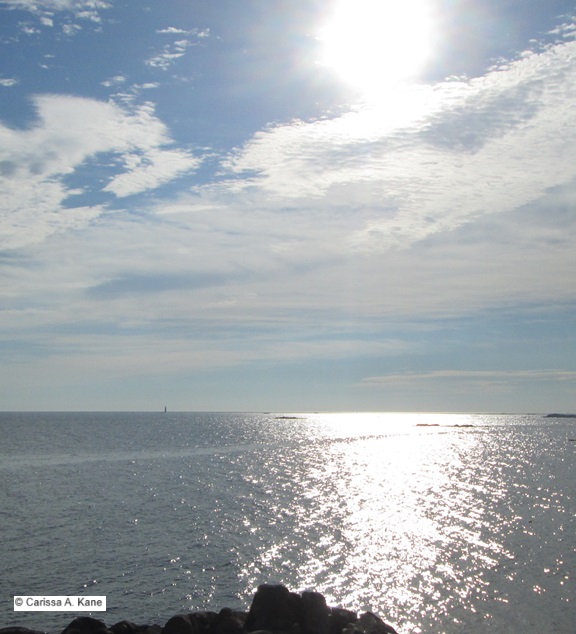
Winter sun shining down on lake

Go in Faith…

After ministering to many people in Capernaum, Jesus sets out for a deserted place, yet the crowds search for, and find him. They don’t want him to leave. However, he explains that he must go because his ministry and proclamation of the Kingdom of God must extend to other villages and towns. After witnessing and hearing his preaching, and all the healings, how do you imagine the people of Capernaum took this news? Do you think they were skeptical or upset at the idea of other people, from a different village or town, and who perhaps they considered as outsiders, being the recipients of Jesus’s preaching and healing, too?

What’s it like when you consider Jesus’s mission as one that extends to all people, regardless of who they are or from where they come?

The Gospel for the Fifth Sunday in Ordinary Time (Luke 5:1-11), begins with Jesus having moved on to Judea and then Lake Gennesaret. It is written:

“While the crowd was pressing in on Jesus and listening to the word of God, he was standing by the Lake of Gennesaret.” – Luke 5:1.

Take some time to put yourself in the crowd. As you draw in toward Jesus and listen to the word of God, what comes into your mind, and how is your heart stirred? What prayer arises within you?

As the Gospel passage continues, Jesus gets into Simon’s boat and asks him to push away from the shore. This is not so that he can leave the crowd that has been closing in on him. Rather, it is so that he can continue to minister, teaching them from the boat.

Envision yourself on the shore with Jesus and then in the boat a short distance from the shore. What’s different when you’re in the crowd versus when you’re in the boat? What might Jesus want you to learn from his actions in this situation? What words does Jesus have for you and the crowd?

When Jesus’s preaching to the crowd ends, it is written:

“…he said to Simon,
‘Put out into deep water and lower your nets for a catch.’
Simon said in reply,
‘Master, we have worked hard all night and have caught nothing,
but at your command I will lower the nets.’
When they had done this, they caught a great number of fish
and their nets were tearing.
They signaled to their partners in the other boat
to come to help them.
They came and filled both boats
so that the boats were in danger of sinking.
When Simon Peter saw this, he fell at the knees of Jesus and said,
‘Depart from me, Lord, for I am a sinful man.’
For astonishment at the catch of fish they had made seized him
and all those with him,
and likewise James and John, the sons of Zebedee,
who were partners of Simon.
Jesus said to Simon, ‘Do not be afraid;
from now on you will be catching men.’
When they brought their boats to the shore,
they left everything and followed him.” – Luke 5:4-11

After working hard all night to no avail, Peter does as Jesus asks. He goes back out into the deep part of the sea, and with Jesus by his side, where there was nothing, now there is an abundance, so much so that his nets and the boats can hardly hold it. However, for this to be possible, Peter had to first leave behind and let go of what he had already come to know—he was out all night and there were no fish to be caught—and rather than holding onto defeat or being discouraged, he had to put his hope, faith, and trust in Jesus.

Recall a time when you experienced a challenge, difficulty, or drought of some kind and how faith and Jesus’s presence helped you? What were your prayers like during that time? In what ways did you avail yourself, or help yourself, to be open to listening to and being present to Jesus? Thinking of that time, how can you relate to Peter in this Gospel passage?

Turning to today, think about a situation you’re currently facing. How are you inspired as you continue to seek and draw nearer to Jesus?

Winter sun shining down on lake

“On the day I cried out, you answered; you strengthened my spirit.” – Psalm 138:3

Everything In Between

Everything In Between…

As a young person, August was synonymous with some last hurrahs and the winding down of what we considered summer; the passage of time between the ending of one school year and the beginning of another. The readings for the 18th Sunday in Ordinary Time offer an opportunity to consider more deeply, where God is in the in-between moments.

In the First Reading (Ex 16:2-4, 12-15), the Israelites are in between leaving Egypt and arriving to the Promised Land. They express feeling even more destitute than they did as slaves, complaining about the lack of provisions.

“Would that we had died at the Lord’s hand in the land of Egypt,
as we sat by our fleshpots and ate our fill of bread!
But you had to lead us into this desert
to make the whole community die of famine!” – The Israelites to Moses and Aaron, Ex 16:3  

Oftentimes, the in-between moments can feel worse than the known moments that precede or follow them. God is aware of the complaints of the people as well as the position that Moses and Aaron are in, and God responds by meeting all of their needs (those of the people as well as Moses and Aaron), and thus helping them to hang on and continue the journey. How do you express your needs in prayer? And how has God provided for you in times when perhaps you felt like you couldn’t take more of whatever you may have been experiencing or felt stuck in between?

Looking to the Psalm (Ps 78:3-4, 23-24, 25, 54), we are called to remember and to share the stories of God’s faithfulness.

What we have heard and know,
and what our fathers have declared to us,
We will declare to the generation to come
the glorious deeds of the Lord and his strength
and the wonders that he wrought. – v. 3-4

It is our belief in God and our experiences of the Divine which strengthen and increase our faith. By recalling and sharing these experiences, we not only help to pass along faith and tradition, but also to build awareness and gratitude in ourselves and of those who journey alongside us, in terms of the personal ways in which God works, and the depth of God’s care and love for creation.

The response for the psalm is, “The Lord gave them bread from heaven.” (v. 24b). The people did not know what manna was and it is described as “fine flakes on the ground” (Ex 16:15). Take some time to reflect on what has been your bread from heaven—ways in which God has provided for you that perhaps you didn’t initially recognize, or were unexpected and/or different from what you thought you needed.  

In the Second Reading (Eph 4:17,20-24), St. Paul exhorts the people:

“you must no longer live as the Gentiles do,
in the futility of their minds;” – v. 17    

This is a key component to faith. That is the fact that, along the way in seeking to find and fulfill one’s purpose, human reasoning alone is not enough. For the human mind alone, cannot fully comprehend or discern what is best. The only way, as St. Paul says is to be renewed in Christ:

“…be renewed in the spirit of your minds,
and put on the new self, created in God’s way in righteousness and holiness of truth.” (v. 23-24)

Recall a time when you felt stuck or challenged by a situation. What happened and how did your faith come into play? How might you be renewed in Christ regarding a situation you’re facing now?

Turning to the Gospel for the 18th Week in Ordinary Time (Jn 6:24-35), we are told about the crowds going out to find Jesus when they realize he is no longer in their midst. They end up finding him across the sea, and Jesus says to them:

“Amen, amen, I say to you,
you are looking for me not because you saw signs
but because you ate the loaves and were filled.
Do not work for food that perishes
but for the food that endures for eternal life,
which the Son of Man will give you.
For on him the Father, God, has set his seal.” – v. 26-27  

Jesus is referring to the crowd’s experience of eating their fill when he multiplied the loaves of bread and fish (Jn 6:1-15) and calling them, and us, to consider, or examine, what satisfies us, what is it that we are seeking, and to what lengths or degree do we go (or have we gone) to find or obtain it. Take some time to consider this in the light of what is currently going on in your life and in the world. What are you seeking and to what extent? How does this differ from or fit in with the past? How is God present to you in this process, and what comes to mind when thinking about it as an in-between moment?

Everything In Between

Love is the bridge between you and everything. – Rumi

Radiant sun

Sustenance…

Planning,
And packing.
Considering all things.

What’s known,
And what is not.
Calculating possibilities.

Looking then leaping,
A snapshot in time.
Measuring risk, and seeking reward.

Guarantees,
Warranties,
Yet, nothing is certain.

The seeker being sought,
The Sought, searching seekers.
Meeting up, teeing up,
And, finding what is lost.

Radiant sun

to live in a manner worthy of the call you have received, with all humility and gentleness, with patience, bearing with one another through love, striving to preserve the unity of the spirit through the bond of peace – Ephesians 4:1-3

Orchids

In the Presence of Peace…

In the Gospel passage for the Twelfth Sunday in Ordinary Time, Jesus’s disciples reach out to him as the boat they are in is taking on water in the middle of a storm. Jesus says to the wind and the raging sea, “Quiet! Be Still!” and just like that, the storm settles down. This is something he could have done without saying any words, but Jesus, always the teacher, gives his disciples, and us, both an example to follow and words to ponder.

After quieting the storm, Jesus asks his disciples, “Why are you terrified? Do you not yet have faith?” He is not reprimanding them or trying to make them feel bad, but rather he is asking them to reflect on the situation, and trying to help them to know, and to remember, that he is there with them and for them, and so, there is nothing to fear. Without Jesus, the storm can rage on, whether loud and brash or quiet and discreet. It is Jesus’s presence that both quells the storm and brings peace into the quiet and stillness.

Orchids

On that day, as evening drew on, Jesus said to his disciples:
“Let us cross to the other side.”
Leaving the crowd, they took Jesus with them in the boat just as he was.
And other boats were with him.
A violent squall came up and waves were breaking over the boat,
so that it was already filling up.
Jesus was in the stern, asleep on a cushion.
They woke him and said to him,
“Teacher, do you not care that we are perishing?”
He woke up,
rebuked the wind, and said to the sea, “Quiet! Be still!”
The wind ceased and there was great calm.
Then he asked them, “Why are you terrified?
Do you not yet have faith?”
They were filled with great awe and said to one another,
“Who then is this whom even wind and sea obey?” – Mark 4:35-41