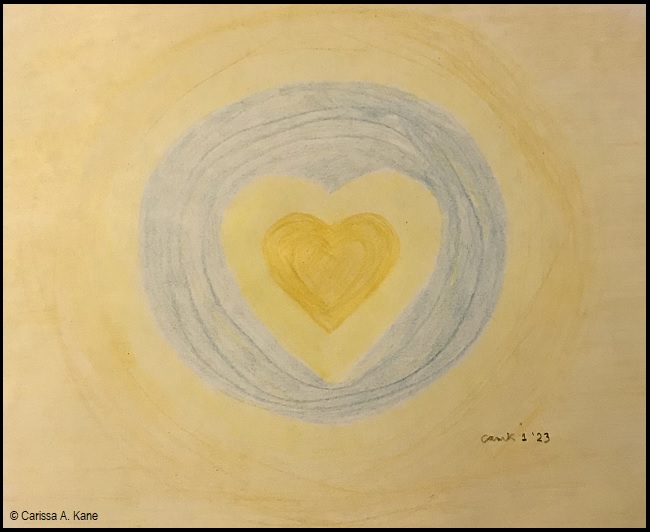
An Unconquered Heart…

From a young age, one is often taught to pay attention to the weather. When you hear thunder, go inside as rain, wind, and lightning may be near or approaching, if not already there. If there are heavy winds and/or lightning, stay inside and away from the windows, and so on. When there’s snow or sleet, beware of the road conditions—stay home. Most of what is taught about stormy weather is about actively retreating or staying put for one’s own well-being. Yet, sometimes, these efforts can instill fear and anxiety as the motivators for one’s actions.

Considering the state of, or conditions in the world today, the feeling or thought that we are in stormy times, both literally and figuratively, is palpable for so many. At times, it can lead one to retreat or stay put, shrinking, or turning away from active participation in the larger world. And while a certain amount of self-preservation can be good, withdrawal serves one and all best, not only when it is temporary, but also when one is intentional in how that time away is spent, and the choices and actions that result from it.

So, while the times may be stormy, perhaps the storm is perfect. Perfect for taking a step back and noticing for what one’s heart beats. Perfect for contemplating where one is, and where one is moved to be. Perfect for retreating to prayer and reflecting on what the world needs, one’s openness to the invitations of Grace that await, whether amid the storm, on its edges, or in an entirely different relation, and one’s desire to become more aware of what active participation in this stormy world might mean on a personal level, as well as how these storms can be overcome by being held as a meeting place for Jesus.

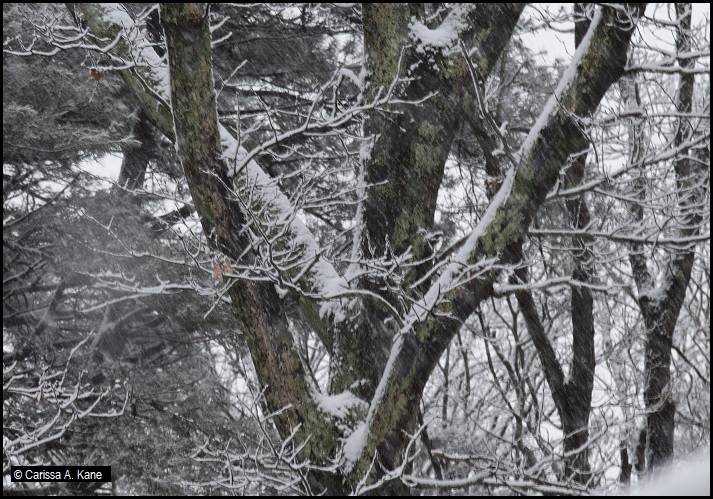
We often think or speak of the calm after the storm, and it often seems easier to appreciate the beauty of the sun after a rainstorm, or the snow-covered trees when removed from the threat and possible dangers of the driving winds and snow. However, Jesus tells us that he is with us always. Thus, the calm never ceases. It’s up to us though, to nurture our deepest, truest desires, to strive to invite peace into each situation, and to choose to not only look for, but to also navigate in, with, and through Grace. In doing so, we stay connected, our retreating or staying put remains temporary, and brings forth fruit that is lasting. Fruit that is ordained by God, bringing us back into the fold, with greater life, and as unconquered hearts whose actions flow from, and glorify God, and all creation.    

Give me, O Lord, a steadfast heart, which no unworthy affection may drag downwards; give me an unconquered heart, which no tribulation can wear out; give me an upright heart, which no unworthy purpose may tempt aside. Bestow on me also, O Lord my God, understanding to know you, diligence to seek you, wisdom to find you, and faithfulness that may finally embrace you, through Jesus Christ our Lord. Amen. – St. Thomas Aquinas

When Jesus saw the crowds, he went up the mountain,
and after he had sat down, his disciples came to him.
He began to teach them, saying:
“Blessed are the poor in spirit,
for theirs is the kingdom of heaven.
Blessed are they who mourn,
for they will be comforted.
Blessed are the meek,
for they will inherit the land.
Blessed are they who hunger and thirst for righteousness,
for they will be satisfied.
Blessed are the merciful,
for they will be shown mercy.
Blessed are the clean of heart,
for they will see God.
Blessed are the peacemakers,
for they will be called children of God.
Blessed are they who are persecuted for the sake of righteousness,
for theirs is the kingdom of heaven.
Blessed are you when they insult you and persecute you
and utter every kind of evil against you falsely because of me.
Rejoice and be glad,
for your reward will be great in heaven. Thus they persecuted
the prophets who were before you.” – Mt 5:1-12

Company…

In the process of growing up, a sense of right and wrong forms within. It’s based upon lessons learned, whether explicitly taught to one or gleaned from experiences. This sense is accompanied by the development of principles as well as the assignment of value to people, places, and things. Oftentimes this process is impacted not only by one’s immediate environment, but also by one’s community, the broader society, and perhaps, the happenings throughout the world as well. It’s human nature, after all, to derive meaning and to be affected by one’s surroundings and the people, places, and things, to which one is exposed. Hence the saying that one is known by one’s companions.

In chapter one of the First Letter of Saint Paul to the Corinthians, Paul is imploring the Corinthians to be united in the Lord rather than torn apart by their differences. How poignant for the times we live in today. The wisdom of this Bible passage speaks to us today just as the letter of St. Paul did to the Corinthians. Warning them, and us, that continuing on a path with such great division, serves only to unravel us, and that it is only through unity that we can overcome such a fate. So how do we move toward greater unity?

Most importantly, as St. Paul suggests, we need to return to the truth. Underneath all that divides us, and at the core of all that we are, and all that we can be, is the fact that our meaning and purpose comes from something far greater than any one person or group could ever encompass. We need to recognize when we are being pulled away and distracted from this truth, and to remove ourselves from partaking in any movements that seek to undermine honesty and integrity, in any way. The “win at all costs” mentality that seems so pervasive and accepted in society, needs to be challenged.

This is what St. Paul is talking about when he writes about there being rivalries and urges the people to stop thinking of themselves as belonging solely to one identity over another. This is what causes the great divide, and serves to scatter us, undoing the power and potential of unity.

When we move through the influence of our Oneness, see our differences as being ordained by God, and use them as the bond of perfection that they can be, we are able to come together in ways that value, serve, and work to benefit all of creation, and that give glory to God. When we trust the longings of true love and follow the example of Jesus, pride, prejudice, status, and exclusivity fall away and the unity that results brings greater—lasting—meaning and purpose to our lives than we could ever achieve on our own or within any segment of society seeking its own good over the good of all.

Paul writes, “For Christ did not send me to baptize but to preach the gospel, and not with the wisdom of human eloquence, so that the cross of Christ might not be emptied of its meaning.”

“The wisdom of human eloquence” would encourage one to find and stay with those around whom one feels most comfortable and identifies most closely. St. Paul is saying, don’t be fooled. He is saying, seek to be in the company of the Lord. Identify, first and foremost, with the Lord, so that you may experience redemption and your life may have direction and meaning that extend beyond the narrow confines of human understanding.         

Reflect and pray:

When you contemplate the company you keep, what are some of the values or meaning you derive from your relationship with God and others? Where, and in what ways, do you experience unity?

As you go about your day or your week, what kind of companion are you?

How do expectations come into play with regards to your ability for companionship? And in what ways do you see the Lord as companioning you and vice versa?

When you reflect on the notion of an invitation to be a companion of the Lord awaiting you in all circumstances, what is your reaction or response?

I urge you, brothers and sisters, in the name of our Lord Jesus Christ,
that all of you agree in what you say,
and that there be no divisions among you,
but that you be united in the same mind and in the same purpose.
For it has been reported to me about you, my brothers and sisters,
by Chloe’s people, that there are rivalries among you.
I mean that each of you is saying,
“I belong to Paul,” or “I belong to Apollos,”
or “I belong to Cephas,” or “I belong to Christ.”
Is Christ divided?
Was Paul crucified for you?
Or were you baptized in the name of Paul?
For Christ did not send me to baptize but to preach the gospel,
and not with the wisdom of human eloquence,
so that the cross of Christ might not be emptied of its meaning. – 1 Cor 1:10-13, 17

Enabled by Grace

To be

Radically, yet gently,

Influenced by, and

Utterly, without doubt,

Moved to, and in, the light of

Peace, love, and

Healing

“…I will make you a light to the nations, that my salvation may reach to the ends of the earth.” – Is 49:6

The Essence of Holidays and More…

Into the night and all day too,
The glow of lights sprinkled here and there,
but really, almost everywhere.
This peace, this joy, ever present,
Sometimes noticed more than others,
Sometimes not at all,
Nevertheless, a presence always there.
The heart, holding all together,
Ups and downs, yeas and nays,
Judgments, and lessons learned.
Steady in the flow of life,
Brave but never brazen.
Standard bearer, but more,
Usher of truth and light.
There through it all,
From year to year,
And age to age.

Holy Spirit, help us turn the page,
As the bells ring,
And a new year begins,
Renew our listening,
Renew our resolve.
Show us love,
Show us kindness.
Bring us peace,
Bring us newness.
Help us to work with Grace,
To change what we need to change,
And to carry hope, wherever we go.
Help us, bit by bit, to turn our world around.


May God be gracious to us and bless us; may God’s face shine upon us. – Psalm 67:2

Signs and Wonder…

Approaching the intersection of two busy streets, cones and temporary stop signs come into view, and then fallen lines disrupting service to the traffic lights that normally direct cars safely from one side to the other. It’s interesting how in driving or using other forms of transportation, one not only learns to look for signs, but also to be guided by them in reaching destinations safely.

Similarly, as one journeys through life, guidance comes, and prayers are often answered through signs, coming in various forms of interaction with God and others. Sometimes, in both times of light and times of darkness, whether personal or societal, it can be easy to miss signs, lose sight of, or take for granted, experiences of grace. The scripture readings throughout Advent and Christmas, remind us of God’s faithfulness and guiding presence, especially to Mary and Joseph, leading up to and beyond the birth of Jesus.

Through allowing or inviting God to be the source of their path and the sustenance of their hope, Mary and Joseph were not only drawn into their God-given purpose, but they were also led all the way through to its fulfillment… teaching us that the path can be difficult, the road uncertain, but that there can also be great joy when we embrace the spirit of Christmas—a heart full of light, and hope in the Lord.

All the ends of the earth have seen the saving power of God. – Psalm 98:3c

A Christmas Prayer: Lord, help me to remember your faithfulness, and to be open to the signs and guidance you place along my path. Turn my gaze always toward you, Emmanuel, as the source of all hope, that my heart may faithfully embrace the spirit of Christmas all year long, leading me to notice and appreciate the beauty and goodness of all creation, and the heart and soul of those I encounter each day.

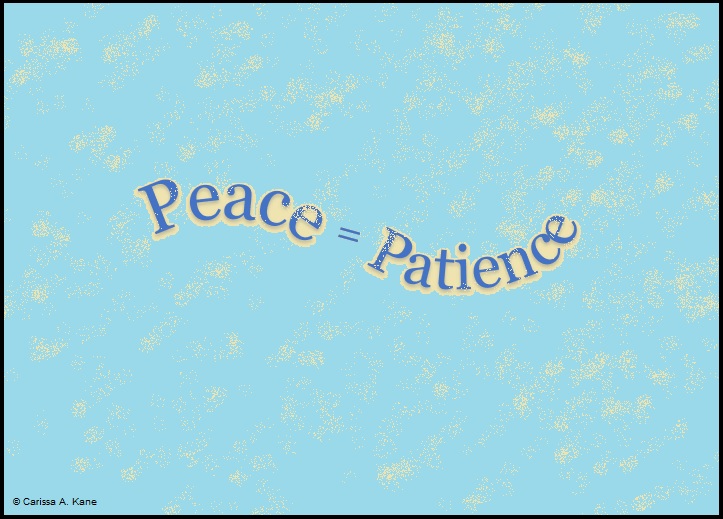
Time to Stop and Time to Go… Time for Peace?

Literally, the second the light turns green, horns are honking. Sometimes, it is from cars two or three deep in line! Imagine if instead of cars on the roads, it was just people, single file, moving on foot. Stop or go to the rhythm of the traffic lights. Perhaps it would be more like the game musical chairs than the one named “Simon Says,” but in today’s world, likely more dangerous, and certainly far more intense.

While in situations like driving, signs of impatience can be much easier to spot, at other times it can be harder to see when patience is absent or slipping away. The second reading for the Third Sunday of Advent (Jas 5:7-10), begins with, “Be patient, brothers and sisters.” It seems so fitting that during one of the busiest times of the year for many people, these verses in the Letter of James contain a form of the word, and urges patience four times, once each in three out of the four verses. And, as for the one verse that doesn’t use the word, it calls us to ponder one of the ways that human beings tend to handle displeasure with one another (“Do not complain, brothers, about one another, that you may not be judged.” – v.9).

Think of a recent experience where you were on the receiving end of your own or someone else’s impatience or displeasure. What happened? And what judgments were involved?

Now, think of a recent experience where you were the one responding with impatience or displeasure. What was going on? And what opinions or beliefs were involved?

In each situation, how might an increase of your own patience have improved the situation or the aftermath of it?

When pausing to think of recent experiences where patience was lacking or displeasure arose, on someone else’s part or on your part, which experience was easier to recall? Which experience came to mind more quickly?

It can be tempting to see patience in terms of something someone has or does not have. However, like any other attribute, it’s possible for it to exist in some situations and not in others. This is important because oftentimes it can be easy to think, “I’m patient,” or “I’m…” this or that based on a small sampling of situations that one’s ego might readily serve up to “pass the test” and move us along from further introspection and possibly attaining additional growth and greater freedom; things that are impossible without honestly looking across and considering the spectrum of one’s life experiences.

An Advent Prayer: Lord, help me to allow you to direct the pace of each day. Through my stopping and going, and all that may occur between, may my actions and responses reflect grace and genuine patience and understanding that flows from you, regardless of what I may or may not receive in return. And help me to continue to look to you, that you may grant me the grace to notice and appreciate the beauty and goodness of all creation, and the heart and soul of those I encounter each day.

Be patient, brothers and sisters,
until the coming of the Lord.
See how the farmer waits for the precious fruit of the earth,
being patient with it
until it receives the early and the late rains.
You too must be patient.
Make your hearts firm,
because the coming of the Lord is at hand.
Do not complain, brothers and sisters, about one another,
that you may not be judged.
Behold, the Judge is standing before the gates.
Take as an example of hardship and patience, brothers and sisters,
the prophets who spoke in the name of the Lord. – James 5:7-10

Facing All Sides…

Today, November 20th, is also the Solemnity of Our Lord Jesus Christ, King of the Universe. Although the date of this occasion is not the same every year, this year is one where it coincides with the anniversary of the official release of Windows 1.0 (November 20, 1985) which included a game, Reversi, based on another game named Othello.

Regardless of the name though, the two-player game like the push and pull of life on earth is all about strategy. It involves a green board and round pieces that are black on one side and white on the other, and players take turns trying to “book-end” their opponent’s pieces either horizontally or vertically. When successful, a player can then convert pieces from the other player’s color to one’s own, and when all the pieces are used, the player who has more of their color pieces on the board wins.

Essentially, this game is another that is all about paying attention, thinking ahead, maneuvering, and navigating to benefit from both one’s own plays as well as the missteps of one’s opponent. Typical of pretty much any kind of competition. Or, on the other hand, it can just be a simple, engaging game while spending time with a loved one. The pieces like coins or chips, creating an interesting rhythm as they shake back and forth in a loosely closed fist, and a pattern that slowly emerges as each piece is placed on the board of green amid moments of speaking and ones of silence. Ultimately, like many things, it depends on the eye with which one views it.

Sitting with chapter 23, verses 35-43, of the Gospel according to Luke (below), one can see two sides of the piece. There were those, the rulers, soldiers, and one of the criminals, who saw the situation solely in terms of themselves and in the world (winning, losing, us against them). They taunt Jesus and browbeat him about not fighting back and overcoming them, which they assume he would do if he was really a king.

And then, there was the other criminal, who saw the situation as it truly was. He could see and acknowledge the truth, that both criminals had done wrong, and Jesus had not. He also pushed back against the misconceptions and aggressive behavior toward Jesus. It seems that the eye through which he viewed what was happening was more flexible, able to take in a broader view—the full picture including beyond himself, and less hardened than the others who were there. As a result, he was more open, and this allowed him to see through the noise and mentality of the crowd. It led him to the truth and a desire that drew him closer to Jesus, Savior, in the moment he was facing… in the moment they were facing together.

In this month of Thanksgiving and remembrance, with which eye are you viewing situations? And in what ways do you desire to face each moment together with Jesus?

The rulers sneered at Jesus and said,
“He saved others, let him save himself
if he is the chosen one, the Christ of God.”
Even the soldiers jeered at him.
As they approached to offer him wine they called out,
“If you are King of the Jews, save yourself.”
Above him there was an inscription that read,
“This is the King of the Jews.”

Now one of the criminals hanging there reviled Jesus, saying,
“Are you not the Christ?
Save yourself and us.”
The other, however, rebuking him, said in reply,
“Have you no fear of God,
for you are subject to the same condemnation?
And indeed, we have been condemned justly,
for the sentence we received corresponds to our crimes,
but this man has done nothing criminal.”
Then he said,
“Jesus, remember me when you come into your kingdom.”
He replied to him,
“Amen, I say to you,
today you will be with me in Paradise.” – Lk 23:35-43

Recalling…

In the quiet stillness,
A peace easy to remember,
Flowing from what was,
What is, and what shall always be.
It is in a gentle whisper,
Sometimes a sturdy breeze,
Raining down, then kicking up,
All sorts of memories.
The beckon of a beacon,
Remaining steady in its yearning.
Always right on center,
In both time and space,
Calling back the mind
That tends to wander,
Calling for a time
To pause, sit and ponder.
Although clock is moving,
And pledges have been made,
This is not a race.
Think about the prayer,
The way things are,
What has passed, 
And may never be again.
Yet hope does not fade,
Sometimes it saunters to a linger.
A soft and warming glow,
But held in place,
Infused with cherished memories.
Some say only time will tell,
Yet faith knows or better senses,
Only truth will tell.
Your deep abiding love,
The only trust worth trusting.
For, ever is it known,
That all is well or on its way,
But only in remembrance
Of your ever-present grace.

Lord, show us the light of your face! – Psalm 4:7b

Which Way…

With the pitter patter of rain and dense mist earlier in the week, it became more and more challenging to see clearly. However, once the rain slowed, visibility improved ever so slightly. Then, as we continued, we exited an area that was overcome with fog. Once more our vision was restored more fully, until that is, we came across the next pocket of thick mist and its partnering wave of rain. Overall, in slowing down, the weather, although an obstacle, did not pull us off course or lead us astray. Remaining focused on the road, we found our way, and eventually, arrived safely.    

In the Gospel reading for the Thirty-first Sunday in Ordinary Time (Luke 19:1-10 below), we read that Zacchaeus was searching for Jesus, “but he could not see him because of the crowd.” The crowd, perhaps like waves of rain and dense like fog, was an obstacle, yet Zacchaeus remained focused on his desire “to see who Jesus was.” Allowing himself to be led by the longing of his heart, Zacchaeus does not get lost in the crowd or become discouraged. Nor does he push through the crowd or use whatever means he may have had as a wealthy tax collector. Rather, Zacchaeus seems to abandon any such notions and instead, he lets go of his status as he looks to overcome the limitations of his physical stature and climbs a tree to get a glimpse of Jesus.

Next, comes perhaps the most important part of this passage. What does Zacchaeus do in response to his encounter with Jesus? He owns his previous actions and changes his ways. He vows to repair any damage he has done and to adjust how he operates. He promises to extend not only his pocketbook, but also his heart to others, especially those in need. He does not deny the truth, but instead rightfully embraces it.

The Lord is near to all who call upon him, to all who call upon him in truth. – Psalm 145:18

Zacchaeus truly wanted to know who Jesus was and was willing to let go of all he had to find out. Not only that, but once he experienced Jesus for himself, he was also willing to let go of all he had known. In joining the way of Jesus, he was not going for something that would lead him to become less tolerant or accepting or disparage and drag him and others down. The changes Zacchaeus makes are ones aligned with honesty, integrity, respect, and dignity. These are all hallmarks of life-giving choices; ones that honor and praise the beauty of God and all God’s creation.

So, while the rain falls where it may, and the fog may seem endless as if extending well beyond the horizon, as for the Way, it remains clear as can be, if only one is open to it.        

At that time, Jesus came to Jericho and intended to pass through the town.
Now a man there named Zacchaeus,
who was a chief tax collector and also a wealthy man,
was seeking to see who Jesus was;
but he could not see him because of the crowd,
for he was short in stature.
So he ran ahead and climbed a sycamore tree in order to see Jesus,
who was about to pass that way.
When he reached the place, Jesus looked up and said,
“Zacchaeus, come down quickly,
for today I must stay at your house.”
And he came down quickly and received him with joy.
When they all saw this, they began to grumble, saying,
“He has gone to stay at the house of a sinner.”
But Zacchaeus stood there and said to the Lord,
“Behold, half of my possessions, Lord, I shall give to the poor,
and if I have extorted anything from anyone
I shall repay it four times over.”
And Jesus said to him,
“Today salvation has come to this house
because this man too is a descendant of Abraham.
For the Son of Man has come to seek
and to save what was lost.” – Luke 19:1-10

On Earth…

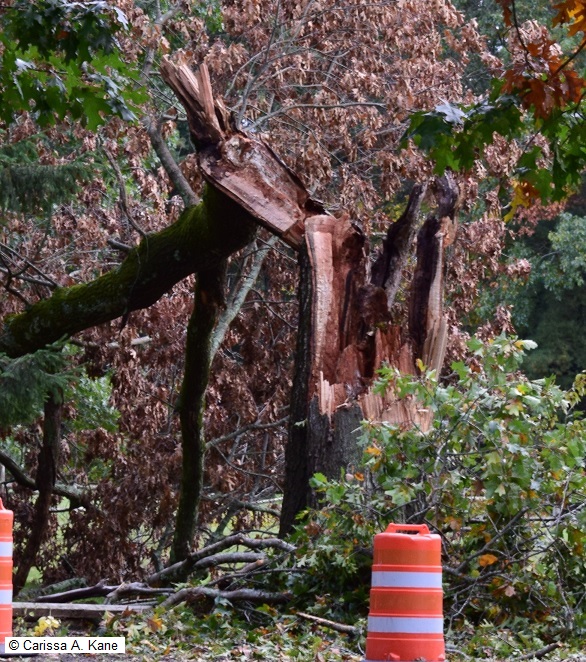
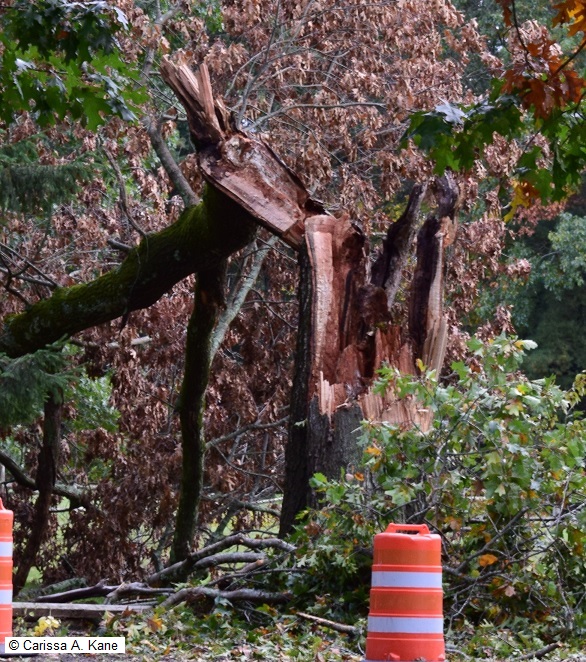
This week, during a rainy, windy evening, suddenly there was a loud and thunderous noise. Jumping up to look out the window, the street and lantern lights made visible a blur of branches and leaves on a large oak tree as it made its way down to the ground. Thankfully, despite the cars traveling in both directions on the road, at the time, no one was hurt. Traffic ended up being re-routed and within hours the Department of Public Works pushed all the debris off the road so that cars could once again travel freely up and down the street.

Now, this tree had a very large limb dry up during months of drought in the area and in the weeks prior to this one, it had partially fallen away from the trunk. From the street, one could see it was resting on the ground while still hanging on, as if by a thread. However, it wasn’t until the remainder of the tree fell to the ground, that one could see the dried-out limb not only hanging on still, but also looking like a giant pair of legs, perhaps trying to run by or break free from the rest of the tree.

Today, taking in the sight that lies beyond construction barrels put into place to forewarn or keep back passers-by, but seeming more like a beacon calling forth, it’s interesting how these legs and their trunk appear so much bigger than they seemed when the tree was standing tall. It seems there’s so much more to discover about them now that they are down to earth, unmasked in a sense. Their depth, their breadth, their character, shine brighter than before… legs posing as if in an athletic move of some kind or another. Are they coming? Are they going? Maybe they’re doing both. Or, perhaps, it’s a maneuver, careful to resist trampling the branches and leaves all around them.

Shifting focus, fallen branches spread about, pointing in many ways; some with shriveled, brown leaves holding on, and then others with green or yellow leaves, holding on as well. Common ground on the ground, connected at the core, together. Next, a splintered trunk displaying hearty, woody layers that, though broken, still look fresh and full of life.

Imagine now, all these things once hidden, or less likely to be noticed, now laying on or partly resting on the floor, as if drawing closer to one another, to reveal an image not of heaven, but of faith on earth.

My help comes from the Lord, the maker of heaven and earth. – Psalm 121:2