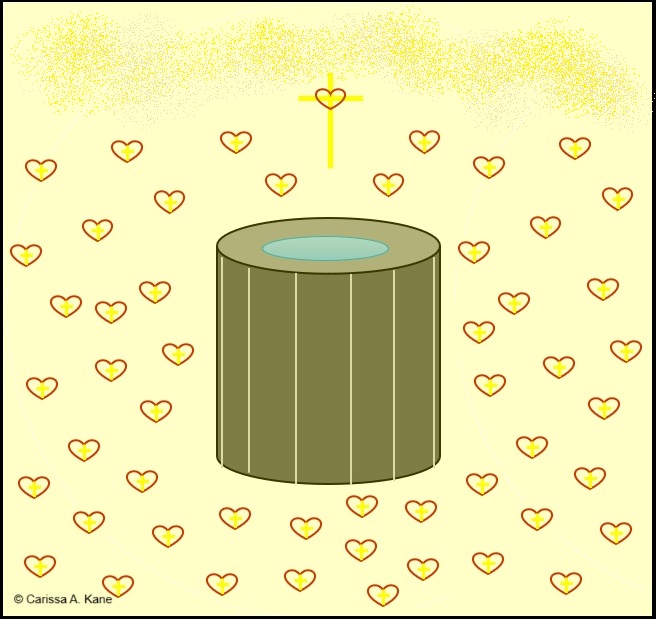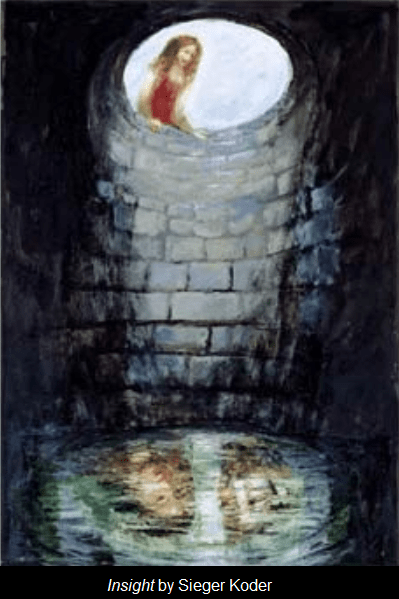
Hearts at the well; Jesus

When Hearts Are Best…

The response to the Psalm for the Third Sunday of Lent is, “If today you hear his voice, harden not your hearts.” (Psalm 95:8). In last Sunday’s second reading (Philippian’s 3:17-4:1), St. Paul encourages discipleship with a focus on the Lord and the goal of citizenship in heaven, and instructs us to “Stand firm in the Lord.” (Phil 4:1). What happens when you reflect on the Lord’s nature as being both firm and kindhearted at the same time?

Continuing to think about the Lord’s characteristics, Let’s turn to the Gospel passage, the Samaritan Woman (John 4:5-42 – included below). Through the ebb and flow of their conversation, what touches your heart most about Jesus, the Samaritan woman, and their interaction? In what places do you sense firmness? And kindness? How do the two characteristics work together, and what do they bring about?

Next, take some time to consider a situation(s) you are currently facing. In what ways are your faith experience and your beliefs working? Do they expand your heart, or constrict it? How do they fit with “stand firm in the Lord” and “harden not your heart,” coming together for what is best. Invite Jesus to join you in prayer and to share His insights and guidance as you ponder this further.

Hearts at the well; Jesus

Jesus came to a town of Samaria called Sychar,
near the plot of land that Jacob had given to his son Joseph.
Jacob’s well was there.
Jesus, tired from his journey, sat down there at the well.
It was about noon.

A woman of Samaria came to draw water.
Jesus said to her,
“Give me a drink.”
His disciples had gone into the town to buy food.
The Samaritan woman said to him,
“How can you, a Jew, ask me, a Samaritan woman, for a drink?”
—For Jews use nothing in common with Samaritans.—
Jesus answered and said to her,
“If you knew the gift of God
and who is saying to you, ‘Give me a drink, ‘
you would have asked him
and he would have given you living water.”
The woman said to him,
“Sir, you do not even have a bucket and the cistern is deep;
where then can you get this living water?
Are you greater than our father Jacob,
who gave us this cistern and drank from it himself
with his children and his flocks?”
Jesus answered and said to her,
“Everyone who drinks this water will be thirsty again;
but whoever drinks the water I shall give will never thirst;
the water I shall give will become in him
a spring of water welling up to eternal life.”
The woman said to him,
“Sir, give me this water, so that I may not be thirsty
or have to keep coming here to draw water.”

Jesus said to her,
“Go call your husband and come back.”
The woman answered and said to him,
“I do not have a husband.”
Jesus answered her,
“You are right in saying, ‘I do not have a husband.’
For you have had five husbands,
and the one you have now is not your husband.
What you have said is true.”
The woman said to him,
“Sir, I can see that you are a prophet.
Our ancestors worshiped on this mountain;
but you people say that the place to worship is in Jerusalem.”
Jesus said to her,
“Believe me, woman, the hour is coming
when you will worship the Father
neither on this mountain nor in Jerusalem.
You people worship what you do not understand;
we worship what we understand,
because salvation is from the Jews.
But the hour is coming, and is now here,
when true worshipers will worship the Father in Spirit and truth;
and indeed the Father seeks such people to worship him.
God is Spirit, and those who worship him
must worship in Spirit and truth.”
The woman said to him,
“I know that the Messiah is coming, the one called the Christ;
when he comes, he will tell us everything.”
Jesus said to her,
“I am he, the one speaking with you.”

At that moment his disciples returned,
and were amazed that he was talking with a woman,
but still no one said, “What are you looking for?”
or “Why are you talking with her?”
The woman left her water jar
and went into the town and said to the people,
“Come see a man who told me everything I have done.
Could he possibly be the Christ?”
They went out of the town and came to him.
Meanwhile, the disciples urged him, “Rabbi, eat.”
But he said to them,
“I have food to eat of which you do not know.”
So the disciples said to one another,
“Could someone have brought him something to eat?”
Jesus said to them,
“My food is to do the will of the one who sent me
and to finish his work.
Do you not say, ‘In four months the harvest will be here’?
I tell you, look up and see the fields ripe for the harvest.
The reaper is already receiving payment
and gathering crops for eternal life,
so that the sower and reaper can rejoice together.
For here the saying is verified that ‘One sows and another reaps.’
I sent you to reap what you have not worked for;
others have done the work,
and you are sharing the fruits of their work.”
Many of the Samaritans of that town began to believe in him
because of the word of the woman who testified,
“He told me everything I have done.”
When the Samaritans came to him,
they invited him to stay with them;
and he stayed there two days.
Many more began to believe in him because of his word,
and they said to the woman,
“We no longer believe because of your word;
for we have heard for ourselves,
and we know that this is truly the savior of the world.” – John 4:5-42

The Sun Rising

Relating to and thru One…

The readings for the Third Sunday of Lent can be seen as a call to pay attention to the nature of relationships and what they lead or point to. In the First Reading (Exodus 20:1-17), God delivers the commandments, which are seemingly clear instructions, and by adhering to them, the people will prosper. Notice how God’s mercy far outweighs any punishment.

For I, the Lord, your God, am a jealous God, inflicting punishment for their ancestors’ wickedness on the children of those who hate me, down to the third and fourth generation; but showing love down to the thousandth generation of those who love me and keep my commandments. (Ex 20:5-6)

Also, notice that punishment is reserved for “those who hate me,” and their children. Hate is a pretty strong word and one can imagine some sort of pattern or learned behavior to reach that point or designation. In that light, perhaps this passage can be viewed as a Lenten invitation to be mindful of one’s actions, the sentiments from which they come, and what they might teach.

Looking at the Responsorial Psalm (Psalm 19:8-11), the response is “Lord, you have the words of everlasting life.” (Jn 6:68c). Again, drawing us to God’s words as priceless and wrapping up by trying to convey just how valuable they are: They are more precious than gold, than a heap of purest gold; sweeter also than syrup or honey from the comb. (Ps 19:11).

As for verses 8-10 of the Psalm, the first part of each line refers to the Lord’s “rules”—laws, decrees, precepts, commands, reverence, and ordinances. The second part of each phrase or sentence provides guidance by giving indicators that one can use to try to determine if they are obeying and honoring the Lord. How? By evaluating the situation and answering the question: Do I experience or have a sense of a refreshed soul/peace, wisdom, a rejoicing heart, enlightenment, endurance/inner strength, truth, or justice?

The law of the Lord is perfect,
    refreshing the soul;
The decree of the Lord is trustworthy,
    giving wisdom to the simple.

The precepts of the Lord are right,
    rejoicing the heart;
the command of the Lord is clear,
    enlightening the eye.

The fear of the Lord is pure,
    enduring forever;
the ordinances of the Lord are true,
    all of them just.

In the Second Reading (1 Corinthians 1:22-25), St. Paul is encouraging the Corinthians, and us, to be careful about the way we go about seeking signs and wisdom. God certainly uses people, situations, and things to accomplish tasks and impart wisdom, however, as St. Paul says, “we proclaim Christ crucified.”  That means, there is no substituting human thoughts, ideas, goals, etc. for God’s will and wisdom as the source or root that one allows to resonate with and guide their soul. Ultimately, things come down to what happens between each person and God, and one is not to blindly follow others thus giving what belongs to or originates with God (one’s soul and will) to another human being and/or their agenda.

In what ways do you take each situation to prayer with an openness to the fact that what is right and just in one situation may not be right and just or the best way in another situation? What’s it like to consider that the “rules” and their application are shaped by God’s love and mercy, and that this is by God’s design? In what ways do you leave room for love and mercy in situations and decisions?

Turning to the Gospel passage referred to as the Cleansing of the Temple (John 2:13-25), we can see Jesus’ disavowal of the perversion of the Temple and the rules and practices around and within it. The focus has become all about transactions and status. Jesus drives everyone out, saying to those profiting at the expense of the poor—those selling doves, “Take these out of here, and stop making my Father’s house a marketplace.” (Jn 2:16). In the verses that follow, Jesus refers to his body as the temple and foreshadows his crucifixion and resurrection. The passage ends with:

But Jesus would not trust himself to them because he knew them all,
and did not need anyone to testify about human nature.
He himself understood it well.
(Jn 2:24-25)

Envision Jesus, who is the source of salvation and redemption, entering the temple area of your life—your heart. Imagine yourself receiving the peace, inner strength, and wisdom of Jesus as you sit together. What would you share? And, what would He who understands human nature well, impart to you in terms of what to drive out and what to keep?

The Flock Being Guided…

As pockets of clouds
drifted across the clear night sky,
the moon, at its fullest
continued to reflect
hope and promise
in each passing moment,
inspiring hope and promise
with each passing thought.
What is,
what would be,
what could be,
beholden to One,
the only One.
There is I Am.

The response to the Psalm for the Third Sunday of Lent is, “If today you hear God’s voice, harden not your hearts.” (Ps 95:8). What does a hardened heart look like? Physically, it is one in which arteries may be clogged, or the lining may be thickening, to name a couple attributes. Overall though, it is a heart that is blocked in one way or another from working optimally or as designed. Spiritually, a hardened heart is also blocked in one way or another from working fully, as intended by God.

So how does one recognize a hardened heart? Well, as with many things, there are indicators as well as tests that can alert one to the status of their heart. And in faith, the directions always start at the beginning. “If today you hear God’s voice…”

What does God’s voice look, or sound like to you? What adjectives would you use to describe God?

Now, taking Light to life, what happens when you try to assign those same adjectives to describe the heart behind your words and actions throughout the day, the week, and more? In what situations do they fit? And in what situations, is there an invitation for greater growth and movement toward taking on the heart of Jesus?

A Lenten Prayer:
Heart of Jesus, open our eyes and ears.
Heart of Jesus, show us what our hearts are looking past.
Heart of Jesus, help us to acknowledge what is, what would be, what could be.
Heart of Jesus, guide us in your way.
Heart of Jesus, bind our hearts to yours.

On Balance…

Tomorrow, March 20, 2022, is the vernal equinox, giving those of us in the Northern Hemisphere an even split between day and night and marking the beginning of spring. It’s not often we experience such balance in a day. In fact, it only happens twice a year on the vernal and autumnal equinoxes, and given the pace of life, the light of these days likely slips by without much notice.

The thing that’s interesting though, is as with many happenings in the natural world around us, there’s a message or lesson they hold. The vernal equinox can serve as a concrete example to not only bring equity and balance to heart and mind, but also perhaps to provide an experience we can all relate to, no matter where we are, and in doing so, on some level, restore a sense of harmony.

Take some time to absorb what is often the background as we go about each day—nature. Bring it to the forefront. Next, as you look around, consider your life. Where do you find balance and harmony? In what ways do you experience the Lord as kind and merciful in the hours of both the day and night? How are you inspired?

Bless the Lord, my soul;
all my being, bless his holy name!
Bless the Lord, my soul;
and do not forget all his gifts,
Who pardons all your sins,
and heals all your ills,
Who redeems your life from the pit,
and crowns you with mercy and compassion,
Who fills your days with good things,
so your youth is renewed like the eagle’s.
The Lord does righteous deeds,
brings justice to all the oppressed.
He made known his ways to Moses,
to the Israelites his deeds.
Merciful and gracious is the Lord,
slow to anger, abounding in mercy.
He will not always accuse,
and nurses no lasting anger;
He has not dealt with us as our sins merit,
nor requited us as our wrongs deserve. – Psalm 103: 1-10