On Earth…

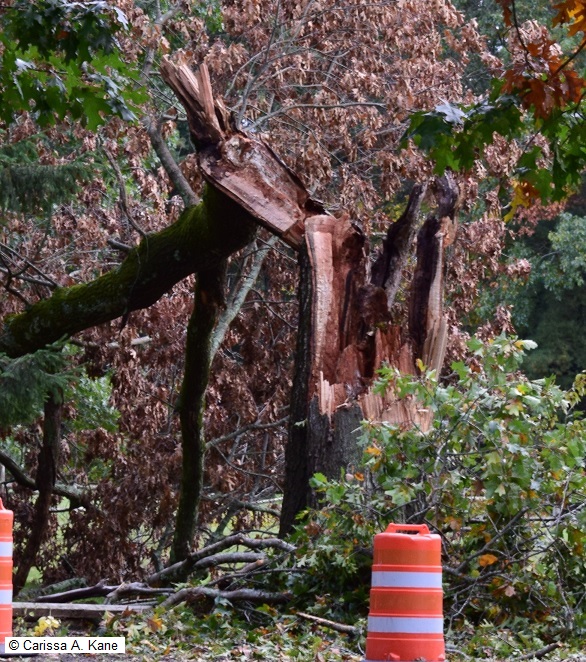
This week, during a rainy, windy evening, suddenly there was a loud and thunderous noise. Jumping up to look out the window, the street and lantern lights made visible a blur of branches and leaves on a large oak tree as it made its way down to the ground. Thankfully, despite the cars traveling in both directions on the road, at the time, no one was hurt. Traffic ended up being re-routed and within hours the Department of Public Works pushed all the debris off the road so that cars could once again travel freely up and down the street.

Now, this tree had a very large limb dry up during months of drought in the area and in the weeks prior to this one, it had partially fallen away from the trunk. From the street, one could see it was resting on the ground while still hanging on, as if by a thread. However, it wasn’t until the remainder of the tree fell to the ground, that one could see the dried-out limb not only hanging on still, but also looking like a giant pair of legs, perhaps trying to run by or break free from the rest of the tree.

Today, taking in the sight that lies beyond construction barrels put into place to forewarn or keep back passers-by, but seeming more like a beacon calling forth, it’s interesting how these legs and their trunk appear so much bigger than they seemed when the tree was standing tall. It seems there’s so much more to discover about them now that they are down to earth, unmasked in a sense. Their depth, their breadth, their character, shine brighter than before… legs posing as if in an athletic move of some kind or another. Are they coming? Are they going? Maybe they’re doing both. Or, perhaps, it’s a maneuver, careful to resist trampling the branches and leaves all around them.

Shifting focus, fallen branches spread about, pointing in many ways; some with shriveled, brown leaves holding on, and then others with green or yellow leaves, holding on as well. Common ground on the ground, connected at the core, together. Next, a splintered trunk displaying hearty, woody layers that, though broken, still look fresh and full of life.

Imagine now, all these things once hidden, or less likely to be noticed, now laying on or partly resting on the floor, as if drawing closer to one another, to reveal an image not of heaven, but of faith on earth.

My help comes from the Lord, the maker of heaven and earth. – Psalm 121:2

Vantage…

Facing the ocean from the walk above or the sand upon the beach it’s easy to stay in place and feel content, and to do so without anywhere near the effort taken to get there. Not only that, but also to slide toward becoming removed from reality—all the lives that exist in various states on and all around the beach and the city or town that encompasses it—and the opportunity to take a life-giving part in it. It’s interesting to think about how swiftly one can be transported to “a world without cares,” with the sound of each wave that breaks upon the shore or the refreshing feeling as each wave washes over everything in its path.

Now, what’s it like to imagine that perhaps this (being caught up in the surroundings) is what it was like for the rich man in the Gospel according to Luke (chapter 16, verses 19-31), before he died?

When we read the Gospel for the Twenty-sixth Sunday in Ordinary Time (below), we learn that a poor man named Lazarus was a constant fixture at the rich man’s door. However, we are not told anything about an interaction(s) between the rich man and Lazarus. This is likely because what matters more than whether the rich man was unaware of, ignored, was indifferent to, or held disdain for Lazarus, is the distance that his worldly aims and wealth put between his ability to help and his desire to do so.

While the rich man was alive, he experienced what is sold in today’s world as “the good life.” However, it led him to becoming insulated from a complete picture of reality (not everyone has it good). And without that, it’s understandable that it would be harder for him not only to choose more wisely, but also to recognize that his openness to, and desire for living in ways that are generative had become diminished.

Neither the rich man nor his brothers could learn from the past (Moses and the prophets), not because the knowledge and wisdom wasn’t available to them, but because their hearts were divided. This—the chasm—is what prevented them from receiving the grace they really needed and making choices for the greater good.

May we be more aware and set our hearts on God to strip away the falsehoods that lead us astray, and to close the chasm that pulls us apart.

Jesus said to the Pharisees:
“There was a rich man who dressed in purple garments and fine linen
and dined sumptuously each day.
And lying at his door was a poor man named Lazarus, covered with sores,
who would gladly have eaten his fill of the scraps
that fell from the rich man’s table.
Dogs even used to come and lick his sores.
When the poor man died,
he was carried away by angels to the bosom of Abraham.
The rich man also died and was buried,
and from the netherworld, where he was in torment,
he raised his eyes and saw Abraham far off
and Lazarus at his side.
And he cried out, ‘Father Abraham, have pity on me.
Send Lazarus to dip the tip of his finger in water and cool my tongue,
for I am suffering torment in these flames.’
Abraham replied,
‘My child, remember that you received
what was good during your lifetime
while Lazarus likewise received what was bad;
but now he is comforted here, whereas you are tormented.
Moreover, between us and you a great chasm is established
to prevent anyone from crossing who might wish to go
from our side to yours or from your side to ours.’
He said, ‘Then I beg you, father,
send him to my father’s house, for I have five brothers,
so that he may warn them,
lest they too come to this place of torment.’
But Abraham replied, ‘They have Moses and the prophets.
Let them listen to them.’
He said, ‘Oh no, father Abraham,
but if someone from the dead goes to them, they will repent.’
Then Abraham said, ‘If they will not listen to Moses and the prophets,
neither will they be persuaded if someone should rise from the dead.'” – Luke 16:19-31

Yes, and…

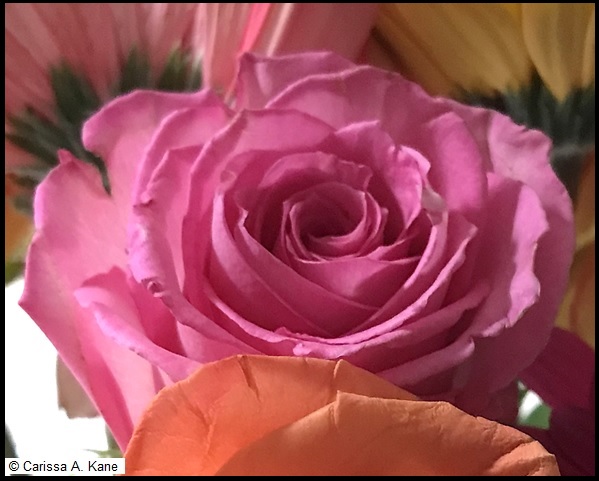
Kahlil Gibran wrote, “The optimist sees the rose and not its thorns; the pessimist stares at the thorns, oblivious of the rose.” Looking at the circumstances occurring around the world today, one might wonder how on earth it is possible to not see thorns and weeds run amok. However, also happening around the world at the same time as all these daunting occurrences are ones that inspire and give cause to celebrate.

Perhaps within these days, too, there is opportunity to hold a broader view and to seek the hope that is awaiting in each moment, in each act of love, kindness, mercy, and compassion. But first, a pause. Maybe there is a letting go or taking up that needs some space to allow it to unfold. These kinds of times are also often great for working through unrest and moving closer, if not to the side of peace.

Imagine a rose without thorns. Is it perfect? Is it incomplete? Either way, honesty urges taking in the entire picture, whether of something familiar or something unknown. For that is when truth comes into view, and with it, a return to what is real. Yet, all along the way, Wisdom softly calls, although we may evolve, sometimes resist, or dig in, there is always something greater happening here. In fact, there is always something greater happening everywhere. Yes, and it is worthwhile to behold.

Lord, you have been our refuge through all generations. – Psalm 90:1

United in Prayer…

Please join in prayer for the people of Ukraine. May they experience a non-stop, abundant outpouring of love from the rest of the world. May God continue to give them the strength, the means, and the courage to keep standing up to those who are perpetrating violence and seeking to overthrow their country and its leadership. May God turn the hearts and minds of all those in positions to affect what’s happening in Ukraine to whatever is the greatest good possible in this situation, and give those people the wherewithal to choose it.

The Light of Faith…

In chapter 18 (verses 33-37) of the Gospel according to John, Pilate asks Jesus who he is and what has done, and Jesus’ answer, as always, is all about truth. And that’s what faith is really all about—Truth and learning not only to recognize it, but also to listen to, and be led by it. In the verses that follow this passage, Pilate knows the Truth—Jesus has done no wrong, but he does not choose to listen and allow himself to be led by it.

On the Feast of Christ the King, this passage presents a great opportunity for prayer and reflection on who we are and what we do as followers of our Lord Jesus Christ. Both collectively and individually, as we approach the season of Advent and the Nativity of Christ our Lord, in what ways do the things we do and the presence of heart and mind with which we do them, reflect the goodness of God? And to what extent are they the result of truly listening and being led by Grace?

Amid one’s hopes and dreams and into the flow of reality, how do the choices of yesterday, infused with faith and the grace of God, inform and shape those of tomorrow?

So Pilate went back into the praetorium
and summoned Jesus and said to him,
“Are you the King of the Jews?”
Jesus answered, “Do you say this on your own
or have others told you about me?”
Pilate answered, “I am not a Jew, am I?
Your own nation and the chief priests handed you over to me.
What have you done?”
Jesus answered, “My kingdom does not belong to this world.
If my kingdom did belong to this world,
my attendants would be fighting
to keep me from being handed over to the Jews.
But as it is, my kingdom is not here.”
So Pilate said to him, “Then you are a king?”
Jesus answered, “You say I am a king.
For this I was born and for this I came into the world,
to testify to the truth.
Everyone who belongs to the truth listens to my voice.” – John 18:33-37

A Clear Path…

The path began at a clearing, steps molded into the landscape, a way ahead with little unknown. It was easy to proceed. However, once those steps reached their end, the terrain gradually became less friendly… less inviting. Continuing deeper in, the area overcome with overgrowth, the air overcome with temptation. Push ahead with determination or turn back in trepidation. Perhaps, another way, take stock, retreat into the moment, and explore. Look inside and ponder, “What are you looking for?”

In the Gospel according to Mark, chapter 10, verse 51, Jesus asks Bartimaeus, “What do you want me to do for you?” He doesn’t presume what Bartimaeus, the blind man, wants from him, even though it may seem obvious. He gives Bartimaeus the opportunity to engage with him and to give voice to his desire.

In the moments leading up to this encounter, Bartimaeus is in the midst of a crowd and cannot see who or what is around him, so he doesn’t know where Jesus is. Despite this, he has heard that Jesus is there, and he begins calling out to him, “Jesus, son of David, have pity on me” (verse 47). The people around him are trying to get him to stop calling out to Jesus, but Bartimaeus is not distracted by them. He stays focused on what he is looking for—his vision, and he knows that only Jesus can heal and restore it.

In today’s hazy world, overcome with overgrowth, temptation in the air, and distractions all around, Jesus is present, wanting to heal and restore vision, and not only to make the path clear for all, but also to be the path for all. Jesus is waiting, even in less friendly, less inviting spaces, wanting us to tell him about it, and wanting to hear the response to, “What do you want me to do for you?”

As Jesus was leaving Jericho with his disciples and a sizable crowd,
Bartimaeus, a blind man, the son of Timaeus,
sat by the roadside begging.
On hearing that it was Jesus of Nazareth,
he began to cry out and say,
“Jesus, son of David, have pity on me.”
And many rebuked him, telling him to be silent.
But he kept calling out all the more,
“Son of David, have pity on me.”
Jesus stopped and said, “Call him.”
So they called the blind man, saying to him,
“Take courage; get up, Jesus is calling you.”
He threw aside his cloak, sprang up, and came to Jesus.
Jesus said to him in reply, “What do you want me to do for you?”
The blind man replied to him, “Master, I want to see.”
Jesus told him, “Go your way; your faith has saved you.”
Immediately he received his sight
and followed him on the way. – Mark 10:46-52             

The Place of Choice…

In the last chapter of the Book of Joshua (Jos 24), Joshua, who succeeded Moses, is nearing death when he gathers the tribes of Israel and speaks the words of the Lord. First, the Lord helps the people to remember the truth of their journey together and God’s presence throughout. Then, the ageless choice, just as poignant today as back in Joshua’s times and prior, is offered: “…choose today whom you will serve…” (Jos 24:15).

Oftentimes the way of society tends toward reaching heights higher than, obtaining more than, and being waited upon or served as if elevated in position. And in that striving and the push to achieve, there are all sorts of temptations moving in and out, and throughout, trying to slide into place without notice, shifting motivation away from what might truly be good. Then, there is also the voice of reason—Truth, seeking balance, calling for heart and soul to live and breathe in all that drives the choices being made, actions being taken, and the spirit in which they are carried out.

So how does one proceed with so many competing interests? More simply, slowing down with prayerful moments that lead to the choosing in each, and every, day.

This past Wednesday was the feast day of Alberto Hurtado Cruchaga, S.J. He was born in 1901 and lived in Chile, becoming a Jesuit priest who served the poor and worked for social justice until his death in 1952. The following prayer is his prayer. It seeks integrity, hope, and faith in God and reminds one of Truth—all things are possible with God.

Prayer of St. Alberto Hurtado Cruchaga, S.J.

Lord, help me to speak the truth in front of the strong
and not say lies to gain the applause of the weak.

If you give me fortune, don’t take happiness away from me.
If you give me strength, don’t take reason away from me.
If you give me success, don’t take humility away from me.
If you give me humility, don’t take dignity away from me.

Help me always see the other side of the medal.
Do not let me blame others of treason
for not thinking like me.
Teach me to love people as myself
and to judge myself as others.

Do not let me fall into pride if I triumph
nor in despair if I fail.
Rather, remind me that failure
is the experience which precedes triumph.

Teach me that forgiving is the grandest for the strong
and that revenge is the primitive sign of the weak.

If you take away my fortune, leave me with hope.
If you take away success, leave me with the strength
to triumph from the defeat.

If I fail people, give me the courage to ask pardon.
If the people fail me, give me the courage to forgive.
Lord, if I forget You, don’t forget me.

Beyond the Fray…

Looking into the world of nature, it can be very easy to come across what makes for a beautiful picture. Whether one’s eye is caught by a single object or multiple ones combining to create a scene that captivates and captures attention, it all starts with posture.

The picture below was taken at the base of a road on the way back down, after having traveled it to the top of a mountain. The way that everything came together and seemed to fall into place in the moments we happened upon it, was rather striking. As we were returning from the summit on a sunny, gorgeous day, the sun was quickly overtaken by fast moving clouds, and as we drove, we moved in and out of brief periods of rain. However, once we reached the base, things looked much brighter. Then, not much further along, we entered the scene. It was like stepping into a painted landscape.

Again, everything—road, rock wall, water, building, sand, trees, and sky—seemed to come together, bringing out the best of what that day and time could offer, and it was perfect. Unity and peace within rising above and beyond turbulence. Not only a pretty sight or precious thought, but also at the heart of faith and faithfulness—the way in which one works, lives, and cooperates with the grace of God, who resides within us, and in whose image, we are all created.

What one carries or holds onto as they journey, quite literally, impacts everything—reception, perception, reaction, response, etc.

Brothers and sisters:
I, a prisoner for the Lord,
urge you to live in a manner worthy of the call you have received,
with all humility and gentleness, with patience,
bearing with one another through love,
striving to preserve the unity of the spirit through the bond of peace:
one body and one Spirit,
as you were also called to the one hope of your call;
one Lord, one faith, one baptism;
one God and Father of all,
who is over all and through all and in all. – Eph 4:1-6

What The World Needs Now…

In chapter 5 of the Gospel according to Mark, the saving power of Jesus is revealed in the healing of the man with unclean spirits (the Gerasene demoniac), the woman who had been hemorrhaging for 12 years, and the daughter of Jairus, a synagogue official. In all three cases, Jesus acts differently than what is expected, in that he is not afraid to meet and embrace those who have met misfortune, and are viewed as less than, and he does not treat anyone or anything as a lost cause or beyond repair. Because of this, even though what he has to offer is beneficial, to those who are married to one way of being he is seen as someone to be weary of and who is dangerous.

When Jesus heals the demoniac, sending the unclean spirits into a herd of swine who then head over the bank and into the sea where they meet their demise, folks become afraid. They cannot see the miracle in the healing that has taken place and ask him to leave. He does get in the boat and depart back to the other side. However, he also remains. The man he healed takes heed in Jesus’s instructions to him. In staying behind, Jesus is with him, and the man gives witness to what the Lord has done for him.

When the hemorrhaging woman touches his cloak, Jesus, who is on the way to heal the synagogue official’s daughter, stops, and takes time not only to seek and find the woman he has just healed, but also to engage with her. Despite fear, the woman comes forward to own, or to claim, the truth. In doing so, she is met, not with a critical, harsh, or condescending response, but rather with affirmation. She believed in Jesus and was willing to take a leap and trust in the healing that she sensed he could bring, when she dared to reached out to touch his garment as he passed by. With Jesus, there is no such thing as too little, too late, not worthwhile, or not enough time.

When it is announced that the synagogue official’s daughter is dead, and that he is no longer needed, Jesus does not turn away. He tells the girl’s father, “Do not be afraid. Just have faith.” (v. 36). Despite the news and being ridiculed by others, Jesus proceeds to their house and wakes the girl up. With Jesus, nothing is impossible.

As a Christian, one is called to follow Jesus, embracing the Way, and striving, through the grace of God, to live it. As challenging, uncomfortable, or unpopular as it may be, oftentimes, this requires change and evolution. Sometimes it may mean the opposite or a variation of the new ways and examples happening in the world, and at other times, it may mean the opposite or a variation of the old ways. Either way, the constant is Love, and the question is whether we trust God enough to let Love be the author.

It’s an incredible mystery of God’s love that the more you know how deeply you are loved, the more you will see how deeply your sisters and your brothers in the human family are loved. – Henri Nouwen

Something Else..

The world,
And its inhabitants,
Who are abundantly “living,”
Something else.
In a shell,
On a hill,
Away from it all.
Yet, Life,
Forgotten,
Trampled, and hidden.
Nothing else.
Something else.

Create a clean heart in me, O God;
Renew within me a steadfast spirit. – Psalm 51:12