What The World Needs Now…

In chapter 5 of the Gospel according to Mark, the saving power of Jesus is revealed in the healing of the man with unclean spirits (the Gerasene demoniac), the woman who had been hemorrhaging for 12 years, and the daughter of Jairus, a synagogue official. In all three cases, Jesus acts differently than what is expected, in that he is not afraid to meet and embrace those who have met misfortune, and are viewed as less than, and he does not treat anyone or anything as a lost cause or beyond repair. Because of this, even though what he has to offer is beneficial, to those who are married to one way of being he is seen as someone to be weary of and who is dangerous.

When Jesus heals the demoniac, sending the unclean spirits into a herd of swine who then head over the bank and into the sea where they meet their demise, folks become afraid. They cannot see the miracle in the healing that has taken place and ask him to leave. He does get in the boat and depart back to the other side. However, he also remains. The man he healed takes heed in Jesus’s instructions to him. In staying behind, Jesus is with him, and the man gives witness to what the Lord has done for him.

When the hemorrhaging woman touches his cloak, Jesus, who is on the way to heal the synagogue official’s daughter, stops, and takes time not only to seek and find the woman he has just healed, but also to engage with her. Despite fear, the woman comes forward to own, or to claim, the truth. In doing so, she is met, not with a critical, harsh, or condescending response, but rather with affirmation. She believed in Jesus and was willing to take a leap and trust in the healing that she sensed he could bring, when she dared to reached out to touch his garment as he passed by. With Jesus, there is no such thing as too little, too late, not worthwhile, or not enough time.

When it is announced that the synagogue official’s daughter is dead, and that he is no longer needed, Jesus does not turn away. He tells the girl’s father, “Do not be afraid. Just have faith.” (v. 36). Despite the news and being ridiculed by others, Jesus proceeds to their house and wakes the girl up. With Jesus, nothing is impossible.

As a Christian, one is called to follow Jesus, embracing the Way, and striving, through the grace of God, to live it. As challenging, uncomfortable, or unpopular as it may be, oftentimes, this requires change and evolution. Sometimes it may mean the opposite or a variation of the new ways and examples happening in the world, and at other times, it may mean the opposite or a variation of the old ways. Either way, the constant is Love, and the question is whether we trust God enough to let Love be the author.
It’s an incredible mystery of God’s love that the more you know how deeply you are loved, the more you will see how deeply your sisters and your brothers in the human family are loved. – Henri Nouwen
More than a recipe…

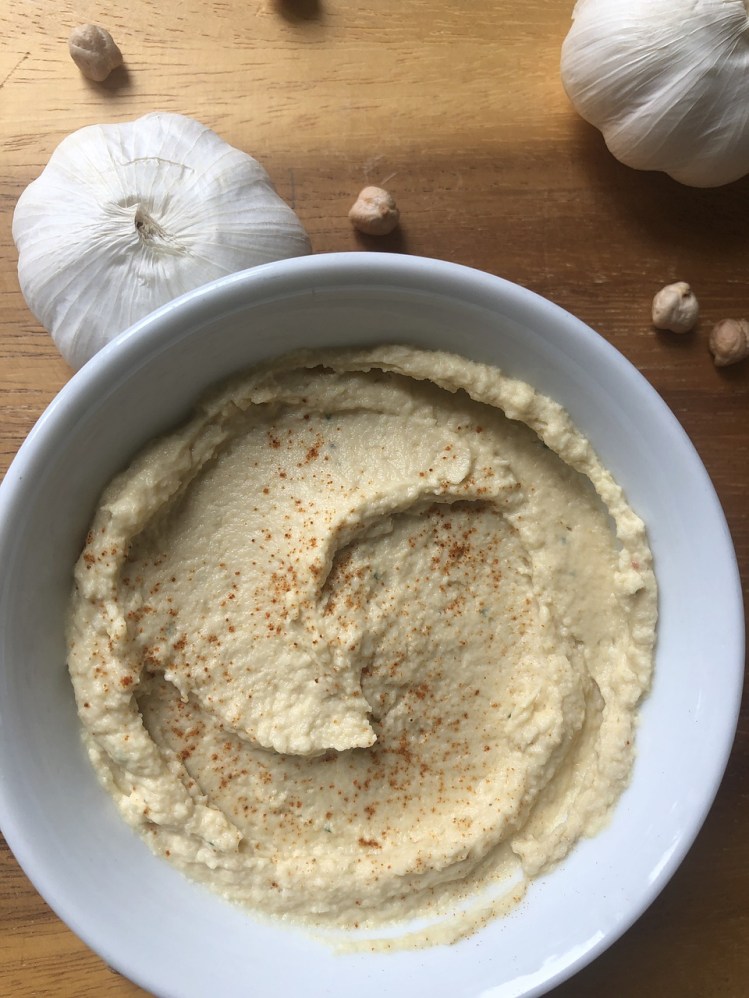
I did not learn to make hummus, with just the “right” amount of fresh garlic, salt, and lemon juice by eating it, reading a recipe, or watching my mother make it over, and over again. Rather, I learned by taking what I saw, remembering what I had tasted, and trying to make it myself, over, and over again. After all, the most helpful way to learn is by ongoing, active observance, repetition, participation, reflection, and openness to growth.

While experience is key, it is interesting that oftentimes as experience increases, awareness to room for improvement can lessen, or even disappear. With that, it may be more than tempting to take moments and situations for granted, rote, or with a “nothing new here” spirit. However, even the process of washing, rinsing, and repeating, holds newness and opportunity with each turn.

In the Gospel according to John, a week later, when the disciples were still locked in the room, Jesus appeared again (Jn 20:26). What was it like for the disciples who had seen the risen Jesus the first time he had appeared? Was it just a been there, done that, repeat for them, or were they able to experience the second appearance in a new or deeper way?

What was the attitude in the room? Were the disciples who had previously seen Jesus able to receive this visitation as being as much for them as it was for Thomas? To whom was Jesus speaking when he said to Thomas, “Have you come to believe because you have seen me?”

In the Gospel according to Mark, chapter 16, verse 11, it is written that when Mary Magdalene told the disciples that the risen Jesus had appeared to her outside the tomb, they did not believe without seeing either. Did the disciples remember this, when Thomas said, “Unless I see the mark of the nails in his hands and put my finger into the nailmarks and put my hand into his side, I will not believe.”(Jn 20:27)?

What did Thomas think, when Jesus said to him, “Have you come to believe because you have seen me? Blessed are those who have not seen and have believed.” (John 20:29)? What did he feel? Perhaps, he felt bad that he did not believe what he had been told by the other disciples. Or, perhaps Thomas felt joy that Jesus heard his need, and responded to it, allowing him to experience the risen Jesus himself.

After all, whether making hummus , dealing with faith, or anything else for which there may be “recipes” or popular thought, there is always more than what is on the page, for “Experience is the teacher of all things” (attributed to Julius Ceasar).

In all times, but most especially in those that are challenging, we must consider experience, both our own and that of others. What has it been like? Do we remember the times and places where we have doubted, questioned, or disagreed, and, do we extend the same courtesy, patience, peace, and understanding that Jesus extends to us, to others?

On the evening of that first day of the week,
when the doors were locked, where the disciples were,
for fear of the Jews,
Jesus came and stood in their midst
and said to them, “Peace be with you.”
When he had said this, he showed them his hands and his side.
The disciples rejoiced when they saw the Lord.
Jesus said to them again, “Peace be with you.
As the Father has sent me, so I send you.”
And when he had said this, he breathed on them and said to them,
“Receive the Holy Spirit.
Whose sins you forgive are forgiven them,
and whose sins you retain are retained.”
Thomas, called Didymus, one of the Twelve,
was not with them when Jesus came.
So the other disciples said to him, “We have seen the Lord.”
But he said to them,
“Unless I see the mark of the nails in his hands
and put my finger into the nailmarks
and put my hand into his side, I will not believe.”
Now a week later his disciples were again inside
and Thomas was with them.
Jesus came, although the doors were locked,
and stood in their midst and said, “Peace be with you.”
Then he said to Thomas, “Put your finger here and see my hands,
and bring your hand and put it into my side,
and do not be unbelieving, but believe.”
Thomas answered and said to him, “My Lord and my God!”
Jesus said to him, “Have you come to believe because you have seen me?
Blessed are those who have not seen and have believed.”
Now Jesus did many other signs in the presence of his disciples
that are not written in this book.
But these are written that you may come to believe
that Jesus is the Christ, the Son of God,
and that through this belief you may have life in his name. – John 20:19-31

Bright, Shining One…

In each moment of challenge, there is the Light, bright and shining.

A couple of days ago, I learned of the passing of a friend. Eileen… the meaning of her name, “bright, shining one,” so true to life. Yet, not in a way that one might think upon reading the words “bright” and “shining,” as if showy or seeking the center of attention. No, far different, in a quiet, and much more powerful way, “bright, and shining one” as in a welcoming, steady glow. A ray of light—exuding warmth and love… a faith-filled, calming presence.

Sometimes, maybe more often than we know, there is the blessing of those around us who reflect life in all its essence—persevering… trusting that in each moment, whether it is challenging or not, there is the Light, bright and shining. Unassuming… not intruding… patiently… peacefully… simply, beautifully present.

Great is our Lord and mighty in power;
to his wisdom there is no limit.
The Lord sustains the lowly;
the wicked he casts to the ground. – Psalm 147:6

The Next Chapter…

So what happened to Jonah? What did he do after delivering the message to “shape up” to the Ninevites?

First, he witnessed them take heed and repent. Next, he witnessed God shower them with mercy (Jonah 3:1-10). And then, in the next chapter, chapter 4, Jonah walked away, angry at God’s forgiveness and understanding of those “wicked” people of Nineveh. Why?

Jonah’s mind had already been made up about the Ninevites. That’s why he initially tried to run away from the mission God gave him (Jonah, chapter 2). Unsuccessful, though, and after being spewed from the belly of the fish, he ended up going to Nineveh to deliver God’s message to the people. And, exactly as Jonah expects, God ends up forgiving the Ninevites.

It’s interesting how God accepts the actions of the people of Nineveh as acknowledgement of their wrong doing, while Jonah, who had already determined the Ninevites did not deserve another chance, hardened his heart toward them and could not see or receive the spirit of their actions as a desire to make amends. That’s okay though, because as the story continues, we see more about God’s ways. Despite his lack of understanding or missing desire for mercy to extend to the Ninevites, God does not abandon Jonah either. Rather, God continues the conversation and keeps seeking to reach Jonah and his heart, the same as with the Ninevites.

The Book of Jonah reveals the story of a prophet whose name means “dove” in Hebrew. In a time when a desire for peace seems so great, for so many, it is important to remember that God’s embrace, and longing for ongoing, personal relationship with all creation, extends to all.  Yes, all!

God accepts those who accept and receive God, even when human beings can’t or won’t. Thank God! There are no exceptions, and only God can ever truly know what is in someone else’s heart.

But this greatly displeased Jonah, and he became angry.

He prayed to the Lord, “O Lord, is this not what I said while I was still in my own country? This is why I fled at first toward Tarshish. I knew that you are a gracious and merciful God, slow to anger, abounding in kindness, repenting of punishment.

So now, Lord, please take my life from me; for it is better for me to die than to live.”

But the Lord asked, “Are you right to be angry?”

Jonah then left the city for a place to the east of it, where he built himself a hut and waited under it in the shade, to see what would happen to the city.

Then the Lord God provided a gourd plant. And when it grew up over Jonah’s head, giving shade that relieved him of any discomfort, Jonah was greatly delighted with the plant.

But the next morning at dawn God provided a worm that attacked the plant, so that it withered.

And when the sun arose, God provided a scorching east wind; and the sun beat upon Jonah’s head till he became faint. Then he wished for death, saying, “It is better for me to die than to live.”

But God said to Jonah, “Do you have a right to be angry over the gourd plant?” Jonah answered, “I have a right to be angry—angry enough to die.”

Then the Lord said, “You are concerned over the gourd plant which cost you no effort and which you did not grow; it came up in one night and in one night it perished.

And should I not be concerned over the great city of Nineveh, in which there are more than a hundred and twenty thousand persons who cannot know their right hand from their left, not to mention all the animals?”

– Jonah 4:1-11

Taken Altogether…

Stepping out and looking up, the night time sky awakens me. Alongside the darkness, the clouds, visible above and behind the tree tops, create a contrast that draws me in. Between them and the sky that is speckled with the light of stars from far away, the scene is even more compelling. There are so many dimensions, and on this night, as opposed to one where the clouds leave no room for the stars, all seem to bring something to the picture in a way that works together and makes it whole.

So much of what’s good and honorable in the world, is not unlike this scene. That is, the parts not only brought together, but also taking care to make room at the table, and in our hearts, for each other. Coming back to the night time sky on this evening, taking in its different parts once more, I imagine each of them embodying, “Here am I, Lord; I come to do your will” (Psalm 40). For although we are different, we are very much the same. And, our well-being and the picture that we make is collective—always tied together.

As Martin Luther King, Jr. Day approaches, thank you Rev. Dr. Martin Luther King, Jr. for standing up and speaking out, for your words and the actions that flowed with them, and most of all, for the spirit with which you shared them with the world.

“In a real sense all life is inter-related. All men are caught in an inescapable network of mutuality, tied in a single garment of destiny. Whatever affects one directly, affects all indirectly. I can never be what I ought to be until you are what you ought to be, and you can never be what you ought to be until I am what I ought to be… This is the inter-related structure of reality.” – Rev. Dr. Martin Luther King, Jr.

The Giving Tree…

During a time when much around the world seems off kilter and unbalanced, Advent waiting proceeds. And, as it does, a place where hearts come together shines bright. Spirit builds in the air, as angels sing, “Come! Come meet me at the giving tree!”

Tomorrow, December 6th, is the Feast of St. Nicholas. Often associated with gifts, and most especially charity, Nicholas and his designated day is one of the places where East meets West. Both Eastern and Western churches honor Nicholas.

So, in this year of many surprises, shocks, and great unknowns, as we continue to journey and navigate through the times in which we live, it seems so fitting that the patron saint of travelers, born one thousand seven hundred fifty years ago (in the year 270), is also one whose spirit of charity is known throughout the world, and whose name means, “victory of the people.”

For it truly is, in giving, hearts unite, and we receive. May God grant peace on Earth as we pray, St. Nicholas—victory of the people—pray for us.  

Do not ignore this one fact, beloved,
that with the Lord one day is like a thousand years
and a thousand years like one day.
The Lord does not delay his promise, as some regard “delay,”
but he is patient with you,
not wishing that any should perish
but that all should come to repentance.
But the day of the Lord will come like a thief,
and then the heavens will pass away with a mighty roar
and the elements will be dissolved by fire,
and the earth and everything done on it will be found out.
Since everything is to be dissolved in this way,
what sort of persons ought you to be,
conducting yourselves in holiness and devotion,
waiting for and hastening the coming of the day of God,
because of which the heavens will be dissolved in flames
and the elements melted by fire.
But according to his promise
we await new heavens and a new earth
in which righteousness dwells.
Therefore, beloved, since you await these things,
be eager to be found without spot or blemish before him, at peace. – 2 Pt 3:8-14

In the Leaves…

On a beautiful November day, unexpected warmth saturates the air alongside the noise of rustling leaves, as they are gathered and removed from around the yard. While it is far more idyllic to sit in a much quieter way, with an image… a nearby scene that captures fall inching its way to winter, there is work to be done. 

Taking a breath and looking at the leaves, they spread across the lawn, front, side, and back. Another breath, then, at last, the process begins a mess. Making something out of what appears to be nothing or perhaps better said, gathering what is separate and bringing it together. What starts as commotion with each swing of the rake, gradually, slowly turns around. Still leaves… still motion… but nestled now in the stillness of devotion.

A great reminder, the dreams for which one hopes do not fade away. Though the pursuit of them may be on pause, it is often in our patient seeking, Wisdom makes her way, work increases, and True desires deepen.

“Respect your ideals. Dare to dream, but be not an idle dreamer.
Dare to do what you dream. Search your heart to know what you most desire to do; then do it, for you can become, by your perseverance, what you long to be.” – Samuel Silas Curry

Channels…

Each time I have had the opportunity to travel west through New York, coming across the Erie Canalway National Heritage Corridor brings me back decades to being a young student, and a favorite social studies lesson that included an explanation of how canals work. I recall listening with great interest about the way that locks and channels along the way, made it possible for canals to bridge the gap where differences of altitude were previously an obstacle.

A few days ago, I attended a virtual meeting featuring two speakers who were former governors of different political affiliations. The topic they discussed was the importance of public service. Both emphasized that in their experience, engaging on a personal level with a wide array of people was critical, and how a lack of openness to each other and ongoing dialogue leads to polarization. In other words, when you get to know people and learn about their lives, you connect in a way that lends itself to trying to work together with respect and courtesy, despite any differences of opinion. It reminded me of locks (or stops) and channels on the canal, working together to level things off, close the space between, and create a solution to overcome the difference that was otherwise impossible.    

October 4th is the feast day of St. Francis of Assisi, who was born into a very well to do family in the 12th century. He lived a lavish lifestyle in his younger years, but in his early 20s, he became disillusioned with the material life and all that came with it, and walked away from it. From that point he increasingly embraced a life of prayer from which his words and actions, through the grace of God, flowed. He is quoted as saying, “It is no use walking anywhere to preach unless our walking is our preaching.”

St. Francis’s life started in a very different space, more than comfortable, and far away from the experience of most. In the end though, he had closed the gap and found the greatest of riches, in doing so.

In current day times, there is too much distance between… too much space across so many arenas, and it is wreaking havoc. It can seem that there is not a lot that one can do. However, we can always decide what kind of channel we want to be, and we can always seek inspiration that helps us to shorten, or even close, the space between, and rise above the deficits that may be.

I have chosen you from the world, says the Lord,
to go and bear fruit that will remain. – John 15:16

Peace Prayer of St. Francis
Lord, make me an instrument of your peace:
where there is hatred, let me sow love;
where there is injury, pardon;
where there is doubt, faith;
where there is despair, hope;
where there is darkness, light;
where there is sadness, joy.
O divine Master, grant that I may not so much seek
to be consoled as to console,
to be understood as to understand,
to be loved as to love.
For it is in giving that we receive,
it is in pardoning that we are pardoned,
and it is in dying that we are born to eternal life.
Amen.

Leaning into Peace…

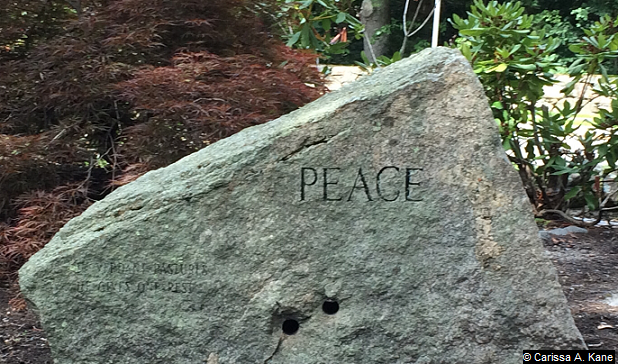
A couple of years ago, I came across this large rock while at a retreat house.

Peace

While the word “Peace” is noticeably engraved toward the top of the stone, not so easily seen are the words engraved toward the bottom left side of it. “In verdant pastures He gives one rest.” These words are reminiscent of Psalm 23, which begins, “The Lord is my shepherd; there is nothing I lack.”

At first glance the rock appears to suggest that peace is an uphill battle. However, despite the fact that it may seem that way, both on this rock and at times in life, perhaps more than anything, it is an invitation. One must remember that Peace is not a destination, but rather a companion on the journey.

As we climb the mountain, the Lord is by our side, solid like a rock, firmly in place, and the peace we find depends upon all that we hold in our hearts and to Whom we lean into, as well as in Whom we rest.

The Lord is my shepherd;
there is nothing I lack.
In green pastures he makes me lie down;
to still waters he leads me;
he restores my soul.
He guides me along right paths
for the sake of his name.
Even though I walk through the valley of the shadow of death,
I will fear no evil, for you are with me;
your rod and your staff comfort me.
You set a table before me
in front of my enemies;
You anoint my head with oil;
my cup overflows.
Indeed, goodness and mercy will pursue me
all the days of my life;
I will dwell in the house of the Lord
for endless days. – Psalm 23    

Reach…

The rays of light poured forth from the sun, extending toward the sea before carrying on and making their way across the water. Then from there, onto the shore, absorbing all in its path, catching passersby, and filling with gratitude, awe and inspiration, each willing soul along the way.

Sometimes getting from one side to the other is easier said than done. Today I found myself thinking about a day, a number of years ago, that I had to fly out of state to do a training session. It had been a productive day, moving right along with no hitches, but still it was a long day and at the end, I could not wait to be home again. However, the return trip was unexpectedly delayed. I remember checking in and boarding the flight, and feeling relieved as the plane began to depart from the gate. I was thinking that soon we would be in the air and less than a couple of hours later reaching the destination. All was good.

Continuing on, we began to move forward, and we kept moving, but without picking up speed. Then, the plane came to a halt, and remained halted on the tarmac for a number of hours. All passengers confined to their seats, I remember feeling more than a little upset as the time standing there, still, grew longer and longer.

Feeling so stuck, it was hard not to wonder, why? Why did the plane pull away from the gate, leaving one and all stranded, with nowhere to go? What is going on? Why are we waiting here? How long will it be?

Eventually, a far time from departing from the gate, the plane was able to take off. I found myself feeling so thankful along the way, upon landing and deplaning, and even more grateful, upon arriving home and climbing into my bed that late night/early morning. Thinking back on that trip, I remember at first feeling defeated in those long moments of waiting. The situation at hand invasive, threatening to wash away the prior, more pleasant happenings of the day. Then, as the time passed, sifting through various thoughts and feelings, somewhere in between, I remember letting go and arriving at a different destination—peace. All was good.

Back then, I did not understand. Since then, I have come to see. The tarmac, what seemed an empty wasteland, the place of being stuck or just waiting and waiting, held the same peace I was longing for at home. Yet, it was only able to reach me, and me it, in my letting go.

Most often what is waiting in between, the in between—Peace—is what gets one through.

Peace, always reaching out, longing to be held.

Peace, a treasure, seeking to be sought, but more than often not.

Peace, always near, always here, wandering care. 

Peace, destined for each other, like the calling of a mother.

Reach