Listen to the flowers As they huddle together. From one petal to another, Be attentive they say, Perhaps in various states of array, All rising from one stem, but in their own way. Looking around, what do they see? What’s happening? What’s that, you say? Cacophony must not dissuade. Take heart and persevere, Regardless of whatever, either, or any way. From one petal to another, Life goes on, and Eternity prevails In taking great care And consideration of each other. Listen to the flowers, From one petal to another, They are one, though many, As they “humble” together.
“Your neighbor is your other self dwelling behind a wall. In understanding, all walls shall fall down. Who knows but that your neighbor is your better self wearing another body? See that you love him as you would yourself. He too is a manifestation of the Most High, whom you do not know.” – Kahlil Gibran
Facing the ocean from the walk above or the sand upon the beach it’s easy to stay in place and feel content, and to do so without anywhere near the effort taken to get there. Not only that, but also to slide toward becoming removed from reality—all the lives that exist in various states on and all around the beach and the city or town that encompasses it—and the opportunity to take a life-giving part in it. It’s interesting to think about how swiftly one can be transported to “a world without cares,” with the sound of each wave that breaks upon the shore or the refreshing feeling as each wave washes over everything in its path.
Now, what’s it like to imagine that perhaps this (being caught up in the surroundings) is what it was like for the rich man in the Gospel according to Luke (chapter 16, verses 19-31), before he died?
When we read the Gospel for the Twenty-sixth Sunday in Ordinary Time (below), we learn that a poor man named Lazarus was a constant fixture at the rich man’s door. However, we are not told anything about an interaction(s) between the rich man and Lazarus. This is likely because what matters more than whether the rich man was unaware of, ignored, was indifferent to, or held disdain for Lazarus, is the distance that his worldly aims and wealth put between his ability to help and his desire to do so.
While the rich man was alive, he experienced what is sold in today’s world as “the good life.” However, it led him to becoming insulated from a complete picture of reality (not everyone has it good). And without that, it’s understandable that it would be harder for him not only to choose more wisely, but also to recognize that his openness to, and desire for living in ways that are generative had become diminished.
Neither the rich man nor his brothers could learn from the past (Moses and the prophets), not because the knowledge and wisdom wasn’t available to them, but because their hearts were divided. This—the chasm—is what prevented them from receiving the grace they really needed and making choices for the greater good.
May we be more aware and set our hearts on God to strip away the falsehoods that lead us astray, and to close the chasm that pulls us apart.
Jesus said to the Pharisees: “There was a rich man who dressed in purple garments and fine linen and dined sumptuously each day. And lying at his door was a poor man named Lazarus, covered with sores, who would gladly have eaten his fill of the scraps that fell from the rich man’s table. Dogs even used to come and lick his sores. When the poor man died, he was carried away by angels to the bosom of Abraham. The rich man also died and was buried, and from the netherworld, where he was in torment, he raised his eyes and saw Abraham far off and Lazarus at his side. And he cried out, ‘Father Abraham, have pity on me. Send Lazarus to dip the tip of his finger in water and cool my tongue, for I am suffering torment in these flames.’ Abraham replied, ‘My child, remember that you received what was good during your lifetime while Lazarus likewise received what was bad; but now he is comforted here, whereas you are tormented. Moreover, between us and you a great chasm is established to prevent anyone from crossing who might wish to go from our side to yours or from your side to ours.’ He said, ‘Then I beg you, father, send him to my father’s house, for I have five brothers, so that he may warn them, lest they too come to this place of torment.’ But Abraham replied, ‘They have Moses and the prophets. Let them listen to them.’ He said, ‘Oh no, father Abraham, but if someone from the dead goes to them, they will repent.’ Then Abraham said, ‘If they will not listen to Moses and the prophets, neither will they be persuaded if someone should rise from the dead.'” – Luke 16:19-31
I believe that sometimes society seems to be hanging by a thread, but that’s not all I believe…
I believe that God creates similarities, differences, and various dimensions intentionally, rather than carbon copies, or only one kind or way of being.
I believe freedom resides within and is a gift from God entrusted to each, to do with as one wills—as in free will.
I believe that it’s up to each to choose for themselves that which affects, most especially, oneself.
I believe and, also trust, that God has more wisdom than all of us together, seeing things we cannot see and understanding in ways which humans simply cannot.
I believe that to love like Jesus is to love like God—with great depth and breadth, yet personal and unique onto each of us as if we were the only one.
I believe that where hearts and minds are open to the Spirit that is Holy, unity and diversity not only live, but also thrive.
I believe that true victory does not rob others from choosing for themselves, and that what some may celebrate as a “win,” God does not.
I believe the compassion and mercy of God is all encompassing, and that clearly humankind’s is often not.
Most of all, I believe that the greater glory belongs to God, all of “this” will fade away, and that ultimately, through the hearts that are willing, God’s unifying way of love, compassion, and mercy prevails.
I believe that sometimes society seems to be hanging by a thread, but maybe sometimes that’s what we need to be.
And Mary kept all these things, reflecting on them in her heart. – Luke 2:19
Every day, no matter where on the face of the earth one might be, there is a source of natural light, whether it be from the sun, moon, stars, or one Aurora or another. Even though, depending on the clouds, it may seem otherwise, there is always a form of natural light that is present. And whether one is a night owl or a day person, or anywhere between, one way or another, there is light to be experienced, and it is pretty much constant.
As with natural, or pure, light, the same constancy exists with the Holy Trinity. That is, the Father, the Son, and the Holy Spirit. In the unity of which life is begotten, truth arises, and authenticity is born. So, one might ask, where does faith come in?
Faith is built by the experience of connection. What, and how, one connects with the world around them, often influences the direction of belief for all involved. This is why the greatest commandment, the one upon which everything else depends, is “to love.” Love connects us to the Holy Trinity, all that is truly good, and is the way in which an individual has the greatest impact. The opposite is true as well. For example, when people are asked to think of interactions they’ve had and that stand out the most, what often comes to mind are situations where they felt uplifted and supported or ones where they felt demeaned or disappointed. At the core of these experiences and what follows from them, is the impact of love or the absence of love, and faith tends to lean that way as well.
When one strives to love as Jesus did, faith becomes evidenced in action that is inspired and generative. We move from sole interest to the interest of all souls—love, patience, kindness, compassion, mercy, and so on. The Holy Trinity is transformative in that through the Father, the Son, and the Holy Spirit, we seek to live in unison and life, like light and truth, becomes a testament from good to better, to even better yet.
Glory be to the Father, the Son and the Holy Spirit. As it was in the beginning, is now, and ever shall be, world without end. Amen.
Therefore, since we have been justified by faith, we have peace with God through our Lord Jesus Christ, through whom we have gained access by faith to this grace in which we stand, and we boast in hope of the glory of God. Not only that, but we even boast of our afflictions, knowing that affliction produces endurance, and endurance, proven character, and proven character, hope, and hope does not disappoint, because the love of God has been poured out into our hearts through the Holy Spirit that has been given to us. – Rom 5:1-5
If you had to describe Easter in one word, what word would you use? While there is a plethora of words that could be chosen, what words speak more profoundly to you today, and what one word would be most fitting to encapsulate the life, death, and resurrection of Jesus?
Reflecting on the Triduum, with all the words, images, and actions that take place from Holy Thursday thru the Easter Vigil, the word authenticity seems apropos. Jesus taught by example and told his disciples what was going to happen, and then it did happen. His words and actions were true from start to finish. However, Jesus was not alone in his authenticity (be who you are, do as you are).
Looking more intently at the words and actions of some of the other individuals closest to Jesus, one might come to see that they were also being themselves during those moments. For example, Judas succumbed to betraying Jesus through his real-life weakness, identifying more strongly with money and power than anything else at that time. Then there’s Peter denying Jesus three times. This is not a reflection of his sincerity and desire to follow Jesus, but rather just part of where he was and what he was capable of at that time. Many of the other disciples, ran and hid after Jesus was arrested. Some did not. For example, the many women who followed Jesus, and John who witnessed the crucifixion by Mary’s side.
Think about these individuals as fellow human beings who were at the same time and place in history, while having different experiences, internal dispositions, and outward responses to the same events. In what ways do you see the beauty of God’s mercy and love shine through loud and clear? What’s it like to know that regardless of shortcomings or strengths, Jesus loved and accepted them all, seeing their value as beloved and part of creation?
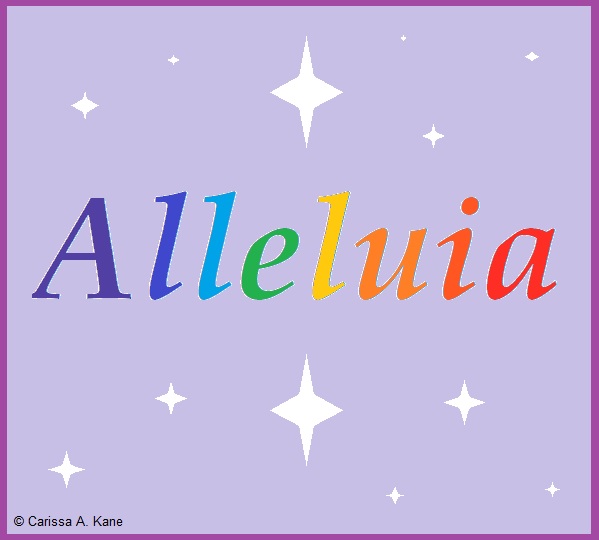
Oftentimes, we can look to label words, decisions, or actions as right or wrong. However, in the process, we neglect to see what we are forfeiting. Jesus, by seeing us for who we are, accepting us where we are, and loving us as we are, not only touches our hearts and enlightens our minds, but also moves us toward resurrection, turning authenticity into Alleluia.
Going about each day, there are many words that we speak and things that we do. What are the things said or done with purpose, and what kind? What do our words and actions mean to us, what inspires them, and how do they reflect eternal life to the world around us?
Give thanks to the LORD, for he is good, his mercy endures forever. – Psalm 118:1
In Greek mythology, keeping the gods and goddesses happy was central to life. So, temples were built, activities were held, sacrifices were made, all to please the gods and goddesses so that the people in turn might be helped along or rewarded rather than punished. Having recently seen a show that involved Greek mythology and the challenge of relationships, reading “…be reconciled to God,” in chapter 5, verse 20 of the Second Letter to the Corinthians, strikes a chord. And then there is the Gospel reading for the Fourth Sunday of Lent which includes the parable of the Prodigal Son (Luke 15:11-32), which really leads one to think about relationships. Combining the two, it can be intriguing to look more closely at the differences and similarities between one’s relationship with God and one’s relationships with others (family, friends, acquaintances, etc.). And perhaps consider further, the impact of both the things we can see and those we think we can see but cannot.
Looking to St. Paul and to the Prodigal Son, it’s all about stripping away the extraneous, drawing closer to what lies within, and trusting one’s experience. However, not one’s experience of self or others, but looking for, remembering and trusting one’s experience of God within the interactions and dealings we have with one another.
Imagine riding along from start to finish with Saul of Tarsus, soldier… warrior, active persecutor of early Christians who was literally knocked off his horse, called to conversion, and way down the road, became St. Paul.
Envision travelling with the Prodigal Son. The son who took his inheritance while his father was still living and turned his back on everyone and everything that he had previously known. He had to take his own path and have his own way; it was just something he needed to do. However, on that path, he lost everything, but then gained so much more than he could have ever dreamed of, by owning the truth and returning home, where he was immediately welcomed and embraced.
For St. Paul and the Prodigal Son, it turned out that the things that drove them… the things that sucked them in as being so important or so necessary, weren’t. And while it may have seemed to them as though they lost everything in the process of their falling, they did not. Both experienced the kindness and love of God both directly and through others—the grace that led them to pivot—and it is through that, that they came to know their true worth as God’s beloved, and that what really matters can never be taken away, only shared and magnified.
Tomorrow, March 20, 2022, is the vernal equinox, giving those of us in the Northern Hemisphere an even split between day and night and marking the beginning of spring. It’s not often we experience such balance in a day. In fact, it only happens twice a year on the vernal and autumnal equinoxes, and given the pace of life, the light of these days likely slips by without much notice.
The thing that’s interesting though, is as with many happenings in the natural world around us, there’s a message or lesson they hold. The vernal equinox can serve as a concrete example to not only bring equity and balance to heart and mind, but also perhaps to provide an experience we can all relate to, no matter where we are, and in doing so, on some level, restore a sense of harmony.
Take some time to absorb what is often the background as we go about each day—nature. Bring it to the forefront. Next, as you look around, consider your life. Where do you find balance and harmony? In what ways do you experience the Lord as kind and merciful in the hours of both the day and night? How are you inspired?
Bless the Lord, my soul; all my being, bless his holy name! Bless the Lord, my soul; and do not forget all his gifts, Who pardons all your sins, and heals all your ills, Who redeems your life from the pit, and crowns you with mercy and compassion, Who fills your days with good things, so your youth is renewed like the eagle’s. The Lord does righteous deeds, brings justice to all the oppressed. He made known his ways to Moses, to the Israelites his deeds. Merciful and gracious is the Lord, slow to anger, abounding in mercy. He will not always accuse, and nurses no lasting anger; He has not dealt with us as our sins merit, nor requited us as our wrongs deserve. – Psalm 103: 1-10
Stature… status… standing… are just a few of the words that the readings for the 25th Sunday in Ordinary Time bring to the forefront as being of great disservice to one and all.
In the Book of Wisdom, the competition is highlighted, and the plot is foreshadowed—how to be rid of the one who is Justice and Mercy—Jesus.
The wicked say: Let us beset the just one, because he is obnoxious to us; he sets himself against our doings, reproaches us for transgressions of the law and charges us with violations of our training. Let us see whether his words be true; let us find out what will happen to him. For if the just one be the son of God, God will defend him and deliver him from the hand of his foes. With revilement and torture let us put the just one to the test that we may have proof of his gentleness and try his patience. Let us condemn him to a shameful death; for according to his own words, God will take care of him. – Wisdom 2:12, 17-20
We all have moments where we disagree with, or feel offended by others, but where is the line that crosses over toward wicked? Perhaps, more importantly, what is it that leads one to feel that another human being is so intolerable, especially (in Jesus’s case) for being true to God and serving Love in both words and actions?
In the second reading, the Letter of James presents the dangers of being drawn into focusing on stature, status, and standing. It is a warning that ill-conceived competition is what wreaks havoc. The author makes a call, or a plea, to look more closely at the ways in which human beings are driven apart and put up against each other instead of being led by grace toward community, communion, and the greater glory of God.
Beloved: Where jealousy and selfish ambition exist, there is disorder and every foul practice. But the wisdom from above is first of all pure, then peaceable, gentle, compliant, full of mercy and good fruits, without inconstancy or insincerity. And the fruit of righteousness is sown in peace for those who cultivate peace.
Where do the wars and where do the conflicts among you come from? Is it not from your passions that make war within your members? You covet but do not possess. You kill and envy but you cannot obtain; you fight and wage war. You do not possess because you do not ask. You ask but do not receive, because you ask wrongly, to spend it on your passions. – James 3:16-4:3
Finally, in chapter nine of the Gospel according to Mark, the exclamation point! Jesus proclaims that human striving is not to be the rising in stature, status, and standing, but in fact, the opposite. That is, to embrace our fellow human beings in both our words and actions… making room, lending a hand, and beholding all that’s in one’s spirit as a child, the channel of God’s love and kindness.
Jesus and his disciples left from there and began a journey through Galilee, but he did not wish anyone to know about it. He was teaching his disciples and telling them, “The Son of Man is to be handed over to men and they will kill him, and three days after his death the Son of Man will rise.” But they did not understand the saying, and they were afraid to question him.
They came to Capernaum and, once inside the house, he began to ask them, “What were you arguing about on the way?” But they remained silent. They had been discussing among themselves on the way who was the greatest. Then he sat down, called the Twelve, and said to them, “If anyone wishes to be first, he shall be the last of all and the servant of all.” Taking a child, he placed it in their midst, and putting his arms around it, he said to them, “Whoever receives one child such as this in my name, receives me; and whoever receives me, receives not me but the One who sent me.” – Mark 9:30-37
Thinking about the great divides in all that’s going on around the world today, so much seems to be created from the tunnel vision that comes with primarily focusing on protecting one’s perceived stature, status, and/or standing. However, just as over 2,000 years ago, the biggest threat and obstacle one must ever overcome, is oneself.
Seek to be led by Justice and Mercy, serve and trust in the grace and glory of God, and remember always, “The Lord upholds my life” (Psalm 54:6b).
Over the past week, each morning has brought with it, the singing of birds in the backyard and surrounding areas. Their music, coming in the minutes prior to any alarm clock or sleep timer signifying the need to get going in a “time is running out” kind of way, has been mostly a pleasant way to move from sleep toward movement into the happenings of the day, and the ongoing heaviness of the times in which we live. Listening as the birds sing their tune, gratitude arises.
It is as if, the birds are trying share anticipation and excitement for the day. It is as if they are trying to say, as Maya Angelou wrote so beautifully, “This is a wonderful day. I’ve never seen this one before.” They sing, and sing some more.
While hearing their songs more prominently in the morning, before the air starts to become filled with waves of other sounds along the way, when I listen carefully, I remember that they also sing all throughout the day. When I look more carefully, I can clearly see. Sometimes they fly, sometimes they perch, and other times they soar. Certainly they have their quiet moments too. Then there’s night, when silence comes. Yet, it seems, whatever darkness night may hold, still when morning comes, they sing their praise… trusting that the gift of the day, and the One who has granted it, is far greater than whatever may be in store.
May the God of all peoples, and all creation, inspire a song of thanks and praise at the start of each day.
May the God of mercy and compassion, inspire a song of love and care for, and to, all, throughout each day.
May the God of all peoples, and all creation, inspire a song of thanks and praise at the mid of each day.
May the God of comfort, peace, and strength, inspire a song of faith, hope, and trust at all moments throughout each day.
May the God of all peoples, and all creation, inspire a song of thanks and praise, at the end of each day.
On the evening of that first day of the week,
when the doors were locked, where the disciples were,
for fear of the Jews,
Jesus came and stood in their midst
and said to them, “Peace be with you.”
When he had said this, he showed them his hands and his side.
The disciples rejoiced when they saw the Lord.
Jesus said to them again, “Peace be with you.
As the Father has sent me, so I send you.”
And when he had said this, he breathed on them and said to them,
“Receive the Holy Spirit.
Whose sins you forgive are forgiven them,
and whose sins you retain are retained.” – John 20:19-23













 HopeThatFloats
You must be logged in to post a comment.