Better Than Gold…

This week the winter Olympics being held in South Korea began. As a child, I remember the first time I watched the opening ceremonies of the Olympics on television. I found it exciting to see people representing so many countries from around the world in their various styles of clothing, together in one place. I also recall being struck by the way the flame spread around and across the cauldron when the Olympic torch was held to it. The flame burned with greater intensity and was there for all to see.

There is a beautiful spirit that comes with the Olympic Games. While there is competition and sides to choose and for which to route, it is interesting to see the ways in which a shared goal, interest, or experience can bring people together and enliven them, no matter how far apart they may be, whether geographically or otherwise. Oftentimes, it shines through brighter than any medals that might be won or any honor that might be awarded.

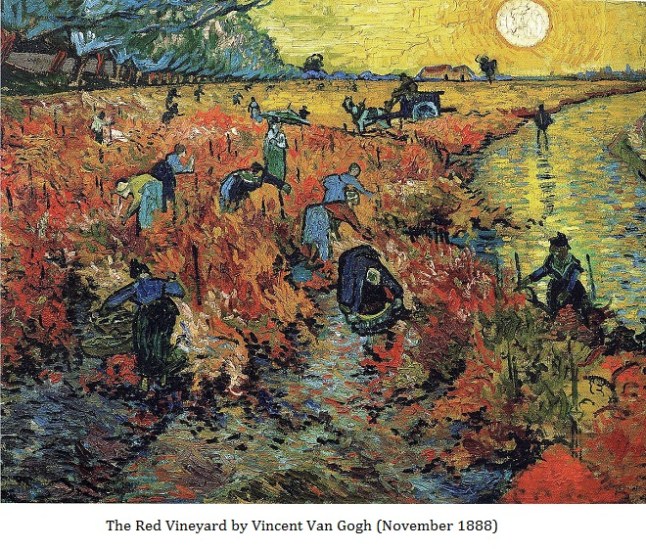
The passion and intensity of the Olympic Games give us a view of what is possible when seeking and striving to honor and celebrate the use of God-given talent and calling. Vincent Van Gogh once said, “Your profession is not what brings home your weekly paycheck, your profession is what you’re put on earth to do, with such passion and such intensity that it becomes spiritual in calling.” He also said, “I am still far from being what I want to be, but with God’s help I shall succeed.” Vincent Van Gogh, completed over 900 paintings and while they are highly valued pieces today, during his lifetime (1853-1890), it is believed that he sold only one, a painting done in 1888.

He did succeed, and although perhaps in the eyes of humankind it was not during his earthly life, the paintings of Vincent Van Gogh and the spirit in which they were done, is inspiring. They live on, touching countless hearts and souls around the world. Vincent Van Gogh carried the torch and protected the flame, with passion, by recognizing his gifts, staying dedicated to being who he was created to be, and trusting that, that was all he needed to do. Perhaps this is part of what draws so many to some level of interest in the Olympic Games. They touch upon the flame within each of us, reminding us of how good it is when we embrace the Spirit and use the gifts we have been given.

TheRedVineyard_VincentVanGogh1

More Than Words…

Oftentimes there is so much more to any story or situation than what one may initially see, perceive, or be told by others. While sometimes, we not get a chance to see beyond the surface for ourselves that is not an excuse to avoid trying. In any situation, both divinity and humanity call us to dive deeper, seeking truth and compassion rather than assuming.

When Mary and Joseph brought Jesus for presentation in the temple, as was customary according to the law of Moses, they encountered Simeon and Anna, two older people who seemed to have more than knowledge, who professed understanding of who this infant before them was and what the future would hold for him and the family. One can only imagine what it must have been like for Mary and Joseph to hear the words of Simeon and Anna, especially, Simeon’s words. He blessed Jesus as Savior and “a light for revelation” and “glory” for God’s people (Luke 2:32). Not only that, but he said to Mary, “Behold, this child is destined for the fall and rise of many in Israel, and to be a sign that will be contradicted” (Luke 2:34).  If that was not confounding enough, he told Mary, “and you yourself a sword will pierce so that the thoughts of many hearts will be revealed” (Luke 2:35).

As we go through life we all experience times of being told information by others. The challenge is figuring out what to believe. How we decide what to listen to and what to dismiss is key. How did Mary, Joseph, Simeon and Anna decide?

Perhaps even more significant, is determining what, of that which is spoken, is one’s business, or what is truly worth one’s time?

Mary and Joseph had already been told by Angels, messengers sent from God, that their Son would be God incarnate. They did not know exactly what that was going to mean or specifically what it would entail. Simeon and Anna both had been waiting for the birth of the Savior. Simeon had been told by the Holy Spirit that he would not die before seeing the Messiah. Surely, Anna, a prophetess, who worshipped day and night, also had been told comparable news along the way.

Mary, Joseph, Simeon, and Anna, were individuals, and unique as such. While they pursued the same goal, to live in faithfulness to God, the way they went about being faithful was likely similar, but not identical. They were four people who experienced and had come to know what many people would consider unbelievable, or fantasy. However, with what they shared, as many before them, as well as after them… with great faith in and devotion to God, and through continued prayer, they were able to know which Voice to listen to and which ones to tune out—examples worth emulating.

Trees

The Flock…

As I gazed out across the quiet, mostly still water, there were a number of Canadian geese slowly making their way to the other side of the pond. They appeared to be in a sort of formation. It was one that could be labeled more interesting or captivating than their typical landside behavior and the annoyance caused by the parting “gifts” they often leave behind.

Although the geese were not in a straight line, they were all pretty much in a row. They were moving together, eventually all in the same direction and with a similar, if not the same, purpose. They were united, even if only by the species to which they belong; not all that different than any other species.

Oftentimes amidst disagreement or unrest, it may seem that all we have is the knowledge that we are the same, but also simultaneously not the same.

When at an impasse, it can be tempting to throw up one’s hands and not only walk away, but also to stay away. While sometimes, this is necessary and perhaps truly for the best, Jesus cautions his disciples not to do so too easily or too quickly. For even in weighing the pros and cons and allowing them to inform and guide decisions, the heart—in all its depth, and holding knowledge of a different kind—can be left behind or squeezed out.

Jesus said to his disciples:
“If your brother sins against you,
go and tell him his fault between you and him alone.
If he listens to you, you have won over your brother.
If he does not listen,
take one or two others along with you,
so that ‘every fact may be established
on the testimony of two or three witnesses.’
If he refuses to listen to them, tell the church.
If he refuses to listen even to the church,
then treat him as you would a Gentile or a tax collector.
Amen, I say to you,
whatever you bind on earth shall be bound in heaven,
and whatever you loose on earth shall be loosed in heaven.
Again, amen, I say to you,
if two of you agree on earth
about anything for which they are to pray,
it shall be granted to them by my heavenly Father.
For where two or three are gathered together in my name,
there am I in the midst of them.” – Matthew 18:15-20

We are to help each other to stay true… to stay in formation—connected—so that we do not get lost and so that the equation does not leave cunning intellect and surface emotions to dominate and direct rather than Wisdom.

In the final analysis, I believe in man, in spite of men – Elie Wiesel

TheFlock

Intuition…

Intuition is sometimes referred to as the voice within or direction from one’s soul. Famed physicist, Albert Einstein once said, “The intellect has little to do on the road to discovery. There comes a leap in consciousness, call it intuition or what you will, and the solution comes to you and you don’t know why or how.”

As we travel along our way throughout life, we all have moments where we act or respond based on a gut feeling, or intuition, more than anything else. Just the same, there are moments where perhaps we ignore that gut feeling and lean toward the voice of reason and act or respond logically. Renowned poet William Wordsworth said, “Faith is a passionate intuition.”

In a letter to the Hebrews, St. Paul wrote:

“Faith is the realization of what is hoped for
and evidence of things not seen.
Because of it the ancients were well attested.
By faith we understand that the universe was ordered by the word of God,
so that what is visible came into being through the invisible.
By faith Abel offered to God a sacrifice greater than Cain’s.
Through this, he was attested to be righteous,
God bearing witness to his gifts,
and through this, though dead, he still speaks.
By faith Enoch was taken up so that he should not see death,
and he was found no more because God had taken him.
Before he was taken up, he was attested to have pleased God.
But without faith it is impossible to please him,
for anyone who approaches God must believe that he exists
and that he rewards those who seek him.
By faith Noah, warned about what was not yet seen,
with reverence built an ark for the salvation of his household.
Through this, he condemned the world
and inherited the righteousness that comes through faith.” (Hebrews 11:1-7)

Whatever one might believe, no matter how different one’s approach might be, we all have intuition. Both the wisdom and insight of intuition are planted within us, pushing through the soil that is knowledge and/or experience to the contrary, and budding at just the right time for just the right occasion, seeking to guide and protect us…to help us choose what is best. This occurs regardless of whether or not we consider and heed it.

While Albert Einstein, William Wordsworth, and St. Paul lived in different times and traveled in very different circles, they all lived with an awareness of that which is sacred and an openness to creation and innovation. They seem to have made every effort to reverence the fruit of the Vine, the work of their hands, and the dreams and longings of their souls. We are called to do the same.

pond2


Take your mark…

The other day I saw a photograph of two swimmers competing in the Olympics. The caption underneath the picture called attention to the fact that one of the swimmers was so focused, his head straight ahead, while the other swimmer’s head was turned in the direction of his competitor rather than toward the “finish line.” The picture and accompanying story made me think about focus and attention in everyday life.

What catches my attention? Or more importantly, what do I allow to hold my attention? On what do I focus and to what does it lead?

The ability to focus is a gift. How do I use it? How do I recognize when I have become too focused, or when my attention has shifted to something of little or lesser importance in a particular situation?

Most often, there are clues when I am drifting (or about to) away rather than toward that which is good, or better, for me. To see or sense them though, is not necessarily easy especially with all the distractions that society offers. What is one to do?

Looking back to the Olympics, with the dedication, discipline and focus required to get there, it is clear that there is something far greater than a bunch of sports being played. It’s as if we are all pulling for each other without necessarily even trying all that hard. There is something that pulls us out of our own world…our own country as we often watch other countries competing and begin cheering them on, too. There is a Spirit that transcends all that is visible. One that propels and lifts both the athletes, enabling them to dig deep down, and the spectators, allowing them to enter the journey.

That same Spirit, creating a sense of unity and providing inner strength, and so much more, is available and waiting to capture our attention. Waiting to lead and guide us whether we are competing in the Olympics, going to school, working a job…doing anything at all…or doing nothing.

A Regular Joe…

Joseph, the carpenter, faithful servant of the Lord, took Mary into his home as his wife and named his son Jesus.

Joseph, faithful servant of the Lord, took Mary and Jesus and fled to Egypt in the middle of the night, remaining there until the appointed time then returning to Nazareth.

Joseph, faithful servant of the Lord, husband of Mary, the mother of God, earthly father of Jesus, the Son of God, lived his faith.

Joseph, faithful servant of the Lord, did all that was spoken to him by the Angel of God.

St. Joseph, the patron Saint of the Universal Church, unborn children, fathers, workers, travelers, immigrants, and a happy death. We do not know much about St. Joseph. Not knowing much though is intriguing, because Joseph could be any of us—a “regular Joe” capable through his faith and God’s grace of facing the challenges of his life and the times in which he lived.

Perhaps, the best place to start though is with what we do know about St. Joseph. We know that he was a carpenter (MT 13:54-55). However, according to scholars the Greek word “Tekton” would have been used to describe Joseph, meaning that he was a craftsman or contractor; someone very skilled at working with wood, stones, and metals. It is also likely that he traveled quite a bit to seek work.

We also know from Bible verses, that St. Joseph was a husband (the husband of Mary the Blessed Virgin) and he was the “foster” or earthly father of Jesus. These two pieces of information, along with the fact that he was a working class man not only make St. Joseph relatable, but they also suggest he was a person of great faith, courage and wisdom. Think about it…the husband of Mary, the mother of God, and the earthly father of Jesus, the son of God.

From the passages in the Bible, we can also see ways that Joseph’s life and his choices exemplify those of someone striving to be faithful to God. We know that he had dreams in which he was visited by an Angel of God telling him to not be afraid to marry Mary (that she had conceived by the Holy Spirit), a dream to flee to Egypt, and then to return from Egypt. We know that Joseph listened, trusted and did as the Angel of God instructed in each case – Joseph married Mary, named his son Jesus, fled to Egypt, and later returned to Nazareth in Galilee all upon the instruction of the Angel of the Lord in dreams.

We can also see wisdom in the spiritual work of mercy exhibited by Joseph in bearing patience against wrongdoing or perceived wrongdoing. Mary, his betrothed, is found to be pregnant, yet they had not had any relations yet. We can only imagine what Joseph’s first thoughts to this news were. I doubt anyone would have trouble understanding if he was livid and decided to leave Mary. Also in that day and time in history, it would have been well within societal expectations for Mary to be stoned to death. Yet, here we have Joseph, deciding to quietly divorce Mary, not wanting her to be harmed. Despite what must have seemed and felt like a “betrayal,” he saw it in his heart, to show mercy and compassion. Joseph’s response, even before a visitation from the Angel of God, is remarkable and seems one only possible by someone very prayerful and inspired by God.

It leaves one to wonder, how am I able to show mercy when I am wronged? How am I able to be patient and to persevere? How can I, how can we, use St. Joseph as a model?

In each of the situations described in Scripture, Joseph dies unto himself, sacrifices and cooperates with God’s will. He shows openness to and focus on God’s will at each point. He was able to survive and make it through difficult and challenging circumstances such as the journey to Bethlehem with an expecting Mary. The journey to Bethlehem would not have been an easy one. Then there is the impending birth of Jesus with nowhere to stay, the flight to Egypt, the journey back to Nazareth and beyond.

How can we have the faith and patience of Joseph? How can we, like Joseph, recognize and accept that things happen in God’s time, not according to our time, and to remember that God is faithful to those who are faithful to God? Do I remind myself of the ways that God has been faithful to and patient with me along my journey so far? Do I allow past experiences to help me to remain patient and faithful, and to continue to trust in God and in God’s timing?

Joseph wasn’t given explicit plans or an outline of all that would happen in the dreams he had. In the Gospel of Luke, chapter 2, we are told that Jesus is laid in a manger because there was no room for them in the inn. We are also told at the presentation of Jesus in the temple that Simeon tells Mary and Joseph that Jesus would be glory for God’s people and that Mary’s heart would be pierced. It then says, “The child’s father and mother were amazed at what was said about him.” Joseph and Mary didn’t know all that was going to happen.

When we look at Joseph, he was just given a basic directive in his dreams…take Mary as your wife…flee to Egypt. He listened and let God lead him. He had faith in God, faith that we can only assume grew with each event in his life and most especially through the birth of Jesus and all that transpired in the time after his birth.

Martin Luther King said, “Faith is taking the first step, even when you don’t see the whole staircase.” That’s the hard part, the “not knowing.” If we knew all the details of what was going to happen, it might be very easy to be patient, to let go of wrongdoings and to trust in God and in God’s plan.

Faith…trusting even when we cannot see the next step…trusting that it will be there when it is time to take that step. Waiting until it is there, taking direction from God and acting once the step appears and the way is made clear. St. Joseph, from what we know of him, did all of this.

It is more likely than not, especially at that time in history, as a father, Joseph not only provided for and protected his family, but also led his family in the observance of prayer and religious custom. We read in Scripture, “Each year his parents went to Jerusalem for the feast of Passover, and when he was twelve years old, they went up according to festival custom.” (Lk 2:41)

With what we know of Joseph, it is not a stretch to imagine him as a very prayerful person.

For Joseph, the beginning of the journey that would lead him to emerge fully into who God created him to be and to fulfill his part in God’s plan, started with a dream, or a desire, long before the first dream, he had and that we read about in the Bible. The journey started with him saying “Yes” to letting God lead him, and continuing to say “Yes”, letting God continue to lead him all along the way. How can I, how can we, do the same?
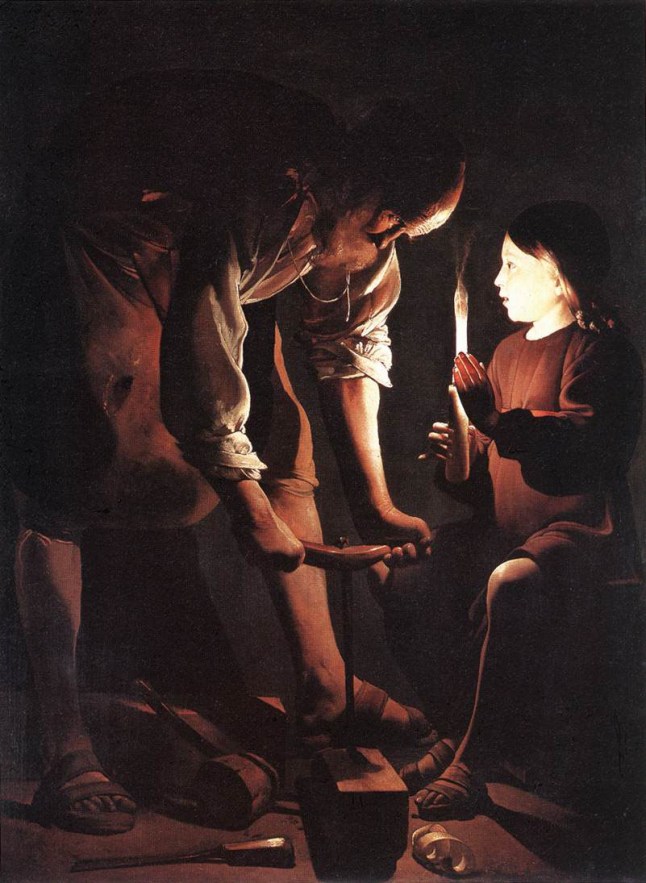
StJosephJoseph the Carpenter rendered by Georges de La Tour
Taking Paul’s Advice…

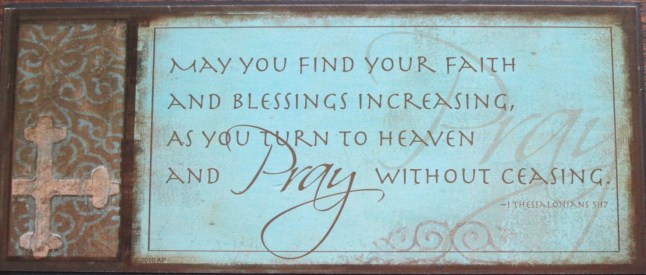
I saw this quote from Frederick Buechner, an American writer and theologian, the other day. I was contemplating what to do about a particular situation and all of a sudden, there was the answer, this quote, “Go where your best prayers take you.”

As I read the words, a smile came across my face. A reminder just at the right moment, and while the words may seem so simple or even obvious, I felt so grateful to see them and to be reminded of what I know through experience to be so true. I think most of us start out with the best of intentions and then along the way, we can get sidetracked or pulled away from the very place to which we started out.

It seems like it has been human nature, since the beginning of time, to want to be in charge, whether consciously or sub-consciously. Yet, I and many people I know, and know of, seem to agree, that being in a place of seeing oneself as being in charge, or the ultimate authority, can be a most dangerous place to be. Putting oneself at the top, in head and heart, seems to be a place that leads to chaos of one kind or another, more often than not. We can all probably point to many examples of such chaos in our lives and throughout the world.

“One of the most arduous spiritual tasks is that of giving up control and allowing the Spirit of God to lead our lives.” – Henri Nouwen

We can all probably also point to moments of joy and triumph that we’ve experienced ourselves or seen around us where the decision(s) seemed to be so guided by prayer rather than motivated by self-determination or self-preservation. This is not to say that decisions led by prayer do not also come with difficulty or challenge. Sometimes they do. However, when I turn my will over to God, putting prayer and listening at the top of the list, and asking God to help me to choose light and hope over fear, I find without fail, peace, calm and blessings in the midst of smooth sailing as well as in the midst of a storm.

PrayWithoutCeasing

St. Paul’s advice to the Thessalonians, “Pray without ceasing…”

From Shaking Dust to Slaying Giants…

Whether one uses the verbiage of today, “Shake it off!”, or that of ancient times, “Shake the dust from your feet”, there are many ways to accomplish the task of not allowing people or situations to drag me down or to take me away from being or striving to be the best I can be (that is, my authentic self).

Jesus’ words to the disciples: “And as for those who do not welcome you, when you leave that town, shake the dust from your feet in testimony against them.”(Luke 9:5)

As I sit with the thought of shaking the dust, I wonder about the situations, where it seems like the dust cannot be shaken off. What about the situations where the dust is more like mud stuck in and around one’s sandals? What is to happen then? Does the “shake” need to become a “stomp” or some other more forceful action? Do the sandals need to be soaked in soapy water until the mud softens and can be washed away? Or, do they need to be removed and replaced with new ones?

Ultimately, any of the above, could be the answer. There could also be other possibilities. It all depends on whom I am and what I am being called to by God in the situation that I find myself.

Many people are familiar with the story of David and Goliath in the Bible, but perhaps not how he ended up standing in front of Goliath. David is the youngest of 8 sons. Between the ages of 10 and 13 he is anointed by the prophet Samuel.

“The LORD said, ‘There–anoint him, for this is he!’ Then Samuel, with the horn of oil in hand, anointed him in the midst of his brothers; and from that day on, the Spirit of the LORD rushed upon David.” – 1 Samuel 16:13

After the anointing and as a young man, David is summoned to Saul (the King) as a musician.

“Saul then told his servants, ‘Find me a good harpist and bring him to me.’ One of the servants spoke up: ‘I have observed that a son of Jesse of Bethlehem is a skillful harpist. He is also a brave warrior, an able speaker, and a handsome young man. The LORD is certainly with him.'” – 1 Samuel 16:17-18

Saul is pleased with David and makes him an armor-bearer. During this time, the Philistines and Israelites go to battle against each other. Goliath is a mammoth Philistine warrior. David, upon his father’s request, is bringing food to his brothers who are soldiers in the Israelite’s army camp. While there, he asks a question about the reward for defeating Goliath and wonders aloud who the giant is that he is against “the armies of the living God.” (1 Sam 17:26). David’s questions and the conversation that results get back to Saul who requests that David be brought to him.

David asks Saul to let him fight Goliath. Saul tells him, “You cannot go up against this Philistine and fight with him, for you are only a youth, while he has been a warrior from his youth.” (v33). David tells Saul how he has fought off lions and bears while tending his father’s sheep and that he will do the same to Goliath “because he has insulted the armies of the living God.” (v36) Then he says, “The same LORD who delivered me from the claws of the lion and the bear will deliver me from the hand of this Philistine.” (v37) Saul agrees and David battles Goliath.

While the battle and victory by David seem swift, it is not without what we might call “trash talk” by the giant who scoffs at the youth and size of David and his weapons (a slingshot and 5 stones). David stays his ground though and responds, loud and clear to Goliath, “For the battle is the LORD’s and the LORD shall deliver you into our hands.” (v47) … that is exactly what happens.

To follow the story of David from his birth order and anointing to his battle with Goliath and beyond, it seems clear that “the Spirit of the Lord rushed upon David” and that David let the Spirit of the Lord lead him. He did so no matter what giant he faced…in doing what seemed impossible (defeating Goliath) and in acknowledging his wrongdoing and turning back to the Lord after succumbing to his weaknesses (in 2 Sam 11-12). In the end, there was no dust or mud on his sandals.

“For the battle is the LORD’s.” When I let it stay that way, instead of making it my own, I know exactly when and how to shake, stomp, soak and wash, or remove and replace my sandals…there is no dust or mud on them.

“The Spirit of the Lord is upon me” (Is 61:1, Lk 4:18), upon us, how do we embrace It?

IMG_1644

Not All Flowers Are Red…That’s Intentional

Flowers Are Red by Harry Chapin

The little boy went first day of school
He got some crayons and he started to draw
He put colors all over the paper
For colors was what he saw

And the teacher said, “What you doin’ young man?”
“I’m paintin’ flowers” he said
She said, “It’s not the time for art young man
And anyway flowers are green and red”

“There’s a time for everything young man
And a way it should be done
You’ve got to show concern for everyone else
For you’re not the only one”

And she said, “Flowers are red young man
And green leaves are green
There’s no need to see flowers any other way
Than the way they always have been seen”

But the little boy said
“There are so many colors in the rainbow
So many colors in the morning sun
So many colors in the flower and I see every one”

Well the teacher said, “You’re sassy
There’s ways that things should be
And you’ll paint flowers the way they are
So repeat after me”

And she said, “Flowers are red, young man
And green leaves are green
There’s no need to see flowers any other way
Than the way they always have been seen”

But the little boy said
“There are so many colors in the rainbow
So many colors in the morning sun
So many colors in the flower and I see every one”

The teacher put him in a corner
She said, “It’s for your own good
And you won’t come out ’til you get it right
And are responding like you should”

Well finally he got lonely
Frightened thoughts filled his head
And he went up to the teacher
And this is what he said

And he said
“Flowers are red, and green leaves are green
There’s no need to see flowers any other way
Than the way they always have been seen”

Time went by like it always does
And they moved to another town
And the little boy went to another school
And this is what he found

The teacher there was smilin’
She said, “Painting should be fun
And there are so many colors in a flower
So let’s use every one”

But that little boy painted flowers
In neat rows of green and red
And when the teacher asked him why
This is what he said

And he said
“Flowers are red, and green leaves are green
There’s no need to see flowers any other way
Than the way they always have been seen”

The longer I live, the more I see that fewer and fewer things are black and white, and that when I am truly focused on, and acting out of love, whatever the situation may be, color, shape or form have very little bearing at all.

Imagine what it might be like to be in a world, where encouragement toward discovering and using one’s God-given gifts was the norm, and where love was the driving force of each word and each action. If society let God be God…If religion, instead of being used at times and/or seen by some as a tool for “fixing” each other, so we can all be the “same,” focused more heavily on love and relationship…relationship with God and with each other. What might it be like, if the need to be “right” were dismissed?

Somehow, I cannot help but think and feel that if God wanted everyone to be, to think, and to feel the exact same, God would have made that happen. God didn’t though. However, God did inscribe the same law, the law of love, on all of our hearts. God also inspired Scripture that is full of examples of love, mercy, and compassion across all kinds of situations and “would be” societal barriers.

While it may seem hard to live in and out of love, day in and day out, it is not impossible. All we have to do is try…and keep on trying. God will make it happen…if we ask (and keep on asking), and then let go and let God be in charge.

“The important thing is not to think much but to love much; and so do that which best stirs you to love.” ― St. Teresa of Ávila

What Instrument Will I Be?

Throughout the past week, I found myself feeling so inspired by the words of Pope Francis during his visit to the United States of America. I continue to find, as many others do, his message and his manner so appealing. There is no duplicity in him, or at least it seems that way. He preaches, and from all evidence, lives a life of love and mercy and promotes peace and unity.

Pope Francis exudes the essence of one who is centered in prayer, has a desire to remain faithful to God, and is filled with and guided by the Holy Spirit. He is inclusive and calls us to look beyond ourselves to focus on the common good. He challenges us to be faithful to God and sets an example through his own actions. Not only that, but what makes his words and actions even more meaningful (at least to me), he does all of this, without making it about himself. All that he says and does seems to point to something greater…to God.

“Just so, your light must shine before others, that they may see your good deeds and glorify your heavenly Father.” – Matthew 5:16

What a great example! One that extends to more than just one group of people, one that is so life giving and aspires a closer relationship with God and others. Pope Francis calls us to be true to who God created us to be. To have a Pope named Francis, who comes to us in the name of God, through Jesus and with the Holy Spirit, at this time in history, how fitting!

Lord, make me an instrument of thy peace.
Where there is hatred, let me sow love;
Where there is injury, pardon;
Where there is doubt, faith;
Where there is despair, hope;
Where there is darkness, light;
Where there is sadness, joy.

O divine Master, grant that I may not so much seek
To be consoled as to console,
To be understood as to understand,
To be loved as to love;
For it is in giving that we receive;
It is in pardoning that we are pardoned;
It is in dying to self that we are born to eternal life.

– Prayer of St. Francis of Assisi