Beating still, beating quietly, beating nonetheless, Attention becomes the disciple of intention. A stir within, roars within, formation from within. Look and listen closely as true passion is revealed.
Following the leader? Where? To what good do they lead? Igniting hearts? Uniting hearts? On whose behalf? All hearts can and must choose for whom and for what they burn. Discern! Discern! Deception has so many voices.
Does the message uplift all of us, like the true one Who gracefully overcomes the small, in all of us, Helping the steadfast to be ready, set, and to ask, How does this represent the good teacher serving all?
The Lord keeps faith forever, secures justice for the oppressed, gives food to the hungry. The Lord sets captives free. The Lord gives sight to the blind; the Lord raises up those who were bowed down. The Lord loves the just; the Lord protects strangers. The fatherless and the widow the Lord sustains, but the way of the wicked he thwarts. The Lord shall reign forever; your God, O Zion, through all generations. Alleluia. – Psalm 146:6-10
For a time, many things are only for a time. Some things forever gone, others, on hiatus. Sometimes returning, welcome on arrival, Sometimes returning, unwanted and in dread, Sometimes slithering, seeping in, seeping out, Creating a stir, unease or great unrest. But Light, the Great Protector, shines thru, Revealing all, shedding lies in time, And casting out, what Time ordains as passed.
The Gospel passage for the First Sunday of Lent (Luke 4:1-13) is referred to as the Temptation of Jesus. After his baptism, Jesus is led into the desert by the Holy Spirit for forty days. And after these days of fasting, he is tempted by the devil in three ways:
First, to use his status as the Son of God to relieve himself of his situation of hunger.
“If you are the Son of God, command this stone to become bread.” (verse 3)
Second, to exalt himself by paying homage, or worshipping, the devil to receive earthly power and glory.
“I shall give to you all this power and their glory; for it has been handed over to me, and I may give it to whomever I wish. All this will be yours, if you worship me.” (verses 6-7)
And third, to show doubt in God, by throwing himself from the parapet of the temple, and thereby testing Scripture:
“If you are the Son of God, throw yourself down from here, for it is written: ‘He will command his angels concerning you, to guard you, and: ‘With their hands they will support you, lest you dash your foot against a stone.’” (verses 9-11)
Jesus responds to these temptations as follows:
“It is written, ‘One does not live on bread alone.’” (verse 4)
“It is written ‘You shall worship the Lord, your God, and him alone shall you serve.’” (verse 8)
And lastly, when the devil tries to zero in on and twist Scripture verses to tempt Jesus away from the truth of who God is calling him to be, Jesus, again focuses on God—a higher purpose—responding:
“It also says, ‘You shall not put the Lord, your God, to the test.’” (verse 12)
The “Temptation of Jesus” Gospel passage ends with, “When the devil had finished every temptation, he departed from him for a time.” (verse 13)
Oftentimes, after going through a challenging situation or event, it is common to be grateful for that time to be over. It can also be tempting to walk away with a notion of achievement or learning from it in a way that we see as being complete. Yet, whether good or bad, there are times when the same, or a similar challenge returns, offering an opportunity to draw even closer to God, and to see or learn even more.
Take some time to consider how open you are to remembering what you’ve learned as well as to learning something new when repeat or similar situations of challenge occur?
Reflecting on Jesus’s words in response to each of the temptations he faced in the desert, what invitation(s) are there for you and Jesus to explore? Allow your prayer to extend into these areas. Express your wants, needs, fears, etc. to Jesus, and allow Jesus to express His thoughts and wisdom to you.
You who dwell in the shelter of the Most High, who abide in the shadow of the Almighty, say to the Lord, “My refuge and fortress, my God in whom I trust.” – Psalm 91:1-2
In the Gospel passage for the Thirty-third Sunday in Ordinary Time (Mark 13:24-32), Jesus says, “Learn a lesson from the fig tree. When its branch becomes tender and sprouts leaves, you know that summer is near.” (v. 24). These words are part of his response to a question asked of him by the disciples, Peter, James, John, and Andrew.
Away from the others, and just after Jesus commented to his disciples on the destruction of the temple, they had asked him, “Tell us, when will this happen, and what sign will there be when all these things are about to come to an end?” (Mark 13:4). The first thing that Jesus says to them is, “See that no one deceives you.” (Mk 13:5). As he continues to tell them the signs and what will happen (trials and tribulations such as war, persecutions, etc.), he also continues to give them instructions as to how to handle themselves and the situations they will face. He says:
“… do not be alarmed” (v. 7)
“Watch out for yourselves.” or be aware (v. 9)
“… do not worry beforehand about what you are to say. But say whatever will be given to you at that hour. For it will not be you who are speaking but the holy Spirit.” (v. 11)
“Be watchful!” (v. 23)
Then he says these words that are part of the Gospel for today, “Learn a lesson from the fig tree. When its branch becomes tender and sprouts leaves, you know that summer is near.” (v. 28). And although Jesus says this as he continues to tell Peter, James, John, and Andrew about the signs that will occur at the end times, the gospel passage ends with Jesus saying, “But of that day or hour, no one knows, neither the angels in heaven, nor the Son, but only the Father.” (v. 32). In other words, perhaps Jesus is reminding us not to focus on the signs, but rather to focus on his instructions.
His last instruction, “Learn a lesson from the fig tree,” is intriguing. In chapter 11 of Mark’s Gospel, Jesus curses a fig tree for being fruitless:
“The next day as they were leaving Bethany he was hungry. Seeing from a distance a fig tree in leaf, he went over to see if he could find anything on it. When he reached it he found nothing but leaves; it was not the time for figs. And he said to it in reply, ‘May no one ever eat of your fruit again!’ And his disciples heard it.” (Mark 11:12-14).
In this earlier passage, there is a mention of time, “… it was not the time for figs.” And now, when Jesus is telling some of his disciples about the signs of the end times and instructing them on how to be prepared, he again, refers to figs and time (and not knowing the exact time of the end).
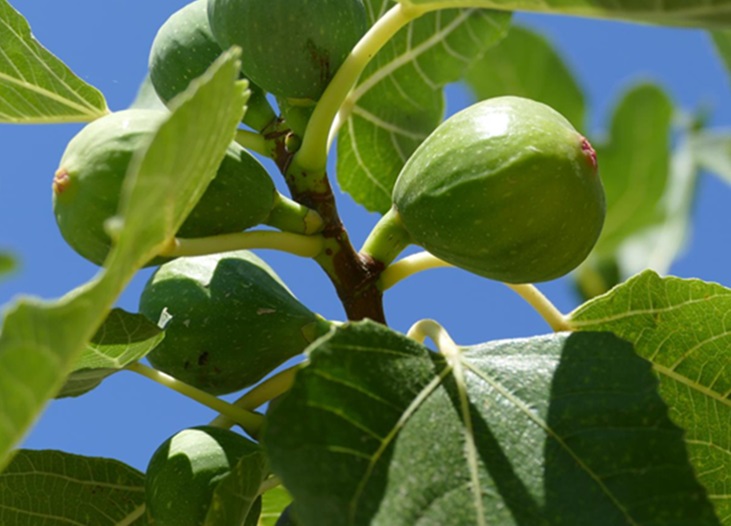
A few interesting things about figs and time… Fig trees, like other fruit trees, have leaves, but unlike other fruit trees, their fruit flowers internally. Also, each fig contains a collection of many flowers and seeds. And while one may think of a fig as a piece of fruit, they are actually an infructescence—a multiple fruit—that in a sense, is always in the process of blooming.
So, in both times of uncertainty and times of comfort, see that no one deceives you, do not worry, and learn from the fig tree, continuing to grow from within, knowing that the fruit will come at the time that is appointed.
“Lord, my allotted portion and my cup, you have made my destiny secure.” – Psalm 16:5
In striving, there is stretching, In learning, there is growth. How high, how low, How hot, how cold, And with what power, Shows, and says, so much. The direction of travel? Mattering so far less, Than the Way, And impact of approach.
“If we could read the secret history of our enemies, we should find in each man’s life sorrow and suffering enough to disarm all hostility.” – Henry Wadsworth Longfellow
I am the good shepherd, and I know mine and mine know me, just as the Father knows me and I know the Father; and I will lay down my life for the sheep. I have other sheep that do not belong to this fold. These also I must lead, and they will hear my voice, and there will be one flock, one shepherd. – John 10:14-16
Sometimes due to the weather or one’s location, for example in the snow, on the sand at a beach, or stepping out of a pool, the impact of where one has traveled can be clearly seen. Most often though, we tread without leaving any physical indications at all.
The response for today’s Psalm is derived from Psalm 86, verse 11ab: Teach me your way, O Lord, that I may walk in your truth.
The text for the complete verse is as follows:
Teach me, Lord, your way that I may walk in your truth, single-hearted and revering your name. – Psalm 86:11
Reflect on the places to which you have traveled and/or spent time over the past few days, or the past week. As you remember where you have been, what comes to mind?
In what ways would you say that you experienced walking in God’s truth, single-hearted and revering God’s name? Were there places or situations where you were more grounded and fully present to the moment?
As you allow yourself to imagine revisiting these places, take time to notice or re-notice things.
Next, have a conversation with the Lord and share whatever thoughts and feelings arise within you. Ask to be shown what the Lord sees in these experiences and wants you to see as you continue striving in discipleship.
When your conversation is completed, pray:
Teach me, Lord, your way that I may walk in your truth, single-hearted and revering your name. – Ps 86:11
It seems that human nature tends toward comparison and judgment along with practices that help one to “find their place” and obtain some level of comfort. However, although these skills might be helpful in deciphering and navigating the world around us, they can also lead to complacency, and a sedentary or fixed way of seeing and being. The readings for the Solemnity of Christ the King offer an opportunity to reflect upon choices, judgments, and viewpoints, and to consider by what or whom they are influenced. Or, in other words, to contemplate who is leading you.
In the First Reading (Ezekiel 34:11-12, 15-17), the deep level of care and protective nature of God is expressed.
“Thus says the Lord God: I myself will look after and tend my sheep.” (v. 11).
The passage continues to describe God’s desire to rescue, find, and heal as well as God’s promise to make judgments and course correct those who are wrong or have gone astray.
How do you feel about this notion? What’s it like to leave the judgment and course correction to God? Are there areas in which it is more of a challenge than others? Spend some time in prayer asking for guidance around replacing judgments that veer away from God’s desire for you and for a clearer vision of what role God desires for you.
In the Responsorial Psalm (Psalm 23:1-3,5-6), we stay with the image of the Shepherd who takes care of and provides for his sheep. The psalmist writes of the Lord as refreshing their soul, guiding them in right paths, and blessing them so that “goodness and kindness follow” them. The psalmist then says, “I shall dwell in the house of the Lord for years to come” (v. 6).
What do you think they mean? What do you imagine that would be like? How would it feel? In what places or situations have you experienced similar feelings?
“The Lord is my shepherd; there is nothing I shall want.” (v. 1).
In what ways do you feel inspired when you imagine God’s loving presence permeating all experiences and capable of extending beyond all that might otherwise be a barrier?
Looking to the Second Reading (1 Corinthians 15:20-26, 28), St. Paul writes about Christ the King who helps us to life by helping us to overcome death, in its various forms, while at the same time leaving the ultimate judgment to God.
“then comes the end, when he hands over the kingdom to his God and Father, when he has destroyed every sovereignty and every authority and power. For he must reign until he has put all his enemies under his feet. The last enemy to be destroyed is death. When everything is subjected to him, then the Son himself will also be subjected to the one who subjected everything to him, so that God may be all in all.” (v. 24-26, 28).
What happens when you think about Jesus, to whom God subjected all things, handing the kingdom back to God (v. 24) and subjecting Himself to God? What’s it like for you to let go of something that you have obtained or been given? Where is God in that decision or process?
Now turning to the Gospel (Matthew 25:31-46), Jesus talks to his disciples about the final judgment and separation between sheep (the righteous) and goats. Notice how the criteria that Jesus describes are all things that can be done to take care of and protect others.
“For I was hungry and you gave me food, I was thirsty and you gave me drink, a stranger and you welcomed me, naked and you clothed me, ill and you cared for me, in prison and you visited me.” (v. 35-36).
There is always more than just “I,” “me,” and “mine,” and part of striving for the Kingdom of God is not only to know this, but also to live in a way that shows respect, dignity, appreciation, and care for others. Also, it’s not about being perfect or being able to amass a long list of service to others, but rather about focusing efforts on being in service of God by surrendering one’s heart and mind to being under the influence, united with, and led by God.
The Lord is my shepherd; there is nothing I shall want. – Ps 23:1
As pockets of clouds drifted across the clear night sky, the moon, at its fullest continued to reflect hope and promise in each passing moment, inspiring hope and promise with each passing thought. What is, what would be, what could be, beholden to One, the only One. There is I Am.
The response to the Psalm for the Third Sunday of Lent is, “If today you hear God’s voice, harden not your hearts.” (Ps 95:8). What does a hardened heart look like? Physically, it is one in which arteries may be clogged, or the lining may be thickening, to name a couple attributes. Overall though, it is a heart that is blocked in one way or another from working optimally or as designed. Spiritually, a hardened heart is also blocked in one way or another from working fully, as intended by God.
So how does one recognize a hardened heart? Well, as with many things, there are indicators as well as tests that can alert one to the status of their heart. And in faith, the directions always start at the beginning. “If today you hear God’s voice…”
What does God’s voice look, or sound like to you? What adjectives would you use to describe God?
Now, taking Light to life, what happens when you try to assign those same adjectives to describe the heart behind your words and actions throughout the day, the week, and more? In what situations do they fit? And in what situations, is there an invitation for greater growth and movement toward taking on the heart of Jesus?
A Lenten Prayer: Heart of Jesus, open our eyes and ears. Heart of Jesus, show us what our hearts are looking past. Heart of Jesus, help us to acknowledge what is, what would be, what could be. Heart of Jesus, guide us in your way. Heart of Jesus, bind our hearts to yours.















 HopeThatFloats
You must be logged in to post a comment.