Facing All Sides…

Today, November 20th, is also the Solemnity of Our Lord Jesus Christ, King of the Universe. Although the date of this occasion is not the same every year, this year is one where it coincides with the anniversary of the official release of Windows 1.0 (November 20, 1985) which included a game, Reversi, based on another game named Othello.

Regardless of the name though, the two-player game like the push and pull of life on earth is all about strategy. It involves a green board and round pieces that are black on one side and white on the other, and players take turns trying to “book-end” their opponent’s pieces either horizontally or vertically. When successful, a player can then convert pieces from the other player’s color to one’s own, and when all the pieces are used, the player who has more of their color pieces on the board wins.

Essentially, this game is another that is all about paying attention, thinking ahead, maneuvering, and navigating to benefit from both one’s own plays as well as the missteps of one’s opponent. Typical of pretty much any kind of competition. Or, on the other hand, it can just be a simple, engaging game while spending time with a loved one. The pieces like coins or chips, creating an interesting rhythm as they shake back and forth in a loosely closed fist, and a pattern that slowly emerges as each piece is placed on the board of green amid moments of speaking and ones of silence. Ultimately, like many things, it depends on the eye with which one views it.

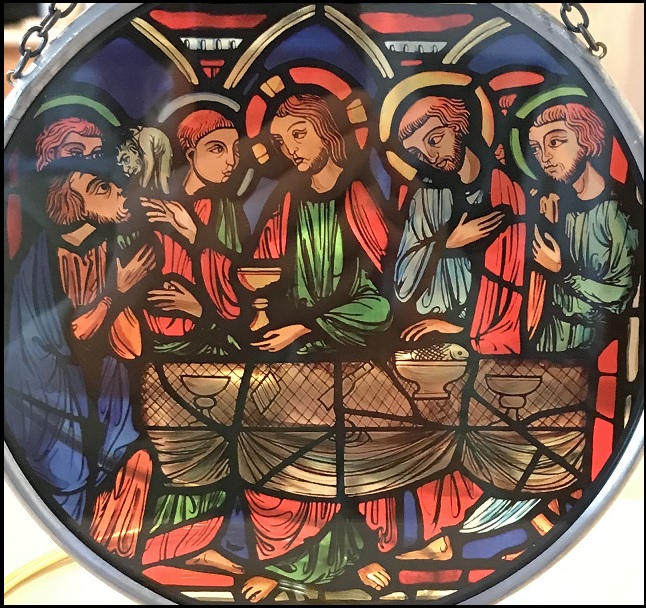
Sitting with chapter 23, verses 35-43, of the Gospel according to Luke (below), one can see two sides of the piece. There were those, the rulers, soldiers, and one of the criminals, who saw the situation solely in terms of themselves and in the world (winning, losing, us against them). They taunt Jesus and browbeat him about not fighting back and overcoming them, which they assume he would do if he was really a king.

And then, there was the other criminal, who saw the situation as it truly was. He could see and acknowledge the truth, that both criminals had done wrong, and Jesus had not. He also pushed back against the misconceptions and aggressive behavior toward Jesus. It seems that the eye through which he viewed what was happening was more flexible, able to take in a broader view—the full picture including beyond himself, and less hardened than the others who were there. As a result, he was more open, and this allowed him to see through the noise and mentality of the crowd. It led him to the truth and a desire that drew him closer to Jesus, Savior, in the moment he was facing… in the moment they were facing together.

In this month of Thanksgiving and remembrance, with which eye are you viewing situations? And in what ways do you desire to face each moment together with Jesus?

The rulers sneered at Jesus and said,
“He saved others, let him save himself
if he is the chosen one, the Christ of God.”
Even the soldiers jeered at him.
As they approached to offer him wine they called out,
“If you are King of the Jews, save yourself.”
Above him there was an inscription that read,
“This is the King of the Jews.”

Now one of the criminals hanging there reviled Jesus, saying,
“Are you not the Christ?
Save yourself and us.”
The other, however, rebuking him, said in reply,
“Have you no fear of God,
for you are subject to the same condemnation?
And indeed, we have been condemned justly,
for the sentence we received corresponds to our crimes,
but this man has done nothing criminal.”
Then he said,
“Jesus, remember me when you come into your kingdom.”
He replied to him,
“Amen, I say to you,
today you will be with me in Paradise.” – Lk 23:35-43

At Our Best…

The readings for the Thirty-third Sunday in Ordinary Time extend an opportunity to think about one’s relationship with Jesus and reflect on how justice and perseverance come into play. In the first reading (Mal 3:19-20a), we read the phrase, “the sun of justice with its healing rays.” How have you experienced the healing rays of justice? In what ways do you impart the fruits of that healing in your daily life?

In the responsorial psalm (Ps 98:5-6, 7-8, 9), we read:

Let the rivers clap their hands,
the mountains shout with them for joy,
Before the Lord who comes,
who comes to govern the earth,
To govern the world with justice
and the peoples with fairness. – Psalm 98:8-9

Envision something that recently brought you joy and excitement. How did it impact the people and the environment around you? Was everyone happy? Was anyone affected in a way that was not beneficial? Where do sense Jesus was in this situation?

Now, let’s take a step back. Consider this: What is your understanding and experience of justice and fairness? Can you think of some examples of the two? Do they include situations where there may be no personal benefit involved? How is your understanding and application of justice and fairness influenced by the example of Jesus’s life, death, and resurrection, and the many parables he told?

In the second reading (2Thes 3:7-12), St. Paul reminds the Thessalonians of how he, Silvanus, and Timothy have behaved and urges them to do likewise.

Brothers and sisters:
You know how one must imitate us.
For we did not act in a disorderly way among you,
nor did we eat food received free from anyone.
On the contrary, in toil and drudgery, night and day
we worked, so as not to burden any of you.
Not that we do not have the right.
Rather, we wanted to present ourselves as a model for you,
so that you might imitate us.
In fact, when we were with you,
we instructed you that if anyone was unwilling to work,
neither should that one eat.
We hear that some are conducting themselves among you in a
disorderly way,
by not keeping busy but minding the business of others.
Such people we instruct and urge in the Lord Jesus Christ to work quietly
and to eat their own food. – 2Thes 3:7-12

As you contemplate St. Paul’s words to the Thessalonians calling on them to focus on their work and to persevere in faith so as not to become idle and then “disorderly,” by getting caught up or interfering in the business of others, what strikes you most? With the current state of many things in the world, what insight(s) can you draw from this passage? In what ways do you experience Jesus in the places that have been capturing your focus these days?

Looking to the Gospel passage (Lk 21:5-19 included below), Jesus speaks of what’s to come, understood as the end of days. He essentially tells those who are listening, do not fall prey to being distracted by the signs and chaos around you, and do not be worried about how to respond or react, but rather, stay focused on me, and I will help you to know what to say… what to do. The passage closes with Jesus saying, “By your perseverance you will secure your lives.” How do you know the difference between being driven by the perseverance of faith in Jesus and being driven by your own sheer will masked as perseverance of faith in Jesus?

The Gospel verses taken together, tell us that the answers are not predetermined or black and white, but are all encompassing, pure, and speak to the uniqueness of each moment that can often escape the human mind and heart. Jesus, through his abundant love and wisdom, knows the importance, and all the implications of each moment, far better than anyone else could ever know. So, when we stay focused on Jesus with a desire to follow him, we can overcome any obstacles in ways that imitate the example of Jesus and honor the glory of God. And in doing so, we receive the grace we need to meet each moment.

What’s it like to envision justice and perseverance of faith in Jesus as a call of discipleship to surrender to Jesus in each moment, remembering his example, no matter what the moment holds, with a willingness to evolve, allowing room for movement? How might this influence the things you celebrate, and the things you don’t?

“Power at its best is love implementing the demands of justice, and justice at its best is power correcting everything that stands against love.” – Martin Luther King, Jr.

While some people were speaking about
how the temple was adorned with costly stones and votive offerings,
Jesus said, “All that you see here–
the days will come when there will not be left
a stone upon another stone that will not be thrown down.”

Then they asked him,
“Teacher, when will this happen?
And what sign will there be when all these things are about to happen?”
He answered,
“See that you not be deceived,
for many will come in my name, saying,
‘I am he,’ and ‘The time has come.’
Do not follow them!
When you hear of wars and insurrections,
do not be terrified; for such things must happen first,
but it will not immediately be the end.”
Then he said to them,
“Nation will rise against nation, and kingdom against kingdom.
There will be powerful earthquakes, famines, and plagues
from place to place;
and awesome sights and mighty signs will come from the sky.

“Before all this happens, however,
they will seize and persecute you,
they will hand you over to the synagogues and to prisons,
and they will have you led before kings and governors
because of my name.
It will lead to your giving testimony.
Remember, you are not to prepare your defense beforehand,
for I myself shall give you a wisdom in speaking
that all your adversaries will be powerless to resist or refute.
You will even be handed over by parents, brothers, relatives, and friends,
and they will put some of you to death.
You will be hated by all because of my name,
but not a hair on your head will be destroyed.
By your perseverance you will secure your lives.” – Lk 21:5-19

Recalling…

In the quiet stillness,
A peace easy to remember,
Flowing from what was,
What is, and what shall always be.
It is in a gentle whisper,
Sometimes a sturdy breeze,
Raining down, then kicking up,
All sorts of memories.
The beckon of a beacon,
Remaining steady in its yearning.
Always right on center,
In both time and space,
Calling back the mind
That tends to wander,
Calling for a time
To pause, sit and ponder.
Although clock is moving,
And pledges have been made,
This is not a race.
Think about the prayer,
The way things are,
What has passed, 
And may never be again.
Yet hope does not fade,
Sometimes it saunters to a linger.
A soft and warming glow,
But held in place,
Infused with cherished memories.
Some say only time will tell,
Yet faith knows or better senses,
Only truth will tell.
Your deep abiding love,
The only trust worth trusting.
For, ever is it known,
That all is well or on its way,
But only in remembrance
Of your ever-present grace.

Lord, show us the light of your face! – Psalm 4:7b

Which Way…

With the pitter patter of rain and dense mist earlier in the week, it became more and more challenging to see clearly. However, once the rain slowed, visibility improved ever so slightly. Then, as we continued, we exited an area that was overcome with fog. Once more our vision was restored more fully, until that is, we came across the next pocket of thick mist and its partnering wave of rain. Overall, in slowing down, the weather, although an obstacle, did not pull us off course or lead us astray. Remaining focused on the road, we found our way, and eventually, arrived safely.    

In the Gospel reading for the Thirty-first Sunday in Ordinary Time (Luke 19:1-10 below), we read that Zacchaeus was searching for Jesus, “but he could not see him because of the crowd.” The crowd, perhaps like waves of rain and dense like fog, was an obstacle, yet Zacchaeus remained focused on his desire “to see who Jesus was.” Allowing himself to be led by the longing of his heart, Zacchaeus does not get lost in the crowd or become discouraged. Nor does he push through the crowd or use whatever means he may have had as a wealthy tax collector. Rather, Zacchaeus seems to abandon any such notions and instead, he lets go of his status as he looks to overcome the limitations of his physical stature and climbs a tree to get a glimpse of Jesus.

Next, comes perhaps the most important part of this passage. What does Zacchaeus do in response to his encounter with Jesus? He owns his previous actions and changes his ways. He vows to repair any damage he has done and to adjust how he operates. He promises to extend not only his pocketbook, but also his heart to others, especially those in need. He does not deny the truth, but instead rightfully embraces it.

The Lord is near to all who call upon him, to all who call upon him in truth. – Psalm 145:18

Zacchaeus truly wanted to know who Jesus was and was willing to let go of all he had to find out. Not only that, but once he experienced Jesus for himself, he was also willing to let go of all he had known. In joining the way of Jesus, he was not going for something that would lead him to become less tolerant or accepting or disparage and drag him and others down. The changes Zacchaeus makes are ones aligned with honesty, integrity, respect, and dignity. These are all hallmarks of life-giving choices; ones that honor and praise the beauty of God and all God’s creation.

So, while the rain falls where it may, and the fog may seem endless as if extending well beyond the horizon, as for the Way, it remains clear as can be, if only one is open to it.        

At that time, Jesus came to Jericho and intended to pass through the town.
Now a man there named Zacchaeus,
who was a chief tax collector and also a wealthy man,
was seeking to see who Jesus was;
but he could not see him because of the crowd,
for he was short in stature.
So he ran ahead and climbed a sycamore tree in order to see Jesus,
who was about to pass that way.
When he reached the place, Jesus looked up and said,
“Zacchaeus, come down quickly,
for today I must stay at your house.”
And he came down quickly and received him with joy.
When they all saw this, they began to grumble, saying,
“He has gone to stay at the house of a sinner.”
But Zacchaeus stood there and said to the Lord,
“Behold, half of my possessions, Lord, I shall give to the poor,
and if I have extorted anything from anyone
I shall repay it four times over.”
And Jesus said to him,
“Today salvation has come to this house
because this man too is a descendant of Abraham.
For the Son of Man has come to seek
and to save what was lost.” – Luke 19:1-10

Social Security…

Listen to the flowers
As they huddle together.
From one petal to another,
Be attentive they say,
Perhaps in various states of array,
All rising from one stem, but in their own way.
Looking around, what do they see?
What’s happening?
What’s that, you say?
Cacophony must not dissuade.
Take heart and persevere,
Regardless of whatever, either, or any way.
From one petal to another,
Life goes on, and Eternity prevails
In taking great care
And consideration of each other.
Listen to the flowers,
From one petal to another,
They are one, though many,
As they “humble” together.

“Your neighbor is your other self dwelling behind a wall. In understanding, all walls shall fall down. Who knows but that your neighbor is your better self wearing another body? See that you love him as you would yourself. He too is a manifestation of the Most High, whom you do not know.” – Kahlil Gibran

On Earth…

This week, during a rainy, windy evening, suddenly there was a loud and thunderous noise. Jumping up to look out the window, the street and lantern lights made visible a blur of branches and leaves on a large oak tree as it made its way down to the ground. Thankfully, despite the cars traveling in both directions on the road, at the time, no one was hurt. Traffic ended up being re-routed and within hours the Department of Public Works pushed all the debris off the road so that cars could once again travel freely up and down the street.

Now, this tree had a very large limb dry up during months of drought in the area and in the weeks prior to this one, it had partially fallen away from the trunk. From the street, one could see it was resting on the ground while still hanging on, as if by a thread. However, it wasn’t until the remainder of the tree fell to the ground, that one could see the dried-out limb not only hanging on still, but also looking like a giant pair of legs, perhaps trying to run by or break free from the rest of the tree.

Today, taking in the sight that lies beyond construction barrels put into place to forewarn or keep back passers-by, but seeming more like a beacon calling forth, it’s interesting how these legs and their trunk appear so much bigger than they seemed when the tree was standing tall. It seems there’s so much more to discover about them now that they are down to earth, unmasked in a sense. Their depth, their breadth, their character, shine brighter than before… legs posing as if in an athletic move of some kind or another. Are they coming? Are they going? Maybe they’re doing both. Or, perhaps, it’s a maneuver, careful to resist trampling the branches and leaves all around them.

Shifting focus, fallen branches spread about, pointing in many ways; some with shriveled, brown leaves holding on, and then others with green or yellow leaves, holding on as well. Common ground on the ground, connected at the core, together. Next, a splintered trunk displaying hearty, woody layers that, though broken, still look fresh and full of life.

Imagine now, all these things once hidden, or less likely to be noticed, now laying on or partly resting on the floor, as if drawing closer to one another, to reveal an image not of heaven, but of faith on earth.

My help comes from the Lord, the maker of heaven and earth. – Psalm 121:2

Humility: Against the Grain or With It…

It’s said that only 10% of the energy received from the sun by a plant or tree (a.k.a. a producer) is transferred to the consumer of that plant or tree, and as one moves up the chain, although 10% keeps getting passed along to the next level, the amount of energy becomes less. This means that the further away from the original source one is, more consumption or effort is necessary to achieve or capture the same amount of energy that the plant or tree receives as a producer. As for the 90% of the energy that is retained by producers, it is used for growth and reproduction as well as some of it simply escaping as heat into the atmosphere.

It’s intriguing to think about only 1/10th of the energy received from the original source, the sun, as being passed along from the 1st level to the next, and only 1/10th of that lesser amount going to the next level, and so on. Yet, despite this comparatively small portion shrinking at each level, life not only goes on, but also evolves. It calls to mind last Sunday’s Gospel when in response to the disciples asking for an increase in faith Jesus said, “If you have faith the size of a mustard seed, you would say to [this] mulberry tree, ‘Be uprooted and planted in the sea,’ and it would obey you.” (Lk 17:5-6). It also leads to this Sunday’s readings and a key component of faith.

Although the way of the world might urge one and all to seek what is big, bold, or grand, and to make it known, the readings for the Twenty-eighth Sunday in Ordinary Time (shown below) offer an opportunity to contemplate humility. In the first reading (2 Kgs 5:14-17), Naaman, a successful and celebrated commander of King Aram’s army, is cured of leprosy by submerging himself in the Jordan seven times at the direction of the prophet Elisha. Yet, it is only by taking time to go back and look behind the scenes at the prior verses of this passage, that one can see or be reminded that it was at the urging of servants that Naaman made his way to Elisha, eventually overcame his notions and resistance to listening to the prophet, entered the waters of the Jordan, and was healed. Had Naaman dismissed his servants’ perspectives without consideration and continued to be bound up by his judgments, preferences, and ideas about the unexpected and less than grand actions Elisha instructed him to take, the healing would not have been possible. It’s important to consider humility as requiring an openness to considerations that originate and/or extend beyond oneself.

Turning to the second reading (2 Tim 2:8-13), St. Paul continues to exhort and encourage Timothy, to draw strength from the truth, keeping and carrying on the faith. While St. Paul is recognized for the tendency to be long on words, his point is always focused on the glory of God and eternal life. In this passage he writes, “Remember Jesus Christ, raised from the dead, a descendant of David: such is my gospel, for which I am suffering, even to the point of chains, like a criminal. But the word of God is not chained.” (v. 8-9). What’s it like to reflect on this vision or belief that, even though forces that seek to hold back, limit, or impose restraints on God-given freedom exist, the word of God, and therefore God, remains unchained and is not held back. How do you invite or allow the ever-unchained God into your times of challenge to comfort, sustain, and empower you? What’s it like to embrace or re-embrace, “I can’t, but God can,” and experience humility in this way?

Now, moving on to the Gospel According to Luke (Lk 17:11-19), we come back to a passage involving not 1, but 10 lepers. Jesus meets them as he is making his way to Jerusalem. They all call out to Jesus, asking for pity and they all listen when he tells them, “Go show yourselves to the priests.” (v. 14). However, only one of them becomes aware that he has been healed and goes back to Jesus to express gratitude. Jesus asks where the other 9 who were cleansed are, and goes on to tell the leper who returned, and whom he identifies as a foreigner, that his faith has saved him.” As you think about this passage, what is your first thought or feeling? What strikes you most?

It can be effortless to jump to a place of judgment either toward the one who returned or the 9 who did not. What happens though when you look again and shift your attention in this passage solely to Jesus? As you continue to reflect on this week’s readings, notice where you tend to look for or to celebrate examples of humility in your life? Share your observations with Jesus?

Humility beckons us away from focusing too much on thinking about who or where we are and draws us toward truth and unity. We are called not to shrink, but to open our hearts to all, to seek God (the Source) in all things, remembering to strive to embrace what is eternal while living within the limited reality of this world. Humility is not only letting God be God, but also asking for the grace to relinquish what we can, trust that we are more than what’s measurable, and that what’s left is and will be enough.

First Reading:
Naaman went down and plunged into the Jordan seven times
at the word of Elisha, the man of God.
His flesh became again like the flesh of a little child,
and he was clean of his leprosy.

Naaman returned with his whole retinue to the man of God.
On his arrival he stood before Elisha and said,
“Now I know that there is no God in all the earth,
except in Israel.
Please accept a gift from your servant.”

Elisha replied, “As the Lord lives whom I serve, I will not take it;”
and despite Naaman’s urging, he still refused.
Naaman said: “If you will not accept,
please let me, your servant, have two mule-loads of earth,
for I will no longer offer holocaust or sacrifice
to any other god except to the Lord.” – 2 Kgs 5:14-17

Second Reading:
Beloved:
Remember Jesus Christ, raised from the dead, a descendant of David:
such is my gospel, for which I am suffering,
even to the point of chains, like a criminal.
But the word of God is not chained.
Therefore, I bear with everything for the sake of those who are chosen,
so that they too may obtain the salvation that is in Christ Jesus,
together with eternal glory.
This saying is trustworthy:
If we have died with him
we shall also live with him;
if we persevere
we shall also reign with him.
But if we deny him
he will deny us.
If we are unfaithful
he remains faithful,
for he cannot deny himself. – 2 Tm 2:8-13

Gospel Reading:
As Jesus continued his journey to Jerusalem,
he traveled through Samaria and Galilee.
As he was entering a village, ten lepers met him.
They stood at a distance from him and raised their voices, saying,
“Jesus, Master! Have pity on us!”
And when he saw them, he said,
“Go show yourselves to the priests.”
As they were going they were cleansed.
And one of them, realizing he had been healed,
returned, glorifying God in a loud voice;
and he fell at the feet of Jesus and thanked him.
He was a Samaritan.
Jesus said in reply,
“Ten were cleansed, were they not?
Where are the other nine?
Has none but this foreigner returned to give thanks to God?”
Then he said to him, “Stand up and go;
your faith has saved you.” – Lk 17:11-19

Light Along the Way…

Heading out to somewhere that was new to us, we carried an excitement along the way. After quite some time on foot and feeling a little weary, we unexpectedly came to a tunnel. We had no idea how long it was or what was involved in getting through it. On top of that, all we could see was that it was pitch black inside. However, knowing it was part of the route and using one of the tools we had, a cellphone flashlight, we proceeded step by step, shining the light so we could see, and making our way through each curve until eventually we saw light coming from the opening on the other side.

However, if we didn’t have a flashlight, or a tool, to help us navigate through the darkness, I’m not sure we would have gone through that tunnel. Instead, we probably would’ve found a way around it or turned around and headed back to where we began. And, while finding a way around an obstacle or avoiding it, may be harmless in some cases, in others it is not. Sometimes the measures one may take to circumnavigate or escape a situation, may also lead to compromising, in one way or another, the well-being of oneself and/or others.  

Considering the readings for the Twenty-seventh Sunday in Ordinary Time, they provide advice, wisdom, and encouragement to strive to serve God, not man, and to trust in God’s plan and in God’s ways. This is important no matter the time or place, but most especially in troubling or challenging times and environments.

If the knowledge that there is light at the end of the tunnel, and a way to make it through darkness, was enough to sustain courage, integrity, and faithfulness on its own, humankind would not fall prey to the shortcuts, traps, and tricks along the way. Faith is the tool that holds the keys and keeps one and all together; hearts, souls, and minds. It enables one “to be more than,” infused with grace, driven by truth and trust to face challenges, and find and follow the way through darkness; oftentimes leading one to discover a depth they never knew existed within them.  

Take some time to read the Scripture passages from the Twenty-seventh Sunday in Ordinary Time (Hab 1:2-3; 2:2-4, Ps 95:1-2, 6-7, 8-9, 2 Tm 1:6-8, 13-14, and Lk 17:5-10 – shown below). Contemplate them in relation to today’s world. What are your concerns? What are some of the phrases or images that inspire you? Allow your heart and mind to draw together. Invite Jesus into the process and see what happens.

How long, O Lord?  I cry for help
but you do not listen!
I cry out to you, “Violence!”
but you do not intervene.
Why do you let me see ruin;
why must I look at misery?
Destruction and violence are before me;
there is strife, and clamorous discord.
Then the Lord answered me and said:
Write down the vision clearly upon the tablets,
so that one can read it readily.
For the vision still has its time,
presses on to fulfillment, and will not disappoint;
if it delays, wait for it,
it will surely come, it will not be late.
The rash one has no integrity;
but the just one, because of his faith, shall live. – Hab 1:2-3; 2:2-4

R. If today you hear his voice, harden not your hearts.
Come, let us sing joyfully to the Lord;
let us acclaim the Rock of our salvation.
Let us come into his presence with thanksgiving;
let us joyfully sing psalms to him.
R. If today you hear his voice, harden not your hearts.
Come, let us bow down in worship;
let us kneel before the Lord who made us.
For he is our God,
and we are the people he shepherds, the flock he guides.
R. If today you hear his voice, harden not your hearts.
Oh, that today you would hear his voice:
“Harden not your hearts as at Meribah,
as in the day of Massah in the desert,
Where your fathers tempted me;
they tested me though they had seen my works.”
R. If today you hear his voice, harden not your hearts.
– Ps 95:1-2, 6-7, 8-9

Beloved:
I remind you, to stir into flame
the gift of God that you have through the imposition of my hands.
For God did not give us a spirit of cowardice
but rather of power and love and self-control.
So do not be ashamed of your testimony to our Lord,
nor of me, a prisoner for his sake;
but bear your share of hardship for the gospel
with the strength that comes from God.
Take as your norm the sound words that you heard from me,
in the faith and love that are in Christ Jesus.
Guard this rich trust with the help of the Holy Spirit
that dwells within us. – 2 Tm 1:6-8, 13-14

The apostles said to the Lord, “Increase our faith.”
The Lord replied,
“If you have faith the size of a mustard seed,
you would say to this mulberry tree,
‘Be uprooted and planted in the sea,’ and it would obey you.
“Who among you would say to your servant
who has just come in from plowing or tending sheep in the field,
‘Come here immediately and take your place at table’?
Would he not rather say to him,
‘Prepare something for me to eat.
Put on your apron and wait on me while I eat and drink.
You may eat and drink when I am finished’?
Is he grateful to that servant because he did what was commanded?
So should it be with you.
When you have done all you have been commanded,
say, ‘We are unprofitable servants;
we have done what we were obliged to do.'” – Lk 17:5-10

Vantage…

Facing the ocean from the walk above or the sand upon the beach it’s easy to stay in place and feel content, and to do so without anywhere near the effort taken to get there. Not only that, but also to slide toward becoming removed from reality—all the lives that exist in various states on and all around the beach and the city or town that encompasses it—and the opportunity to take a life-giving part in it. It’s interesting to think about how swiftly one can be transported to “a world without cares,” with the sound of each wave that breaks upon the shore or the refreshing feeling as each wave washes over everything in its path.

Now, what’s it like to imagine that perhaps this (being caught up in the surroundings) is what it was like for the rich man in the Gospel according to Luke (chapter 16, verses 19-31), before he died?

When we read the Gospel for the Twenty-sixth Sunday in Ordinary Time (below), we learn that a poor man named Lazarus was a constant fixture at the rich man’s door. However, we are not told anything about an interaction(s) between the rich man and Lazarus. This is likely because what matters more than whether the rich man was unaware of, ignored, was indifferent to, or held disdain for Lazarus, is the distance that his worldly aims and wealth put between his ability to help and his desire to do so.

While the rich man was alive, he experienced what is sold in today’s world as “the good life.” However, it led him to becoming insulated from a complete picture of reality (not everyone has it good). And without that, it’s understandable that it would be harder for him not only to choose more wisely, but also to recognize that his openness to, and desire for living in ways that are generative had become diminished.

Neither the rich man nor his brothers could learn from the past (Moses and the prophets), not because the knowledge and wisdom wasn’t available to them, but because their hearts were divided. This—the chasm—is what prevented them from receiving the grace they really needed and making choices for the greater good.

May we be more aware and set our hearts on God to strip away the falsehoods that lead us astray, and to close the chasm that pulls us apart.

Jesus said to the Pharisees:
“There was a rich man who dressed in purple garments and fine linen
and dined sumptuously each day.
And lying at his door was a poor man named Lazarus, covered with sores,
who would gladly have eaten his fill of the scraps
that fell from the rich man’s table.
Dogs even used to come and lick his sores.
When the poor man died,
he was carried away by angels to the bosom of Abraham.
The rich man also died and was buried,
and from the netherworld, where he was in torment,
he raised his eyes and saw Abraham far off
and Lazarus at his side.
And he cried out, ‘Father Abraham, have pity on me.
Send Lazarus to dip the tip of his finger in water and cool my tongue,
for I am suffering torment in these flames.’
Abraham replied,
‘My child, remember that you received
what was good during your lifetime
while Lazarus likewise received what was bad;
but now he is comforted here, whereas you are tormented.
Moreover, between us and you a great chasm is established
to prevent anyone from crossing who might wish to go
from our side to yours or from your side to ours.’
He said, ‘Then I beg you, father,
send him to my father’s house, for I have five brothers,
so that he may warn them,
lest they too come to this place of torment.’
But Abraham replied, ‘They have Moses and the prophets.
Let them listen to them.’
He said, ‘Oh no, father Abraham,
but if someone from the dead goes to them, they will repent.’
Then Abraham said, ‘If they will not listen to Moses and the prophets,
neither will they be persuaded if someone should rise from the dead.'” – Luke 16:19-31

With Kindness…

Breaking hearts,
Breaking hope.
Acting without thought.
Wondering without feeling.
What kind of way is that?
What kind of life is that?

Dribbles and drabbles,
The weight of punches and kicks,
Bit by bit and day over day,
Knocking down,
Breathing threats,
And more than wrath.
What gives?
Who?… No, what is being satisfied?
How much? How many?
Will it ever be enough?
Even the mirror turns away.
Come on now,
Wake up and try to see.
That’s no kind of life.
That’s no kind of way.

Take a roundabout,
But stop somewhere in the middle.
Make a life, make a way.
Swim upstream for a change.
Make it new, make it better.
Ask for courage, take in grace,
Wash away the mud.
Stand next to, and up, for those in need.
That’s the way to travel,
Kind—that’s the Way to Life.

You cannot serve both God and mammon. – Luke 13:16