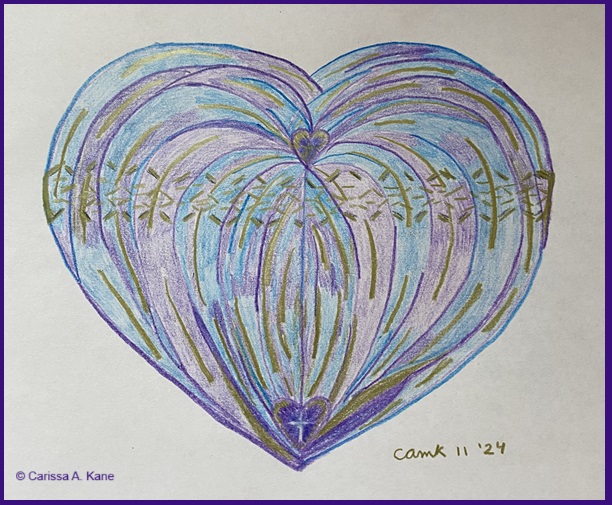
Robed in Majesty…

Today is the Solemnity of our Lord Jesus Christ, King of the Universe. The response for the Psalm is, “The Lord is King; he is robed in majesty.” (Psalm 93:1a). Take some time to reflect on this. What is this King like?

As you continue to envision the Lord as King, think about what you have learned about Jesus through both Scripture and experience. How has his majesty impacted your life, and influenced your choices?

In today’s Gospel (John 18:33b-37), Jesus is being interrogated by Pilate. This is after Peter has denied knowing Jesus for the third time and the cock has crowed.

In response to Pilate asking, “Then you are a king?”, Jesus replies,

“You say I am a king.
For this I was born and for this I came into the world,
to testify to the truth.
Everyone who belongs to the truth listens to my voice.” – John 13:37

Think about how Jesus testifies to the truth—to God—in his life, through his words and actions, and the choices he makes. What do you admire most about Jesus? And how does he inspire you?

Mindful of being someone who belongs to the truth, robed in majesty, and continuing to hold onto the qualities of Jesus that you admire and are inspired by, consider how you are listening to Jesus’s voice in today’s world, by entering into a conversation with Jesus. Invite him to show you the ways in which you are listening to his voice. Ask him to reveal any blind spots that may be interfering with your ability to listen and/or creating misunderstanding of his voice and to what it testifies.

After a sufficient period of time, when the conversation has run its course, what is your prayer to Jesus as you prepare to go forth?

Now, giving Jesus the last word, what is his prayer for you?

The Lord is king; he is robed in majesty. – Psalm 93:1a

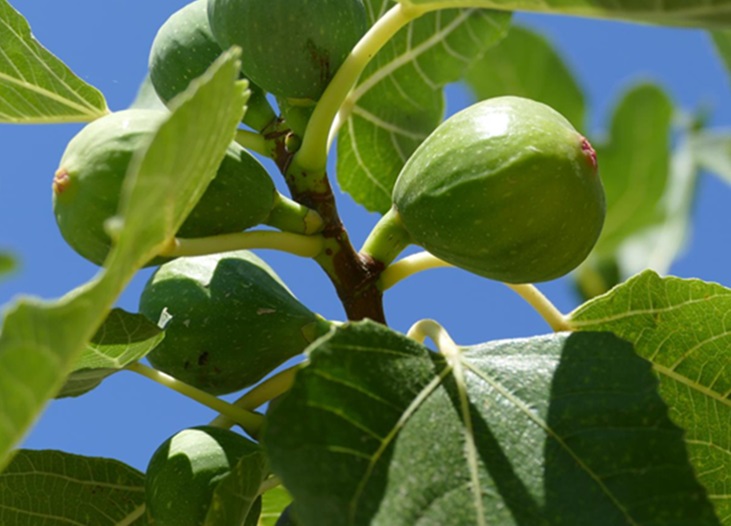
Learning from the Fig Tree…

In the Gospel passage for the Thirty-third Sunday in Ordinary Time (Mark 13:24-32), Jesus says, “Learn a lesson from the fig tree. When its branch becomes tender and sprouts leaves, you know that summer is near.” (v. 24). These words are part of his response to a question asked of him by the disciples, Peter, James, John, and Andrew.

Away from the others, and just after Jesus commented to his disciples on the destruction of the temple, they had asked him, “Tell us, when will this happen, and what sign will there be when all these things are about to come to an end?” (Mark 13:4). The first thing that Jesus says to them is, “See that no one deceives you.” (Mk 13:5). As he continues to tell them the signs and what will happen (trials and tribulations such as war, persecutions, etc.), he also continues to give them instructions as to how to handle themselves and the situations they will face. He says:

“… do not be alarmed” (v. 7)

“Watch out for yourselves.” or be aware (v. 9)

“… do not worry beforehand about what you are to say. But say whatever will be given to you at that hour. For it will not be you who are speaking but the holy Spirit.” (v. 11)

“Be watchful!” (v. 23)

Then he says these words that are part of the Gospel for today, “Learn a lesson from the fig tree. When its branch becomes tender and sprouts leaves, you know that summer is near.” (v. 28). And although Jesus says this as he continues to tell Peter, James, John, and Andrew about the signs that will occur at the end times, the gospel passage ends with Jesus saying, “But of that day or hour, no one knows, neither the angels in heaven, nor the Son, but only the Father.” (v. 32). In other words, perhaps Jesus is reminding us not to focus on the signs, but rather to focus on his instructions.

His last instruction, “Learn a lesson from the fig tree,” is intriguing. In chapter 11 of Mark’s Gospel, Jesus curses a fig tree for being fruitless:

“The next day as they were leaving Bethany he was hungry. Seeing from a distance a fig tree in leaf, he went over to see if he could find anything on it. When he reached it he found nothing but leaves; it was not the time for figs. And he said to it in reply, ‘May no one ever eat of your fruit again!’ And his disciples heard it.” (Mark 11:12-14).

In this earlier passage, there is a mention of time, “… it was not the time for figs.” And now, when Jesus is telling some of his disciples about the signs of the end times and instructing them on how to be prepared, he again, refers to figs and time (and not knowing the exact time of the end).

A few interesting things about figs and time… Fig trees, like other fruit trees, have leaves, but unlike other fruit trees, their fruit flowers internally. Also, each fig contains a collection of many flowers and seeds. And while one may think of a fig as a piece of fruit, they are actually an infructescence—a multiple fruit—that in a sense, is always in the process of blooming.

So, in both times of uncertainty and times of comfort, see that no one deceives you, do not worry, and learn from the fig tree, continuing to grow from within, knowing that the fruit will come at the time that is appointed.  

“Lord, my allotted portion and my cup, you have made my destiny secure.” – Psalm 16:5

Fall time - Tree with red leaves

From Trust to Joy…

In The Return of the Prodigal Son, Henri Nouwen wrote, “Both trust and gratitude require the courage to take risks because distrust and resentment, in their need to keep their claim on me, keep warning me how dangerous it is to let go of my careful calculations and guarded predictions. At many points I have to make a leap of faith to let trust and gratitude have a chance. The leap of faith always means loving without expecting to be loved in return, giving without wanting to receive, inviting without hoping to be invited, holding without asking to be held. And every time I make a little leap, I catch a glimpse of the One who runs out to me and invites me into his joy, the joy in which I can find not only myself, but also my brothers and sisters.”

Take a moment now to reflect on where you’ve experienced the Lord this past week and to what degree trust was involved. How did or does your experience help you to trust or to have faith, placing hope in the Lord with regards to a situation(s)? What happens when you bring areas in which your trust has possibly shifted away, back into prayer and back to the Lord?

Continuing to contemplate your experience, what qualities or characteristics that you associate with the Lord, are most noticeable? And how do these same qualities inform, influence, and inspire you and your choices?

The Gospel for the Thirtieth Sunday in Ordinary Time (Mark 10:46-52) begins in a sea of people, from within which, Bartimaeus, the blind man, is calling out to the Lord. And despite others around him telling him to stop and to keep quiet, he keeps calling out, “Son of David, have pity on me!” (v. 48).

Imagine what Bartimaeus might be holding in his heart as he’s trying to get Jesus’ attention? How about Jesus? What might be in his heart as he navigates through the crowd? What qualities do they each seem to have that might be informing, influencing, and inspiring them? What do each of them seem to be focused on?

Next, notice how Jesus receives and responds to Bartimaeus, the blind man who has let his guard down and opened himself up to both chance and Grace.

Jesus stopped and said, “Call him.”
So they called the blind man, saying to him,
“Take courage; get up, Jesus is calling you.”
He threw aside his cloak, sprang up, and came to Jesus.
Jesus said to him in reply, “What do you want me to do for you?”
The blind man replied to him, “Master, I want to see.”
Jesus told him, “Go your way; your faith has saved you.”
Immediately he received his sight
and followed him on the way. – Mk 10:49-52

Jesus is essentially saying: I’m here and I’m listening… I see you… I hear you… Come closer… Tell me more. And Bartimaeus, by coming closer and sharing more with Jesus, is able to receive peace, healing, and greater faith.

Take whatever you are focused on, to Jesus, the One who is, who was, and who will ever be—here for you, listening to you, seeing and hearing you, and always saying, come closer, tell me more.

Then, after a period of sharing and listening, envision Jesus saying the same to you as he did to Bartimaeus, “Go your way; your faith has saved you.”

The Lord has done great things for us; we are filled with joy. – Psalm 126:3

With Hope Well Placed…

Walking past crates of pumpkins and gourds at a local farm, the different colors and shapes are stunning. It’s interesting to think that such variety can grow out of the seemingly blah ground. Yet, when examined more closely, the soil, although drab compared to its yield, is actually quite diverse and multidimensional, holding various nutrients necessary to growth.

Turning to the readings for the Twenty-eighth Sunday in Ordinary Time, we are provided with an invitation to contemplate the relationship and impact of prayer, openness to Wisdom, and placing hope in God on environment and yield.

First, in the Book of Wisdom, we are encouraged to seek Wisdom above all else. It is written:

I prayed, and prudence was given me;
I pleaded, and the spirit of wisdom came to me.
I preferred her to scepter and throne,
and deemed riches nothing in comparison with her,
nor did I liken any priceless gem to her;
because all gold, in view of her, is a little sand,
and before her, silver is to be accounted mire.
Beyond health and comeliness I loved her,
and I chose to have her rather than the light,
because the splendor of her never yields to sleep.
Yet all good things together came to me in her company,
and countless riches at her hands. – Wisdom
(7:7-11

Notice how the passage begins with praying and pleading, or in other words a humble posture. Not only that, but there is also the choice to seek Wisdom as well as to abide by it; this is further described throughout the passage. However, to be open to Wisdom, one must be open to the possibility that things are not what they seem or that there might be a better way. In addition, one must also be willing to loosen the grip, or let go of other notions, even if just temporarily, so as to allow Wisdom to shine the Light and make things clear.

In Psalm 90, the Psalmist also writes of Wisdom, reminding us of its source—God’s kindness (love)—and characteristics as well as its impact—prosperity through God’s grace.

Teach us to number our days aright,
that we may gain wisdom of heart.
Return, O Lord! How long?
Have pity on your servants!
Fill us at daybreak with your kindness,
that we may shout for joy and gladness all our days.
Make us glad, for the days when you afflicted us,
for the years when we saw evil.
Let your work be seen by your servants
and your glory by their children;
and may the gracious care of the Lord our God be ours;
prosper the work of our hands for us!
Prosper the work of our hands! – Psalm 90:12-17

Although we cannot control the timing and placement of Wisdom, we can pray and plead for it, be aware of its characteristics, and open ourselves to it, and the graces it holds. In the Letter of St. Paul to the Hebrews, we are reminded of the power of God’s word.

Brothers and sisters:
Indeed the word of God is living and effective,
sharper than any two-edged sword,
penetrating even between soul and spirit, joints and marrow,
and able to discern reflections and thoughts of the heart.
No creature is concealed from him,
but everything is naked and exposed to the eyes of him
to whom we must render an account. – Hebrews 4:12-13

As human beings, our natural tendency is to fall into wanting to possess (control) or to fall into being possessed (controlled) by or too attached to things. However, God is not subject to this Achilles heel of ours. God, and God’s word, is “living and effective” because God is not bound, tied up, or confused, like we can be. Rather, God is all-knowing and constantly evolving, adjusting, and adapting to meet us where we are. This is not to inflict punishment or take away freedom, but to lift us up and fill us with an abundance of love and mercy, making the way for Wisdom to help us see clearly, and to use our free will to operate and navigate this world with love and mercy.

Looking at the Gospel passage for this week, we are reminded that faith and faithfulness to God not only extends beyond oneself, but that they also require flexibility and an openness to change, which is hindered when attachments to people, places, or things, outside of God exist.    

As Jesus was setting out on a journey, a man ran up,
knelt down before him, and asked him,
“Good teacher, what must I do to inherit eternal life?”
Jesus answered him, “Why do you call me good?
No one is good but God alone.
You know the commandments: You shall not kill;
you shall not commit adultery;
you shall not steal;
you shall not bear false witness;
you shall not defraud;
honor your father and your mother.”
He replied and said to him,
“Teacher, all of these I have observed from my youth.”
Jesus, looking at him, loved him and said to him,
“You are lacking in one thing.
Go, sell what you have, and give to the poor
and you will have treasure in heaven; then come, follow me.”
At that statement his face fell,
and he went away sad, for he had many possessions.

Jesus looked around and said to his disciples,
“How hard it is for those who have wealth
to enter the kingdom of God!”
The disciples were amazed at his words.
So Jesus again said to them in reply,
“Children, how hard it is to enter the kingdom of God!
It is easier for a camel to pass through the eye of a needle
than for one who is rich to enter the kingdom of God.”
They were exceedingly astonished and said among themselves,
“Then who can be saved?”
Jesus looked at them and said,
“For human beings it is impossible, but not for God.
All things are possible for God.” – Mark 10:17-27

In the passage above, the man who approaches Jesus likely finds a great deal of security and comfort through his possessions, so much so that he walks away. In what ways can you understand how the man’s attachment prevents him from talking more with Jesus, or even asking Jesus for help? Notice how Jesus acknowledges that what he asked the man to do is not easy. Take some time to share with Jesus any challenges you may be facing with sharing the wealth—whether it is in the form of making a sacrifice to actively show care and concern for those in need, sharing something that you’re carrying all on your own and is weighing you down, or something else you’ve refrained from bringing to Jesus. Envision yourself as the man who walked away, and then, turn back around and bring yourself and your concerns back to Jesus.

We all have struggles, challenges, and hardships, yet at the same time, life and prosperity, and so many signs of it, also occur. It’s not an all or nothing, one way or the other, too late kind of world, but rather, it’s a world created by a God who is broadminded, far-reaching, for whom nothing is impossible, showing care and concern for everything and everyone, who tells us, place your hope in me, because, with me, anything is possible.

A Time to Reflect…

The Gospel acclamation for the Twenty-Seventh Sunday in Ordinary Time is, “If we love one another, God remains in us and his love is brought to perfection in us.” (1 John 4:12). Take some time to consider this verse.

What are the things that you heard and saw this past week that caught your attention? What values, notions, and ideas did they express?

It can be tempting to rush toward opinions and judgments based on listening to and watching what others are doing, what they have to say about situations, and about what’s happening in society and throughout the world. Not only that, but also to not really take time to honestly consider, reflect on, and discern the values being represented.

It can also be easy to be drawn in by a thing or two that may seem of the utmost importance, only to be swept up and moved along without recognizing movement away from values, expressed notions, and ideas that truly align with and promote the sentiments of Love.

In the coming days try to notice the words and actions to which not only your ears and eyes are exposed or drawn, but also your heart. What is stirred inside of you? and how are these things a reflection of Love?

Continuing to take these things to prayer, seek to see them as God sees them.

No one has ever seen God. Yet, if we love one another, God remains in us, and his love is brought to perfection in us. – 1 John 4:12

Violet Hydrangeas

More Than Just Another Day…

In the Gospel for the Fourteenth Sunday in Ordinary Time (Mark 6:1-6), as Jesus is teaching in the synagogue in Nazareth (his hometown), the people there are rather cynical due to their preconceived notions about what someone teaching with authority needs to be or look like, or where they need to come from. This is nothing new though. A common misstep of humankind throughout history has often been allowing for the appearance of strength, status, or other superficial measures to supersede the things that really matter, such as substance.

In this Gospel passage, we learn that Jesus couldn’t do much in Nazareth. It is written of Jesus, “He was amazed by their lack of faith.” What do you think is meant by that? What do you think made the people so closed off to Jesus, his approach, and what he was trying to teach them?

Whatever it was, there was a lack of openness to the Spirit of God exuding from Jesus. Perhaps the people couldn’t accept his words as truth or take to heart and ponder them, because they challenged them to consider things differently. However, with God, relationships are all about being mutual. And so, Jesus works with those in Nazareth who are open to the Spirit, and then moves on to places where the people are more open to him and the Way. Nothing is forced upon the Nazoreans, or those who disagree, and as always, Jesus models an example of respecting free will and trusting his Father to be the ultimate judge and decider of their fate. Anything else would lead to Jesus putting himself over God and would lead to further division and chaos.

Jesus can see this, but most of the people in the synagogue are too caught up in their own ideas and ideologies to notice the substance of Jesus’s teaching. Perhaps they recognize that it’s more than just another day in the synagogue, but their faith has shifted into a fixed version of the way things ought to be based on what they can wrap their minds around, rather than remaining fixed on God and, therefore, flexible to receive the Spirit’s guidance toward what may be new and different but is still of God.

When one comes to expect, or demands, the same of every day or has become self-centered and self-preserving above all else, faith becomes stagnant and fixed, for with God, Jesus, and the Holy Spirit, there’s always something happening for the good of all, there is breadth and depth, there is newness and life… there is acceptance, and it is always more than just another day.

Violet Hydrangeas

Therefore, I am content with weaknesses, insults, hardships, persecutions, and constraints, for the sake of Christ; for when I am weak, then I am strong. – 2 Corinthians 12:10

With God, It’s All For Good…

It is written in the Book of Wisdom, “God did not make death, nor does he rejoice in the destruction of the living.” (Wisdom 1:13). As ones created in the image of God, we are to live and behave as such. And while an eye for an eye or “getting even” may be tempting at times, it can lead to the destruction of another of God’s creation and can create a false sense of satisfaction, neither of which are in line with the image of God, or life giving.

In the second reading for the Thirteenth Sunday in Ordinary Time, St. Paul reminds the Corinthians that there is much more to discipleship than what one believes, what one knows, says, and does, and one’s conviction. It is the spirit in which one lives, and that guides one.

St. Paul writes, “For you know the gracious act of our Lord Jesus Christ, that though he was rich, for your sake he became poor, so that by his poverty you might become rich. Not that others should have relief while you are burdened, but that as a matter of equality your abundance at the present time should supply their needs, so that their abundance may also supply your needs, that there may be equality.” (2 Corinthians 8:9, 13-14).

It is only fitting that those created in God’s image be mindful of disparity and strive to recognize and honor the image of God in others, and therefore work toward, encourage, and support equality. The mindset that St. Paul is encouraging is not new. In fact, he writes, “As it is written: ‘Whoever had much did not have more, and whoever had little did not have less.'” (2 Corinthians 8:15). He is referring to the Book of Exodus (Ex 16:18) and how the Manna (the nourishment that God provided for Moses and Israelites) was allotted. It did not matter how much or how little one person gathered, there was enough for everyone to have what they needed. Not only that, but also there was great awareness that it was all provided through the goodness—love and mercy—of God.

One could not think of what they collected as belonging to oneself, but rather as being provided by God, and as one created in the image of God, it was to be shared and for everyone to partake of. There was to be equality, or equity, in terms of everyone having what they needed to not only survive, but to keep moving along the journey.

Turning to the Gospel passage (Mark 5:21-43), again we can see that it’s all about equity. A synagogue official’s daughter is on her death bed, and he begs Jesus to heal her, “Please, come lay your hands on her that she may get well and live.” Jesus begins to follow Jairus. They are moving through the heavy crowd when a woman who also needs Jesus’s help touches his cloak saying, “If I but touch his clothes, I shall be cured.”

One can imagine, especially given that period of time in history, that as a man and a synagogue official, Jairus would be able to gain Jesus’s attention and position himself to have access to Jesus more easily than the woman. Both Jairus (or his daughter) and the woman need healing, but each needs to approach the situation differently because of their circumstances. To Jesus, it doesn’t matter who got to him first or last, or who has more or less (power, possessions, status, etc.). As with God’s grace, Jesus’s healing is equitable and those who approach in faith get what they need—the woman’s hemorrhaging comes to an end and Jairus’s daughter is raised by Jesus. How do you relate to Jairus and/or the woman with a hemorrhage in terms of approach and asking in prayer?

Oftentimes, when thinking about faith and asking for something, it can be can easy to only think in terms asking God or Jesus for what one needs or wants. However, being created in the image of God, we are called to also look at the other side of this. Take some time to pray and reflect on the spirit in which you respond when it comes the needs and wants of others. In what ways does Jesus’s sense of equality and equity increase your faith and inspire you?

Sing praise to the Lord, you faithful;
give thanks to his holy memory.
For his anger lasts but a moment;
his favor a lifetime.
At dusk weeping comes for the night;
but at dawn there is rejoicing. – Psalm 30:5-6

Orchids

In the Presence of Peace…

In the Gospel passage for the Twelfth Sunday in Ordinary Time, Jesus’s disciples reach out to him as the boat they are in is taking on water in the middle of a storm. Jesus says to the wind and the raging sea, “Quiet! Be Still!” and just like that, the storm settles down. This is something he could have done without saying any words, but Jesus, always the teacher, gives his disciples, and us, both an example to follow and words to ponder.

After quieting the storm, Jesus asks his disciples, “Why are you terrified? Do you not yet have faith?” He is not reprimanding them or trying to make them feel bad, but rather he is asking them to reflect on the situation, and trying to help them to know, and to remember, that he is there with them and for them, and so, there is nothing to fear. Without Jesus, the storm can rage on, whether loud and brash or quiet and discreet. It is Jesus’s presence that both quells the storm and brings peace into the quiet and stillness.

Orchids

On that day, as evening drew on, Jesus said to his disciples:
“Let us cross to the other side.”
Leaving the crowd, they took Jesus with them in the boat just as he was.
And other boats were with him.
A violent squall came up and waves were breaking over the boat,
so that it was already filling up.
Jesus was in the stern, asleep on a cushion.
They woke him and said to him,
“Teacher, do you not care that we are perishing?”
He woke up,
rebuked the wind, and said to the sea, “Quiet! Be still!”
The wind ceased and there was great calm.
Then he asked them, “Why are you terrified?
Do you not yet have faith?”
They were filled with great awe and said to one another,
“Who then is this whom even wind and sea obey?” – Mark 4:35-41

Heart

Putting Heart into the matter…

In the Gospel passage for the 10th Sunday in Ordinary Time (Mark 3:20-35), Jesus says to his disciples and the crowd, “If a kingdom is divided against itself, that kingdom cannot stand.” (verse 24). This is in response to the scribes claim that Jesus is driving out demons by or through the prince of demons. Jesus’s words make sense. After all, one cannot bring peace and healing by or through chaotic means. With so much division and vitriol circulating throughout the world, it’s worth considering the heart in the matter.

In the days leading up to this Sunday, the Solemnity of the Most Sacred Heart of Jesus and the Memorial of the Immaculate Heart of the Blessed Virgin Mary are celebrated. When you consider the heart of Jesus, what qualities come to mind? How about when you think about Mary’s immaculate heart?

Based on Scripture, what are some concrete ways that their words and actions reflect these qualities? How does Mary receive unexpected news or events such as the Annunciation, at the Presentation in the temple, and Jesus’s arrest and crucifixion? How does Mary react and respond to the young Jesus when she finds him in the temple after 3 days apart? What does Mary do, and how does she do it, when the wine runs out at the wedding feast in Cana?

What kinds of words does Jesus use and what is his attitude in his encounters with the pharisees and scribes, his disciples, and the crowds? What do Jesus’s actions express? And how does Jesus respond and react during the Passion?

Contemplating the heart of Jesus and the heart of Mary in the happenings of today’s world, how or where do you see the qualities of their hearts coming to life through words and actions? Take time this week to notice the heart behind your words and actions as well as those in the happenings directly around you, in your country, and in the world.

Prayer: Immaculate heart of Mary, intercede on our behalf, so that lies, deception, and all who seek to distort what is true, just, and honorable may be revealed. Sacred heart of Jesus, help us to see through your eyes, and to speak, act, and love, with your heart. Amen.

Heart

With the Lord there is mercy, and fullness of redemption. – Psalm 130:7bc

Fulfillment…

On the Solemnity of the Most Holy Body and Blood of Christ also known as Corpus Christi, the Collect (opening prayer) is: “O God, who in this wonderful Sacrament have left us a memorial of your Passion, grant us, we pray, so to revere the sacred mysteries of your Body and Blood that we may always experience in ourselves the fruits of your redemption.”

Spend some time reflecting on this prayer and on the Sacrament of the Eucharist. What does it mean to you and how has it impacted you? Remember how you have experienced the fruits of the Lord’s redemption. What wonders has the Lord worked in your life? Take a few moments to express gratitude for these experiences and the awareness of them.

In the hymn One Bread, One Body, the lyrics direct us to mindfulness of our call, one and all, to unity as God’s people (the church):

One bread, one body, one Lord of all
One cup of blessing which we bless
And we, though many, throughout the Earth
We are one body in this one Lord
– John Foley, SJ (excerpt from One Bread, One Body)

Recall a time(s) when you have experienced unity and the fruits of the Lord’s redemption with others? In what ways have you witnessed the hand of the Lord? Give thanks for these times of common ground and the remembrance of them.

What hopes and desires do you have at this moment for awareness and unity in your life? your community? your country? and the world? Share these with the Lord. Ask the Lord for the grace to further appreciate and be inspired by experiences of the outpouring of His love.

Pray for one and all to have an open heart and mind to the well-being of all creation, and above all, to draw closer to God so as to embody (to speak and act in accord with) God’s desires as expressed through the example of Jesus.

Rhododendron Flowers

How shall I make a return to the Lord
for all the good he has done for me?
The cup of salvation I will take up,
and I will call upon the name of the Lord. – Psalm 116:12-13